
Introduction
Businesses today operate in a global economy where payments are no longer limited to local suppliers or employees. Companies frequently send money to freelancers, vendors, affiliates, marketplace sellers, contractors, partners, and customers across multiple countries. Processing these payments individually is time-consuming, expensive, and prone to errors. This is where Mass Payout solutions become essential.
A mass payout system enables businesses to send hundreds or even thousands of payments simultaneously through a single platform. Instead of initiating every payment manually, organizations can automate the entire payout process while ensuring speed, accuracy, and compliance.
From e-commerce platforms and gig economy companies to financial institutions and global enterprises, mass payout solutions help organizations streamline financial operations, reduce administrative costs, and improve recipient satisfaction. As digital commerce continues to grow, efficient payout infrastructure has become a critical component of modern business operations.
What Is a Mass Payout?
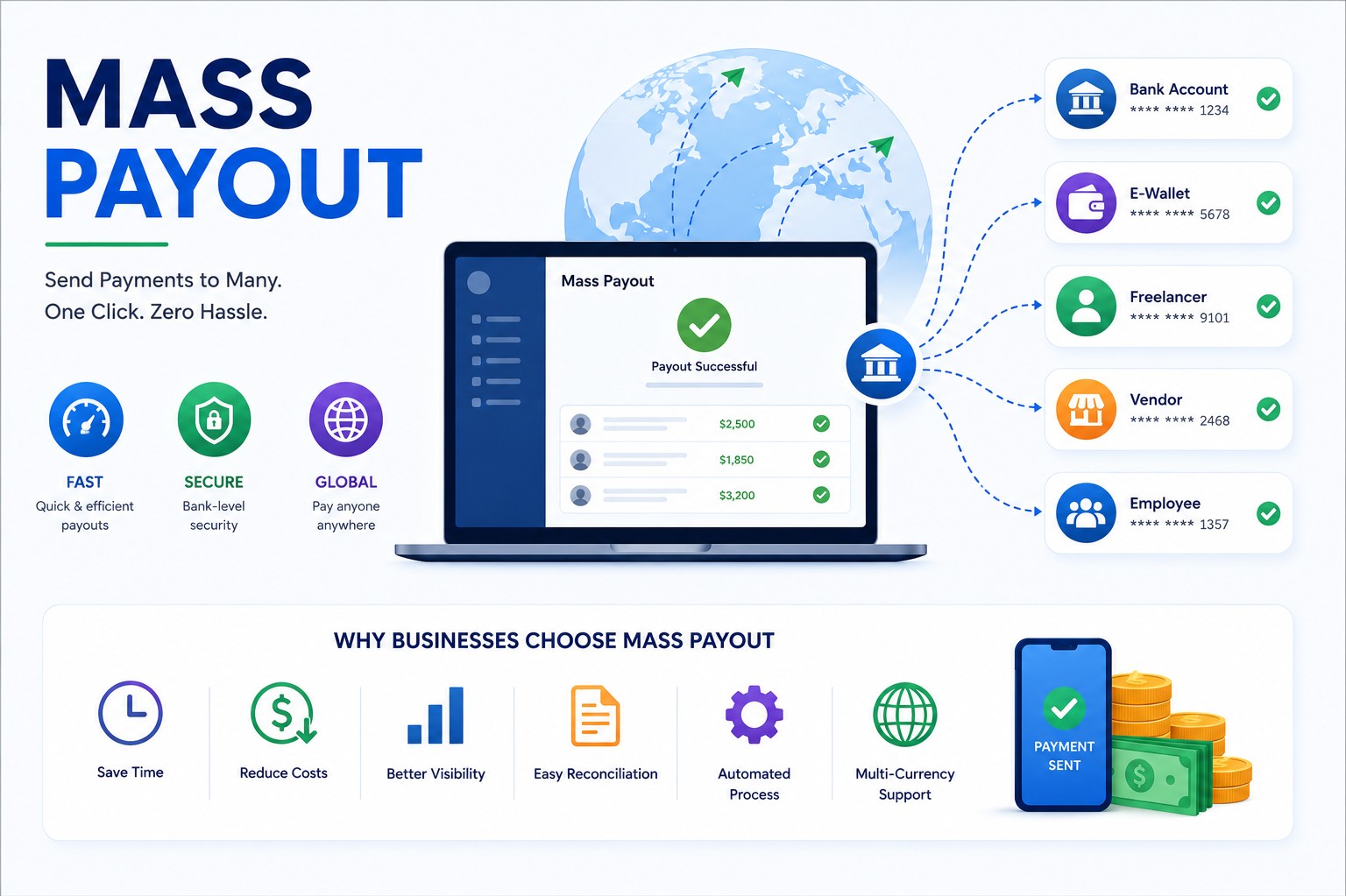
A Mass Payout is a payment solution that allows businesses to distribute funds to multiple recipients in one automated process.
Rather than processing each transfer separately, organizations upload payment details through a dashboard, API, or integrated financial system. The payout platform then processes all eligible payments simultaneously across supported banking networks and payment methods.
Mass payout solutions support domestic and international transfers, making them ideal for organizations with large payment volumes.
Businesses benefit from faster payment execution, simplified reconciliation, and centralized payment management.
How Mass Payout Works
The process begins when a business prepares a list of recipients, payment amounts, currencies, and preferred payment methods.
This information is uploaded into the payout platform manually or through API integration with ERP, payroll, or accounting systems. The platform validates recipient information, performs compliance and security checks, and routes payments through the appropriate banking or payment network.
Once approved, payments are processed in bulk and recipients receive their funds according to the selected payment method.
Businesses can monitor payment status in real time through centralized reporting dashboards.
Why Businesses Use Mass Payout Solutions
As businesses grow, manual payment processing becomes increasingly inefficient.Finance teams often spend hours initiating individual bank transfers, reconciling transactions, and resolving payment errors. These repetitive tasks consume valuable resources while increasing operational risks.
Mass payout solutions automate these processes, allowing businesses to distribute payments quickly, accurately, and consistently.
Organizations benefit from lower administrative costs, improved payment visibility, and better financial control.
Key Features of Mass Payout Platforms
Modern mass payout platforms provide a wide range of features designed for enterprise-scale payment operations.
Businesses can automate bulk payments, schedule recurring payouts, support multiple currencies, integrate with accounting software, monitor payment status in real time, and generate detailed financial reports.
Many platforms also include APIs that enable seamless integration with ERP systems, payroll software, marketplaces, and financial management tools.
Automation reduces manual intervention while improving operational efficiency.
Multi-Currency and Cross-Border Payments
One of the biggest advantages of mass payout platforms is their ability to support international payments.
Businesses can send payouts in multiple currencies without maintaining banking relationships in every country. Currency conversion is often handled automatically, simplifying global payment operations.
Cross-border payment support is especially valuable for multinational organizations, digital marketplaces, affiliate programs, and international employers.
Efficient global payouts improve recipient satisfaction while reducing payment delays.
Common Business Use Cases
Mass payout solutions are used across a wide variety of industries.Marketplaces use them to pay sellers after completed transactions. Gig economy platforms distribute earnings to freelancers and independent contractors. Affiliate networks automate commission payments, while payroll providers use bulk payouts to pay employees across multiple countries.
Insurance companies process claim settlements, financial institutions manage customer disbursements, and e-commerce businesses pay suppliers efficiently using automated payout systems.
Any organization managing frequent outgoing payments can benefit from mass payout automation.
Benefits of Mass Payout
Mass payout systems significantly improve payment efficiency by replacing manual workflows with automated processes.
Businesses reduce processing time, minimize payment errors, and lower transaction costs through centralized payment management.
Automation also improves cash flow planning by allowing finance teams to schedule payments according to business requirements.
Recipients benefit from faster payments, while businesses strengthen relationships through reliable and consistent payment experiences.
As organizations scale globally, these efficiencies become increasingly valuable.
Security and Compliance
Security is a critical requirement for high-volume payment processing.
Mass payout platforms use encryption, tokenization, secure authentication, and role-based access controls to protect sensitive payment information.
Providers also support Know Your Customer (KYC), Anti-Money Laundering (AML), sanctions screening, and regulatory reporting requirements.
Continuous transaction monitoring helps identify suspicious payment activity while maintaining compliance with international financial regulations.
Strong security protects both businesses and payment recipients.
Integration with Business Systems
Modern payout platforms integrate with ERP software, accounting systems, HR platforms, marketplaces, and payment gateways.
Through APIs, businesses can automate payment creation, approval workflows, reconciliation, and financial reporting.
This integration eliminates duplicate data entry while improving operational efficiency and reporting accuracy.
Cloud-based platforms also enable businesses to scale payment operations without investing in complex infrastructure.
Artificial Intelligence in Mass Payouts
Artificial intelligence is transforming the way businesses manage mass payouts.
AI-powered platforms analyze payment patterns, optimize payment routing, predict transaction failures, detect fraud, and automate exception handling.
Machine learning also improves reconciliation by matching outgoing payments with financial records more accurately.
These intelligent capabilities help businesses increase payment success rates while reducing operational risks and administrative effort.
Challenges of Implementing Mass Payouts
Although mass payout systems offer significant advantages, businesses should plan implementation carefully.
Organizations need accurate recipient data, secure system integrations, regulatory compliance procedures, and reliable payment providers.
Cross-border payments may also involve foreign exchange management, local banking regulations, and varying settlement timelines.
Selecting an experienced payout provider helps minimize implementation challenges while supporting long-term scalability.
Future of Mass Payout Solutions
The future of mass payouts is becoming faster, smarter, and more connected.
Real-time payment networks, Open Banking APIs, embedded finance, digital wallets, and blockchain technologies are transforming global payout infrastructure.
Businesses increasingly expect instant international settlements, automated reconciliation, intelligent payment routing, and AI-driven payment optimization.
As global commerce expands, mass payout platforms will continue evolving into comprehensive financial automation solutions capable of supporting complex international payment ecosystems.
Choosing the Right Mass Payout Provider
Selecting the right provider requires evaluating several key factors.
Businesses should consider global coverage, supported currencies, payment methods, API capabilities, security standards, compliance expertise, pricing, settlement speed, reporting features, and customer support.
A scalable platform should not only meet current payout requirements but also support future business growth and international expansion.
Choosing a reliable provider helps ensure consistent payment performance while reducing operational complexity.
Conclusion
A Mass Payout solution is an essential tool for businesses managing high-volume domestic or international payments. By automating bulk payment processing, organizations can reduce manual work, improve accuracy, strengthen security, and deliver faster payouts to employees, vendors, freelancers, affiliates, and customers.
As digital commerce, remote work, and global marketplaces continue to grow, mass payout platforms will play an increasingly important role in helping businesses operate efficiently across borders.
Organizations that invest in scalable, secure, and intelligent payout solutions will be better positioned to streamline financial operations and support sustainable global growth.
Comments
No comments yet. Be the first to share your thoughts.
Leave a comment