
Introduction
Every time a customer taps a card, makes an online purchase, transfers money through a banking application, or pays through a digital wallet, a sophisticated financial process begins behind the scenes. While these transactions often appear instantaneous, they involve multiple systems, institutions, and technologies working together to move funds securely and accurately.In today’s digital economy, businesses and consumers expect payments to be fast, reliable, and seamless. Whether processing a retail purchase, a cross-border transfer, or a real-time bank payment, financial institutions must ensure that transactions are completed efficiently while maintaining security and compliance. This responsibility falls on a critical function known as Transaction Processing.
Transaction processing serves as the foundation of modern financial ecosystems. It enables the movement of money between parties, supports global commerce, and ensures that financial records remain accurate and transparent. As payment volumes continue to grow worldwide, transaction processing has become one of the most important components of digital finance.
What Is Transaction Processing?
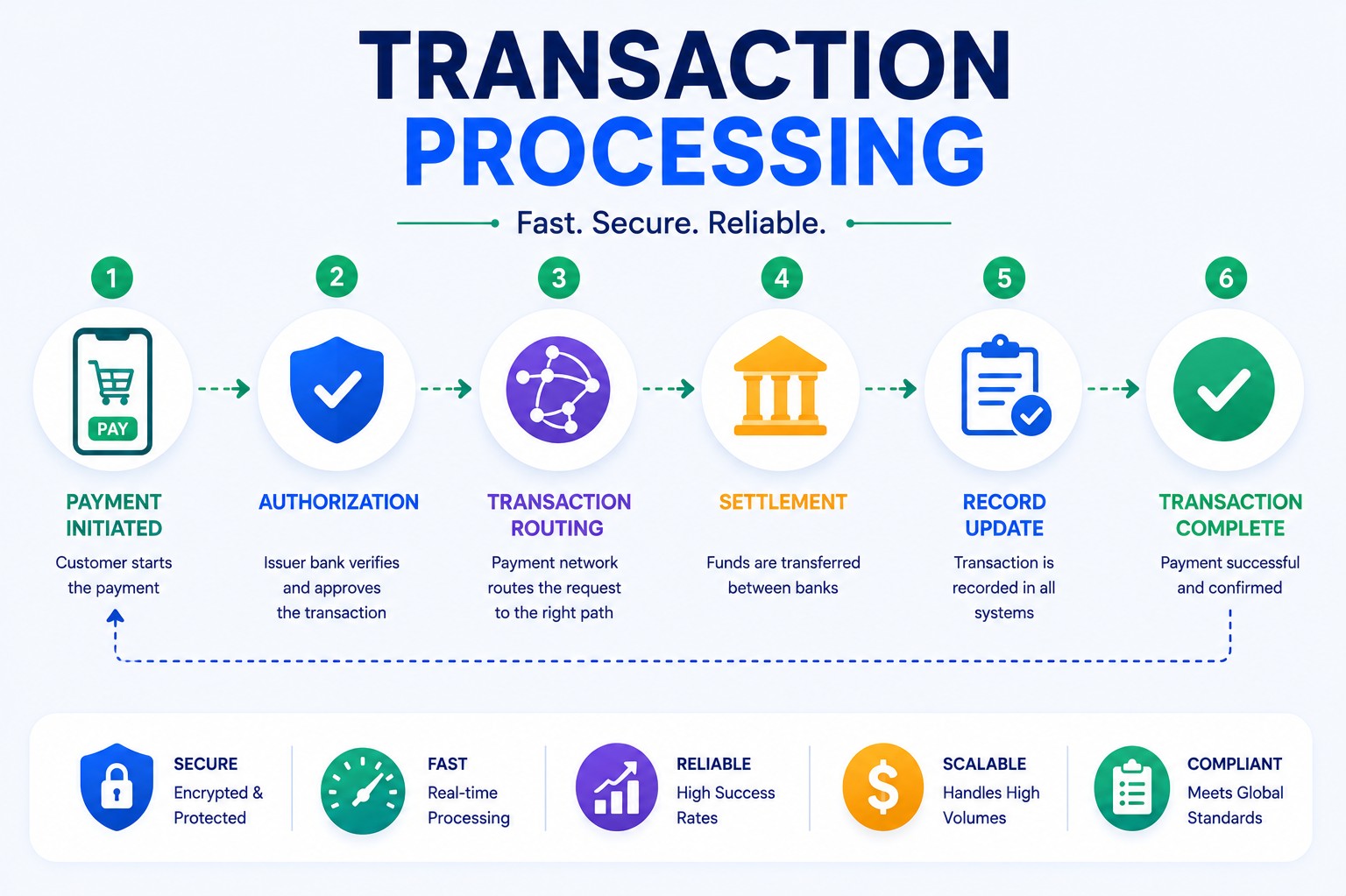
Transaction processing refers to the series of actions required to validate, authorize, route, settle, and record a financial transaction. It encompasses every step involved in transferring funds from one party to another while ensuring accuracy, security, and compliance.
The process begins when a payment instruction is initiated and continues until funds are successfully transferred and recorded in the relevant financial systems. Depending on the payment method, transaction processing may involve banks, payment gateways, card networks, acquiring institutions, issuing banks, and payment processors.
Although customers typically see only the final result, multiple systems work together behind the scenes to complete each transaction.
Why Transaction Processing Matters
Efficient transaction processing is essential for maintaining trust in financial systems. Consumers expect payments to be completed quickly and accurately, while businesses depend on reliable payment infrastructure to generate revenue and manage operations.
Even minor disruptions can have significant consequences. Payment failures may result in lost sales, customer dissatisfaction, operational delays, and reputational damage. For financial institutions and payment providers, poor transaction processing can increase costs and expose organizations to regulatory risks.
As digital commerce expands and transaction volumes rise, robust processing capabilities have become a critical competitive advantage.
The Transaction Processing Lifecycle
Every payment follows a structured lifecycle designed to ensure security and accuracy. While the specific steps vary depending on the payment method, the overall process generally follows a similar pattern.
The journey begins when a customer initiates a payment. This may occur through a card transaction, online banking transfer, mobile wallet payment, or another digital payment channel. The payment request is then transmitted through the relevant processing infrastructure for validation and authorization.
Once approved, the transaction moves through settlement processes that facilitate the transfer of funds between financial institutions. Finally, records are updated to reflect the completed transaction, ensuring accurate financial reporting and reconciliation.
Each stage plays an essential role in maintaining the integrity of the payment ecosystem.
Authorization: The First Critical Step
Authorization is one of the most important stages of transaction processing. During this phase, the payment system verifies whether the transaction can proceed.
For card payments, the issuing bank evaluates factors such as account status, available funds, transaction risk, and fraud indicators. If the payment meets all requirements, authorization is granted and the transaction moves forward.
Authorization helps protect both merchants and consumers by identifying potential issues before funds are transferred. Advanced authorization systems increasingly rely on artificial intelligence and behavioral analytics to improve decision-making accuracy.
High authorization rates are often a key indicator of payment processing efficiency.
Transaction Routing and Payment Networks
Once a transaction is initiated, it must be routed through the appropriate payment infrastructure. Payment networks act as intermediaries that facilitate communication between various financial institutions and processing systems.
The routing process determines the most effective path for completing the transaction. Factors such as payment type, geographic location, currency, and processing costs may influence routing decisions.
Modern payment ecosystems increasingly use intelligent routing technologies to optimize transaction performance. By selecting the most suitable processing path, organizations can improve approval rates, reduce costs, and enhance customer experiences.
As payment environments become more complex, routing optimization continues gaining importance.
Settlement and Fund Transfer
Settlement is the stage where money actually moves between financial institutions. After a transaction has been authorized, settlement processes ensure that funds are transferred from the payer’s institution to the recipient’s institution.
Depending on the payment method, settlement may occur in real time or through scheduled clearing cycles. Real-time payment networks enable immediate fund transfers, while traditional card transactions often settle within one or two business days.
Efficient settlement processes are essential for maintaining liquidity, reducing operational risks, and supporting positive customer experiences.
The global shift toward faster payments is accelerating innovation in settlement infrastructure worldwide.
Transaction Processing and Digital Payments
The growth of digital payments has significantly increased the importance of transaction processing systems. Consumers now use a wide variety of payment methods, including cards, digital wallets, bank transfers, QR code payments, and account-to-account payment solutions.
Each payment type introduces unique processing requirements. Transaction processing platforms must support multiple channels while maintaining consistent performance and security standards.
As digital payment adoption continues rising, organizations require scalable processing infrastructure capable of handling large transaction volumes without compromising speed or reliability.
This demand has fueled significant investment in payment technology and financial infrastructure.
Security in Transaction Processing
Security remains one of the most critical aspects of transaction processing. Financial institutions and payment providers must protect sensitive information while preventing fraud, cyberattacks, and unauthorized access.
Modern processing systems use encryption, tokenization, authentication technologies, and fraud monitoring tools to safeguard transactions. These measures help ensure that payment data remains secure throughout the transaction lifecycle.
Artificial intelligence is increasingly being used to identify suspicious activity in real time. Machine learning algorithms can analyze transaction patterns and detect anomalies that may indicate fraud.
Strong security controls help maintain trust and support regulatory compliance across financial ecosystems.
Compliance and Regulatory Requirements
Transaction processing operates within a highly regulated environment. Financial institutions must comply with regulations related to anti-money laundering, data protection, sanctions screening, fraud prevention, and payment security.
Compliance requirements vary across jurisdictions, creating additional complexity for organizations operating internationally. Payment processors must ensure that transactions are monitored appropriately and that regulatory obligations are met consistently.
Automated compliance solutions are becoming increasingly important as transaction volumes grow and regulations evolve.
Organizations that integrate compliance directly into processing workflows can reduce risks while improving operational efficiency.
Challenges in Transaction Processing
Despite technological advancements, transaction processing continues to face several challenges. Rising transaction volumes place pressure on infrastructure scalability, while increasingly sophisticated fraud tactics create new security concerns.
Cross-border payments introduce additional complexities involving currencies, regulations, and settlement networks. Payment failures, technical disruptions, and system downtime can also negatively impact customer experiences.
Organizations must continuously invest in technology, monitoring capabilities, and infrastructure resilience to address these challenges effectively.
As financial ecosystems become more interconnected, maintaining processing reliability remains a top priority.
The Role of Artificial Intelligence
Artificial intelligence is transforming transaction processing by improving efficiency, security, and decision-making. AI-powered systems can analyze vast amounts of payment data in real time, enabling faster and more accurate transaction assessments.
Machine learning algorithms help identify fraud risks, optimize payment routing, improve authorization rates, and automate operational processes. These capabilities allow organizations to process transactions more effectively while reducing manual intervention.
As AI technologies continue advancing, their role within transaction processing environments is expected to expand significantly.
Future payment systems will likely become increasingly intelligent and adaptive.
The Future of Transaction Processing
The future of transaction processing will be shaped by real-time payments, open banking, embedded finance, and artificial intelligence. Businesses and consumers increasingly expect instant transactions, greater transparency, and seamless financial experiences.
Cloud-based infrastructure, API-driven connectivity, and advanced analytics are enabling more flexible and scalable processing environments. At the same time, emerging technologies are creating opportunities for greater automation and operational efficiency.
As financial services continue evolving, transaction processing will remain a foundational component supporting innovation across the payment ecosystem.
Conclusion
Transaction processing is the engine that powers modern digital payments. From authorization and routing to settlement and compliance, every financial transaction depends on efficient processing systems working behind the scenes.
As payment ecosystems become faster, more global, and increasingly digital, the importance of reliable transaction processing continues to grow. Organizations that invest in modern processing infrastructure can improve payment performance, strengthen security, enhance customer experiences, and support long-term growth.
In an era where digital transactions drive global commerce, transaction processing remains one of the most critical pillars of the financial services industry.
Comments
No comments yet. Be the first to share your thoughts.
Leave a comment