
Introduction
The digital commerce landscape has evolved dramatically over the past two decades. What began as simple online shopping has transformed into highly personalized, data-driven experiences powered by artificial intelligence, automation, and advanced payment technologies. Today, another transformative shift is emerging Agentic Commerce Payments.
As AI systems become increasingly capable of making decisions, completing tasks, and interacting with digital ecosystems independently, payments are no longer limited to direct human actions. Intelligent software agents can now search for products, compare prices, negotiate services, manage subscriptions, and even execute purchases on behalf of consumers and businesses.
This emerging concept, known as agentic commerce, represents a significant leap forward in how transactions are initiated and completed. Instead of humans manually conducting every step of a purchase journey, AI-powered agents are beginning to handle many of these activities autonomously.
The rise of Agentic Commerce Payments has the potential to redefine customer experiences, business operations, and the broader future of commerce.
Understanding Agentic Commerce
Agentic commerce refers to a digital commerce environment where autonomous AI agents actively participate in purchasing decisions and transaction execution.
Unlike traditional automation, which follows predefined rules, agentic systems can analyze information, evaluate options, make recommendations, and take actions based on objectives and contextual understanding.
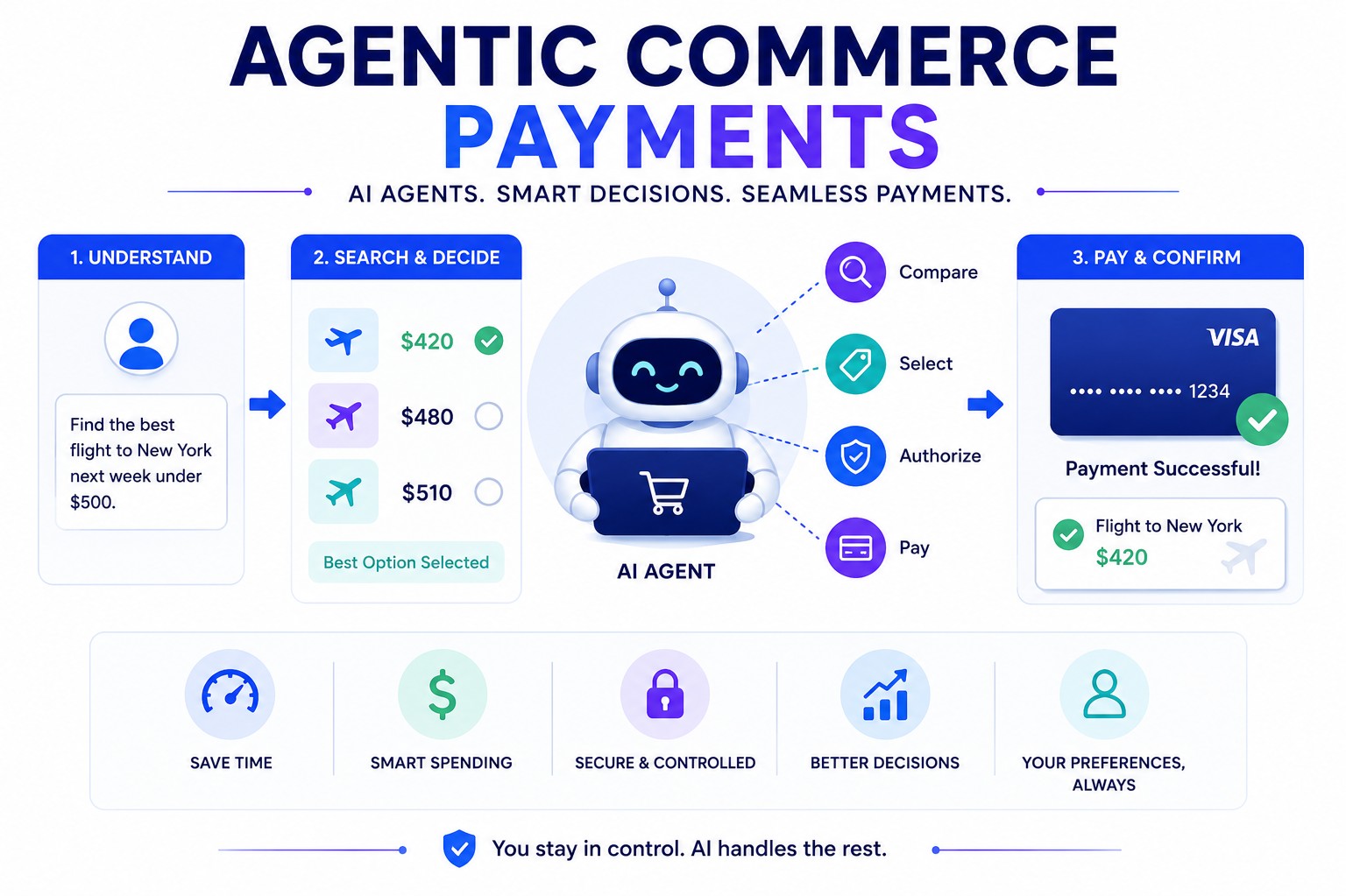
For example, a consumer may instruct an AI assistant to find the most cost-effective flight within certain travel dates. The AI agent can search multiple platforms, compare prices, assess preferences, identify optimal options, and complete the booking process.
The payment component becomes a critical element of this workflow. Once an agent determines the best purchasing decision, it must securely and efficiently execute the associated payment.
This is where Agentic Commerce Payments enter the equation.
What Are Agentic Commerce Payments?
Agentic Commerce Payments are payment transactions initiated, managed, or executed by intelligent software agents acting on behalf of users or organizations.
Rather than requiring a customer to manually approve every payment step, authorized AI agents can complete transactions according to predefined preferences, permissions, budgets, and rules.
The objective is not to remove human oversight but to reduce friction in purchasing processes while improving efficiency and decision-making.
These payments can occur across various scenarios, including:
- Automated procurement
- Subscription management
- Travel bookings
- Supply chain purchasing
- Digital services acquisition
- Business expense management
As AI capabilities continue advancing, the number of potential use cases is expected to grow significantly.
Why Agentic Commerce Payments Matter
The significance of Agentic Commerce Payments extends beyond simple automation.
Modern consumers and businesses face an overwhelming number of purchasing decisions daily. Evaluating products, comparing providers, reviewing pricing structures, and managing transactions require substantial time and effort.
AI agents can dramatically reduce this complexity by performing these tasks continuously and intelligently.
For businesses, agentic payments can improve procurement efficiency, reduce administrative burdens, and optimize purchasing decisions. For consumers, they can deliver greater convenience while ensuring purchases align with personal preferences and financial constraints.
The result is a commerce ecosystem that becomes increasingly proactive rather than reactive.
The Technology Behind Agentic Payments
Several technologies are converging to enable agentic commerce payments.
Artificial intelligence serves as the decision-making engine. Large language models, machine learning systems, and predictive analytics help agents understand user preferences and evaluate available options.
Open banking infrastructure provides secure access to financial services and payment initiation capabilities. Through APIs, AI agents can interact with banking systems while maintaining regulatory compliance.
Embedded finance solutions integrate payment functionality directly into digital platforms, reducing the need for external payment processes.
Real-time payment networks further enhance the ecosystem by enabling immediate transaction execution and settlement.
Together, these technologies create the foundation for intelligent and autonomous payment experiences.
Benefits for Consumers
One of the most compelling advantages of Agentic Commerce Payments is convenience.
Consumers increasingly value experiences that reduce effort while delivering personalized outcomes. AI agents can monitor prices, identify promotions, renew subscriptions, and complete purchases without requiring constant user involvement.
Beyond convenience, agentic payments can help users make more informed financial decisions. Intelligent agents can analyze spending patterns, compare alternatives, and recommend cost-saving opportunities.
Additional benefits include faster purchasing processes, improved personalization, and enhanced financial management.
Importantly, consumers retain control through permission frameworks, spending limits, and approval settings that govern agent behavior.
Benefits for Businesses
Businesses stand to gain significant advantages from agentic commerce ecosystems.
Procurement teams can automate repetitive purchasing tasks, reducing operational costs and improving efficiency. AI agents can monitor inventory levels, identify supply shortages, and execute purchases automatically when predefined conditions are met.
Retailers and service providers can also benefit from more intelligent customer interactions. AI agents may help consumers discover products that align more closely with their needs, increasing conversion rates and customer satisfaction.
Furthermore, agentic payments can reduce friction during checkout processes, creating smoother customer journeys and improving transaction completion rates.
Security and Trust Considerations
As with any emerging financial technology, security remains a critical concern.
Consumers and businesses must trust that AI agents will act responsibly and within authorized boundaries. This requires robust authentication mechanisms, transparent consent management, and clear accountability frameworks.
Financial institutions, payment providers, and technology companies are actively exploring methods to ensure secure agent authorization and transaction validation.
Key safeguards may include:
- Spending limits
- Multi-factor authentication
- Real-time transaction monitoring
- AI behavior auditing
- User-controlled permissions
These measures help maintain confidence while enabling greater levels of automation.
Challenges Facing Agentic Commerce Payments
Despite their promise, several challenges remain.
Regulatory frameworks are still evolving to address autonomous financial decision-making. Questions surrounding liability, consumer protection, and AI accountability must be resolved before widespread adoption can occur.
Interoperability is another challenge. Agentic commerce requires seamless integration across payment providers, merchants, financial institutions, and technology platforms.
Consumer trust may also take time to develop. Many users remain cautious about granting AI systems authority over purchasing decisions and financial transactions.
Addressing these concerns will be essential to achieving mainstream adoption.
The Future of Agentic Commerce Payments
The future of commerce is increasingly autonomous.
Industry experts predict that AI agents will become trusted digital assistants capable of managing significant portions of both personal and business purchasing activities. Rather than manually searching, comparing, and transacting, users will focus on defining objectives and preferences while AI handles execution.
As artificial intelligence, open banking, embedded finance, and real-time payment infrastructures continue to mature, Agentic Commerce Payments are likely to become a standard component of digital commerce ecosystems.
Organizations that begin preparing for this shift today will be better positioned to capitalize on emerging opportunities and evolving consumer expectations.
Conclusion
Agentic Commerce Payments represent one of the most exciting developments at the intersection of artificial intelligence, payments, and digital commerce. By empowering intelligent agents to initiate and manage transactions within predefined parameters, businesses and consumers can benefit from greater efficiency, personalization, and convenience.
While challenges related to security, regulation, and trust remain, the momentum behind autonomous commerce continues to grow. As technology advances and adoption expands, Agentic Commerce Payments are poised to play a central role in shaping the next generation of financial and commercial interactions.
In the coming years, the question may no longer be whether AI can make payments on our behalf—but how intelligently and securely it can do so.
Comments
No comments yet. Be the first to share your thoughts.
Leave a comment