
Introduction
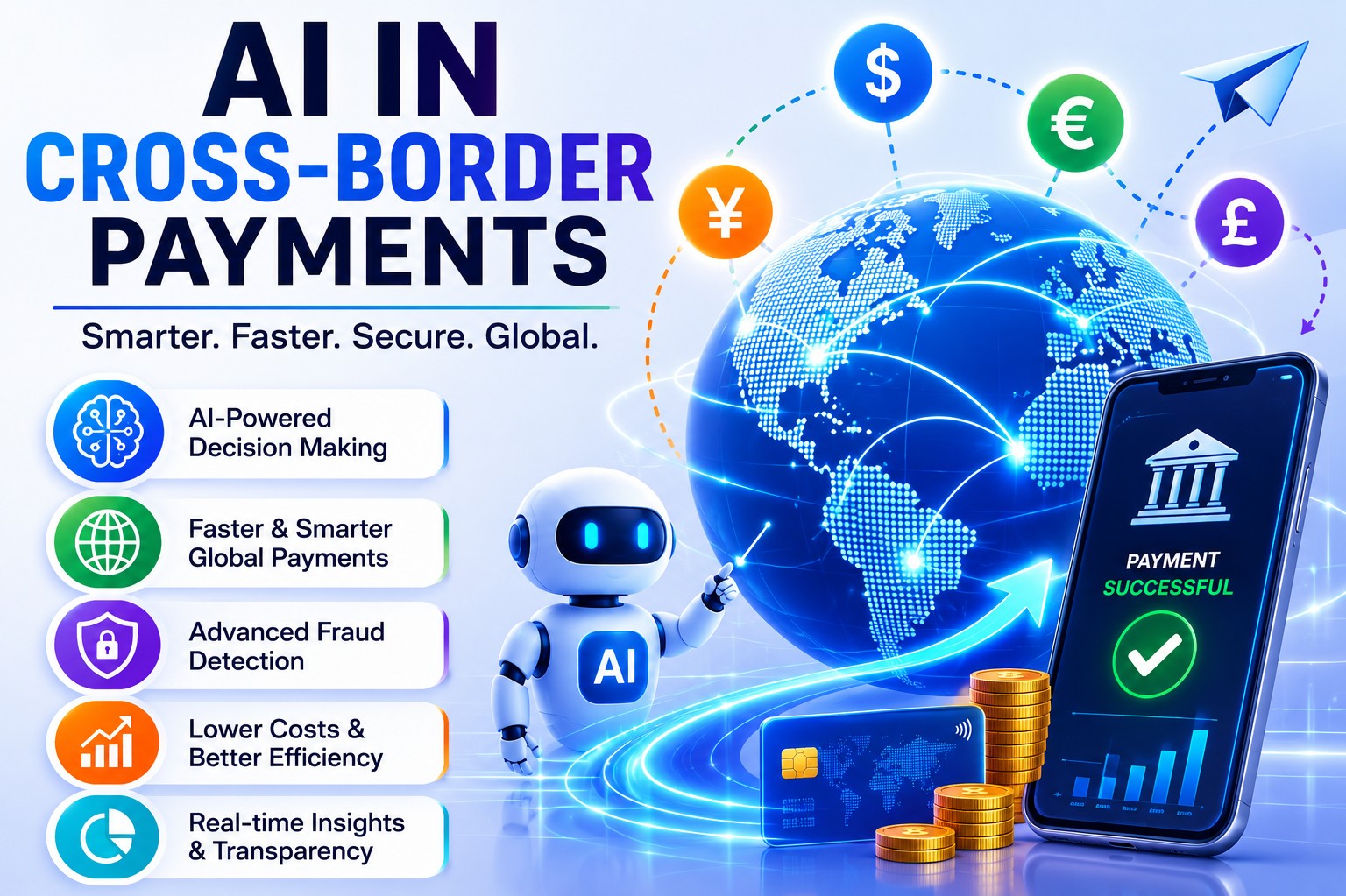
Cross-border payments are the backbone of global commerce, enabling businesses to pay suppliers, settle invoices, manage international payroll, and expand into new markets. However, despite significant advances in financial technology, international payments have traditionally been associated with high costs, slow settlement times, compliance challenges, and limited transparency.AI is rapidly transforming the cross-border payments landscape by automating processes, enhancing fraud detection, improving compliance management, optimizing payment routing, and delivering greater transparency across international transactions. Financial institutions, fintech companies, payment providers, and multinational businesses are leveraging AI to overcome longstanding inefficiencies and create a smarter global payments ecosystem.The integration of AI in cross-border payments is not simply an upgrade to existing systems it represents a fundamental shift in how money moves across borders.
Understanding Cross-Border Payment Challenges
International transactions involve multiple participants, including banks, payment networks, correspondent banks, regulators, and foreign exchange providers.
This complexity often creates several challenges:
- High transaction costs
- Slow settlement times
- Compliance burdens
- Fraud risks
- Currency conversion issues
- Limited payment visibility
- Manual reconciliation processes
For businesses operating globally, these challenges can affect cash flow, customer satisfaction, and operational efficiency.
AI is helping financial institutions address these issues through intelligent automation and data-driven decision-making.
What Is AI in Cross-Border Payments?
AI in cross-border payments refers to the use of machine learning, predictive analytics, natural language processing, and intelligent automation technologies to improve international payment processing and management.
AI systems analyze large volumes of transaction data in real time to identify patterns, detect anomalies, predict risks, and automate complex workflows.
Rather than relying solely on traditional rule-based systems, AI continuously learns from transaction behavior and adapts to evolving payment environments.
This enables businesses and payment providers to process transactions faster, more accurately, and more securely.
AI-Powered Fraud Detection
Fraud remains one of the biggest concerns in international payments.
Traditional fraud detection systems often rely on static rules that may struggle to identify sophisticated threats.
AI enhances fraud prevention by:
- Monitoring transactions in real time
- Detecting unusual payment patterns
- Identifying suspicious account behavior
- Analyzing transaction histories
- Flagging high-risk activities instantly
Machine learning models can continuously improve detection accuracy by learning from new fraud attempts.
This helps financial institutions reduce losses while minimizing false positives that may disrupt legitimate transactions.
Smarter Compliance and AML Monitoring
Cross-border payments must comply with strict regulatory requirements, including:
- Anti-Money Laundering (AML)
- Know Your Customer (KYC)
- Sanctions screening
- Counter-terrorism financing regulations
Traditional compliance reviews often require significant manual effort.
AI helps streamline compliance processes by:
- Automating customer risk assessments
- Screening transactions against sanctions lists
- Monitoring suspicious activities
- Generating compliance alerts
- Reducing manual investigation workloads
This allows compliance teams to focus on higher-risk cases while improving operational efficiency.
Optimizing Payment Routing
One of the most valuable applications of AI in cross-border payments is intelligent payment routing.
International payments often travel through multiple intermediary institutions before reaching their destination.
AI can analyze:
- Transaction costs
- Processing times
- Network availability
- Historical performance
- Currency corridors
Based on this information, AI identifies the most efficient route for each transaction.
Benefits include:
- Faster settlement
- Lower fees
- Reduced payment failures
- Improved customer experiences
For businesses processing high transaction volumes, optimized routing can deliver substantial cost savings.
Enhancing Foreign Exchange Management
Currency conversion is a critical component of cross-border payments.
Exchange rate fluctuations can significantly impact transaction values and profitability.
AI-driven analytics help businesses:
- Predict currency movements
- Optimize conversion timing
- Reduce foreign exchange exposure
- Improve treasury management
- Support strategic financial planning
These insights enable organizations to make more informed decisions regarding international payment operations.
Improving Payment Transparency
One of the biggest frustrations in traditional international payments is limited visibility.
Businesses often struggle to determine:
- Where a payment is located
- Why a delay occurred
- When funds will arrive
AI-powered payment platforms provide greater transparency through:
- Real-time transaction tracking
- Predictive settlement estimates
- Automated notifications
- Intelligent exception management
Improved visibility enhances trust and helps businesses manage cash flow more effectively.
Automating Reconciliation
Reconciling international payments can be a time-consuming and resource-intensive process.
AI simplifies reconciliation by automatically matching:
- Payments
- Invoices
- Customer records
- Reference data
Machine learning algorithms can identify transaction relationships even when payment details are incomplete or inconsistent.
This reduces manual work, minimizes errors, and accelerates financial reporting processes.
AI and Customer Experience
Customer expectations continue to evolve in the digital age.
Businesses and consumers increasingly expect payment experiences that are:
- Fast
- Secure
- Transparent
- Convenient
AI contributes to better customer experiences through:
- Faster transaction processing
- Personalized payment recommendations
- Proactive issue resolution
- Intelligent customer support
- Real-time payment updates
By improving the overall payment journey, organizations can strengthen customer relationships and increase satisfaction.
Industries Benefiting from AI-Powered Cross-Border Payments
E-Commerce
Global online retailers use AI to improve payment acceptance, reduce fraud, and streamline international transactions.
Fintech Companies
Fintech firms leverage AI to enhance payment infrastructure, automate compliance, and improve operational efficiency.
Marketplaces
Digital marketplaces benefit from AI-driven reconciliation, fraud prevention, and payment optimization.
Multinational Corporations
Large enterprises use AI to manage international cash flows, optimize treasury operations, and improve payment visibility.
Financial Institutions
Banks and payment providers deploy AI to modernize legacy systems and deliver more competitive cross-border payment services.
Challenges of AI Adoption
Despite its benefits, implementing AI in cross-border payments presents certain challenges.
Data Quality
AI systems rely on high-quality data to generate accurate insights.
Incomplete or inconsistent data can affect performance.
Regulatory Considerations
Organizations must ensure AI systems comply with evolving financial regulations and data privacy requirements.
Technology Integration
Integrating AI into existing payment infrastructure can require significant investment and technical expertise.
Model Transparency
Financial institutions must understand how AI models make decisions, particularly in regulated environments.
Addressing these challenges is essential for successful AI deployment.
The Future of AI in Cross-Border Payments
The role of AI in international payments is expected to expand significantly over the coming years.
Key trends include:
Real-Time Intelligent Payments
AI will support instant payment processing and real-time transaction optimization.
Predictive Payment Analytics
Organizations will gain deeper insights into payment behavior, cash flow trends, and financial risks.
AI-Powered Digital Identity
Advanced identity verification systems will strengthen security while simplifying onboarding processes.
Hyper-Automation
AI will automate increasingly complex payment workflows, reducing operational costs and improving efficiency.
Integrated Financial Ecosystems
AI will help connect banks, fintech companies, payment providers, and businesses within seamless global payment networks.
Conclusion
Artificial Intelligence is redefining the future of cross-border payments by making international transactions faster, safer, more transparent, and more efficient. From fraud detection and compliance monitoring to payment routing and reconciliation, AI is helping financial institutions and businesses overcome many of the challenges that have traditionally limited global payment efficiency.
As international commerce continues to grow and payment ecosystems become increasingly digital, AI will play an even greater role in enabling seamless global transactions. Organizations that embrace AI-powered payment technologies today will be better positioned to reduce costs, improve customer experiences, strengthen compliance, and compete successfully in the evolving world of global finance.
Comments
No comments yet. Be the first to share your thoughts.
Leave a comment