
Introduction
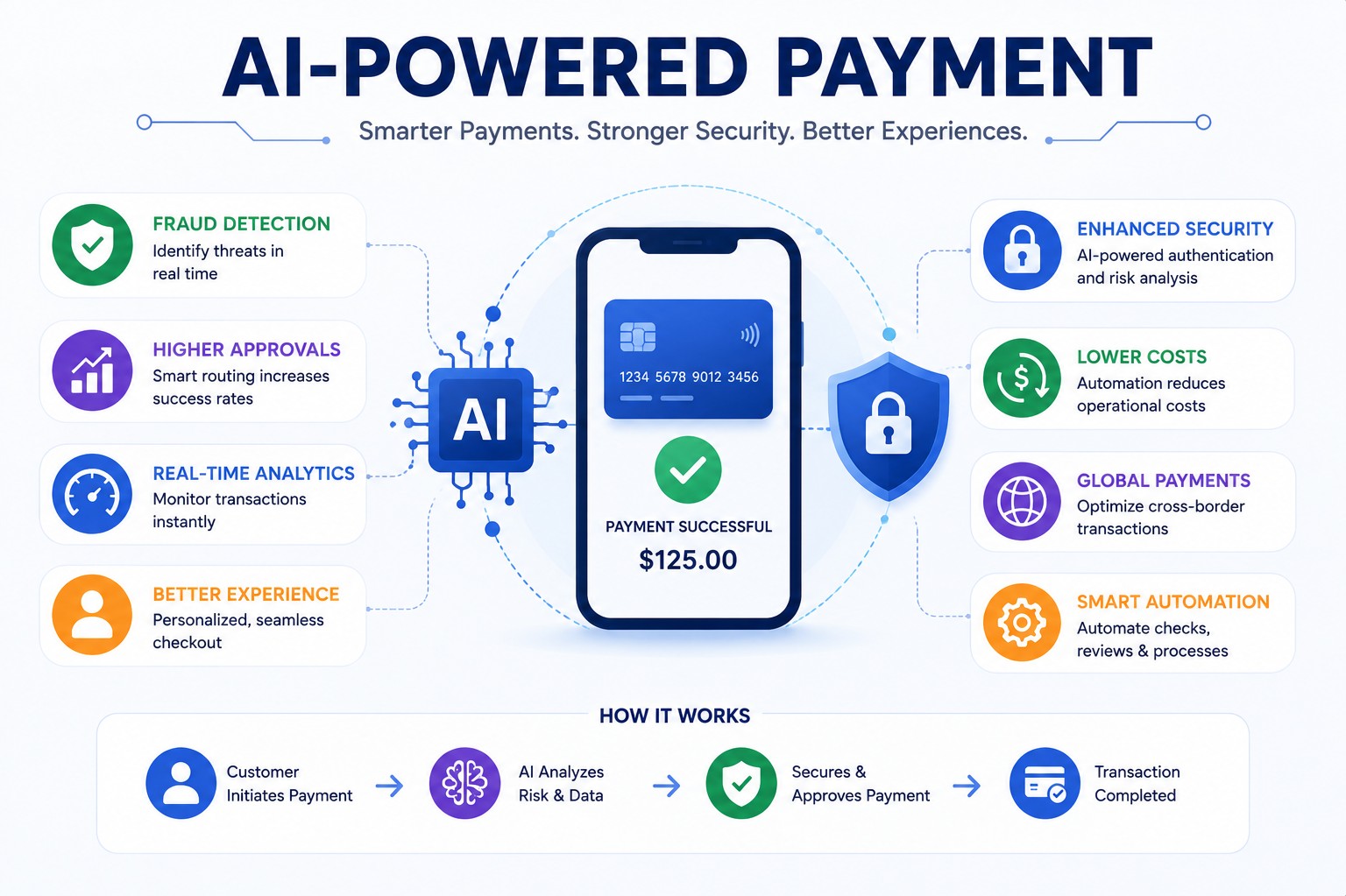
The payments industry is undergoing a significant transformation driven by artificial intelligence. As businesses process millions of transactions daily, traditional payment systems are facing increasing pressure to deliver greater speed, security, efficiency, and personalization. To meet these demands, organizations are turning to AI-Powered Payment solutions.
Artificial intelligence is no longer limited to chatbots and predictive analytics. It is now playing a central role in payment processing, fraud prevention, customer authentication, transaction monitoring, and financial decision-making. By analyzing large volumes of data in real time, AI-powered payment systems help businesses improve performance while enhancing customer experiences.
As digital commerce continues to expand globally, AI-powered payment technology is becoming a cornerstone of modern financial infrastructure.
What Is AI-Powered Payment?
AI-Powered Payment refers to the use of artificial intelligence technologies to automate, optimize, and secure payment processes.
These systems use technologies such as:
- Machine learning
- Predictive analytics
- Natural language processing
- Behavioral analysis
- Real-time data processing
AI helps payment providers make intelligent decisions faster than traditional rule-based systems.
The result is a payment ecosystem that is more adaptive, efficient, and secure.
Why AI Is Transforming Payments
The digital economy generates enormous amounts of transaction data every second.
Traditional systems often struggle to process this information efficiently, particularly when identifying fraud patterns or optimizing payment performance.
AI can analyze vast datasets instantly and identify trends that human analysts might miss.
This capability enables businesses to:
- Improve transaction approvals
- Detect fraud faster
- Reduce operational costs
- Enhance customer experiences
- Optimize payment routing
As transaction volumes continue growing, AI is becoming essential rather than optional.
AI-Powered Fraud Detection
Fraud prevention is one of the most valuable applications of AI in payments.
Traditional fraud detection systems often rely on static rules that may not adapt quickly to emerging threats.
AI-powered systems continuously learn from transaction patterns and identify suspicious behavior in real time.
These systems can analyze:
- Transaction history
- Device information
- Geographic locations
- Spending habits
- Behavioral patterns
By identifying anomalies instantly, AI helps prevent fraud before financial losses occur.
Enhancing Payment Security
Security remains a top priority for payment providers and merchants.
AI-powered payment systems strengthen security through advanced risk assessment and behavioral monitoring.
Instead of relying solely on passwords or static authentication methods, AI can evaluate user behavior to determine whether a transaction appears legitimate.
Examples include:
- Typing patterns
- Login behavior
- Device usage
- Transaction habits
This adaptive security approach improves protection while reducing friction for legitimate customers.
Improving Payment Approval Rates
Failed transactions can lead to lost revenue and customer frustration.
AI-powered payment systems help improve authorization rates by analyzing transaction conditions in real time.
The technology can determine:
- Optimal payment routes
- Preferred acquiring banks
- Regional processing performance
- Historical approval trends
This intelligent routing increases the likelihood of successful transactions while reducing unnecessary declines.
Even small improvements in approval rates can significantly impact business performance.
Personalized Customer Experiences
Consumers increasingly expect personalized financial experiences.
AI-powered payment platforms can analyze customer preferences and purchasing behavior to create tailored experiences.
Benefits include:
- Personalized payment options
- Customized rewards
- Targeted offers
- Improved checkout experiences
These enhancements help increase customer satisfaction and encourage long-term loyalty.
Personalization is becoming a key competitive advantage in digital payments.
Real-Time Transaction Monitoring
Modern payment environments require constant monitoring.
AI enables real-time transaction analysis across millions of payment events.
This capability helps organizations:
- Identify unusual activity
- Detect operational issues
- Monitor compliance requirements
- Improve transaction visibility
Real-time intelligence supports faster decision-making and more efficient payment operations.
AI-Powered Payment in E-Commerce
E-commerce businesses benefit significantly from AI-powered payment solutions.
Online merchants face challenges including fraud, cart abandonment, payment failures, and customer experience optimization.
AI helps address these challenges by:
- Detecting fraudulent transactions
- Optimizing checkout flows
- Reducing false declines
- Improving payment success rates
As online commerce continues expanding, AI-powered payment technologies will become increasingly important for merchants worldwide.
Supporting Cross-Border Payments
International transactions often involve multiple currencies, payment networks, regulatory requirements, and fraud risks.
AI helps simplify cross-border payments by:
- Optimizing currency conversion
- Detecting international fraud patterns
- Improving transaction routing
- Enhancing compliance monitoring
These capabilities improve efficiency while supporting global business growth.
Challenges of AI-Powered Payment
Despite its advantages, AI-powered payment technology also faces challenges.
These include:
- Data privacy concerns
- Regulatory compliance requirements
- Model transparency issues
- Integration complexity
- Algorithm bias risks
Organizations must implement strong governance frameworks to ensure responsible AI adoption.
Balancing innovation with regulatory compliance remains essential.
The Role of AI in Payment Automation
Automation is a major driver of payment innovation.
AI-powered payment systems automate repetitive tasks such as:
- Transaction reviews
- Fraud investigations
- Risk assessments
- Reconciliation processes
- Customer support interactions
This automation improves efficiency while allowing employees to focus on higher-value activities.
Businesses benefit from lower costs and faster operations.
Future Trends in AI-Powered Payment
The future of AI-powered payment is expected to include:
- Autonomous payment systems
- Predictive fraud prevention
- Voice-activated payments
- AI-driven financial assistants
- Intelligent payment orchestration
- Hyper-personalized customer experiences
As artificial intelligence continues evolving, payment systems will become increasingly intelligent and proactive.
The combination of AI, real-time payments, and embedded finance will reshape the future of financial services.
Conclusion
AI-Powered Payment is revolutionizing how money moves through the digital economy. By combining artificial intelligence with modern payment infrastructure, businesses can improve security, increase efficiency, reduce fraud, and deliver superior customer experiences.
As transaction volumes continue growing and customer expectations evolve, AI-powered payment solutions will play an increasingly important role in shaping the future of commerce. Organizations that embrace these technologies today will be better positioned to compete in a rapidly changing financial landscape and unlock new opportunities for innovation and growth.
Comments
No comments yet. Be the first to share your thoughts.
Leave a comment