
Introduction
The global payments landscape has evolved dramatically over the past decade. Consumers now expect instant, secure, and seamless payment experiences whether they are shopping online, paying through mobile applications, subscribing to digital services, or making international purchases. As payment expectations continue to rise, businesses require sophisticated infrastructure capable of handling transactions efficiently across multiple channels and markets.This is where a Payment Service Provider (PSP) plays a critical role. A Payment Service Provider acts as the technology and operational bridge between merchants, customers, banks, card networks, and alternative payment methods. By simplifying payment acceptance and management, PSPs enable businesses to focus on growth rather than the complexities of payment processing.
Today, Payment Service Providers have become a fundamental part of the digital economy, supporting businesses of all sizes as they navigate increasingly complex payment ecosystems.
What Is a Payment Service Provider?
A Payment Service Provider is a company that enables businesses to accept and process electronic payments through a unified platform.
Rather than requiring merchants to establish separate relationships with acquiring banks, card networks, payment gateways, and alternative payment providers, a PSP consolidates these services into a single solution.
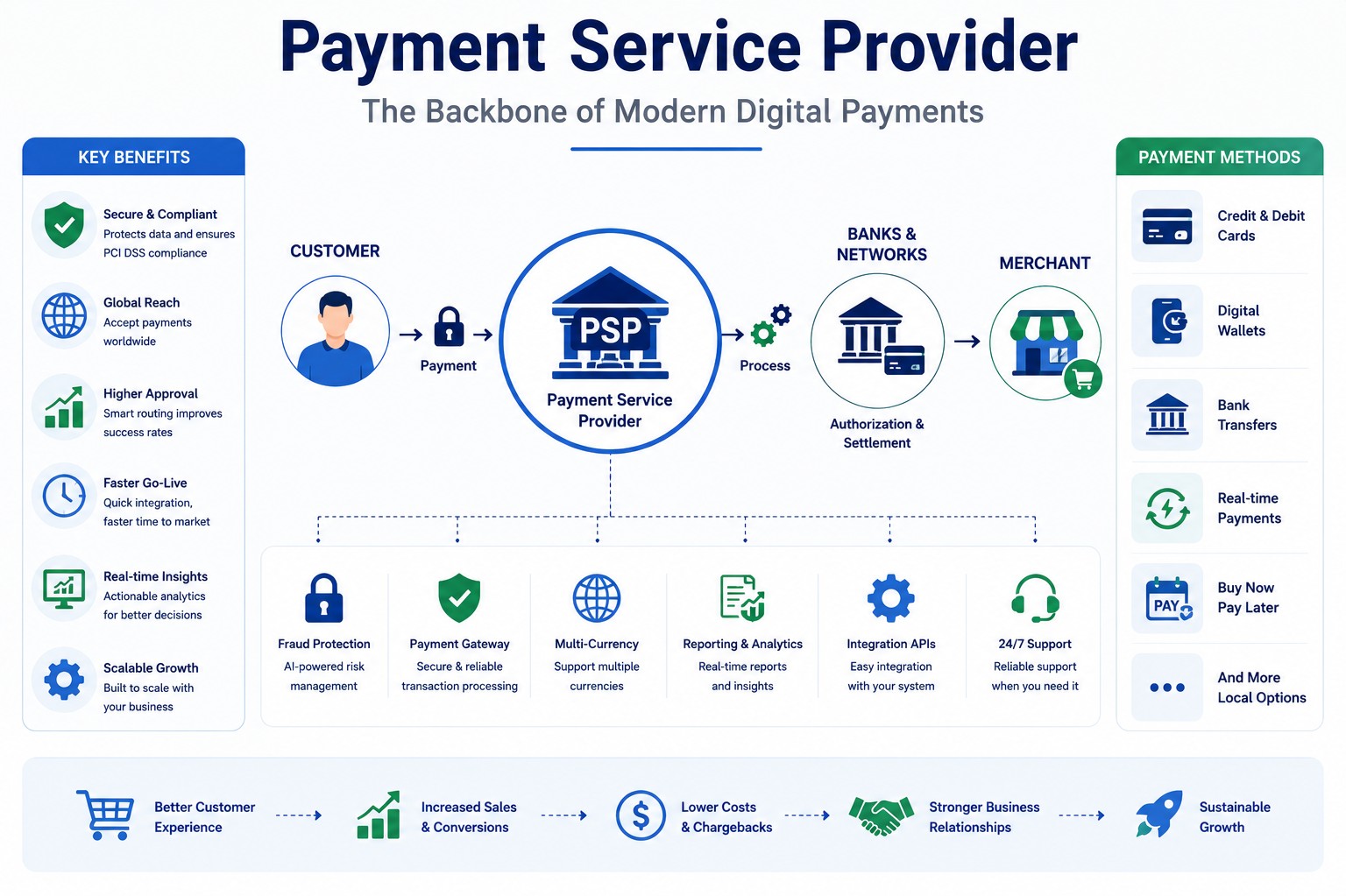
Through one integration, businesses can often accept:
- Credit cards
- Debit cards
- Digital wallets
- Bank transfers
- Real-time payments
- Buy Now Pay Later solutions
- Alternative payment methods
This streamlined approach simplifies payment operations while improving efficiency and scalability.
Why Payment Service Providers Are Important
Managing payments independently can be highly complex.
Businesses must handle payment processing, security requirements, fraud prevention, compliance obligations, settlement processes, and customer payment preferences. As companies expand internationally, these challenges become even more difficult.
Payment Service Providers address these issues by offering centralized payment infrastructure.
Their services help businesses:
- Accept payments globally
- Improve transaction success rates
- Reduce operational complexity
- Enhance security
- Access payment analytics
- Support business growth
These advantages make PSPs essential partners in modern commerce.
How a Payment Service Provider Works
When a customer initiates a payment, the PSP securely captures and transmits transaction information through the payment ecosystem.
The process generally involves:
- Payment information is submitted by the customer.
- The PSP securely processes the transaction request.
- The acquiring bank and card network validate the transaction.
- Authorization is returned to the merchant.
- Funds are settled according to the provider’s settlement schedule.
Although this process occurs within seconds, multiple financial institutions and technology systems work together behind the scenes.
The PSP coordinates these interactions while ensuring speed, reliability, and security.
Key Services Offered by Payment Service Providers
Modern PSPs provide far more than simple transaction processing.
Many providers offer comprehensive payment ecosystems that support various aspects of business operations.
Common services include:
Payment Acceptance
PSPs enable businesses to accept multiple payment methods through a single integration.
Payment Gateway Services
Secure transaction routing and authorization processing help facilitate smooth payment experiences.
Fraud Prevention
Advanced fraud detection systems monitor transactions and identify suspicious activities.
Reporting and Analytics
Businesses gain visibility into transaction performance, customer behavior, and operational metrics.
Cross-Border Payments
Many PSPs support international transactions, multiple currencies, and localized payment methods.
These services contribute to a more efficient payment infrastructure.
Benefits of Using a Payment Service Provider
One of the primary advantages of a Payment Service Provider is simplicity.
Instead of managing multiple payment vendors, businesses can centralize payment operations through a single platform.
Additional benefits include:
- Faster implementation
- Reduced operational complexity
- Enhanced security
- Global payment acceptance
- Better customer experiences
- Improved scalability
- Advanced fraud management
- Real-time reporting
These benefits help businesses improve both operational efficiency and customer satisfaction.
Supporting E-Commerce Growth
E-commerce businesses rely heavily on effective payment processing.
Even minor payment issues can result in abandoned carts, lost sales, and frustrated customers.
Payment Service Providers help optimize online checkout experiences by supporting multiple payment options and improving transaction approval rates.
Consumers increasingly expect flexibility when paying online. A PSP allows merchants to offer various payment methods while maintaining a seamless purchasing experience.
As digital commerce continues expanding globally, PSPs remain central to online business success.
Cross-Border Payment Capabilities
International expansion presents significant payment challenges.
Different countries use different payment methods, currencies, regulations, and banking systems. Without appropriate payment infrastructure, global growth can become difficult.
Payment Service Providers often simplify international commerce by offering:
- Multi-currency processing
- Local payment methods
- Currency conversion services
- International acquiring capabilities
- Cross-border settlement solutions
These capabilities allow businesses to serve customers worldwide more effectively.
Payment Security and Compliance
Security is one of the most critical aspects of payment processing.
Businesses handling payment information must protect sensitive customer data while complying with industry regulations.
Payment Service Providers typically invest heavily in:
- Data encryption
- Tokenization
- Fraud monitoring
- PCI DSS compliance
- Secure authentication
- Risk management systems
These protections help reduce security risks while building customer trust.
Strong security infrastructure is often one of the most valuable benefits a PSP provides.
Fraud Prevention and Risk Management
Payment fraud continues to evolve as cybercriminals develop increasingly sophisticated attack methods.
Modern PSPs use advanced technologies such as artificial intelligence and machine learning to detect suspicious activity.
Fraud management tools may analyze:
- Transaction behavior
- Device information
- Geographic patterns
- Customer activity
- Historical transaction data
These insights help businesses identify fraudulent transactions before financial losses occur.
Effective fraud prevention contributes directly to profitability and customer confidence.
Payment Service Providers and Fintech Innovation
The rise of fintech has transformed the PSP industry.
Today’s providers increasingly offer advanced capabilities beyond basic payment processing. Open banking integrations, real-time payments, embedded finance, and intelligent payment routing are becoming standard features.
Artificial intelligence is also improving payment optimization, risk management, and customer experiences.
As financial technology continues evolving, PSPs are playing a leading role in delivering innovative payment solutions to businesses worldwide.
Challenges Businesses Should Consider
While PSPs offer numerous benefits, businesses should carefully evaluate providers before making a selection.
Important considerations include:
- Processing fees
- Supported payment methods
- Geographic coverage
- Security capabilities
- Integration requirements
- Settlement timelines
- Customer support quality
Selecting the right provider requires balancing functionality, scalability, reliability, and cost.
A PSP should align with both current business requirements and future growth objectives.
The Future of Payment Service Providers
The future of payment processing will likely be shaped by continued technological innovation.
Real-time payments, artificial intelligence, open banking, digital identities, embedded finance, and blockchain technologies are expected to influence payment ecosystems significantly.
Payment Service Providers are investing heavily in these areas to create faster, more secure, and more efficient payment experiences.
Businesses increasingly demand flexible payment infrastructure capable of adapting to changing customer expectations and market conditions.
PSPs that continue innovating will remain essential partners in the digital economy.
Conclusion
A Payment Service Provider serves as the foundation of modern payment infrastructure, enabling businesses to accept, process, secure, and manage digital transactions efficiently. By simplifying payment operations, supporting global commerce, enhancing security, and improving customer experiences, PSPs have become indispensable to organizations operating in today’s digital marketplace.
As payment technologies continue to evolve and consumer expectations rise, the importance of reliable Payment Service Providers will only grow. Businesses that leverage robust PSP solutions can improve operational efficiency, expand internationally, reduce payment risks, and position themselves for long-term success in an increasingly connected financial world.
Comments
No comments yet. Be the first to share your thoughts.
Leave a comment