
Introduction
As digital payments continue to replace cash and traditional banking methods, protecting sensitive payment information has become one of the biggest priorities for financial institutions, payment providers, and online businesses. Every online transaction involves valuable cardholder data that can become a target for cybercriminals if not properly secured. Data breaches, payment fraud, and account compromise continue to cost businesses billions of dollars each year while damaging customer trust.One of the most effective technologies developed to address these challenges is Network Tokenization. Instead of transmitting and storing an actual payment card number during every transaction, network tokenization replaces the sensitive card details with a unique digital token that has no exploitable value outside the authorized payment ecosystem.
Supported by major card networks, network tokenization enhances payment security, improves transaction approval rates, reduces fraud, and simplifies compliance with industry security standards. As digital commerce expands across websites, mobile applications, digital wallets, and subscription services, network tokenization has become a cornerstone of modern payment infrastructure.
What Is Network Tokenization?
Network Tokenization is a payment security technology that replaces a customer’s actual payment card number with a unique digital token issued by a card network or its authorized Token Service Provider (TSP).
The token acts as a substitute for the original card number during payment processing. Even if intercepted, the token cannot be used to perform unauthorized transactions outside its approved environment.
The actual card details remain securely stored within the card network’s protected systems, significantly reducing the exposure of sensitive payment information.
Why Network Tokenization Is Important
Traditional payment processing often requires merchants to store or transmit card numbers, increasing the risk of data theft if systems are compromised.
Network tokenization minimizes this risk by ensuring that merchants handle tokens instead of actual card credentials. Because the token has no independent value, stolen payment data becomes far less useful to attackers.
In addition to improving security, network tokenization supports smoother payment experiences by reducing transaction failures caused by expired or replaced cards.
For businesses processing high volumes of digital payments, this technology enhances both security and operational efficiency.
How Network Tokenization Works
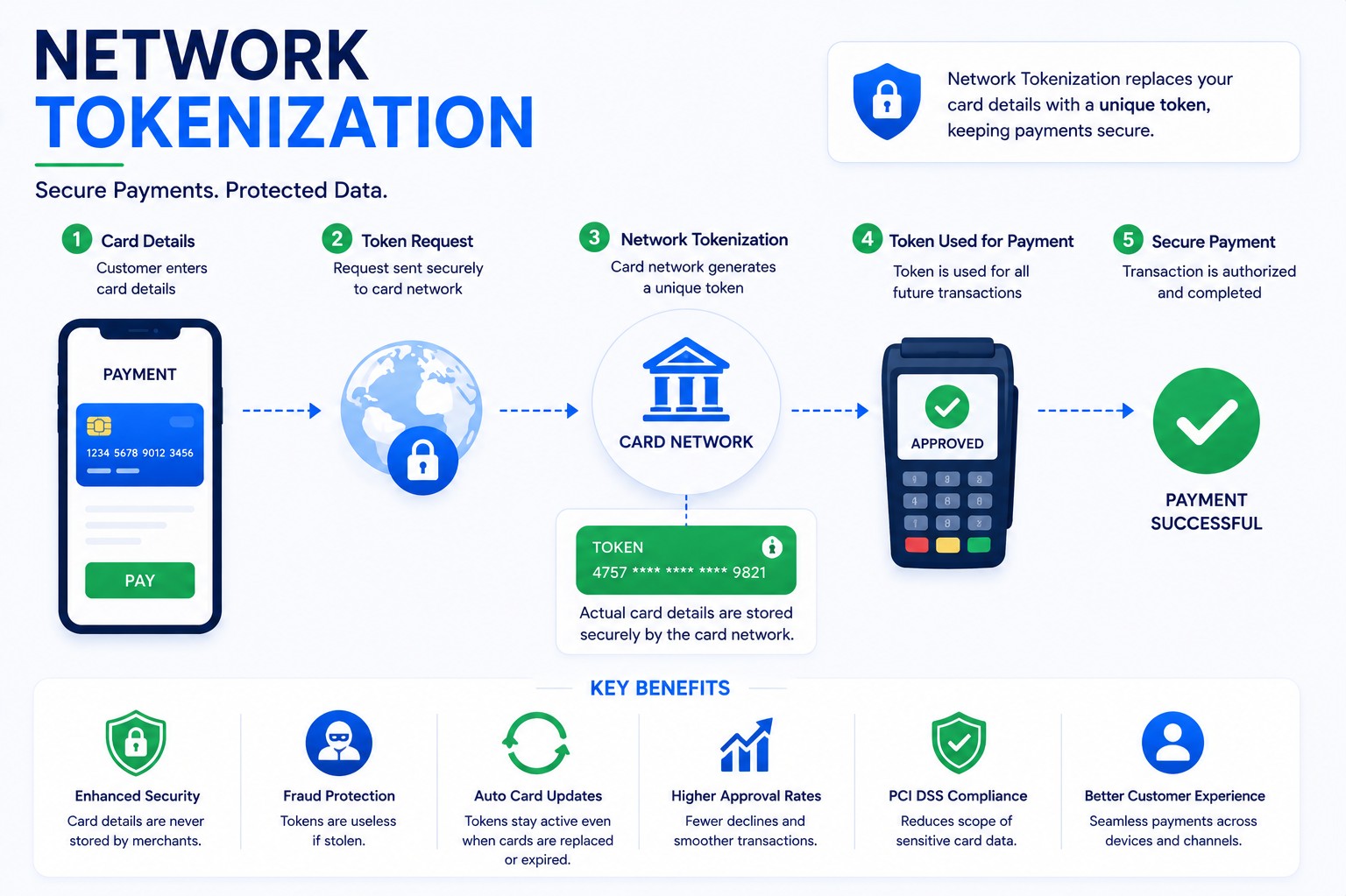
When a customer enters card details during checkout or adds a card to a digital wallet, the payment information is securely transmitted to the card network.
The network generates a unique payment token that replaces the original Primary Account Number (PAN). This token is returned to the merchant or payment provider and used for future transactions instead of the real card number.
During payment authorization, the card network securely maps the token back to the original card credentials and completes the authorization process with the issuing bank.
The merchant never needs to store or repeatedly process the actual card number.
Network Tokenization vs Traditional Tokenization
Although both methods protect payment data, they differ in how tokens are created and managed.
Traditional tokenization is usually performed by a payment gateway or merchant, with tokens stored within that provider’s environment.
Network tokenization is managed directly by major card networks, creating standardized tokens that can automatically update when a customer receives a replacement card.
This network-level management provides stronger interoperability, higher reliability, and better long-term payment performance.
Benefits of Network Tokenization
One of the biggest advantages of network tokenization is improved payment security.
Since merchants no longer store actual card numbers, the potential impact of data breaches is significantly reduced. Businesses also experience lower fraud rates because tokens are restricted to specific merchants, devices, or payment channels.
Network tokenization can improve payment approval rates by allowing card networks to apply advanced authentication and lifecycle management capabilities.
Customers also enjoy uninterrupted recurring payments when their cards expire or are replaced.
Token Lifecycle Management
A major advantage of network tokenization is automatic token lifecycle management.
When a customer receives a replacement card because of expiration, renewal, or loss, the associated payment token can often remain valid without requiring the customer to update payment information manually.
This capability reduces subscription payment failures, improves recurring billing success, and minimizes customer inconvenience.
Businesses benefit from fewer declined transactions and reduced revenue loss caused by outdated payment credentials.
Security and Fraud Prevention
Network tokenization significantly strengthens payment security.
Tokens are generated using secure cryptographic methods and are often linked to a specific merchant, device, or transaction type. Even if intercepted, they cannot be reused in unauthorized environments.
Combined with encryption, EMV technology, multifactor authentication, and AI-powered fraud detection, network tokenization provides multiple layers of protection against payment fraud.
This approach helps financial institutions and merchants maintain customer trust while reducing financial losses.
PCI DSS Compliance
Businesses processing card payments must comply with the Payment Card Industry Data Security Standard (PCI DSS).
Network tokenization reduces the amount of sensitive cardholder data stored within merchant environments, helping organizations simplify compliance requirements and reduce security risks.
Although PCI compliance responsibilities do not disappear completely, tokenization significantly decreases the scope of sensitive data requiring protection.
This lowers operational complexity while improving overall security posture.
Use Cases Across Industries
Network tokenization is widely used across digital commerce.
E-commerce retailers use it to protect online card payments. Subscription businesses rely on tokenized credentials for recurring billing, while mobile wallet providers secure contactless payments using network-issued tokens.
Travel companies, digital marketplaces, financial institutions, gaming platforms, and mobile applications also use network tokenization to improve payment security and customer convenience.
As digital transactions continue growing, adoption is expanding across virtually every payment-enabled industry.
Artificial Intelligence and Network Tokenization
Artificial intelligence complements network tokenization by strengthening fraud prevention and payment optimization.
AI systems analyze tokenized transaction data to identify suspicious behavior, detect anomalies, optimize payment routing, and improve authorization rates.
Machine learning continuously adapts to emerging fraud techniques while minimizing false transaction declines.
Together, AI and network tokenization create a more secure and efficient digital payment ecosystem.
Future of Network Tokenization
The future of network tokenization is closely linked to the evolution of digital payments.
As contactless payments, embedded finance, Open Banking, digital wallets, and Internet of Things (IoT) commerce continue expanding, tokenization will become even more important.
Card networks are investing in broader token adoption, improved lifecycle management, stronger authentication, and enhanced fraud protection to support emerging payment technologies.
Businesses that adopt network tokenization today will be better prepared for the next generation of secure digital commerce.
Choosing a Payment Provider That Supports Network Tokenization
When selecting a payment provider, businesses should evaluate whether it supports network tokenization through major card networks.
Important considerations include token lifecycle management, recurring billing support, API integration, fraud prevention capabilities, PCI DSS compliance, global payment coverage, reporting tools, and compatibility with digital wallets.
A provider with robust tokenization capabilities can improve payment security while increasing transaction approval rates and customer satisfaction.
Conclusion
Network Tokenization has become one of the most important technologies in modern payment security. By replacing sensitive card information with secure digital tokens, it reduces fraud, protects customer data, improves authorization rates, and simplifies compliance with industry standards.
From e-commerce stores and subscription platforms to digital wallets and enterprise payment systems, network tokenization helps businesses process payments more securely and efficiently.
As digital commerce continues to evolve, network tokenization will remain a critical foundation for protecting payment ecosystems, strengthening customer trust, and enabling safe, seamless financial transactions worldwide.
Comments
No comments yet. Be the first to share your thoughts.
Leave a comment