
Introduction
The digital commerce industry has spent years trying to solve one persistent challenge: checkout friction. Consumers expect online purchases to be fast, simple, and secure, yet many transactions are abandoned because checkout processes remain cumbersome. Re-entering card details, remembering passwords, and navigating multiple authentication steps can disrupt the customer journey and negatively impact conversion rates.As online shopping continues to grow globally, payment providers are investing heavily in technologies that streamline the checkout experience without compromising security. One of the most significant innovations to emerge in recent years is Click to Pay.
Designed by major card networks to simplify online payments, Click to Pay offers consumers a faster and more secure way to complete transactions across websites and devices. By reducing checkout complexity while leveraging advanced security technologies, Click to Pay is helping reshape the future of digital commerce.
What Is Click to Pay?
Click to Pay is a streamlined online payment solution developed by major card networks to provide a consistent and secure checkout experience. It allows consumers to store their payment credentials and complete purchases without manually entering card information each time they shop online.
The concept is similar to contactless payments in the physical world. Just as consumers can tap a card or smartphone at a point-of-sale terminal, Click to Pay enables a simplified digital checkout experience for online transactions.
Once enrolled, customers can make purchases using participating cards across supported merchants without repeatedly entering lengthy payment details.
The goal is to reduce friction, improve convenience, and enhance security throughout the payment process.
Why Click to Pay Was Developed
Traditional online checkout experiences often create obstacles for consumers. Entering card numbers, expiration dates, billing information, and security codes can be time-consuming, particularly on mobile devices.
For merchants, every additional step increases the risk of cart abandonment. Studies consistently show that complicated checkout processes contribute significantly to lost sales opportunities.
At the same time, businesses must maintain strong security measures to protect customer information and prevent fraud.
Click to Pay was developed to address both challenges simultaneously. It simplifies the payment experience while utilizing modern security technologies that reduce exposure to payment fraud.
The result is a checkout process that benefits both consumers and merchants.
How Click to Pay Works
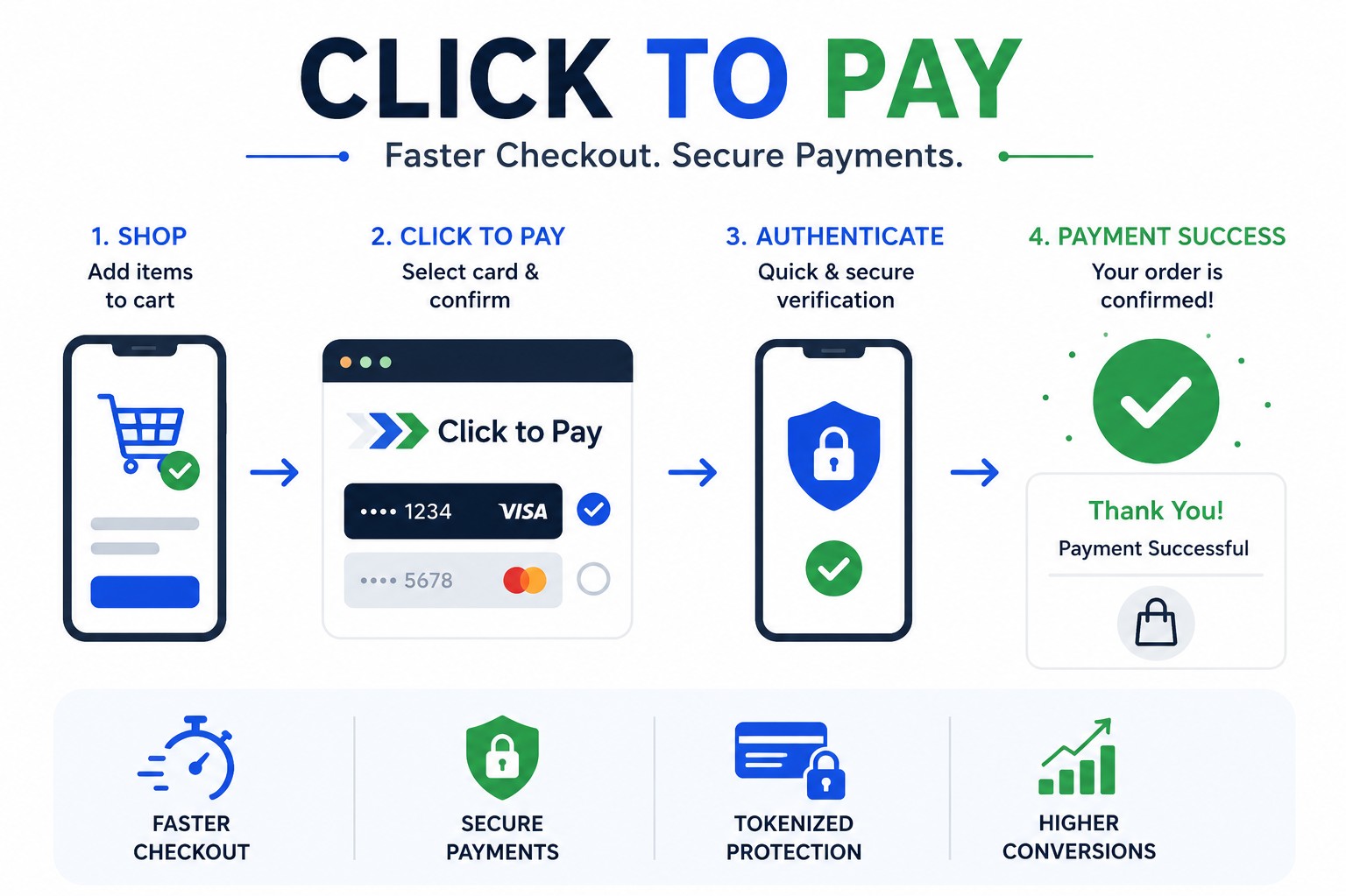
The process begins when a customer enrolls an eligible payment card in the Click to Pay ecosystem. Once registered, the card information is securely stored using tokenization technologies rather than exposing actual card numbers during transactions.
When shopping online at participating merchants, consumers can select the Click to Pay option during checkout. The system recognizes the user through secure verification mechanisms and presents available payment methods.
After selecting the desired card, the transaction is processed without requiring the customer to manually enter payment details.
This streamlined experience significantly reduces checkout time while maintaining high security standards.
The Role of Tokenization in Click to Pay
One of the key technologies behind Click to Pay is tokenization.
Tokenization replaces sensitive card information with a unique digital token that has no exploitable value outside the specific transaction environment. This means actual card numbers are not exposed during the payment process.
By minimizing the transmission of sensitive data, tokenization helps reduce fraud risks and strengthens payment security.
For merchants, this approach lowers the burden of handling sensitive payment information while supporting compliance with industry security requirements.
As cyber threats continue evolving, tokenization has become an increasingly important component of modern payment infrastructures.
Benefits for Consumers
The appeal of Click to Pay lies largely in its convenience.
Consumers no longer need to repeatedly enter card details across different websites. The simplified checkout process enables faster purchases and a smoother shopping experience, particularly on mobile devices where typing payment information can be cumbersome.
Beyond convenience, security is another major advantage. Customers benefit from advanced authentication mechanisms and tokenized payment credentials that help protect against fraud.
The consistency of the experience across participating merchants also improves usability. Instead of managing multiple checkout methods, consumers can rely on a familiar payment process across different online stores.
These benefits contribute to greater confidence and satisfaction during online shopping.
Benefits for Merchants
Merchants also stand to gain significantly from Click to Pay adoption.
One of the most immediate advantages is improved conversion rates. By reducing friction at checkout, businesses can decrease cart abandonment and increase completed transactions.
The simplified payment experience can also enhance customer loyalty. Consumers are more likely to return to merchants that offer convenient and secure payment options.
From a security perspective, tokenization helps reduce exposure to payment fraud while supporting compliance efforts. Merchants can benefit from lower fraud-related losses and improved risk management.
Additionally, the standardized checkout experience creates consistency across customer touchpoints, helping businesses optimize digital commerce performance.
Click to Pay vs Traditional Online Checkout
Traditional checkout methods often require customers to manually enter payment information for each transaction. This process can be time-consuming and vulnerable to user errors.
Click to Pay simplifies the experience by eliminating repetitive data entry while leveraging tokenization and network-level security features.
The difference becomes particularly noticeable on mobile devices, where streamlined checkout experiences can significantly improve conversion rates.
As consumers increasingly prioritize speed and convenience, solutions like Click to Pay are becoming essential components of competitive e-commerce strategies.
Challenges to Adoption
Despite its advantages, Click to Pay still faces certain adoption challenges.
Consumer awareness remains a key factor. Many shoppers are familiar with digital wallets but may not yet fully understand the benefits of Click to Pay.
Merchant adoption is equally important. The value of the ecosystem increases as more online retailers integrate the solution into their checkout processes.
There are also technical considerations related to integration and user experience optimization. Businesses must ensure that Click to Pay is implemented effectively to maximize its potential benefits.
As awareness and adoption continue to grow, these challenges are expected to diminish.
The Future of Click to Pay
The future of online payments is increasingly focused on reducing friction while enhancing security.
As e-commerce continues expanding, consumers will expect checkout experiences that are as seamless as contactless payments in physical stores. Click to Pay is well positioned to meet these expectations through its combination of convenience, security, and interoperability.
The continued evolution of tokenization, digital identity solutions, and payment authentication technologies will likely strengthen the Click to Pay ecosystem further.
Integration with emerging technologies such as embedded finance, artificial intelligence, and digital commerce platforms may create additional opportunities for innovation and growth.
Conclusion
Click to Pay represents a significant step forward in the evolution of online payments. By simplifying checkout experiences and leveraging advanced security technologies such as tokenization, it addresses many of the challenges that have traditionally hindered digital commerce.
For consumers, it delivers faster and more convenient transactions. For merchants, it offers opportunities to improve conversion rates, enhance customer experiences, and strengthen fraud prevention efforts. As digital commerce continues to evolve, Click to Pay is poised to become an increasingly important component of the modern payments ecosystem, helping create a future where secure and frictionless online transactions are the norm rather than the exception.
Comments
No comments yet. Be the first to share your thoughts.
Leave a comment