
Introduction
Every time a customer taps a card at a retail store, enters payment details online, or completes a transaction through a digital wallet, a complex network of financial institutions works behind the scenes to ensure the payment is processed securely and efficiently.One of the most important participants in this ecosystem is the merchant acquirer. While consumers rarely interact directly with acquiring institutions, these organizations play a critical role in enabling businesses to accept card payments and receive funds from customers.
As digital payments continue to dominate global commerce, merchant acquirers have become increasingly important in supporting merchants, facilitating transactions, managing risks, and driving innovation within the payments industry.
Understanding the role of a merchant acquirer helps businesses make better decisions about payment infrastructure and long-term growth strategies.
What Is a Merchant Acquirer?
A merchant acquirer, often referred to as an acquiring bank or acquiring institution, is a financial institution that enables merchants to accept electronic payments made through credit cards, debit cards, and digital payment methods.
The merchant acquirer establishes and maintains merchant accounts, processes payment transactions, communicates with card networks, and manages the settlement of funds to merchants.
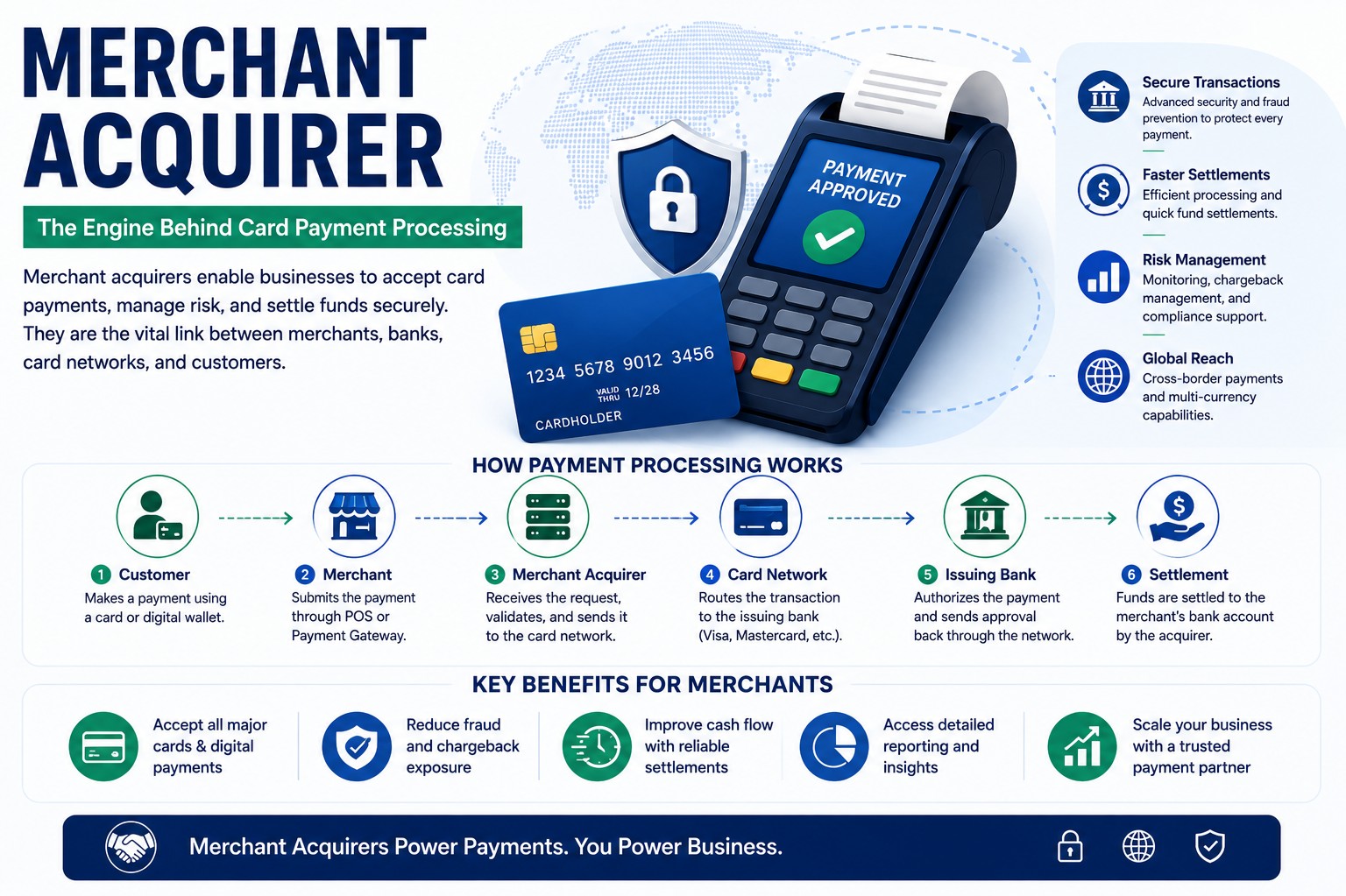
Without merchant acquirers, businesses would not be able to accept card payments efficiently. These institutions serve as the bridge between merchants, payment networks, issuing banks, and payment processors.
Their role is fundamental to the operation of modern payment systems.
How Merchant Acquirers Work
The payment journey begins when a customer initiates a transaction.
When a card payment is submitted, transaction details are transmitted through a payment gateway or point-of-sale system to the merchant acquirer. The acquirer then forwards the request through the relevant card network.
The card network communicates with the issuing bank, which verifies available funds and authorizes the transaction.
Once approved, the authorization is sent back through the payment network to the merchant. The transaction is then completed, and settlement occurs later through established payment clearing processes.
Although the process typically takes only a few seconds, multiple institutions collaborate to ensure speed, security, and accuracy.
The Relationship Between Merchant Acquirers and Merchants
Merchant acquirers act as payment partners for businesses.
They provide merchants with the infrastructure necessary to accept electronic payments across online, mobile, and in-store channels. This relationship extends beyond simple transaction processing.
Acquirers often support merchants through onboarding, risk assessments, fraud prevention services, reporting tools, chargeback management, and compliance assistance.
For many businesses, the merchant acquirer becomes a strategic financial partner that supports payment operations and business expansion.
As transaction volumes increase, the strength of this relationship becomes increasingly important.
Merchant Accounts and Acquiring Services
One of the primary services provided by a merchant acquirer is the merchant account.
A merchant account functions as a temporary holding account where customer funds are deposited before being transferred to the merchant’s business bank account.
This structure allows acquiring institutions to verify transactions, manage settlements, and monitor payment activity effectively.
Merchant accounts also enable acquirers to implement security measures and risk controls that help protect both merchants and consumers.
The quality of acquiring services can significantly influence payment acceptance rates, settlement speed, and overall merchant satisfaction.
Supporting Payment Security
Payment security has become a major priority in today’s digital economy.
Cybercriminals continue to develop increasingly sophisticated fraud techniques, creating significant challenges for merchants and financial institutions alike.
Merchant acquirers play a vital role in protecting payment ecosystems through transaction monitoring, fraud detection systems, encryption technologies, and authentication solutions.
Many acquiring institutions invest heavily in advanced analytics and artificial intelligence to identify suspicious transaction patterns before fraud occurs.
These security capabilities help businesses reduce financial losses while maintaining customer trust.
Risk Management and Merchant Acquiring
Risk management is one of the most important responsibilities of a merchant acquirer.
Not all businesses present the same level of payment risk. Industries with elevated chargeback rates, subscription billing models, international transactions, or regulatory complexities often require additional oversight.
Acquirers assess merchant risk during onboarding and continue monitoring transaction activity throughout the relationship.
Risk management tools may include reserve requirements, transaction limits, fraud controls, and ongoing compliance reviews.
Effective risk management helps create a stable payment environment that benefits merchants, acquiring institutions, and consumers alike.
Chargeback Management
Chargebacks remain one of the most significant challenges within payment processing.
A chargeback occurs when a customer disputes a transaction and requests a reversal through their issuing bank.
While chargebacks provide important consumer protections, excessive disputes can create operational and financial challenges for merchants.
Merchant acquirers help businesses manage chargeback activity through monitoring tools, dispute resolution support, reporting systems, and fraud prevention technologies.
Reducing chargeback rates improves payment performance and strengthens merchant relationships with acquiring partners.
Merchant Acquirers in E-Commerce
The growth of e-commerce has dramatically increased the importance of merchant acquirers.
Online businesses require secure and reliable payment infrastructure capable of processing transactions across multiple channels and regions.
Merchant acquirers support e-commerce merchants through payment gateways, recurring billing capabilities, multi-currency processing, and international payment acceptance.
These services enable businesses to reach global audiences while maintaining efficient payment operations.
As digital commerce continues expanding, acquiring institutions will remain essential enablers of online business growth.
Cross-Border Payments and Global Expansion
Modern businesses increasingly serve customers across multiple countries and regions.
This international expansion creates demand for payment solutions capable of supporting different currencies, payment methods, and regulatory environments.
Merchant acquirers facilitate cross-border commerce by providing international payment acceptance, local acquiring services, and global settlement capabilities.
Localized payment experiences often improve authorization rates and customer satisfaction while reducing payment friction.
For businesses pursuing international growth, acquiring partners play a crucial role in supporting market expansion strategies.
Technology Transforming Merchant Acquiring
The merchant acquiring industry is undergoing significant technological transformation.
Artificial intelligence is enhancing fraud detection and transaction monitoring. Cloud-based platforms are improving scalability and operational flexibility. Open banking initiatives are creating new payment opportunities.
Real-time payments, embedded finance, and API-driven payment solutions are also reshaping how merchants interact with acquiring institutions.
These innovations are helping merchant acquirers deliver faster, more secure, and more efficient services to businesses worldwide.
Organizations that embrace technological advancement are better positioned to meet evolving merchant expectations.
Choosing the Right Merchant Acquirer
Selecting the right merchant acquirer requires careful consideration.
Businesses should evaluate processing fees, settlement times, fraud prevention capabilities, international support, customer service quality, and technology offerings.
Industry expertise is another important factor. Merchants operating in specialized sectors may benefit from acquiring partners that understand their unique challenges and compliance requirements.
A strong acquiring relationship can improve transaction performance, reduce operational risks, and support sustainable business growth.
The right partner should align with both current operational needs and future expansion plans.
The Future of Merchant Acquiring
The future of merchant acquiring will be shaped by digital transformation, evolving consumer expectations, and increasing payment innovation.
Acquirers are expected to provide more integrated solutions that combine payment acceptance, analytics, fraud management, compliance, and financial services within unified platforms.
Artificial intelligence will continue improving decision-making and risk assessment processes. Real-time payment capabilities will accelerate fund settlement. Embedded finance will create new revenue opportunities for merchants and payment providers alike.
As the payments landscape evolves, merchant acquirers will remain central to enabling secure and efficient commerce worldwide.
Conclusion
A merchant acquirer is far more than a transaction processor. It serves as a critical connection between merchants, payment networks, issuing banks, and consumers.
By enabling payment acceptance, managing risk, supporting compliance, and facilitating transaction settlement, merchant acquirers form the foundation of modern payment infrastructure.
As businesses increasingly rely on digital commerce and global payment capabilities, the role of merchant acquirers will continue to expand. Organizations that understand and leverage strong acquiring partnerships will be better positioned to enhance customer experiences, improve operational efficiency, and achieve long-term growth in an increasingly digital economy.
Comments
No comments yet. Be the first to share your thoughts.
Leave a comment