
Introduction
Not all businesses are viewed equally by financial institutions. While many companies enjoy straightforward access to banking services and payment processing, others face greater scrutiny due to the nature of their operations, transaction patterns, regulatory obligations, or elevated chargeback risks.These businesses are commonly categorized as high-risk merchants, creating a need for specialized high-risk payment solutions that can accommodate their unique operational requirements.
As digital commerce continues to expand globally, industries once considered niche are processing substantial transaction volumes across multiple markets. This growth has increased demand for payment infrastructure capable of supporting complex business models while maintaining security, compliance, and operational stability.
For many organizations, access to reliable high-risk payment solutions can determine their ability to scale, enter new markets, and maintain uninterrupted revenue streams.
Understanding High-Risk Businesses
A high-risk business is not necessarily an unsafe or illegitimate business.
Rather, financial institutions classify certain merchants as high-risk based on factors that may increase payment processing exposure. These factors often include elevated chargeback rates, recurring billing models, international transactions, regulatory oversight, reputational concerns, or industries historically associated with fraud.
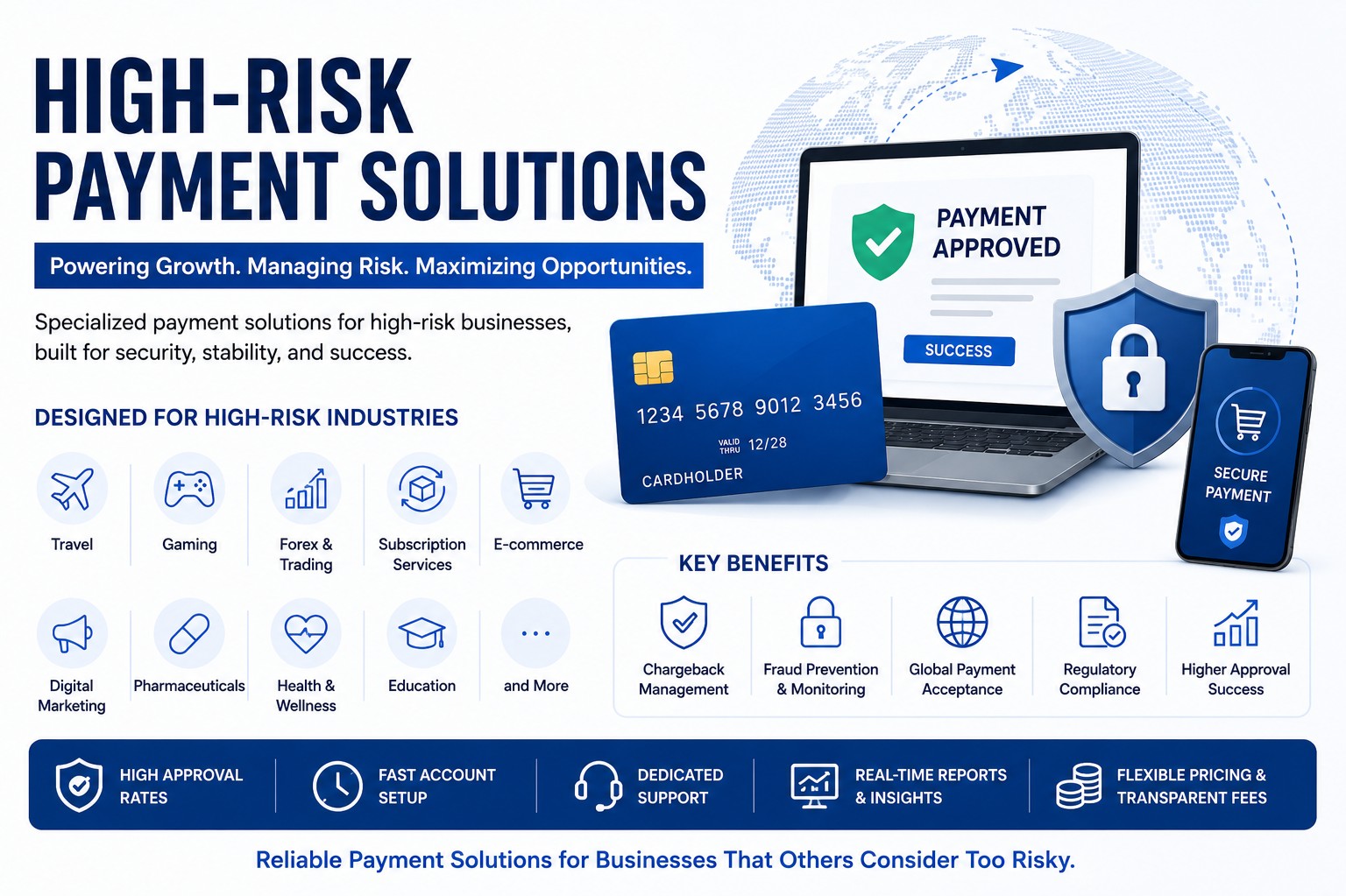
Businesses operating in sectors such as travel, gaming, forex, subscription services, digital products, online marketplaces, and certain financial services frequently encounter high-risk classifications.
The designation reflects payment risk rather than business quality. Many successful and highly regulated companies operate within high-risk categories while maintaining strong compliance standards.
Why Traditional Payment Providers Often Decline High-Risk Merchants
Conventional payment providers typically focus on minimizing exposure to financial losses and compliance challenges.
High-risk merchants often generate transaction patterns that require additional monitoring, underwriting, and risk management resources. As a result, traditional providers may be reluctant to onboard these businesses.
Chargebacks represent a major concern. Excessive customer disputes can result in financial losses, operational costs, and regulatory scrutiny for payment processors.
International transactions, subscription billing, and large transaction volumes can further increase risk assessments.
Consequently, many businesses require specialized providers that understand the complexities of high-risk industries and can offer tailored payment solutions.
What Are High-Risk Payment Solutions?
High-risk payment solutions are specialized financial services designed to support businesses operating in elevated-risk sectors.
These solutions typically include merchant accounts, payment gateways, fraud prevention tools, chargeback management systems, compliance support, and international payment capabilities.
Unlike standard payment services, high-risk payment providers are equipped to manage increased transaction complexity and implement additional controls that help mitigate risk.
The goal is not only to process payments efficiently but also to create a stable financial infrastructure that supports sustainable business growth.
The Importance of High-Risk Merchant Accounts
A high-risk merchant account serves as the foundation of most high-risk payment solutions.
These accounts allow businesses to accept card payments while providing payment providers with mechanisms to manage exposure effectively.
High-risk merchant accounts often include customized underwriting processes, reserve requirements, transaction monitoring, and enhanced compliance reviews.
Although fees may be higher than those associated with standard merchant accounts, these accounts provide businesses with access to payment capabilities that might otherwise be unavailable.
For many organizations, securing a reliable merchant account is the first step toward establishing long-term payment stability.
Managing Chargebacks Effectively
Chargebacks are among the most significant challenges facing high-risk businesses.
A chargeback occurs when a customer disputes a transaction and requests a reversal through their card issuer. Excessive chargeback activity can lead to financial losses, account restrictions, and reputational concerns.
Modern high-risk payment solutions incorporate advanced chargeback management tools designed to minimize disputes and improve resolution outcomes.
These tools may include transaction alerts, dispute monitoring, customer communication systems, and analytics that identify recurring causes of chargebacks.
By proactively managing disputes, businesses can improve payment performance and maintain stronger relationships with payment providers.
Fraud Prevention and Risk Management
Fraud prevention is a critical component of any high-risk payment strategy.
Businesses operating in digital environments face increasing threats from account takeovers, identity theft, payment fraud, and sophisticated cybercrime schemes.
High-risk payment providers typically offer enhanced security capabilities, including real-time transaction monitoring, machine learning-based fraud detection, device fingerprinting, velocity checks, and behavioral analytics.
These technologies help identify suspicious activities before fraudulent transactions are completed.
Strong fraud prevention measures protect revenue, improve customer trust, and support long-term operational resilience.
Supporting Global Business Expansion
Many high-risk merchants operate internationally.
Cross-border commerce creates opportunities for growth but also introduces additional complexities related to currencies, regulations, payment methods, and settlement processes.
High-risk payment solutions often include multi-currency processing, localized payment options, international acquiring capabilities, and cross-border settlement services.
These features allow businesses to serve customers in multiple regions while reducing payment friction and improving transaction success rates.
As global commerce becomes increasingly interconnected, international payment capabilities are becoming a competitive necessity.
Compliance and Regulatory Requirements
Regulatory compliance plays a central role in high-risk payment processing.
Businesses must navigate anti-money laundering requirements, know-your-customer obligations, sanctions screening, consumer protection regulations, and industry-specific compliance standards.
Specialized payment providers help businesses meet these requirements through ongoing monitoring, reporting tools, and compliance support services.
Strong compliance frameworks not only reduce regulatory risks but also enhance credibility with banking partners and customers.
Organizations that prioritize compliance are often better positioned to secure long-term payment processing relationships.
Technology Driving High-Risk Payment Innovation
Technological advancements are transforming the high-risk payments sector.
Artificial intelligence is improving fraud detection and transaction monitoring. Automation is streamlining compliance processes and dispute management. Advanced analytics are providing deeper insights into customer behavior and transaction trends.
Cloud-based payment platforms are enabling businesses to scale operations more efficiently while maintaining security and reliability.
These innovations are helping high-risk merchants overcome traditional barriers and compete more effectively in digital markets.
Choosing the Right High-Risk Payment Provider
Selecting the right provider requires careful evaluation.
Businesses should assess factors such as industry expertise, fraud prevention capabilities, international support, chargeback management tools, pricing structures, settlement timelines, and customer service quality.
A provider’s banking relationships and compliance framework are equally important. Strong partnerships with acquiring banks can contribute to greater processing stability and reduced operational disruptions.
Organizations should seek payment partners that understand their specific industry challenges and can support future growth objectives.
The Future of High-Risk Payment Solutions
The future of high-risk payment solutions will be shaped by increasing digitalization, regulatory evolution, and technological innovation.
Artificial intelligence, open banking, embedded finance, and real-time payments are expected to create new opportunities for high-risk merchants while improving security and operational efficiency.
Payment providers will continue investing in advanced risk management technologies capable of balancing fraud prevention with seamless customer experiences.
As industries evolve and new business models emerge, demand for specialized payment infrastructure will continue to grow.
Conclusion
High-risk payment solutions play a vital role in enabling businesses within complex and regulated industries to process payments securely and efficiently. From specialized merchant accounts and fraud prevention technologies to chargeback management and global payment capabilities, these solutions provide the infrastructure needed to support sustainable growth.
As digital commerce expands and transaction environments become increasingly sophisticated, businesses that invest in reliable high-risk payment solutions will be better equipped to manage risks, meet compliance obligations, and capitalize on new market opportunities.
In today’s fast-changing payments landscape, the right payment partner can transform high-risk challenges into long-term competitive advantages.
Comments
No comments yet. Be the first to share your thoughts.
Leave a comment