
Introduction
Business-to-business transactions have become increasingly complex as companies expand their operations across regions, suppliers, and payment networks. Managing large volumes of invoices, approvals, vendor payments, and reconciliations manually is no longer sustainable for organizations seeking efficiency and scalability.This shift has accelerated the adoption of B2B payment automation, a technology-driven approach that streamlines payment processes from invoice receipt to final settlement. By reducing manual intervention and integrating financial workflows, businesses can improve operational efficiency, strengthen cash flow management, and enhance supplier relationships.
As digital transformation continues to reshape financial operations, B2B payment automation is becoming a critical investment for organizations aiming to remain competitive in a rapidly evolving business environment.
Understanding B2B Payment Automation
B2B payment automation refers to the use of software, artificial intelligence, workflow automation, and digital payment technologies to manage business payments efficiently.
Traditionally, accounts payable teams handled invoices manually, processed approvals through emails, entered payment information into banking systems, and reconciled transactions after settlement. These processes were often time-consuming and prone to human error.
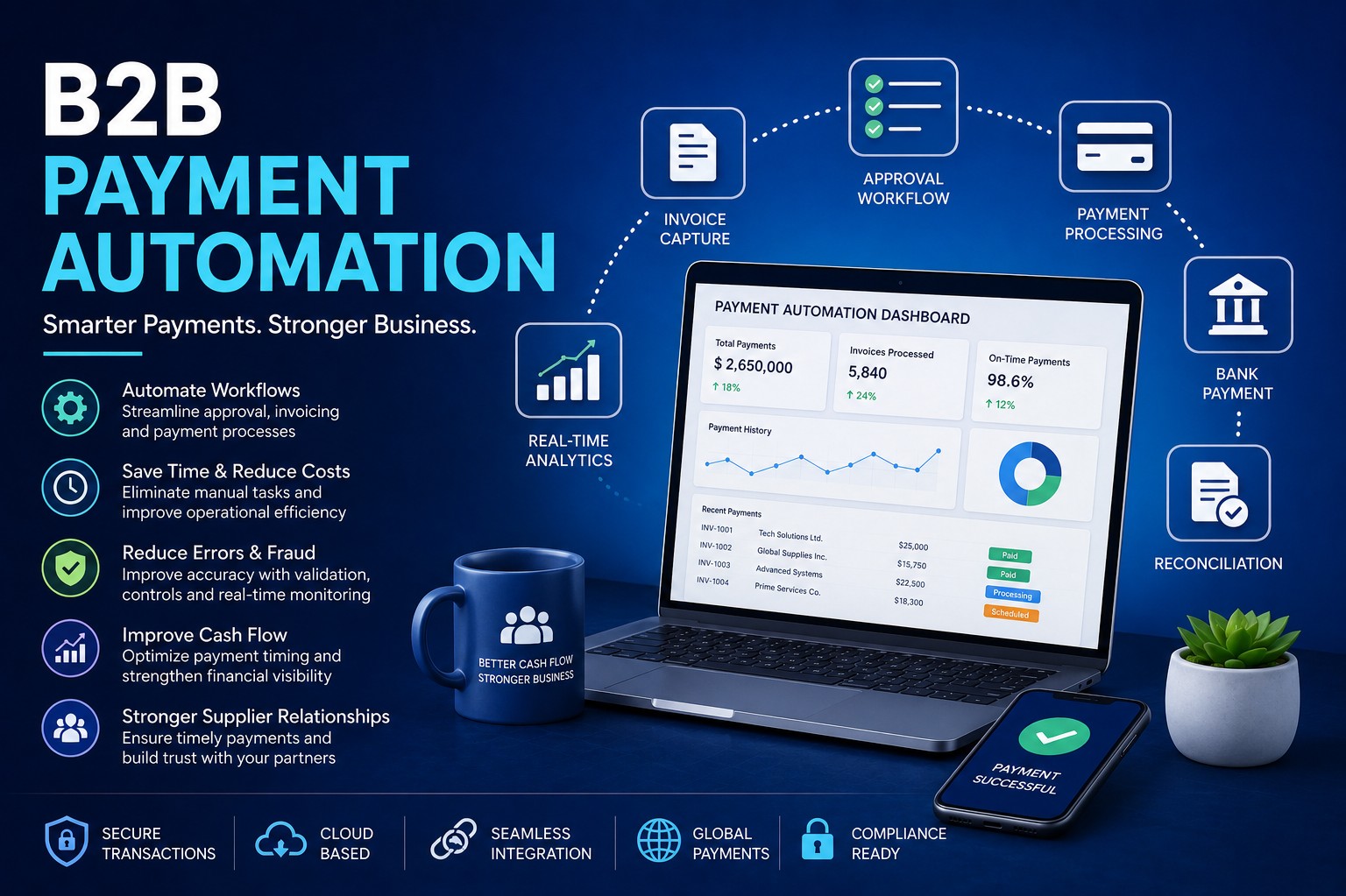
With automated systems, invoices can be captured digitally, matched with purchase orders, routed through approval workflows, and scheduled for payment automatically. The entire payment lifecycle becomes faster, more accurate, and easier to manage.
Modern automation platforms can also integrate with enterprise resource planning (ERP) systems, accounting software, banking networks, and supplier portals, creating a seamless financial ecosystem.
Why Businesses Are Embracing Payment Automation
Organizations face growing pressure to optimize costs while improving financial visibility.
Manual payment processes often create bottlenecks that delay vendor payments and increase administrative workloads. Finance teams spend significant time reviewing invoices, correcting data entry mistakes, responding to supplier inquiries, and managing reconciliation activities.
B2B payment automation eliminates many of these inefficiencies by automating repetitive tasks. As a result, businesses can reduce processing costs, improve payment accuracy, and free finance teams to focus on strategic activities.
In addition, automated systems provide greater transparency into payment status, helping businesses make more informed financial decisions.
Enhancing Accounts Payable Efficiency
Accounts payable departments are among the biggest beneficiaries of payment automation.
Invoice processing traditionally involves multiple stages, including receipt, validation, approval, payment authorization, and reconciliation. Delays at any stage can impact supplier relationships and operational performance.
Automation technologies streamline these processes by automatically extracting invoice data, validating information, matching invoices with purchase orders, and routing approvals to relevant stakeholders.
This significantly reduces processing times while minimizing errors and duplicate payments. Organizations can manage larger transaction volumes without increasing administrative resources.
For businesses experiencing rapid growth, automation provides a scalable solution capable of supporting expanding financial operations.
Improving Cash Flow Management
Effective cash flow management remains one of the most important priorities for businesses of all sizes.
Without clear visibility into payment obligations, organizations may struggle to forecast expenses accurately or optimize working capital. Delayed payments can result in supplier dissatisfaction, while early payments may negatively impact liquidity.
B2B payment automation provides real-time visibility into pending invoices, payment schedules, and cash flow commitments.
Finance teams can monitor obligations more effectively, identify opportunities for early payment discounts, and ensure payments are executed according to strategic priorities.
This enhanced visibility supports better financial planning and strengthens overall business performance.
Reducing Errors and Fraud Risks
Manual payment processes introduce significant risks.
Data entry mistakes, duplicate payments, unauthorized transactions, and invoice fraud can lead to financial losses and operational disruptions. As transaction volumes increase, these risks become even more difficult to manage.
Automated payment systems help reduce these vulnerabilities through built-in controls and verification mechanisms.
Invoices can be validated automatically against predefined criteria, while approval workflows ensure appropriate oversight. Advanced solutions also utilize artificial intelligence and analytics to identify unusual payment patterns and potential fraud indicators.
By strengthening controls and reducing human error, businesses can enhance payment security and regulatory compliance.
Strengthening Supplier Relationships
Timely and accurate payments play a crucial role in maintaining positive supplier relationships.
Late payments can damage trust, disrupt supply chains, and reduce access to favorable contract terms. Suppliers increasingly expect businesses to provide transparency and efficiency throughout the payment process.
B2B payment automation enables organizations to deliver more predictable payment experiences.
Suppliers can receive payment notifications, access self-service portals, and track invoice status without relying on manual communication. Faster processing and improved visibility contribute to stronger business partnerships and increased supplier satisfaction.
In competitive industries, strong supplier relationships can become a significant strategic advantage.
The Role of Artificial Intelligence in Payment Automation
Artificial intelligence is enhancing the capabilities of modern payment automation platforms.
AI-powered systems can analyze invoice data, identify anomalies, predict payment trends, and recommend process improvements. Machine learning algorithms continuously improve accuracy by learning from historical transaction data.
For example, AI can automatically classify invoices, detect duplicate submissions, and identify suspicious activities that may indicate fraud.
Predictive analytics can also help businesses optimize payment timing, manage cash flow more effectively, and anticipate supplier payment requirements.
As AI technology continues to evolve, its integration within B2B payment automation solutions is expected to expand significantly.
Supporting Global Business Operations
International business transactions often involve multiple currencies, payment methods, tax regulations, and banking systems.
Managing cross-border payments manually can be complex, costly, and time-consuming. Currency conversion challenges, compliance requirements, and settlement delays frequently create operational difficulties.
B2B payment automation simplifies global payment management by integrating multi-currency capabilities, international payment rails, and compliance monitoring tools.
Businesses can automate cross-border transactions while maintaining visibility and control over global payment activities.
This capability is particularly valuable for organizations operating within international supply chains and distributed vendor networks.
Challenges to Consider
Despite its benefits, implementing payment automation requires careful planning.
Organizations must evaluate system compatibility, integration requirements, data quality, and employee training needs. Legacy infrastructure can sometimes complicate implementation efforts.
Change management is another important consideration. Employees accustomed to manual workflows may require support and education during the transition process.
Cybersecurity and data protection should also remain priorities. Businesses must ensure automation platforms meet security standards and comply with relevant regulations.
Addressing these challenges proactively can improve implementation outcomes and maximize long-term value.
The Future of B2B Payment Automation
The future of B2B payment automation will be shaped by advances in artificial intelligence, cloud computing, open banking, and embedded finance.
Organizations are increasingly seeking end-to-end automation that connects procurement, invoicing, payments, reconciliation, and reporting within a single ecosystem.
Real-time payments, predictive analytics, intelligent workflows, and API-driven integrations will further enhance automation capabilities.
As businesses continue to digitize financial operations, automation will evolve from a competitive advantage to a standard business requirement.
Companies that invest early in modern payment infrastructure will be better positioned to improve efficiency, reduce costs, and support sustainable growth.
Conclusion
B2B payment automation is transforming how organizations manage financial transactions. By automating invoice processing, payment execution, reconciliation, and reporting, businesses can achieve greater efficiency, accuracy, and visibility across their financial operations.
As transaction volumes grow and financial ecosystems become increasingly complex, manual processes are no longer sufficient. Organizations that embrace B2B payment automation can improve cash flow management, strengthen supplier relationships, reduce risks, and build a more agile finance function.
In an increasingly digital economy, payment automation is not simply a technology upgrade—it is a strategic investment in operational excellence and long-term business success.
Comments
No comments yet. Be the first to share your thoughts.
Leave a comment