
Introduction: Why High-Risk Merchants Pay More – and By How Much
Every merchant accepting card payments pays processing fees. But high-risk merchants, businesses in forex, online gaming, SaaS, nutraceuticals, adult content, crypto, and other elevated-risk verticals, pay significantly more. The question most high-risk operators struggle to answer precisely is: exactly how much more, and where does the extra cost actually go?
Understanding the complete fee structure in high-risk payment processing matters for three reasons. First, payment costs directly affect margins, a 2% difference in effective processing rate on $500K monthly volume is $10,000 per month. Second, opaque fee structures from some payment providers can obscure the true cost of a processing relationship until you’re locked into a contract. Third, knowing the cost components empowers negotiation, merchants who understand interchange, scheme fees, and processor markup can identify where rates can realistically be challenged.
This guide breaks down every cost component in high-risk processing in 2026: MDR, interchange, scheme fees, gateway fees, chargeback fees, rolling reserves, and the hidden costs that rarely appear in the headline rate.
The Cost Layers: How High-Risk Processing Fees Are Built
High-risk processing fees are not a single number, they are a stack of costs from multiple parties, each taking a portion of every transaction processed. Understanding who charges what at each layer is the foundation of cost management.
Layer 1: Interchange Fee (Issuing Bank)
Layer 2: Scheme Fee (Card Network)
Layer 3: Acquirer / Processor Markup
Layer 4: Gateway Fee
Layer 5: Rolling Reserve (Withheld Funds)
Layer 6: Incidental Fees (Chargebacks, Refunds, Compliance)
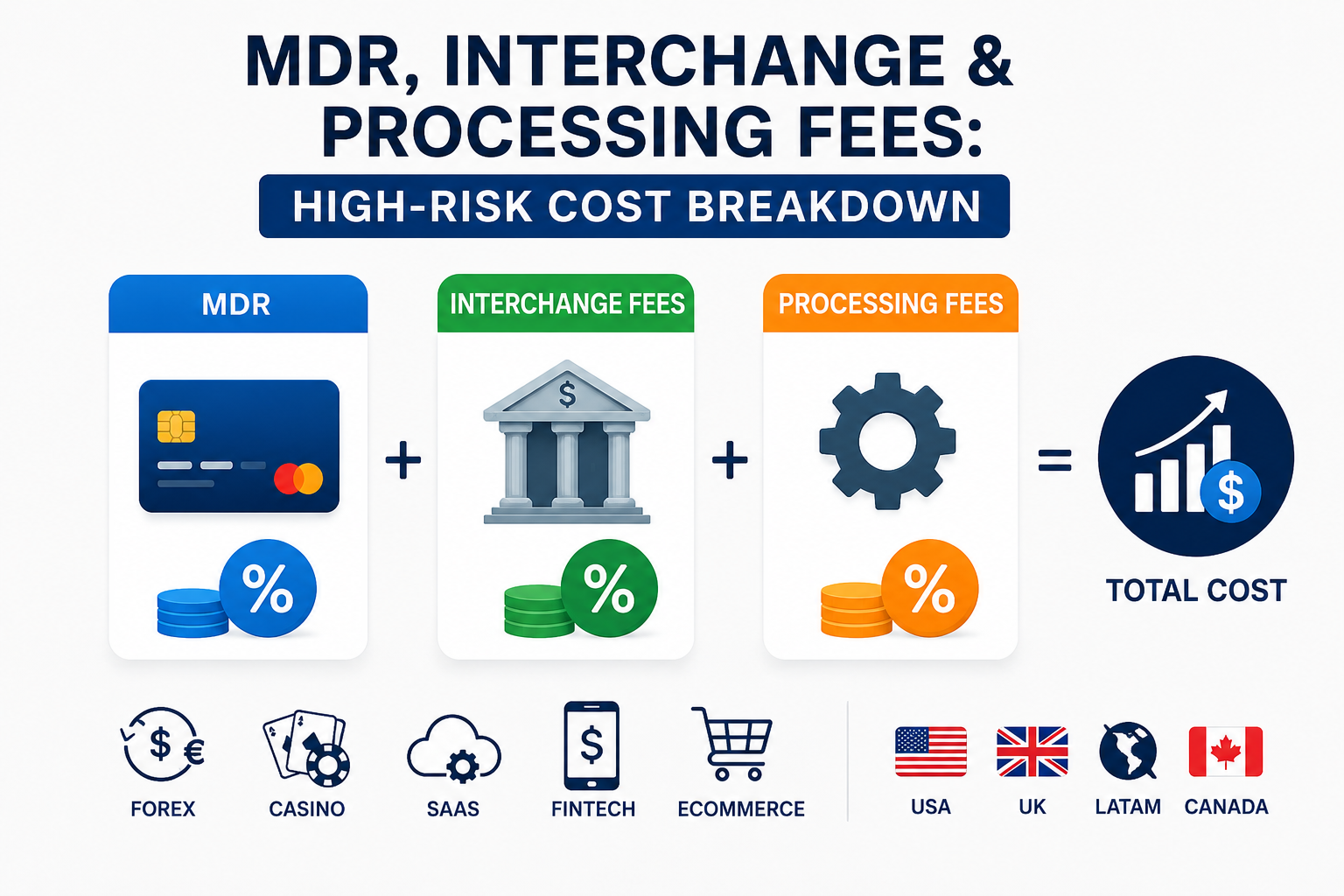
Every card transaction passes through all six layers. The MDR (Merchant Discount Rate) that appears on your processing statement is typically Layers 1–3 combined into a single quoted rate, which is why understanding what sits beneath the MDR headline is essential.
What Is MDR (Merchant Discount Rate)?
The Merchant Discount Rate (MDR) is the total percentage fee charged on each card transaction, deducted from the transaction value before funds are settled to the merchant. It is the most commonly quoted payment processing cost and the figure most often used in provider comparisons.
MDR = Interchange Fee + Scheme Fee + Acquirer/Processor Markup
A merchant quoted an MDR of 4.5% is paying a bundled rate that includes all three underlying components, with the processor’s margin embedded within it. This is called a flat-rate or blended pricing model, simple to understand but often more expensive than interchange-plus pricing for merchants with significant volume.
MDR Ranges for High-Risk Merchants in 2026
| Industry Category | Typical MDR Range | Notes |
|---|---|---|
| Nutraceuticals / Supplements | 3.5%–5.0% | Higher for subscription billing models |
| SaaS / Software Subscriptions | 3.0%–4.5% | Elevated by trial-to-paid chargeback rates |
| Forex / CFD Deposits | 4.0%–6.0% | Offshore acquiring adds 0.5%–1.5% |
| Online Gaming / Casino | 4.5%–7.0% | MCC 7995 carries highest acquiring surcharge |
| Adult Content Platforms | 4.5%–6.5% | Most domestic acquirers decline; offshore adds cost |
| CBD / Hemp Products | 3.5%–5.5% | Farm Bill compliance affects acquirer willingness |
| Crypto Exchanges | 3.5%–5.5% | High fraud risk; volatility surcharge common |
| Travel / Ticketing | 3.5%–5.0% | Future delivery risk elevates rates |
These ranges reflect market conditions in 2026. Actual rates depend on monthly volume, chargeback history, acquiring jurisdiction, and contract terms.
Interchange Fees: The Unavoidable Base Cost
Interchange is the largest single component of most processing fees. It is set by the card networks (Visa and Mastercard) and paid by the merchant’s acquiring bank to the cardholder’s issuing bank on every transaction. The merchant ultimately bears this cost through their MDR.
Interchange is not negotiable, it is fixed by card network rules. What is negotiable is the processor’s markup above interchange.
Key Factors That Determine Interchange Rate
Card type: Premium rewards cards (Visa Infinite, Mastercard World Elite) carry higher interchange, typically 1.8%–2.4%, because the issuing bank funds the rewards programme from interchange income. Basic debit cards carry lower interchange, often 0.2%–0.5% in regulated markets.
Transaction type: Card-not-present (CNP) transactions, all online and digital payments, carry higher interchange than card-present (in-person) transactions because CNP carries higher fraud risk. For high-risk merchants processing exclusively online, this premium applies to every transaction.
Geographic origin: Interchange varies by card-issuing country. Intra-regional transactions (EU-to-EU, US-to-US) carry lower interchange than cross-border transactions. A UK merchant processing payments from Brazilian cardholders faces higher interchange than processing UK-issued cards.
MCC classification: Certain merchant category codes carry mandatory interchange surcharges. MCC 7995 (gambling) attracts one of the highest MCC-specific interchange rates applied by card networks. This is a structural cost for gaming merchants that cannot be avoided regardless of acquirer.
Interchange Rates in Practice: 2026 Reference Points
United States (Visa/Mastercard):
- Standard credit, CNP: 1.65%–2.30% + $0.10
- Premium rewards credit, CNP: 2.10%–2.70% + $0.10
- Debit (regulated under Durbin Amendment): 0.05% + $0.22 (capped)
European Union / UK:
- Credit card, CNP: 0.30%–1.50% (regulated under EU IFR cap of 0.30% for consumer credit; UK maintains similar caps post-Brexit)
- Debit card: 0.20% (capped under EU IFR)
LATAM:
- Brazil: 1.2%–2.5% (domestic); 2.5%–4.0% (cross-border)
- Mexico: 1.5%–3.0% (domestic); higher for international acquirers
The EU’s Interchange Fee Regulation caps significantly reduce processing costs for EU-issuing cards compared to US-issuing cards. This is why high-risk merchants serving EU customers through EU-based acquirers achieve materially lower effective rates than those routing EU traffic through non-EU acquirers.
Scheme Fees: The Card Network Tax
Scheme fees are charged by Visa and Mastercard for access to their payment networks. Unlike interchange (which flows to issuing banks), scheme fees go directly to the card networks themselves.
Scheme fees are typically passed through to merchants as part of the MDR in blended pricing models, or listed separately in interchange-plus pricing. They represent a smaller but non-trivial cost component, typically 0.05%–0.35% of transaction value depending on card type, transaction type, and network.
Key Scheme Fees High-Risk Merchants Encounter
Cross-border assessment fee: Applied when the merchant’s acquirer country differs from the cardholder’s issuing country. Typically 0.40%–1.20% additional. Highly relevant for offshore merchant accounts processing cards issued in the merchant’s home country.
International service assessment (ISA): A Visa-specific fee on cross-border transactions. Currently 0.45% for non-US acquirers processing US-issued Visa cards. A UK-based acquirer processing US cardholders pays this on every transaction, and passes it through to the merchant.
Card-not-present surcharge: An additional scheme fee applied to online transactions versus in-person transactions. Typically 0.10%–0.20%.
High-risk MCC surcharge: Some card networks apply specific scheme fee surcharges to MCCs associated with elevated chargeback risk. MCC 7995 (gambling) is the most commonly affected.
For high-risk merchants running cross-border operations through offshore acquirers, scheme fees alone can add 0.5%–1.5% to the effective cost of every transaction, a cost that is largely invisible in headline MDR quotes from providers using blended pricing.
Acquirer and Processor Markup: Where Negotiation Happens
The acquirer and processor markup is the portion of MDR above interchange and scheme fees that represents the processing provider’s revenue. This is the only component of processing cost that is directly negotiable, interchange and scheme fees are fixed by card networks.
Pricing Models Compared
Blended / Flat-Rate Pricing: A single MDR rate covering interchange + scheme fees + markup. Simple to understand; often more expensive for merchants with high average transaction values or significant volume, because the processor’s margin is hidden inside the bundle.
Example: A flat rate of 4.5% on a transaction where interchange + scheme fees = 2.8% means the processor retains 1.7%, a margin that is neither visible nor negotiable under this model.
Interchange-Plus Pricing: Interchange and scheme fees are passed through at cost, with a separate fixed markup added. Expressed as “interchange + X%” or “interchange + X% + $Y per transaction.”
Example: Interchange-plus pricing of “interchange + 1.2% + $0.15” on the same transaction means the merchant pays the actual interchange (2.8% in this example) plus 1.2% markup plus $0.15. Total: 4.0% + $0.15. Potentially cheaper than the 4.5% flat rate, and completely transparent.
Interchange-plus is the standard for high-volume high-risk merchants: because it provides cost visibility, makes the processor’s margin explicit and negotiable, and ensures the merchant benefits when transaction mix skews toward lower-interchange card types.
Tiered Pricing: Transactions are grouped into “qualified,” “mid-qualified,” and “non-qualified” tiers with different rates. This model is common among smaller ISOs and is generally the most expensive and least transparent pricing structure. Most sophisticated merchants should avoid tiered pricing entirely.
Typical Processor Markups for High-Risk in 2026
| Volume Tier | Typical Processor Markup (above interchange) |
|---|---|
| Startup (< $50K/month) | 1.5%–3.0% + $0.10–$0.25 per transaction |
| Growth ($50K–$250K/month) | 1.0%–2.0% + $0.10–$0.20 per transaction |
| Scale ($250K–$1M/month) | 0.75%–1.5% + $0.08–$0.15 per transaction |
| Enterprise (> $1M/month) | 0.30%–0.80% + $0.05–$0.10 per transaction |
Volume is the most powerful lever in markup negotiation. High-risk merchants who consolidate volume with a single processor often achieve significantly better rates than those splitting volume across multiple providers, though diversification for resilience may justify the cost premium.
Gateway Fees: The Technology Layer Cost
Payment gateway fees are separate from MDR and represent the cost of the technology infrastructure used to route transactions. Most merchants underestimate gateway costs because they appear as separate line items rather than embedded in the per-transaction rate.
Common Gateway Fee Structures
Per-transaction fee: $0.05–$0.30 per transaction. On high-volume operations, this adds up quickly, 10,000 transactions per month at $0.20 = $2,000/month in gateway fees alone.
Monthly platform fee: $25–$200/month for access to the gateway infrastructure, reporting dashboard, and support. Some high-risk gateways charge higher monthly fees as part of their risk management overhead.
Setup / integration fee: One-time fee for account setup, API configuration, and compliance review. Common in high-risk gateway onboarding, typically $100–$500.
3DS2 authentication fee: Some gateways charge a per-transaction fee for 3D Secure authentication, typically $0.05–$0.10 per authenticated transaction. Given 3DS2 is effectively mandatory for EU-facing transactions, this is a recurring cost for cross-border merchants.
Chargeback alert fee: Providers offering Ethoca or Verifi CDRN chargeback alert integration typically charge $15–$40 per alert received. For high-risk merchants with significant dispute volumes, this can add several hundred to several thousand dollars monthly, but is almost always a positive ROI investment compared to the cost of uncontested chargebacks.
Rolling Reserves: The Hidden Working Capital Cost
Rolling reserves are not technically a fee, but they function as a significant working capital cost for high-risk merchants that is systematically underestimated during payment infrastructure planning.
How Rolling Reserves Work
A rolling reserve holds back a percentage of gross processing volume, typically 5%–15%, for a defined period (usually 90–180 days). The withheld funds are eventually released but create a permanent float that scales with processing volume.
Example: The Working Capital Impact of a Rolling Reserve
A high-risk merchant processing $200,000/month with a 10% rolling reserve held for 180 days:
- Month 1–6: $20,000/month withheld = $120,000 total held at the 6-month mark
- From Month 7: reserves begin releasing as Month 1’s reserve is paid out
- Steady state: approximately $120,000 permanently in the reserve float, cycling through
For a startup with limited working capital, $120,000 in withheld funds can be the difference between operational viability and cash flow crisis. Plan for this before signing a processing agreement.
Negotiating Rolling Reserve Terms
Reserve terms are negotiable, particularly the percentage (not the holding period, which is usually fixed at 90–180 days by acquirer policy). After 6–12 months of clean processing history:
- Request a reduction from 10% to 7.5% or 5%
- Provide processing statements demonstrating consistent low chargeback ratios
- Reference any volume increases as leverage, more volume means more interchange revenue for the processor, giving you negotiating power
Chargeback Fees and Dispute Costs
Chargebacks are not just a compliance risk, they are a direct cost. Each chargeback generates fees that compound the financial impact of the disputed transaction itself.
Chargeback Fee Structure
Chargeback processing fee: $15–$100 per chargeback, charged by the acquiring bank regardless of outcome. High-risk merchants typically pay $25–$75 per dispute.
Retrieval request fee: $5–$15 per retrieval request (the pre-chargeback document request). Not all processors charge this; many do.
Representment / dispute fee: Some processors charge $15–$50 for submitting a chargeback representment on the merchant’s behalf. Others include representment in their service.
Scheme monitoring programme fines: Merchants enrolled in Visa’s VDMP or Mastercard’s ECP for exceeding chargeback thresholds face monthly fines:
- Visa VDMP (Standard): $50 per dispute above threshold
- Visa VDMP (Excessive): $25,000/month programme fee
- Mastercard ECP (Excessive): $1,000–$100,000/month fines depending on ratio and duration
These fines represent the catastrophic tail risk of chargeback ratio mismanagement, a risk that high-risk merchants must treat as a core operational priority, not an afterthought.
Total Cost of Processing: A Real-World Example
To make all these components concrete, here is a realistic cost model for a high-risk merchant processing $100,000/month in forex deposits:
| Cost Component | Rate | Monthly Cost |
|---|---|---|
| MDR (blended, offshore acquirer) | 5.0% | $5,000 |
| Gateway per-transaction fee ($0.15 × 2,000 txns) | Fixed | $300 |
| Gateway monthly platform fee | Fixed | $99 |
| 3DS2 authentication fee ($0.08 × 2,000 txns) | Fixed | $160 |
| Chargeback fees (10 chargebacks × $40) | Fixed | $400 |
| Total Direct Processing Cost | $5,959 | |
| Rolling reserve (10% withheld, not a fee) | 10% | $10,000 held |
| Effective Rate (direct costs only) | 5.96% |
This model demonstrates why high-risk payment processing is materially more expensive than standard retail processing, and why the headline MDR rate tells only part of the story. The effective all-in cost including gateway fees and chargeback costs is nearly 1% above the quoted MDR rate.
Cost Reduction Strategies for High-Risk Merchants
1. Negotiate Interchange-Plus Pricing Above $100K/Month
Once processing volume exceeds $100K/month, push for interchange-plus pricing. The transparency it provides enables meaningful cost comparison between providers and eliminates the processor’s ability to inflate margins through opaque blended rates.
2. Optimize Transaction Mix
Encourage customers to use lower-interchange card types where possible. ACH/bank transfer for high-value deposits (forex, gaming) eliminates interchange entirely, ACH processing fees are typically $0.20–$1.50 flat per transaction regardless of amount, making them dramatically cheaper than card payments on large-value transactions.
3. Reduce Cross-Border Fee Exposure
For high-volume markets, invest in local acquiring relationships that eliminate cross-border assessment fees and international scheme surcharges. The savings on scheme fees alone can justify the operational overhead of maintaining regional payment providers.
4. Manage Chargebacks Proactively
Chargeback fees, representment costs, and scheme monitoring fines are avoidable costs with the right tools. Ethoca and Verifi CDRN alert services typically pay for themselves within the first month for any high-risk merchant processing more than 500 transactions/month.
5. Benchmark Annually
Processing fee markets shift. Providers compete aggressively for high-volume high-risk merchants. An annual competitive benchmarking exercise, requesting proposals from two or three alternative providers, creates negotiating leverage with your existing processor even if you don’t intend to switch.
FAQ: MDR, Interchange, and Processing Fees for High-Risk Merchants
Q: What is the difference between MDR and interchange? MDR (Merchant Discount Rate) is the total fee deducted from each transaction, covering interchange + scheme fees + processor markup. Interchange is the base component of MDR paid to the cardholder’s issuing bank. MDR is always higher than interchange alone.
Q: Why do high-risk merchants pay higher MDR than standard merchants? Higher MDR reflects the elevated financial risk the acquiring bank assumes. High-risk categories carry higher average chargeback rates, higher fraud rates, and more complex regulatory profiles. The processor’s markup compensates for this additional liability exposure.
Q: Are offshore merchant accounts more expensive to operate than domestic accounts? Generally yes, due to cross-border scheme fees, currency conversion costs, and the risk premium offshore acquirers apply to compensate for operating in less-regulated jurisdictions. However, for merchants in categories that domestic banks won’t serve, the relevant comparison is not “offshore vs domestic”, it’s “offshore vs no processing at all.”
Q: Can I negotiate my processing fees as a high-risk startup? Limited negotiation is possible even at startup stage, particularly on gateway fees and fixed monthly costs. Per-transaction rates and rolling reserve percentages are harder to move without processing history. The most effective leverage point for fee negotiation is always demonstrated processing volume with a clean chargeback record.
Q: How do I calculate my true effective processing rate? Add all direct processing costs (MDR fees collected, gateway fees, chargeback fees, retrieval fees) over a calendar month and divide by gross processing volume. This gives your true effective rate, which is consistently higher than the headline MDR quoted by your provider.
Conclusion: Know Every Line Item Before You Sign
The high-risk payment processing fee landscape in 2026 is more complex than any single headline rate can capture. MDR is the entry point, but interchange fees, scheme surcharges, gateway costs, chargeback fees, and rolling reserve impacts collectively determine the true cost of processing for high-risk merchants.
Merchants who understand every layer of this cost structure negotiate better contracts, make more informed provider choices, build more accurate margin models, and avoid the unpleasant surprises that come from discovering hidden costs after signing a 24-month processing agreement.
The starting principle is simple: every fee has an owner, every rate has a floor, and every component above interchange is negotiable with the right volume and the right information.
Comments
No comments yet. Be the first to share your thoughts.
Leave a comment