
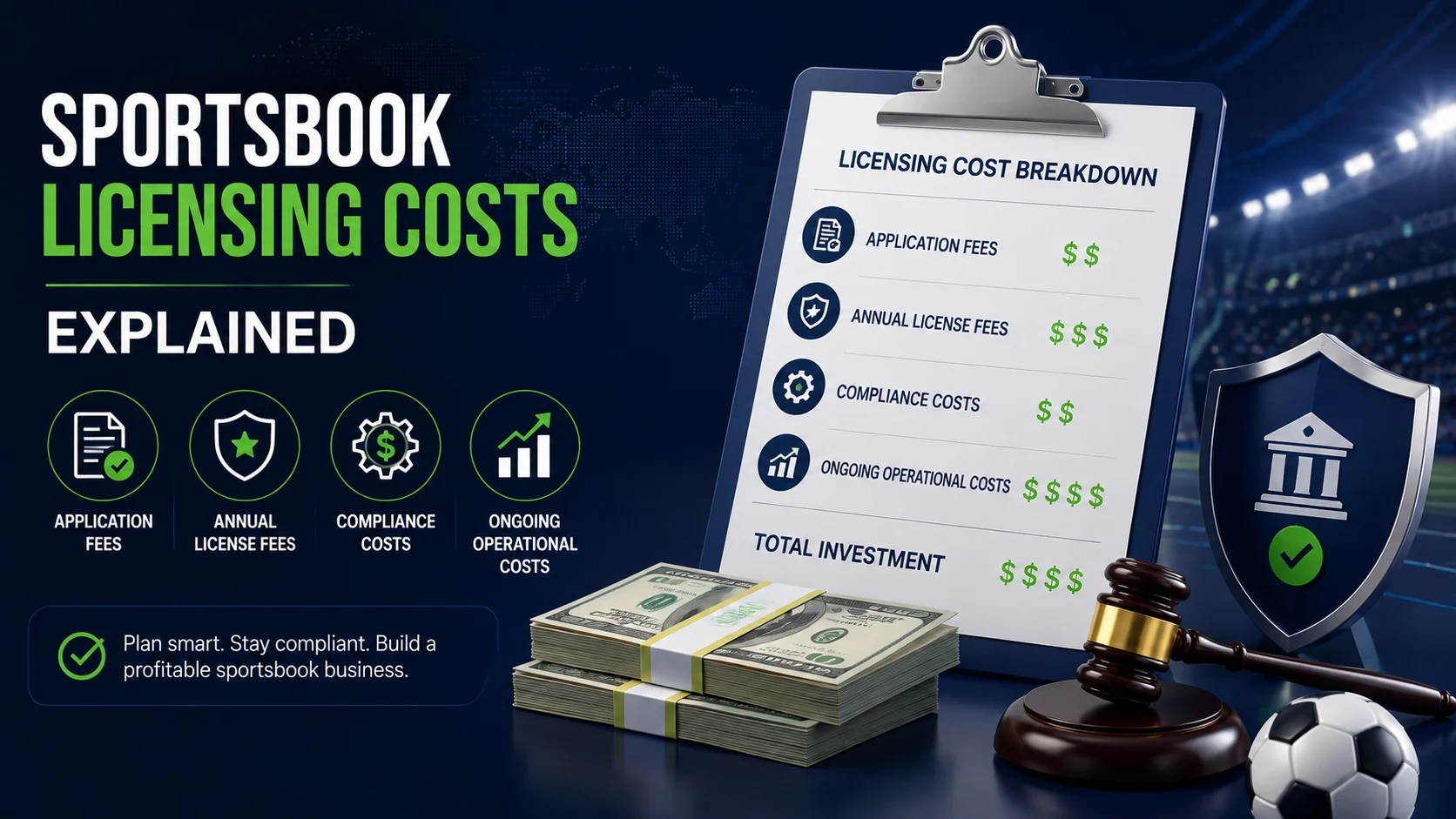
A Malta license might cost €300K to obtain, but you’ll spend another €400K on compliance staff, monitoring systems, and payment processing reserves before you’re cash-flow positive. That line, from a compliance consultant who has worked on 15+ licensed sportsbooks, captures the core problem with how most operators budget for licensing: the headline application fee is rarely more than a third of what actually gets spent before a sportsbook is genuinely operational.
This guide breaks the real cost structure into its actual components, not a jurisdiction-by-jurisdiction comparison (see our companion guide on popular betting jurisdictions for that), but a deep look at what the money actually goes toward, including the costs most first-time applicants discover only after they’ve already committed budget elsewhere.
Why the Headline License Fee Is the Wrong Number to Budget Against
Every jurisdiction publishes a statutory fee schedule, application costs, initial license fees, renewal charges. That’s genuinely the only number most operators find when researching licensing costs, and it’s also the smallest piece of the real total. The full cost structure includes investigation costs, legal and consulting fees, compliance infrastructure, and operational readiness spending that combined often exceed the statutory fee by several multiples.
This isn’t a minor budgeting nuance, it’s the single most common reason operators run into cash flow problems mid-launch, discovering additional six-figure costs after they’ve already committed capital based on the published license fee alone.
The Five Real Cost Categories
1. Statutory Fees
This is the number every regulator publishes, and the only one most operators plan around initially: application costs, the initial license fee itself, and periodic renewal charges. Depending on jurisdiction tier, this alone can range from roughly $7,000 at the low end to $500,000+ for top-tier markets, a wide enough range that jurisdiction choice (covered in depth in our companion guide) remains the single biggest lever on this specific line item.
2. Investigation Costs
Background checks, financial audits, key person investigations, and third-party verification fees typically run $50,000-$200,000, depending heavily on ownership structure complexity. A sportsbook with a simple, single-owner structure investigates far more cheaply than one with multiple investors, holding companies, or complex international ownership, which is exactly why the calculator tools some licensing consultancies offer specifically ask about ownership structure before estimating cost.
3. Legal and Consulting Fees
Application preparation, regulatory strategy, and ongoing compliance counsel commonly run $100,000-$300,000 for reputable firms. This isn’t optional overhead, specialized third-party licensing consultancies with deep regulatory expertise can meaningfully reduce total expenditure by avoiding the costly mistakes that come with a first-time, DIY application, particularly the rejection-and-resubmission cycle covered below.
4. Compliance Infrastructure
Responsible gaming systems, geolocation technology, reporting software, and audit preparation commonly cost $75,000-$250,000 in the first year alone. This is genuinely operational infrastructure, not a one-time compliance checkbox, geolocation technology in particular needs continuous operation and maintenance for the life of the license, not just deployment at launch.
5. Operational Readiness
Staff training, policy documentation, internal controls testing, and dry runs before launch typically add $30,000-$100,000. This category is the one most frequently underbudgeted, since it doesn’t map cleanly to a single line item a regulator requires, it’s the accumulated cost of actually being ready to operate compliantly from day one, rather than compliant on paper only.
Sportsbook-Specific Costs Casino Licensing Guides Miss
Sportsbook licensing isn’t harder than casino licensing, it’s different, and that difference carries its own specific cost items that generic gambling licensing guides frequently overlook entirely.
Conflict-of-Interest Review
Regulators specifically scrutinize conflicts of interest between an operator’s trading staff and sports organizations, and technical provider relationships, confirming that odds feed providers have no ownership stake in the teams or leagues being offered for betting. This process adds three to six weeks to standard application timelines and often requires legal opinions from sports law specialists, typically costing $15,000-$35,000 depending on jurisdiction complexity.
Marketing Partnership Pre-Approval
Sponsorship and marketing partnerships with sports entities frequently require pre-approval in regulated markets, a review step (and associated legal cost) that a casino-only operator simply doesn’t face.
Trading Algorithm Audits
Sports betting operators face ongoing quarterly audits of their trading algorithms specifically, and must demonstrate responsible gambling tools built for in-play betting, not just standard session limits, but tools addressing the faster-paced, higher-frequency betting patterns in-play markets create. This is a recurring compliance cost, not a one-time application item, and it applies even in jurisdictions (like the UK) where the regulator doesn’t formally distinguish between casino and sports betting licensing categories, the compliance expectations diverge in practice even where the license type doesn’t.
Sports Data Feed Licensing
Official, low-latency sports data feeds carry their own licensing cost entirely separate from gambling regulatory fees, enterprise operators can spend anywhere from thousands to hundreds of thousands of dollars annually depending on sports coverage, betting volume, and territorial rights.
Real Cost Scenarios by Market Type
Curaçao (Sublicense Model)
Under Curaçao’s Master License structure, sports betting is treated as one of four gaming categories available under a single sublicense. Processing time runs roughly six to eight weeks, with total setup, sublicense fee, corporate structure, and basic compliance framework, landing around $65,000–$95,000. This is a genuinely lower-cost entry point than Tier-1 jurisdictions, consistent with Curaçao’s positioning as a pragmatic middle-ground option.
Gibraltar
Gibraltar issues separate Gambling Software licenses but allows combined applications, offering a structural efficiency for operators who’d otherwise need to apply for multiple license types separately.
Michigan (US State Example)
A US state-level example illustrates just how much higher this can run in a regulated American market with no prior in-state presence: application fees around $200,000, supplier licensing around $400,000, legal counsel around $175,000, compliance infrastructure around $120,000, technology integration around $350,000, and a working capital reserve requirement around $1,000,000, a total pre-launch cost approaching $2.25 million, before factoring in first-year operating compliance costs of roughly $650,000 on top of that.
This isn’t representative of every US state, requirements and costs vary significantly by jurisdiction, but it illustrates how dramatically the total cost picture can shift once state-specific market access, supplier licensing, and working capital reserve requirements enter the calculation, well beyond anything captured by a headline “license fee” alone.
The Renewal Cost Trap
A mistake worth flagging explicitly: year-one licensing costs don’t repeat identically, but renewal isn’t free either. A reasonable budgeting rule of thumb is 40-50% of initial legal costs annually going forward for ongoing compliance documentation and renewal preparation, and most operators significantly underfund this line item, then scramble during the actual renewal crunch when the bill comes due.
Renewal costs specifically vary enormously by jurisdiction, from a few hundred dollars in some lighter-touch frameworks to genuinely millions of dollars in the most demanding regulated markets, particularly US states with high compliance and audit burdens built into ongoing licensing.
Hidden Costs Most Operators Discover Too Late
Beyond the five core categories and renewal budgeting above, several cost items tend to surface only after an operator is already deep into the licensing process:
- Failed application scenarios: Roughly 12-15% of first-time applicants face requests for additional information that extend timelines by six to twelve months, with each delay costing an estimated $15,000-$30,000 in extended legal fees and compliance maintenance during the extension
- Multi-jurisdiction expansion doesn’t scale linearly: Applying in multiple jurisdictions simultaneously doesn’t save money proportionally, a third jurisdiction typically costs 70-75% of the first jurisdiction’s total cost, not 50%, due to jurisdiction-specific legal work that can’t simply be reused across applications
- Payment processing reserves: As referenced in the opening quote, compliance staff and monitoring systems aren’t the only post-license cost, payment processing reserves (rolling reserves held by high-risk payment gateway providers, covered in depth in our dedicated payment gateway guide) represent real tied-up working capital that operators need to budget for separately from licensing costs proper
- RNG and technical certification renewals: Independent testing to prove fair and random results requires periodic certification renewal and audits, an ongoing cost tied to technical compliance rather than licensing status itself
- Staff training and technical maintenance: Regular staff training and technical website/platform maintenance continue well past initial launch, representing an ongoing operational cost frequently absent from initial licensing budgets entirely
Where Payment Infrastructure Costs Intersect With Licensing Costs
This is worth calling out directly, since it’s the connective thread that ties licensing cost planning back to the operational reality of actually running a sportsbook: a license alone doesn’t make an operator cash-flow positive. The compliance consultant’s framing at the top of this guide, an additional spend roughly matching the license cost itself, covering compliance staff, monitoring systems, and payment processing reserves, reflects a genuine pattern operators need to plan for as one connected budget, not two separate line items.
- Merchant account and payment gateway onboarding: for a newly licensed sportsbook takes real time and often requires demonstrating the license itself as part of underwriting, meaning payment infrastructure setup can’t fully start until licensing reaches a certain stage, creating a sequencing dependency worth planning around explicitly
- High-risk merchant account: underwriting for a betting operator will scrutinize licensing jurisdiction quality directly (a theme covered extensively in our jurisdiction comparison guide), meaning a cheaper, faster license can indirectly increase payment processing costs through worse rolling reserve terms or higher percentage rates
- Cross-border payments: infrastructure, relevant for any operator serving multiple licensed jurisdictions simultaneously, adds its own cost layer on top of both licensing and domestic payment processing costs
Budgeting for licensing in isolation from payment infrastructure costs is one of the more common structural mistakes new operators make, the two are genuinely interdependent, not sequential, separate expenses.
Decision Framework: Budgeting for Your Licensing Path
If you’re a startup testing an MVP with limited budget:
- Budget for a Tier-2/Tier-3 jurisdiction’s full cost structure (not just the statutory fee), expect total setup, including legal, compliance infrastructure, and operational readiness, to land meaningfully above the headline sublicense or application fee
- Plan for the payment processing reserve costs that follow licensing, not just the licensing cost itself, since payment infrastructure won’t be free even at a lower-cost jurisdiction tier
If you’re pursuing a Tier-1 jurisdiction (Malta, UKGC, Gibraltar):
- Budget total cost at 2-3x the headline license fee once investigation, legal/consulting, compliance infrastructure, and operational readiness are all included, treating the published license fee as anywhere close to the full cost is the single most common early-stage budgeting error
- Build renewal costs (40-50% of initial legal costs annually) into multi-year financial planning from the start, not as a surprise when the renewal cycle arrives
If you’re specifically launching sports betting (not just casino):
- Budget separately for conflict-of-interest legal review, marketing partnership pre-approval processes, and ongoing trading algorithm audits, these are real, sportsbook-specific costs that generic gambling license cost guides frequently omit
- Factor sports data feed licensing into the budget as its own line item, separate from gambling regulatory costs entirely
If you’re planning multi-jurisdiction expansion:
- Don’t assume linear cost scaling, budget a third jurisdiction at roughly 70-75% of your first jurisdiction’s total cost, not half, since jurisdiction-specific legal work doesn’t fully transfer between applications
- Sequence expansion deliberately, since simultaneous multi-jurisdiction applications compound both cost and the operational complexity of managing several regulatory relationships at once
If you’re a US state-focused operator:
- Budget dramatically higher than international offshore jurisdictions, application fees, supplier licensing, technology integration, and working capital reserve requirements can combine into a multi-million-dollar pre-launch total in a single state, well beyond what international licensing comparisons would suggest
Common Mistakes in Licensing Cost Planning
- Budgeting only against the published statutory fee: This is consistently the smallest piece of the real total cost, not a reasonable proxy for it
- Treating renewal as a distant, minor concern: Underfunding the 40-50%-of-initial-legal-costs renewal budget leads directly to scrambling during the actual renewal cycle
- Assuming multi-jurisdiction costs scale proportionally: A third jurisdiction costing 70–75% of the first, not 50%, changes the math meaningfully for operators planning rapid multi-market expansion
- Ignoring sportsbook-specific cost items when using generic gambling licensing estimates: Conflict-of-interest review, marketing pre-approval, and trading algorithm audits are real, recurring costs specific to sports betting that a casino-focused cost estimate won’t capture
- Planning licensing and payment infrastructure budgets separately: The two are genuinely interdependent, a cheaper license can indirectly cost more in payment processing terms, and payment onboarding often can’t proceed meaningfully until licensing reaches a certain stage
Conclusion
The real cost of sportsbook licensing is rarely the number published on a regulator’s fee schedule, it’s the sum of statutory fees, investigation costs, legal and consulting fees, compliance infrastructure, operational readiness, sportsbook-specific compliance items, and the payment processing infrastructure that has to work alongside all of it. Operators who budget against the headline license fee alone are budgeting against roughly a third of the real total, and the gap between those two numbers is exactly where launches run out of runway.
Understanding the full structure, and specifically, that licensing and payment infrastructure costs are interdependent rather than sequential, is what separates a launch that goes live on schedule and on budget from one that discovers six-figure surprises after the capital is already committed.
Frequently Asked Questions
Q: What’s the real total cost of a Malta sportsbook license, beyond the published fee?
A: While the MGA license itself runs roughly €80,000-€100,000, the full setup including company formation, compliance infrastructure, banking, payment onboarding, and advisory work commonly reaches €150,000-€300,000+, and ongoing compliance staff and payment processing reserves can add a comparable amount again before the operation is cash-flow positive.
Q: How much should operators budget for license renewal?
A: A reasonable rule of thumb is 40-50% of initial legal costs annually going forward, though actual renewal costs vary enormously by jurisdiction, from a few hundred dollars in lighter-touch frameworks to potentially millions in demanding regulated markets like some US states.
Q: Does applying for licenses in multiple jurisdictions save money through economies of scale?
A: Not proportionally. A third jurisdiction typically costs 70-75% of the first jurisdiction’s total cost rather than roughly half, since much of the legal and compliance work is jurisdiction-specific and doesn’t transfer between applications.
Q: What sportsbook-specific costs don’t apply to casino-only gambling licenses?
A: Conflict-of-interest review between trading staff and sports organizations, marketing partnership pre-approval for sports sponsorships, ongoing quarterly trading algorithm audits, and separate sports data feed licensing are all costs specific to sports betting that generic casino licensing cost estimates typically don’t include.
Q: Why do licensing costs and payment processing costs need to be budgeted together?
A: Payment providers scrutinize licensing jurisdiction quality directly during underwriting, meaning a cheaper or faster license can indirectly increase payment processing costs through worse reserve terms or higher rates. Payment onboarding also often can’t fully proceed until licensing reaches a certain stage, creating a real sequencing and budget dependency between the two.
Q: What percentage of first-time license applications face delays, and what do they cost?
A: Roughly 12–15% of first-time applicants face requests for additional information that extend timelines by six to twelve months, with each delay estimated to cost $15,000-$30,000 in extended legal fees and compliance maintenance.
Comments
No comments yet. Be the first to share your thoughts.
Leave a comment