
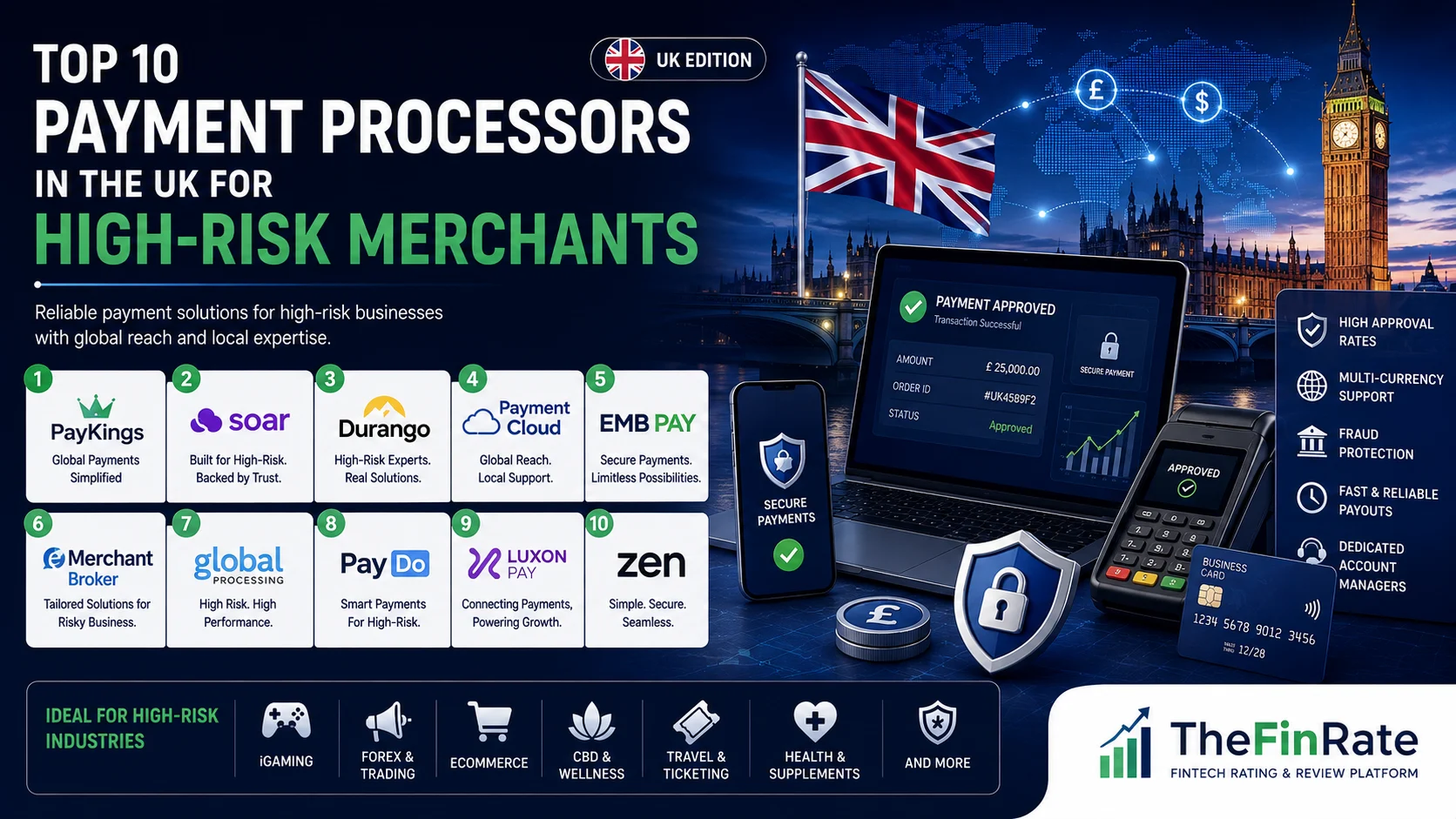
A UK high-risk merchant doesn’t just need “a processor that accepts high-risk businesses.” Post-Brexit, FCA-authorised, and MATCH-list-aware, the practical requirements are specific, and getting them wrong means either a rejected application or an approval that unravels a few months in. This guide compares ten processors genuinely worth evaluating for UK high-risk merchant accounts in 2026, with real regulatory credentials, fee structures, and the tradeoffs each one carries.
What “High-Risk” Actually Means for UK Merchants
Before comparing providers, it’s worth being precise about what puts a UK business in this category, since it shapes which processor actually fits:
- Elevated chargeback exposure: subscription billing, digital goods, and travel businesses often carry structurally higher dispute rates than typical retail
- Regulated or scrutinised verticals: gaming, adult content, nutraceuticals, forex, CBD, and vape products face additional card network and regulatory oversight regardless of individual business quality
- MATCH list history: the Member Alert to Control High-Risk Merchants list (formerly the Terminated Merchant File) is a shared Mastercard database flagging businesses previously terminated for chargebacks, fraud, or scheme rule breaches; merchants typically remain listed for five to seven years
- New or limited trading history: businesses without established processing history carry inherently higher underwriting uncertainty regardless of sector
Understanding which of these applies to your business changes which processor on this list is actually the right fit, MATCH-list compatibility, for instance, is a genuine differentiator that not every provider on this list handles the same way.
What to Check Before Choosing Any Provider
- FCA authorisation status, verified directly: Any payment service provider operating in the UK must hold FCA authorisation as a Payment Institution or Electronic Money Institution, this determines whether the provider can legally hold client funds and operate across UK and EEA markets post-Brexit. Verify status directly on the FCA register rather than taking a provider’s claim at face value
- Rolling reserve terms in writing: A common structure is around 10% of daily transactions held for 90 days, on £100,000/month in volume, that’s roughly £30,000 held in reserve at any given time. Get the exact percentage and hold period before signing
- Chargeback alert network access: Ask whether the provider offers Verifi CDRN or Ethoca alert access, which allow disputes to be resolved before they escalate to a formal chargeback, a meaningful advantage for merchants operating close to scheme thresholds
- MATCH-list policy, stated clearly: Some providers consider MATCH-listed merchants case-by-case; others decline automatically. Know which category a provider falls into before applying if this applies to you
- SCA/3D Secure 2 implementation quality: PSD2 mandates Strong Customer Authentication across the EEA, and a poorly configured SCA flow compounds cart abandonment problems high-risk merchants already tend to face
The Top 10 Processors
1. Trust Payments
Founded in 1997 as Secure Trading and rebranded Trust Payments in 2020 following a 2019 acquisition, this London-headquartered PSP is a directly authorised FCA Payment Institution and separately MFSA-authorised in Malta, with Principal Member status on both Visa and Mastercard, meaning it holds direct scheme membership rather than operating through another acquirer’s BIN. Its TRU Connect gateway covers 160+ payment methods and currencies, with settlement in up to 24 currencies for gaming merchants specifically.
Best fit: UK and EU gaming, iGaming, and other high-risk operators who want their acquiring counterparty inside the FCA regulatory perimeter directly, rather than through a reseller arrangement. Pricing is quote-based rather than published, so request a full fee schedule in writing before committing.
2. PXP Financial
A 2005-vintage company that’s genuinely an acquirer in its own right, FCA-authorised Payment Institution since April 2018, with Principal Visa and Mastercard membership dating to 2011. PXP runs a notable US gaming gateway (BetMGM has operated on it since January 2021) alongside its UK acquiring business, and supports card, SoftPOS, and cash-at-cage payment methods.
Worth knowing before you sign: PXP was owned by Senjō Group from 2017 to 2022, and parked its post-Brexit EEA clients with Senjō’s Finolita Unio, a Lithuanian EMI later shut down in connection with the Wirecard-adjacent Jan Marsalek €100 million affair. No action was found against PXP itself, and its core UK acquiring rails and scheme membership are genuinely real, but this ownership history is worth factoring into your own due diligence, particularly for EEA coverage, which currently runs through an unnamed Austrian partner rather than PXP’s own licence.
Best fit: UK-plus-US omnichannel gaming and high-risk operators who want direct scheme membership, provided you diligence the EEA coverage structure specifically.
3. PayXpert
A London-based processor specialising specifically in high-risk verticals, adult content, forex, online gaming, and nutraceuticals, authorised by the FCA as an Electronic Money Institution, with acquiring capability across more than 150 currencies. Transaction fees start around 3.0% + 25p for UK-issued cards, rising to roughly 4.5% for non-European cards. Rolling reserves start at 7.5% held for 180 days, negotiable downward after six months of clean processing history.
Best fit: Merchants in PayXpert’s named specialty verticals who want a provider with genuine sector-specific underwriting rather than generic high-risk tolerance, and who can work toward the reduced-reserve threshold through a clean processing track record.
4. Worldpay
One of the largest acquirers operating in the UK, with a broad technology stack expanded further by its acquisition of Total Processing, including smart dynamic routing that retries failed transactions with a fallback acquirer in real time. Worldpay is among the providers that will consider MATCH-listed merchants on a case-by-case basis, rather than declining automatically.
Best fit: Higher-volume UK high-risk merchants who want major-acquirer scale and technical infrastructure, including those with MATCH-list history worth appealing on a case-by-case basis.
5. Nomupay
Alongside Worldpay, Nomupay is specifically noted for considering MATCH-listed merchants case-by-case rather than blanket-declining based on list presence alone, a meaningful differentiator for merchants who’ve had a prior account terminated and need a provider willing to evaluate the underlying circumstances rather than filtering by list status automatically.
Best fit: MATCH-listed UK merchants seeking a provider that reviews individual circumstances rather than applying a blanket policy.
6. CorePay
Rather than holding its own banking or e-money licence, CorePay positions itself as a specialty underwriter placing merchants with acquiring banks and processors across four regions, the US, EU, UK, and Australia, with region-specific compliance built in, including FCA-regulated processing with GBP settlement for the UK specifically. Its underwriting approach reviews chargeback history, refund policy, business model, and compliance documentation individually rather than auto-declining based on industry code, and it structures rolling reserves to release on a predictable schedule.
Best fit: Multi-region high-risk merchants, spanning nutraceuticals, iGaming, telemedicine, subscription billing, CBD, and med spas, who want one underwriting relationship across several jurisdictions rather than separate provider relationships per region.
7. GMPays
Positioned as an alternative to the underwriter model, GMPays operates under its own electronic money institution licence rather than placing merchants with third-party acquirers, meaning merchants working with GMPays deal with the licensed institution directly rather than through an intermediary underwriting layer.
Best fit: High-risk merchants who prioritise working directly with the licensed institution itself, as an alternative to CorePay’s underwriter-and-placement model, worth comparing the two directly against your specific vertical and risk profile.
8. Fibonatix
A processor with a clear compliance-first positioning for UK and EEA high-risk merchants, emphasising verified FCA authorisation, PSD2/SCA compliance, and access to Verifi and Ethoca chargeback alert networks as core parts of its offering rather than add-ons.
Best fit: Merchants who want a provider whose public positioning explicitly leads with regulatory compliance and chargeback prevention tooling, useful for categories like CBD and other EEA-scrutinised verticals.
9. PaymentCloud
A US-headquartered high-risk specialist known for flexible underwriting, dedicated support, multiple gateway options, and willingness to review MATCH-listed applicants case-by-case, with meaningful experience serving international merchants including UK-based businesses.
Best fit: UK merchants comfortable working with a US-rooted high-risk specialist, particularly those also processing US volume or wanting a provider with broad, cross-vertical high-risk underwriting experience.
10. Easy Pay Direct
Another US-based high-risk specialist, generally positioned as a strong fit for high-risk SaaS and subscription billing businesses specifically, with international reach extending to UK and other markets.
Best fit: Subscription and SaaS-model high-risk merchants with UK operations who want a provider with specific strength in recurring billing risk management.
Comparison at a Glance
| Provider | Regulatory Status | Vertical Focus | MATCH-List Policy | Notable Consideration |
|---|---|---|---|---|
| Trust Payments | FCA PI + MFSA (Malta) | Gaming, iGaming, general high-risk | Not specified as case-by-case | Quote-based pricing only |
| PXP Financial | FCA PI, Principal Visa/MC | Gaming (UK + US) | Not specified | Past ownership (Senjō/Finolita Unio) worth diligencing |
| PayXpert | FCA EMI | Adult, forex, gaming, nutraceuticals | Not specified | Clear published fee/reserve structure |
| Worldpay | Major UK acquirer | Broad high-risk | Case-by-case | Strong technical infrastructure (dynamic routing) |
| Nomupay | UK acquiring | Broad high-risk | Case-by-case | Notable specifically for MATCH-list flexibility |
| CorePay | Underwriter, placed with FCA-regulated acquirers | Nutraceuticals, iGaming, telehealth, CBD, subscription | Individual review | Multi-region (US/EU/UK/Australia) coverage |
| GMPays | Own EMI licence | Broad high-risk | Individual review | Direct-institution model vs. underwriter model |
| Fibonatix | FCA-authorised | UK/EEA high-risk broadly | Not specified | Compliance/chargeback-tooling-first positioning |
| PaymentCloud | US-based, international reach | Broad high-risk | Case-by-case | Strong for merchants also processing US volume |
| Easy Pay Direct | US-based, international reach | SaaS/subscription specialists | Not specified | Best specifically for recurring billing models |
Decision Framework: Which Provider Fits Your Business
If you’re a gaming or iGaming operator wanting direct FCA/MFSA scheme membership:
- Trust Payments and PXP Financial both offer direct Principal Visa/Mastercard membership, diligence PXP’s EEA coverage structure specifically given its ownership history
If you’re in adult content, forex, or nutraceuticals specifically:
- PayXpert’s named vertical specialisation and published fee/reserve structure make it worth evaluating first, alongside CorePay for multi-region coverage
If you have MATCH-list history:
- Prioritise Worldpay, Nomupay, GMPays, CorePay, or PaymentCloud, all noted for case-by-case or individual review rather than automatic decline based on list presence alone
If you’re a subscription or SaaS business:
- Easy Pay Direct’s specific strength in recurring billing risk management is worth prioritising over generalist high-risk providers
If you’re processing across multiple regions, not just the UK:
- CorePay’s four-region model (US/EU/UK/Australia) avoids managing separate provider relationships per jurisdiction
If you want the licensed institution directly rather than an underwriter placing you with one:
- GMPays’ own-EMI-licence model is worth comparing directly against CorePay’s underwriter-and-placement approach for your specific vertical
Common Mistakes UK High-Risk Merchants Make Choosing a Processor
- Not verifying FCA authorisation directly on the register: A provider’s own claims aren’t sufficient, check status independently before onboarding
- Focusing on headline rate over reserve terms: A lower percentage rate with a longer reserve hold period or higher reserve percentage can cost more in tied-up working capital than a slightly higher rate with better reserve terms
- Ignoring MATCH-list policy until after applying: Know whether a provider reviews case-by-case or declines automatically before spending time on an application that was never going to succeed
- Overlooking chargeback alert network access: Providers offering Verifi/Ethoca access give merchants a real opportunity to resolve disputes before they become formal chargebacks, a meaningful difference for merchants near scheme thresholds
- Assuming one provider fits every vertical equally well: A processor’s named specialisation (gaming, nutraceuticals, subscription billing) generally reflects genuinely deeper underwriting expertise in that category, not just marketing language
Conclusion
There’s no single best high-risk payment processor for every UK merchant, there’s a best fit for your specific vertical, MATCH-list status, and regional footprint. Trust Payments and PXP Financial offer direct scheme membership for gaming-adjacent merchants willing to diligence the specifics. PayXpert and Fibonatix bring named vertical and compliance-first specialisation. Worldpay, Nomupay, CorePay, GMPays, and PaymentCloud offer real flexibility for MATCH-listed merchants. Easy Pay Direct stands out specifically for subscription models.
What matters most is verifying regulatory status independently, getting reserve and fee terms in writing before signing, and matching a provider’s actual vertical expertise to your business, not just picking the first name that says yes to a high-risk application.
Frequently Asked Questions
Q: Why does FCA authorisation matter so much for UK high-risk merchants?
A: Any payment service provider operating in the UK must hold FCA authorisation as a Payment Institution or Electronic Money Institution to legally hold client funds and operate across UK and EEA markets post-Brexit. Working with an unauthorised provider exposes a merchant to serious regulatory risk, independent of the provider’s payment technology quality.
Q: What’s the difference between a processor with its own licence and one that places merchants with acquiring banks?
A: Providers like GMPays and Trust Payments hold their own regulatory licences and scheme membership directly. Providers like CorePay act as specialty underwriters, reviewing merchants individually and placing them with FCA-regulated acquiring partners rather than holding the licence themselves, both models can work well, but it’s worth understanding which one you’re dealing with.
Q: How long does MATCH list status affect a merchant’s ability to get a new account?
A: Merchants typically remain on the MATCH list for five to seven years. Some UK-relevant providers, including Worldpay, Nomupay, GMPays, CorePay, and PaymentCloud, will consider MATCH-listed merchants on a case-by-case basis rather than declining automatically.
Q: What’s a typical rolling reserve structure for UK high-risk merchants?
A: A common structure holds around 10% of daily transaction volume for 90 days, though this varies significantly by provider and vertical, PayXpert, for example, publishes a 7.5% reserve held for 180 days, negotiable downward after six months of clean processing.
Q: Should I choose a UK-licensed provider over a US-based one with international reach?
A: Not necessarily, it depends on your specific needs. UK-licensed providers like Trust Payments or PayXpert offer direct FCA oversight and local acquiring, while US-rooted specialists like PaymentCloud can be a strong fit for merchants also processing significant US volume or wanting broader cross-vertical high-risk underwriting experience.
Q: What should I check regarding a provider’s ownership history before signing?
A: Ownership changes and any past regulatory action involving affiliated entities are worth researching directly, as with PXP Financial’s history under Senjō Group ownership, even where the current entity’s own regulatory standing is clean, since it affects your broader risk picture and due diligence.
Comments
No comments yet. Be the first to share your thoughts.
Leave a comment