
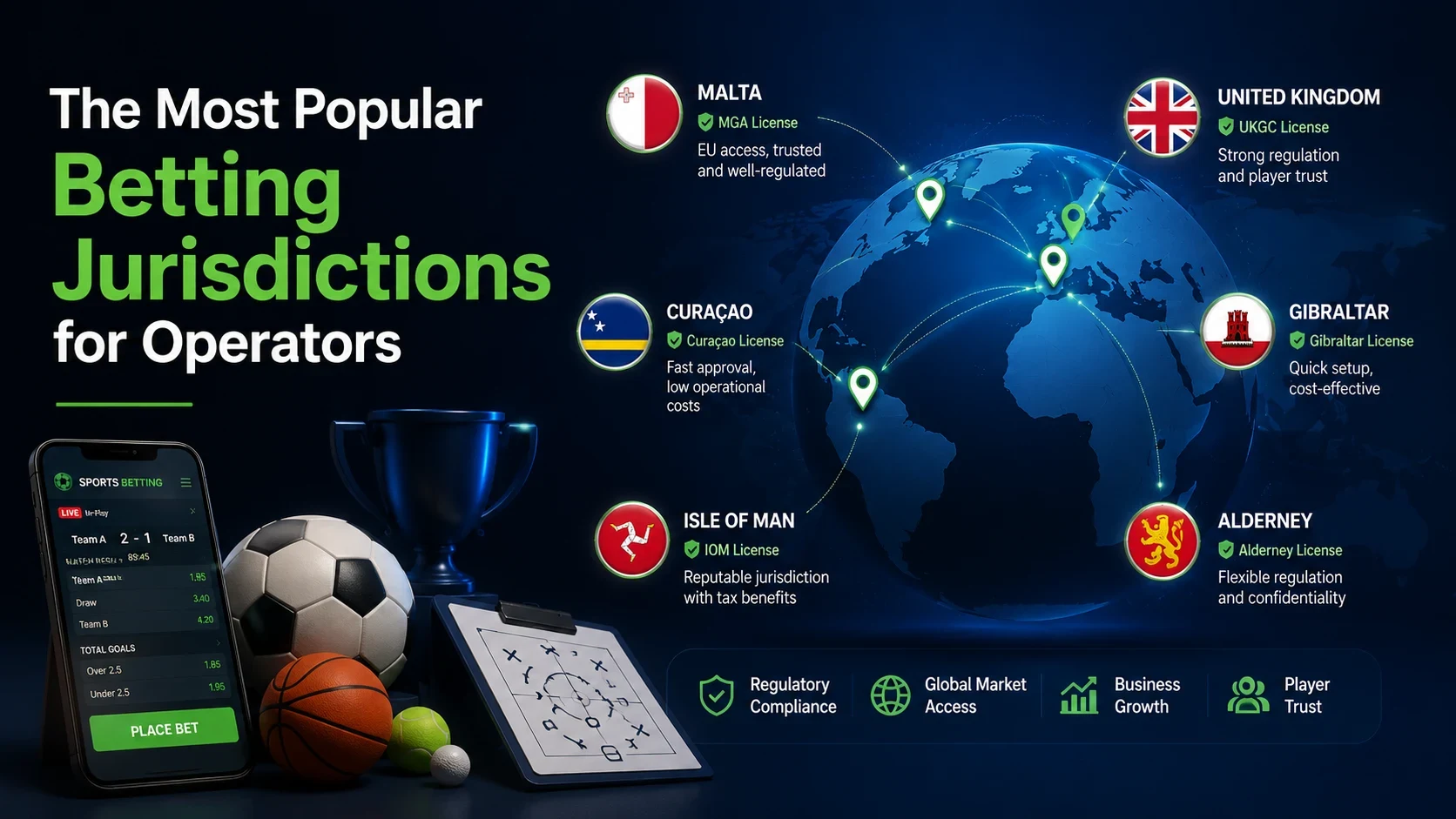
Picking a gambling licence jurisdiction is the foundation decision of any betting or iGaming operation, it determines banking access, payment processor relationships, tax exposure, target market eligibility, and increasingly, whether cryptocurrency can be integrated into the stack at all. Choose the wrong one, and an operator can lose months and tens of thousands of dollars addressing payment access issues discovered only after filing.
This guide compares the licensing jurisdictions operators actually shortlist in 2026, organized around what genuinely moves the decision: cost, timeline, regulatory reputation, and, the throughline that connects every jurisdiction choice back to payments, banking and payment processor accessibility.
Why Jurisdiction Choice Is Really a Payments Decision
It’s tempting to treat licence selection as a purely legal exercise, but for operators actually running a business, it’s just as much a payments and banking decision. A regulator’s reputation directly determines:
- Which banks and payment providers will open an account for the business at all: Tier-1 licences unlock relationships that are genuinely harder to secure elsewhere
- What kind of merchant services and payment gateway terms an operator can negotiate: reserve requirements, chargeback tolerance, and pricing all shift based on the perceived credibility of the underlying licence
- Whether major payment method providers and card networks will process without additional friction: some jurisdictions face documented “payment processor friction” specifically because of their regulatory reputation, independent of an individual operator’s actual business quality
- Cross-border payments viability: a licence recognized in the EU, for instance, materially simplifies cross-border payment relationships within that market compared to a licence with no such recognition
This is why an operator evaluating jurisdictions should weigh banking accessibility as heavily as licensing cost and timeline, a cheaper, faster licence that creates ongoing payment processing friction can cost far more over time than a more expensive, slower one that doesn’t.
Premium, Reputation-First Jurisdictions
Malta (Malta Gaming Authority – MGA)
Malta remains one of the most established and attractive jurisdictions for online gambling operators, offering a mature regulatory framework and, critically, EU market access as a member state. An MGA licence costs roughly €80,000-€100,000 to obtain, with the full first-year cost (company setup, compliance, banking, payment onboarding, audits, advisory) running considerably higher, commonly cited in the €150,000-€300,000+ range for a proper Tier-1 setup. Processing typically takes 6-12 months.
For sports betting specifically, operators need a Type 2 Gaming Service Licence, and the MGA requires detailed “Fit & Proper” checks on every stakeholder along with a minimum share capital, typically around €100,000, to demonstrate financial stability.
What operators are really buying: credibility that opens banking relationships harder to secure elsewhere, and often preferential access to game content some studios restrict to higher-tier jurisdictions. Malta also offers a genuine strategic ecosystem, a concentration of sportsbook software providers and compliance consultants that makes ongoing operations meaningfully easier than in less-established jurisdictions.
Best fit: Larger, well-capitalized operators targeting the EU market who can absorb the cost and timeline in exchange for premium banking access and long-term credibility.
United Kingdom (UK Gambling Commission – UKGC)
The UKGC is widely regarded as the world’s most demanding regulator, and the UK is arguably the largest and most lucrative regulated betting market globally, the two facts are directly related. A UKGC licence requires $100,000+ in costs, a 21% gaming duty on all UK-origin revenue (non-negotiable), and both annual audits plus biennial technical security audits.
As of 2026, UKGC reforms have introduced frictionless financial risk checks and, for certain sectors, a Remote Gaming Duty as high as 40%.
What operators are really buying: the ultimate seal of approval. Excellent payment processor support follows directly from this, Tier-1 processors prioritize UKGC-licensed operators specifically, and the licence signals fairness and social responsibility standards that matter enormously to both banks and institutional investors.
Important caveat: market access from a UKGC licence alone is limited to the UK and Gibraltar; it is not recognized for EU licensing purposes, meaning operators wanting both UK and EU access typically need to hold licences in both jurisdictions rather than treating one as a substitute for the other.
Best fit: Operators specifically targeting the UK market, for whom the licence isn’t optional, operating in the UK without UKGC authorization isn’t a viable path regardless of how strong an operator’s other jurisdictional licensing is.
Isle of Man
Frequently mentioned alongside Malta as a Tier-1 option, the Isle of Man carries strong regulatory reputation and correspondingly strong recognition with banks, PSPs, investors, and major suppliers. It’s also specifically noted for strong crypto compatibility, making it a common shortlist entry for operators wanting to integrate cryptocurrency into their payment stack without sacrificing regulatory credibility.
Best fit: Operators prioritizing banking confidence and institutional trust over speed, particularly those building a crypto-inclusive payment strategy from the outset.
Gibraltar
Gibraltar’s 2026 Act introduced stricter economic substance requirements and individual accountability standards, positioning it more competitively against Malta and the Isle of Man while raising the bar for operators that previously relied on lighter-touch structures.
Best fit: Operators wanting a Tier-1-adjacent reputation with a regulatory environment that has recently tightened specifically to compete more directly with Malta and Isle of Man on credibility.
The Pragmatic Middle Ground
Curaçao (post-2024 reform)
Curaçao has long served as the pragmatic middle ground between premium and offshore jurisdictions, and the 2024 regulatory overhaul (commonly referenced as the LOK/GLB reform, replacing the old “master licence” sub-licensing model) meaningfully increased compliance standards. The Curaçao eGaming Authority (CEGA, formerly GCB) now issues licences under this updated framework, with costs ranging roughly $50,000-$200,000 depending on the specific licence structure and services required.
Existing licences issued under the old sub-licensing system are being transitioned to the new regulatory requirements over time, with operators required to register and provide updated information as the new regime phases in, a meaningful shift for a jurisdiction previously known mainly for its speed and low cost rather than regulatory rigor.
The honest tradeoff: while the 2026 reforms have increased compliance standards and improved international recognition, Curaçao still faces more payment processor friction than Malta or the UKGC, and operators should budget for potential payment infrastructure workarounds rather than assuming Tier-1-equivalent banking access.
Best fit: Operators wanting broader international recognition and improving regulatory credibility without Malta or UKGC’s cost and timeline commitment, a genuinely stronger position than it held pre-reform, but still a step below Tier-1 on banking accessibility.
Fast, Low-Cost Offshore Jurisdictions
This tier trades regulatory prestige and banking ease for genuine speed and low entry cost, a real, legitimate strategy for early-stage operators, provided the payment processing tradeoffs are understood going in rather than discovered after launch.
Anjouan
The Anjouan Gaming Authority delivers among the fastest application timelines available (commonly cited at 3-6 weeks) for $15,000-$50,000, making it a common launchpad for startups wanting to test a product before committing to a premium jurisdiction. The explicit tradeoff: Anjouan licences face documented payment processor friction, meaning operators should expect to need workarounds, potentially including crypto rails or specialist high-risk payment gateway relationships, rather than assuming mainstream banking access.
Kahnawake
Operating under First Nations gaming sovereignty in Canada, Kahnawake is specifically noted as a strong option for North American-focused operators, alongside similar sovereignty-based jurisdictions like Tobique.
Nevis
Positioned as an option for established operators specifically seeking offshore privacy and stability, with a reputation for confidentiality that appeals to operators prioritizing discretion over the credibility signal a Malta or UKGC licence provides.
Costa Rica and El Salvador
Among the lowest entry-cost options available (Costa Rica: $8,000-$25,000; El Salvador: $10,000–$20,000), with El Salvador specifically noted for strong crypto compatibility given its Bitcoin legal tender status, relevant for operators building a crypto-forward payment strategy from day one.
Tuvalu
Another fast, low-cost option (4–8 weeks) frequently shortlisted alongside Anjouan and Curaçao for operators prioritizing speed to market above all else.
Comparison at a Glance
| Jurisdiction | Approx. Cost | Timeline | Tax | Banking/Payment Strength | Best For |
|---|---|---|---|---|---|
| Malta (MGA) | €80K-€100K license; €150K–€300K+ full setup | 5-12 months | ~5% gaming tax | Excellent – premium banking, Tier-1 PSP access | EU-focused, well-capitalized operators |
| UK (UKGC) | $100K+ | Several months, ongoing biennial audits | 21% duty (up to 40% for some sectors) | Excellent – Tier-1 processors prioritize UKGC operators | UK market entry (mandatory, not optional) |
| Isle of Man | Comparable to Malta, Tier-1 range | 3+ months | Favorable | Strong – notable crypto compatibility | Institutional trust + crypto-inclusive strategy |
| Gibraltar | Tier-1 range, rising with 2026 reforms | Several months | Favorable | Strong, improving | Tier-1-adjacent credibility |
| Curaçao (post-2024) | $50K-$200K | ~6 weeks to a few months | Low | Improving, but real friction remains | Mid-cost international recognition |
| Anjouan | $15K-$50K | 3-6 weeks | Very low | Weak – documented processor friction | Fast, cheap product testing |
| Kahnawake / Tobique | Varies | Weeks to months | Low | Moderate, North America-focused | North American-focused operators |
| Nevis | Moderate | Weeks to months | Low | Moderate | Privacy-focused established operators |
| Costa Rica / El Salvador | $8K-$25K | Weeks | Very low | Weak, crypto-friendly | Lowest-cost entry, crypto-forward |
| Tuvalu | Low | 4-8 weeks | Low | Weak | Speed-to-market above all |
The Hybrid Strategy: Why Many Operators Don’t Pick Just One
A pattern worth understanding explicitly: many successful operators begin with a fast, low-cost licence (commonly Anjouan or a comparable Tier-3 jurisdiction) to launch quickly and validate the platform, then add a secondary, more prestigious licence, MGA, UKGC, or Nevis, once funding and target markets justify the investment. This dual-licence approach optimizes for both speed early on and long-term market access and banking credibility later, rather than forcing an early-stage operator to commit to Malta’s 6-12 month timeline and six-figure cost before validating the business.
The practical payments implication: an operator running this strategy should plan its payment infrastructure in two phases too, accepting the reality of a narrower, more high-risk-oriented merchant account setup during the fast-launch phase, with a defined plan to migrate toward mainstream payment providers once the premium licence is in place.
Substance Requirements: A 2026-Specific Consideration
“Substance”, meaning genuine physical presence in the licensing jurisdiction, such as a local office and at least one local director or key person, has become a more prominent requirement across multiple jurisdictions in 2026, specifically to prevent shell companies from obtaining licences without real operational presence. Both Malta and Curaçao now require this kind of local substance, a meaningful shift for operators who previously treated licensing as a purely paperwork exercise separate from actual operational presence.
This matters for the payments conversation too: banks and payment providers increasingly scrutinize substance as part of their own due diligence, treating a licence obtained without genuine local presence as a weaker credibility signal than one backed by real operational substance in the jurisdiction.
The Cost of Choosing the Wrong Jurisdiction
It’s worth being direct about the downside risk here. Choosing a jurisdiction that doesn’t fit an operator’s actual banking route, target markets, or payment model can add three to six months of delay and tens of thousands of dollars in additional cost if the team has to address payment access issues, restricted-market conflicts, or regulator-fit problems discovered after filing rather than before.
And at the most serious end of the spectrum: operating without any licence at all in a market that requires one isn’t a cost-saving shortcut, it can lead to a website being blacklisted by ISPs, bank accounts being frozen, and significant legal prosecution. Every jurisdiction on this list, including the fastest and cheapest Tier-3 options, still requires genuine licensing; the tradeoffs discussed throughout this guide are between different levels of legitimate regulatory oversight, not between regulation and no regulation.
Decision Framework: Choosing the Right Jurisdiction
If you’re an early-stage operator validating a new product:
- A fast, low-cost Tier-3 jurisdiction (Anjouan, Curaçao, Tuvalu) gets you live in weeks rather than months, accepting the payment processor friction as a known, manageable tradeoff during this phase
- Plan explicitly for a future migration to a premium licence once the business validates and target markets become clearer
If you’re targeting the EU market specifically:
- Malta (MGA) remains the clearest path to genuine EU market access, and the banking and PSP relationships it unlocks are difficult to replicate through a lower-tier jurisdiction alone
If you’re targeting the UK market:
- UKGC licensing isn’t optional, it’s the only legal path to operating in the UK, regardless of what other jurisdictional licensing an operator holds
If banking confidence and crypto integration both matter:
- Isle of Man stands out specifically for combining strong institutional reputation with genuine crypto compatibility, a combination not every Tier-1 jurisdiction offers equally well
If you’re building a crypto-first payment strategy from day one:
- El Salvador’s Bitcoin legal tender status and Isle of Man’s crypto compatibility are both worth prioritizing over jurisdictions with no particular crypto-specific advantage
If you’re already operating and considering adding a second licence:
- The hybrid strategy, a fast Tier-3 launch licence plus a premium jurisdiction added later, is a well-established, legitimate pattern rather than an unusual approach, and it directly maps onto a phased payment infrastructure strategy as the business matures
Conclusion
There’s no single best betting jurisdiction for every operator, there’s a best fit for your target markets, stage of growth, and how much weight you put on banking accessibility versus speed and cost. Malta, the UK, Gibraltar, and the Isle of Man sit at the top for a reason: they unlock the strongest payment processing and banking relationships in the industry, at real cost in time and money. Curaçao’s post-reform framework offers a genuinely improving middle path. And the fast, low-cost offshore tier remains a legitimate way to validate a product quickly, provided the payment processing tradeoffs are planned for rather than discovered after the fact.
What matters most is treating jurisdiction selection as the payments and banking decision it actually is, not just a legal formality, and building a phased strategy, where necessary, rather than assuming one licence choice needs to serve the business at every stage of its growth.
Frequently Asked Questions
Q: Why does jurisdiction choice affect payment processing so directly?
A: A regulator’s reputation functions as a credibility signal banks and payment providers rely on heavily when underwriting a betting operator. Tier-1 licences (Malta, UKGC, Isle of Man) unlock banking relationships and payment processor terms that are genuinely harder to secure through lower-tier jurisdictions, independent of an individual operator’s actual business quality.
Q: Is Curaçao still a good option after the 2024 regulatory reform?
A: Yes, and arguably a stronger option than before, the LOK/GLB reform increased compliance standards and improved international recognition. It remains a pragmatic middle ground rather than a Tier-1 equivalent, and operators should still expect somewhat more payment processor friction than Malta or the UKGC.
Q: Can an operator hold licences in multiple jurisdictions at once?
A: Yes, and many operators do, commonly starting with a fast, low-cost jurisdiction to launch quickly, then adding a premium licence (Malta, UKGC, Nevis) once the business and target markets justify the additional cost and timeline.
Q: Does a UKGC licence also grant access to the EU market?
A: No. UKGC market access is limited to the UK and Gibraltar and is not recognized for EU licensing purposes, operators wanting both UK and EU access generally need separate licensing in each region.
Q: What is a “substance” requirement, and why does it matter in 2026?
A: Substance refers to genuine physical presence in the licensing jurisdiction, a local office and at least one local director or key person. Both Malta and Curaçao now require this specifically to prevent shell companies from obtaining licences, and it’s increasingly scrutinized by banks and payment providers as part of their own due diligence too.
Q: Is it ever a viable strategy to operate without any gambling licence at all?
A: No. Operating without a required licence in a market can lead to ISP blacklisting, frozen bank accounts, and legal prosecution. The comparisons in this guide are between different levels of legitimate regulatory oversight, not between regulation and no regulation.
Comments
No comments yet. Be the first to share your thoughts.
Leave a comment