
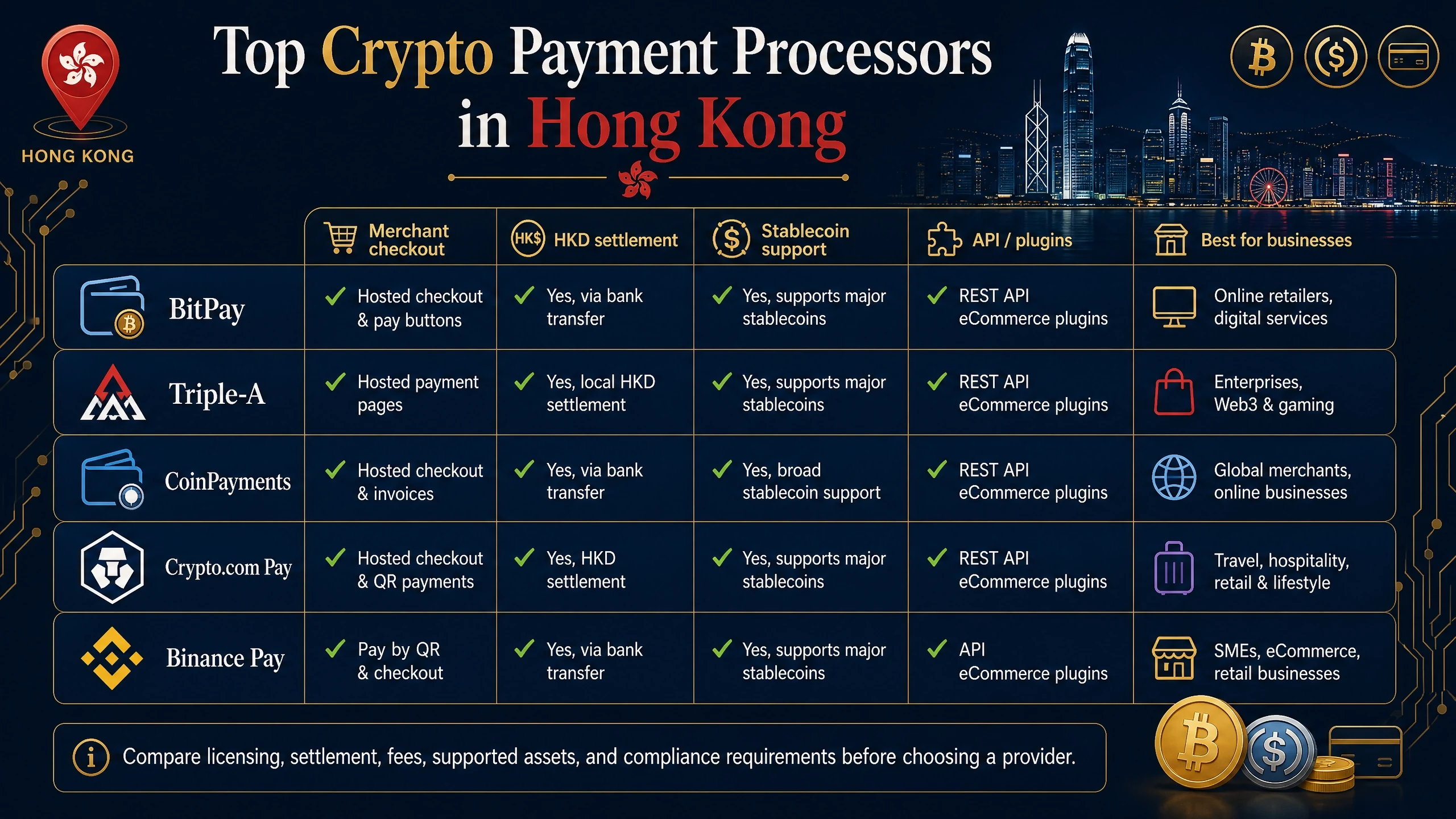
Every few months I get the same message from a Hong Kong merchant: “We just got a settlement freeze and nobody at the processor will explain why.” Nine times out of ten, the root cause isn’t fraud. It’s a merchant who picked a crypto payment provider based on a Google search ranking instead of understanding how Hong Kong’s SFC and HKMA licensing regimes actually interact with that provider’s compliance posture. I’ve spent enough time reviewing merchant onboarding files and post-incident reports to know exactly where this goes wrong, and which providers are worth the paperwork.
Not every global crypto payment provider is safe to build a Hong Kong business on. Triple-A, BitPay, BVNK, and CoinGate are the ones I actually recommend, and each earns its place for a different reason, regulated settlement, brand reach, treasury control, or EU alignment. Coinbase Commerce’s March 2026 pullback from non-US/non-Singapore markets caught a lot of merchants off guard, and I’d treat that as a warning about single-jurisdiction dependency generally. Match the provider to your settlement currency and risk category before you look at the fee sheet, not after.
What I’ve Learned Watching This Market Mature
I’ve watched Hong Kong go from a market where crypto payment acceptance was a novelty add-on to one where it’s genuinely load-bearing infrastructure for cross-border trade. The turning point, in my view, wasn’t the technology, stablecoin rails have been technically ready for years. It was the licensing. The SFC’s mandatory VASP regime, live since June 2023, gave Hong Kong banks something they’d never had before: a reference point for deciding which crypto-adjacent businesses were bankable and which weren’t. By early 2026, the SFC had licensed 13 virtual asset trading platforms, and that number matters less than what it signals, a regulator willing to grant licenses, not just collect applications.
The piece I think most content on this topic misses is the Stablecoins Ordinance. It went live in August 2025, with the first HKMA stablecoin issuer licenses expected in early 2026, and it fundamentally changes how a digital payments business should think about which rail it’s using. I’ve had merchants tell me “we accept USDT, that’s the same as any other crypto payment”, it isn’t, not from a compliance-exposure standpoint, and treating it that way is how businesses end up with a frozen account they can’t explain.
The scale backing this shift isn’t small either. Global stablecoin settlement volume crossed $31 trillion annually in 2026, and stablecoins now account for over 70% of on-chain merchant payment volume. For a trade hub moving goods and capital between mainland China, ASEAN, and the West, that’s not a speculative trend, it’s become working capital infrastructure.
Why Licensing Status Is the First Thing I Check, Not the Last
Most merchants I talk to compare payment providers on fees first. I check licensing exposure first, because it determines whether the fee comparison even matters. Hong Kong’s regulatory structure is genuinely two-agency: the SFC covers Virtual Asset Trading Platforms and is actively expanding into dealing, custody, advisory, and management categories, while the HKMA governs stablecoin issuance separately under the 2025 Ordinance.
Here’s the part that catches merchants off guard: local banks have started asking merchants directly which crypto processor they use, and evaluating that processor’s compliance documentation as part of the merchant’s own banking relationship risk. I’ve seen a clean, well-run merchant get a banking review triggered purely because their payment processing partner’s licensing story was murky. The lesson I keep repeating to clients: your processor’s compliance posture is now part of your own risk profile, whether you like it or not.
The Processors I’d Actually Point a Hong Kong Merchant Toward
| Processor | Best For | Settlement | Fee Range | Licensing Strength |
|---|---|---|---|---|
| Triple-A | Regulated cross-border settlement, APAC merchants | Fiat (HKD, USD, EUR, 30+ currencies) | ~1% typical | MAS-licensed (Singapore), Hong Kong office |
| BitPay | Global reach, established brand trust | Fiat or crypto | 1–2% + $0.25 | Strong US compliance posture, 229 countries |
| BVNK | Enterprise stablecoin treasury | Stablecoin or fiat | Custom/enterprise | 25+ licenses globally |
| CoinGate | EU-aligned merchants, broad altcoin support | Fiat or crypto | ~1% | MiCA-aligned, EU-focused |
| NOWPayments | Stablecoin-first, non-custodial | Crypto or fiat | ~0.5% | Non-custodial model, wide coin support |
Triple-A – my default recommendation for HK-to-mainland or HK-to-ASEAN trade
Triple-A is the one provider on this list with an actual physical Hong Kong presence, not just market access. That’s not a trivial detail in my experience, when something goes wrong with settlement, having a local office changes how fast it gets resolved. It settles into HKD, USD, EUR, and 30-plus other currencies, and its MAS license in Singapore gives it a compliance profile Hong Kong banks already recognize, which smooths the account-opening conversation considerably.
BitPay – the safe, boring choice, and sometimes that’s the right call
BitPay isn’t exciting, but it’s reached roughly 130,000 merchants globally, and its tiered pricing rewards volume, 2% plus $0.25 below $500,000 monthly, down to 1% above $1 million. I recommend it to merchants who want the most globally recognized brand at checkout, even if its compliance infrastructure leans more US-centric than Hong Kong-native.
BVNK – for merchants who don’t want to auto-convert
BVNK now processes over $25 billion a year for clients like Deel and Worldpay, and I point merchants here specifically when they want to hold stablecoin balances rather than convert everything to fiat on receipt. That’s a real strategic choice, not just a technical preference, it matters for businesses managing FX exposure or treasury timing across borders.
CoinGate – the pick when Europe is a real revenue line, not a side market
CoinGate’s MiCA alignment is the reason I bring it up whenever a Hong Kong exporter tells me Europe is more than a minor market for them. It backs that up with broad altcoin support too, which is a combination I don’t see often.
NOWPayments – cheapest, but understand what you’re trading away
At roughly 0.5% with 350-plus coins supported on a non-custodial model, NOWPayments wins on pure cost. I’m comfortable recommending it to merchants who understand the non-custodial trade-off; I’m less comfortable when a merchant picks it purely because it’s the cheapest line on a spreadsheet without understanding what that model means operationally.
The Coinbase Commerce Lesson I Won’t Stop Bringing Up
Coinbase Commerce shut down for merchants outside the US and Singapore in March 2026. I bring this up in nearly every consultation now, because it’s the clearest real-world proof of a point I’ve been making for years: don’t build core payment gateways infrastructure around a single-jurisdiction provider, no matter how strong the brand. Thousands of stores got pushed toward CoinGate, Plisio, and NOWPayments with essentially no warning. Merchants who’d diversified across two processors barely noticed. Merchants who hadn’t scrambled.
How I’d Actually Choose, If It Were My Business
Strip away the marketing copy and here’s the filter I actually use with clients:
- Need HKD or local currency in your bank account? Triple-A and BitPay both handle that conversion for you.
- Want stablecoins as working capital, not just a pass-through? BVNK is built for that; the others aren’t.
- Europe matters commercially? CoinGate’s MiCA posture removes friction the others don’t address.
- Running a high-volume, high-risk vertical: gaming, adult, forex, nutraceuticals? Mainstream processors will likely decline you outright, and you’re better served applying directly to a high-risk payment gateway specialist with crypto-specific underwriting rather than collecting rejections first.
- Cost is the deciding factor and you understand non-custodial mechanics? NOWPayments is genuinely hard to beat on price.
A Mistake I See Repeatedly: Treating Coin Support as the Main Filter
Merchants new to this space almost always ask “which coins do you support” before they ask “how does settlement actually reach my bank account.” I understand the instinct, it feels like the most concrete, comparable data point. But in practice, coin count rarely determines whether a business runs smoothly. Settlement mechanics do.
I’ve reviewed integrations where a merchant chose a provider with the widest coin list on the market, only to discover months later that reconciling dozens of small-balance token payments against Hong Kong accounting requirements was a genuine operational headache nobody had budgeted time for. Meanwhile, a competitor running the same volume through a fiat-settling processor with narrower coin support closed their books in a fraction of the time.
My rule of thumb: if your customer base is genuinely crypto-native and diverse, coin breadth earns its keep. If most of your buyers are paying in USDT or USDC because it’s convenient, not because they’re loyal to a particular chain, optimize for settlement simplicity instead. Getting this filter backwards is the single most common reason I see merchants switch payment providers within their first year.
Frequently Asked Questions
Is crypto payment processing legal for merchants in Hong Kong? Yes. Accepting crypto payments as a merchant is legal, though the processors and platforms involved may need SFC or HKMA licensing depending on the services they provide.
Do Hong Kong crypto payment processors settle in HKD? Some do. Triple-A and BitPay both offer fiat settlement, with Triple-A supporting HKD directly alongside 30-plus other currencies.
Are stablecoins the same as regular crypto payments for compliance purposes? Not entirely, and this is where I see merchants trip up most often. Since August 2025, stablecoin issuers fall under HKMA’s dedicated Stablecoins Ordinance, a separate framework from the SFC’s VASP regime for exchanges.
Can a high-risk business accept crypto payments in Hong Kong? Often, yes, but expect more thorough underwriting. I generally steer high-risk merchants directly to specialist high-risk payment gateway providers rather than letting them collect declines from mainstream processors first.
What happened to Coinbase Commerce for Hong Kong merchants? Coinbase Commerce discontinued service for merchants outside the US and Singapore in March 2026, prompting a shift toward alternatives like CoinGate, Plisio, and NOWPayments.
How do processing fees compare between providers? Fees generally range from about 0.5% (NOWPayments) to 2% plus a flat fee (BitPay’s lower-volume tier), with enterprise providers like BVNK pricing custom contracts based on volume.
Where This Market Goes From Here
If the SFC keeps expanding VASP licensing into custody, dealing, and advisory categories the way it’s signaled, I expect the gap between “regulated” and “unregulated” crypto processors serving Hong Kong to widen fast, and the merchants who picked a provider on brand recognition alone are going to feel that gap first. My advice hasn’t changed in three years of watching this market: pick the processor whose compliance story you can actually explain to your bank, then optimize for fees.
Comments
No comments yet. Be the first to share your thoughts.
Leave a comment