
TL;DR:
Visa has issued more than 12.6 billion network tokens, up 44% year-over-year. Mastercard’s tokenized e-commerce volume has more than doubled in two years. Juniper Research projects tokenized transactions will roughly double again by 2029. The tension driving all of it: the 16-digit card number was never built for a world of subscriptions, digital wallets, and constant data breaches, and merchants are discovering that tokenization isn’t just a security upgrade, it’s now a revenue lever too.
Here’s a number worth sitting with: card-not-present fraud now accounts for roughly 81% of all fraud cases globally, and around two-thirds of total credit card fraud losses. Meanwhile, the fix that’s actually moving the needle isn’t a new fraud-scoring algorithm or a stricter password policy, it’s a decade-old idea that’s finally hit critical mass. Network tokenization replaces the static 16-digit card number with a dynamic, merchant-and-device-specific credential that’s useless to anyone who steals it. That’s the real tension behind this shift: the card number, the single piece of data the entire payment processing industry was built around, is quietly being retired as the primary credential, and most consumers have no idea it’s happening.
What Network Tokenization Actually Is
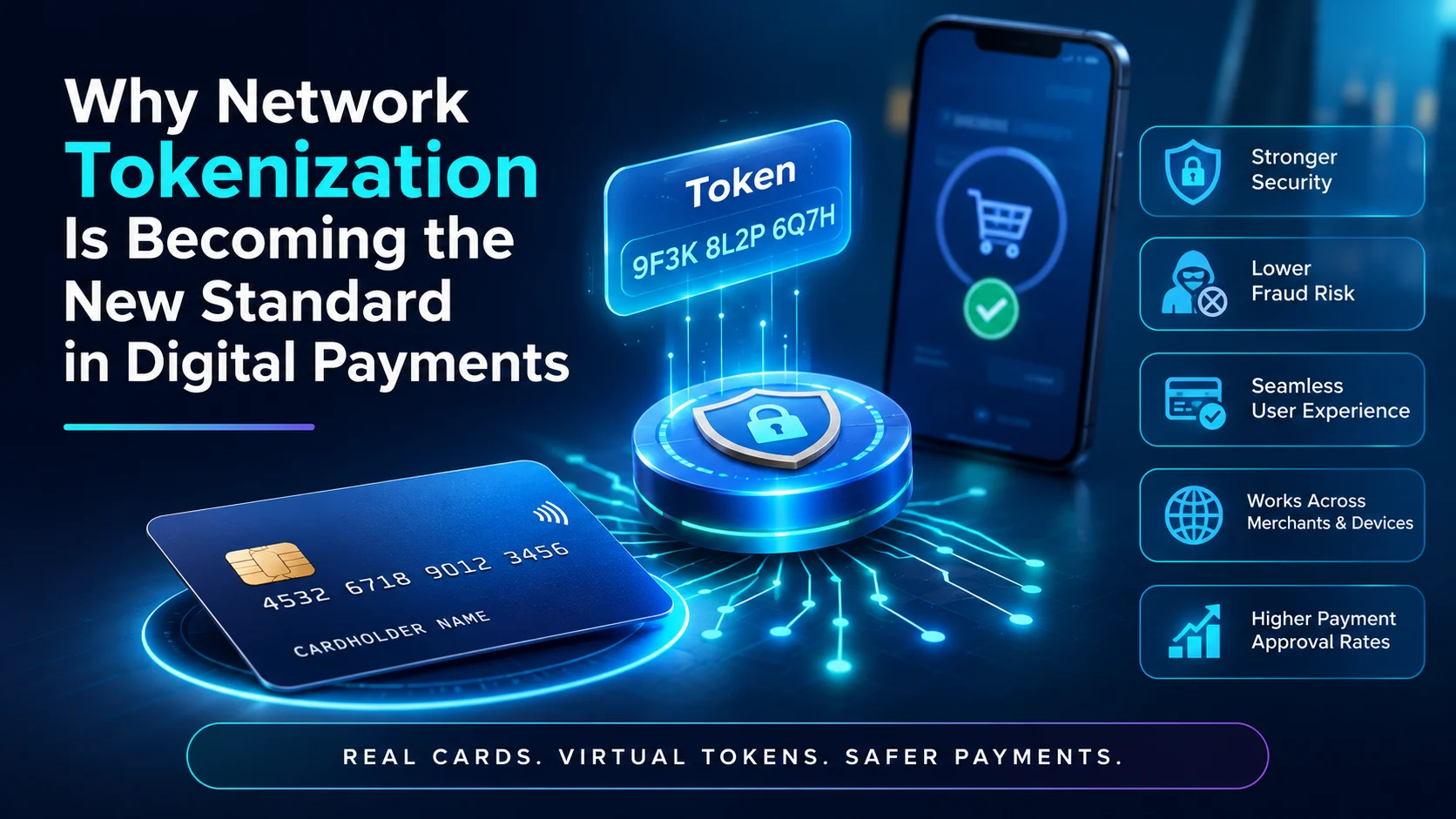
Network tokenization is different from the “tokenization” many merchants already use at the gateway level. A gateway token is generated by your payment gateway or processor and only means something inside that specific system. A network token, by contrast, is issued directly by the card network, Visa, Mastercard, and others, and travels with the transaction across the entire payment chain, from wallet to acquirer to issuer.
Here’s the mechanical difference that matters:
- A raw card number: (the Primary Account Number, or PAN) is static. It doesn’t change until the card itself is reissued, which means a breached number stays valuable to fraudsters until the cardholder notices and cancels.
- A network token: is tied to a specific device, merchant, or payment channel and can be restricted, suspended, or updated without touching the underlying card at all. If a customer’s physical card expires or gets reissued, the token updates automatically behind the scenes, no failed subscription payment, no customer support call.
- Because the network itself issues and validates the token, issuers get a stronger trust signal at authorization than they would from a raw PAN, which is a major reason tokenized transactions get approved more often.
The Numbers Behind the Shift
The scale of adoption here is hard to overstate, and it’s worth grounding the “new standard” claim in actual figures rather than vendor enthusiasm:
- Visa has issued more than 12.6 billion network tokens: as of mid-2026, a 44% increase in the past year alone, with tokens increasingly tied to specific devices and payment channels rather than just cards.
- Mastercard has more than doubled its tokenized e-commerce transaction volume in the past two years: according to the company’s own published figures.
- Juniper Research projects global tokenized transactions will grow at an 18.1% compound annual rate through 2030: reaching roughly 2.4 trillion secured transactions between 2026 and 2030, representing an estimated 86% of applicable transactions by the end of that window.
- Separately, Juniper’s earlier analysis put tokenized transaction volume at 283 billion in 2025, projected to roughly double to 574 billion by 2029.
- On the performance side, Visa reports network tokens lift card-not-present authorization rates by 4.6% compared to raw card numbers, while Mastercard reports a 2.1% average uplift, different methodologies, but both networks pointing the same direction.
That authorization-rate detail is the part merchants tend to underweight. A failed authorization isn’t just a security non-event, it’s a lost sale, and at scale, a meaningful one.
The Core Argument: Why This Is Becoming the Standard, Not Just an Option
1. It solves a real merchant pain point: false declines and payment churn
For any merchant running merchant accounts with recurring billing, subscriptions, memberships, SaaS, the single most common revenue leak isn’t fraud itself, it’s false declines and card-update failures. A customer’s card expires, gets reissued after a breach, or gets flagged by an overcautious issuer, and the subscription payment silently fails. Network tokens directly address this: because the token updates automatically when the underlying card changes, merchants using tokenized payment wallets and online payments infrastructure see meaningfully fewer failed renewals. Checkout.com’s own merchant data, cited by Mastercard, shows a 10.3 percentage-point increase in approval rates and a 7.2% increase in gross sales revenue among merchants using network tokens versus raw card numbers, a rare case where a security upgrade shows up directly on the revenue line.
2. It shrinks the blast radius of a data breach
Traditional card-on-file storage means every merchant holding customer card numbers is a potential breach target with real value to attackers. A network token, by design, is useless outside its specific merchant-device-channel context, even if a database of tokens leaks, the tokens themselves can’t be replayed elsewhere the way a raw card number could. For payment providers managing large volumes of stored payment credentials, that shift meaningfully reduces both breach risk and the compliance burden of storing sensitive cardholder data in the first place.
3. It’s becoming infrastructure for things that didn’t exist when the card number was designed
Tokenization is increasingly the enabling layer for use cases the original card system was never built for: Click to Pay checkout experiences, agentic and AI-initiated purchases, connected-device commerce (wearables, cars, IoT), and guest checkout flows that need to feel instant without asking a customer to re-enter card details. Visa has explicitly framed tokens as “the credential layer for long-lived customer relationships” rather than a narrow security tool, a sign that the networks themselves see tokenization as foundational infrastructure, not a bolt-on feature.
4. Regulators and networks are pushing adoption past “optional”
Visa and Mastercard are actively pushing toward near-universal tokenization in Europe and beyond, and Juniper Research’s near-universal-adoption forecast for 2030 reflects that institutional push, not just organic merchant demand. That matters for cross-border payments specifically, where inconsistent card-data handling across jurisdictions has long been a friction point, a common token standard reduces that fragmentation meaningfully.
Where Tokenization Fits Into the Bigger Merchant Toolkit
Tokenization doesn’t operate in isolation, and treating it as a standalone fix misses how it actually gets deployed in practice. For merchants running payment gateways across multiple regions, tokenization typically sits alongside a few other layers:
- 3D Secure and biometric authentication: for step-up verification on higher-risk transactions, working alongside, not instead of, the token itself.
- Card-on-file lifecycle management: where tokens automatically update as cards expire or get reissued, removing a recurring source of involuntary customer churn for subscription businesses.
- Click to Pay integration: which relies on network tokens to let returning customers check out without re-entering card details, a growing expectation among online shoppers.
- Vaultless architecture options: where merchants can accept tokenized payments without storing sensitive card data at all, simplifying PCI DSS compliance scope considerably.
For payment providers building out merchant services for high-risk or cross-border payments verticals specifically, this layered approach matters even more, since those merchants tend to face both higher fraud exposure and higher false-decline rates simultaneously, exactly the two problems tokenization is best positioned to address at once.
The Counterpoint
The steelman case against treating tokenization as an unambiguous win: it isn’t free, and the networks are increasingly monetizing it. Visa introduced a Card-Present Token Fee on tokenized transactions starting April 2026, and Mastercard’s Digital Enablement Fee follows a similar pattern, invest in adoption, wait for critical mass, then start charging for it. Industry analysis estimates these network-fee changes could add hundreds of millions of dollars annually in incremental costs for merchants, layered on top of interchange, precisely because that layer isn’t subject to the same regulatory caps that interchange fees increasingly face. A skeptical merchant could reasonably ask whether “the new standard” is really about security, or whether it’s becoming a new toll booth the networks control unilaterally.
That’s a legitimate concern, and merchants adopting tokenization should go in with eyes open about the fee structure rather than assuming it’s purely a cost-saving move. But the counterpoint doesn’t erase the underlying case, even accounting for new token-related fees, the combination of higher authorization rates, reduced fraud losses, and lower breach liability still nets out positive for most merchants processing meaningful digital payments volume, particularly in high-risk payment gateway categories where authorization-rate improvements translate directly into recovered revenue. The fee layer is a real cost to plan for, not a reason to opt out.
Comparison: Network Tokens vs. Traditional Card Numbers
| Dimension | Raw Card Number (PAN) | Network Token |
|---|---|---|
| Value if stolen | High – usable across any merchant until cancelled | Low – restricted to specific merchant/device/channel |
| Updates on card reissue | No – requires manual customer action | Yes – updates automatically, no customer action needed |
| Authorization rate (CNP) | Baseline | +4.6% (Visa) / +2.1% (Mastercard) reported uplift |
| Breach exposure for merchants | Full PAN storage risk | Token has no standalone value outside its context |
| Cost structure | Standard interchange | Standard interchange plus emerging network token fees |
| Best fit | Legacy systems not yet upgraded | Recurring billing, digital wallets, cross-border, high-risk verticals |
Practical Takeaway for Merchants and Payment Providers
If you’re running recurring billing, cross-border checkout, or any high-volume payment processing operation and haven’t moved to network tokenization yet, the false-decline and authorization-rate data alone make a strong case to prioritize it, the revenue recovered from fewer failed payments often outweighs the emerging token-fee costs, though that math is worth running for your specific volume and vertical. For merchant services providers and payment gateways still selling tokenization purely as a security feature, the data suggests a stronger pitch: this is now a checkout-conversion tool first, and a security upgrade second.
Open question worth watching: as Visa and Mastercard both introduce new fees tied specifically to tokenized transactions, does that risk slowing the very adoption curve they’ve spent a decade building, or has tokenization become embedded enough in modern checkout, subscriptions, and crypto payment-adjacent digital wallets that merchants will absorb the new costs simply because there’s no realistic way to opt back out?
Comments
No comments yet. Be the first to share your thoughts.
Leave a comment