
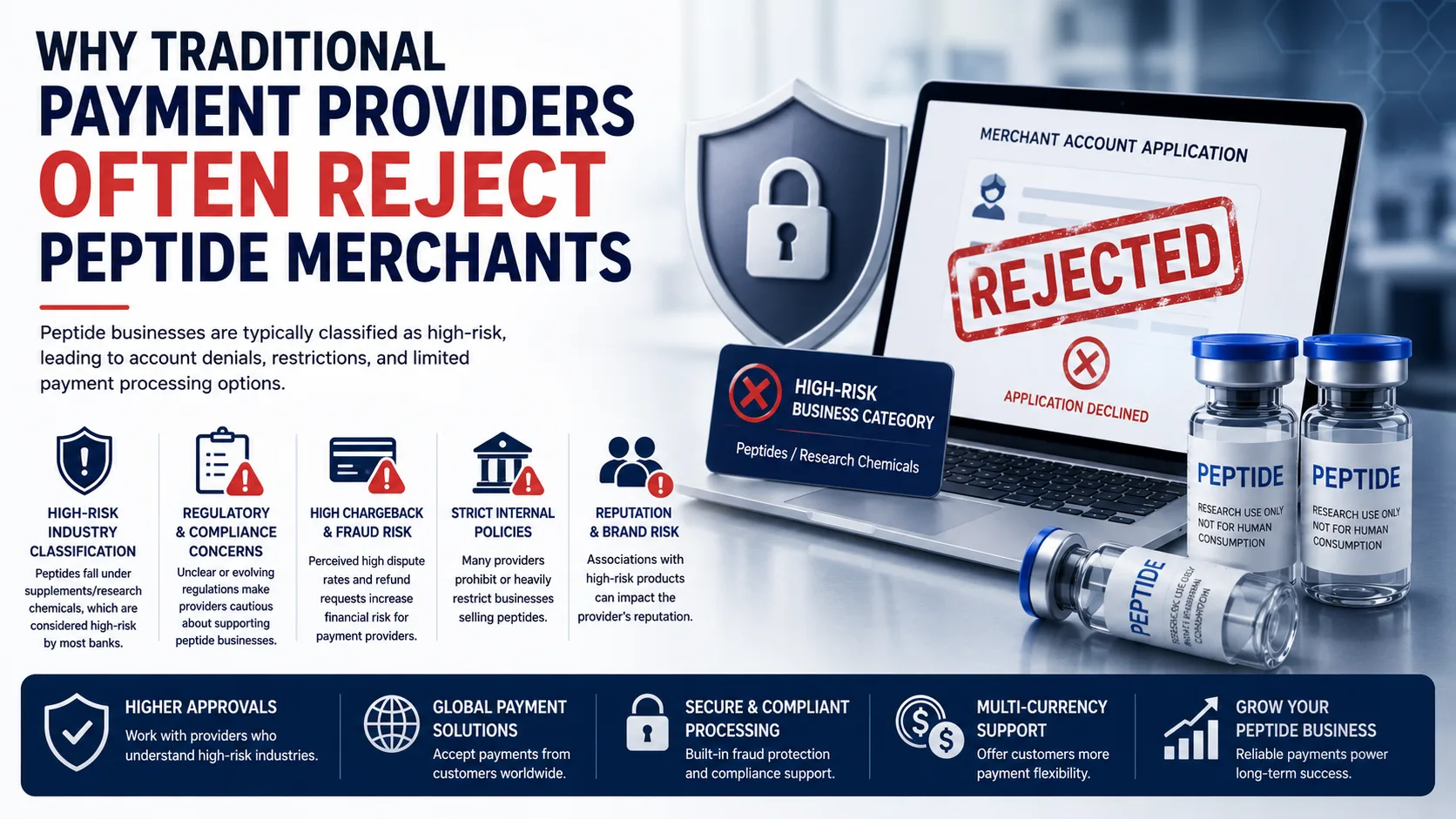
A peptide business owner does everything right, clean books, documented sourcing, a professionally built website, and still gets declined by a mainstream processor within days of applying. Or worse: gets approved, processes normally for a few months, then wakes up to a termination notice and a frozen balance.
This isn’t a paperwork problem. It’s the predictable output of how mainstream payment providers actually make underwriting decisions in 2026, automated, category-based, and increasingly risk-averse regardless of how well-run an individual business actually is. This piece breaks down exactly why that happens, mechanism by mechanism.
The Short Version: It’s Not About You
The hardest thing for peptide business owners to accept is also the most important one to understand: rejection usually isn’t a verdict on your specific business. It’s a structural filter that would reject nearly any business in the category, regardless of how well it’s run. Here’s why that distinction matters, and exactly how the filtering actually works.
Merchant Category Codes Sweep Peptides in With Pharmaceuticals
Every business that applies for card processing gets assigned a Merchant Category Code (MCC), a four-digit classification that tells the processor’s risk systems what kind of business it’s underwriting. This is the single biggest, and most misunderstood, reason peptide businesses get rejected.
The MCCs that apply to peptide sales overlap heavily with categories mainstream processors treat as automatic red flags: nutraceuticals, research chemicals, and pharmaceutical-adjacent products. A risk algorithm scanning an application doesn’t distinguish between a GMP-certified peptide laboratory with airtight documentation and an unlicensed operation selling unregulated substances online, it sees the MCC, and the outcome is the same either way.
This is why documentation quality often doesn’t move the needle at the mainstream-processor level the way business owners expect it to. The rejection happens before a human underwriter ever sees the certificates of analysis or the business plan.
Card Network Risk Programs Specifically Target the Category
Beyond generic MCC filtering, card networks run dedicated monitoring programs that name research peptides directly.
- Mastercard’s BRAM program (Business Risk Assessment and Mitigation) specifically flags unapproved pharmaceuticals, research peptides, and nutraceuticals as categories requiring additional scrutiny
- BRAM controls were updated further in 2026 to apply stricter, more specific oversight to research peptide accounts
- Processors that previously accepted the category under looser standards have responded by either exiting it entirely or re-underwriting existing merchant relationships more conservatively
This matters because it shows the rejection isn’t coming from an individual bank’s judgment call, it’s coming from policy set at the card network level, which every processor working with that network has to comply with or risk its own standing.
Automated, AI-Driven Underwriting Has Replaced Manual Review
The underwriting process itself has changed structurally in the last few years, and that shift disproportionately hurts categories like peptides.
Rather than manually reviewing complex business models, mainstream aggregators increasingly rely on AI-driven risk filtering that automatically triggers account terminations and fund freezes the moment processing parameters match a flagged pattern, often with no human review at all until after the fact.
This explains a pattern peptide business owners describe constantly: initial approval that runs smoothly for weeks or months, followed by a sudden termination once transaction volume, ticket size, or product-page language crosses an automated threshold. The account wasn’t actually reviewed and approved by a person who understood the business, it was approved by default and later caught by a monitoring system.
Bank-Wide “De-Risking” Is Accelerating Industry-Wide
“De-risking”, banks and processors proactively exiting entire categories rather than managing risk merchant-by-merchant, has intensified sharply heading into 2026, driven by several converging pressures:
- Tighter global AML and KYC enforcement: Regulators worldwide have pushed stricter anti-money-laundering and know-your-customer requirements, and the compliance cost of maintaining relationships in genuinely high-risk categories has risen accordingly
- New transparency requirements adding operational cost: Under newer commercial regulations in several jurisdictions, payment providers can no longer terminate accounts without disclosing a specific reason, a consumer protection that ironically makes some processors more inclined to avoid the category altogether rather than build the compliance infrastructure to manage it properly
- Correspondent and sponsor bank liability concerns: Banks are fundamentally risk-averse institutions primarily concerned with financial liability; if a merchant category is seen as a potential source of regulatory exposure, the simplest response is often blanket avoidance rather than case-by-case underwriting
None of this is specific to peptides, the same dynamic hits forex, adult content, online gaming, and other regulated verticals, but peptides sit squarely in the crosshairs because of the regulatory ambiguity layered on top.
The Underlying Product Category Genuinely Sits in a Gray Zone
It would be inaccurate to suggest the rejection is purely bureaucratic, there’s a real regulatory ambiguity underneath it that mainstream processors aren’t equipped to evaluate carefully.
- Many peptides lack FDA approval for human consumption and are legally sold strictly for research purposes, which creates a structural gap between how a product is labeled and how some customers may actually use it
- The FDA expanded its 503A Category 2 list in 2024 to include additional peptides, placing them under a “significant safety risks” designation that adds another layer of regulatory scrutiny banks have to account for
- Processors don’t have the specialized compliance expertise to evaluate whether a specific peptide business’s labeling, sourcing, and marketing genuinely stay within legal “research use only” boundaries, so rather than investing in that expertise, most simply decline the entire category
This is the one root cause that a well-run peptide business genuinely can influence, clean, consistent “research use only” labeling and documented compliance materially reduce risk, but it doesn’t overcome MCC-level filtering at mainstream processors regardless of how well it’s executed.
Chargeback Risk Is Real, Not Just Perceived
Beyond classification and regulation, peptide merchants do carry genuinely elevated dispute risk compared to typical e-commerce categories:
- Efficacy disputes: since peptide effects vary meaningfully by individual and aren’t FDA-approved for the outcomes many customers expect, dissatisfaction converts into disputes more often than with standard consumer goods
- Billing recognition disputes: customers who don’t recognize a billing descriptor file a chargeback rather than contacting the merchant directly first
- Continuity and subscription billing exposure: recurring billing models, common in the wellness and nutraceutical space broadly, carry structurally higher dispute rates than one-time purchases
Underwriting guidance across the high-risk industry generally treats a chargeback ratio above roughly 1% as a serious red flag, a threshold peptide businesses with weak dispute-prevention practices can cross more easily than typical retail categories, reinforcing the case processors make for blanket avoidance.
New Businesses Face a Data Catch-22
Even setting the product category aside, new peptide businesses face a structural problem that has nothing to do with peptides specifically: processors need transaction history to calculate accurate risk, and new businesses don’t have any.
- No processing history means no data to calculate an actual chargeback ratio
- No data means the processor defaults to the most conservative possible risk assumption
- Insufficient monthly volume prevents the kind of statistical risk assessment mainstream underwriting models are built around
Combined with the category-level red flags above, a new peptide business is fighting two rejection triggers simultaneously, one about what it sells, one about not yet having a track record.
What This Means for Where You Should Actually Apply
Understanding these root causes changes the practical calculus significantly. If rejection is driven by automated, category-level, network-policy filtering rather than individual business quality, then the fix isn’t “try harder to look low-risk” on a mainstream application, it’s applying somewhere the underwriting model is actually built to evaluate this category properly.
- Mainstream aggregators (Stripe, PayPal, Square): are structurally unsuited to this category, their entire underwriting model is built around fast, automated approval for low-risk retail, with monitoring systems that catch high-risk patterns after the fact rather than evaluating them properly up front
- A dedicated high-risk payment gateway: with documented peptide or nutraceutical underwriting experience evaluates the actual business model, documentation, and compliance posture before approval, rather than approving by default and reviewing later
- Multiple payment providers: including a backup domestic processor and potentially an offshore relationship, reduce the risk that a single account review or category-wide de-risking wave stops your revenue entirely
This is covered in depth in our companion guide on getting approved for a peptide-specific merchant account, the short version here is simply that knowing why rejection happens should redirect where you apply, not just how polished your application looks.
The Broader Pattern: This Isn’t Unique to Peptides
It’s worth zooming out, because the mechanics described above apply well beyond peptides. Any category carrying elevated chargeback exposure, regulatory ambiguity, or card network scrutiny, forex brokerages, online gaming, adult content, CBD, offshore-adjacent business models, faces the same structural filtering:
- Automated MCC-based rejection before human review
- Card network monitoring programs targeting specific categories by name
- Bank-wide de-risking driven by AML/KYC compliance cost, not individual merchant behavior
- A widening gap between what mainstream payment gateways are built to underwrite and what genuinely regulated or high-dispute businesses actually need
Peptide businesses evaluating payment processing options in 2026 are, in effect, solving the same infrastructure problem every other high-risk category has already had to solve: building a payment stack around specialized merchant services providers instead of hoping a mainstream platform makes an exception.
What Peptide Businesses Can Actually Control
Given how much of the rejection is structural rather than merchant-specific, it’s worth being precise about what genuinely is within a business owner’s control:
- Clean, consistent “research use only” labeling: across the website, product pages, and packaging, inconsistency here is one of the few factors that can turn an already-difficult category into an outright compliance red flag
- Complete, transparent website policies: visible business name, physical address, clear refund and shipping policy, and no hidden or undisclosed high-risk products not mentioned in the original application
- Documentation readiness: certificates of analysis, business licensing, and (where required) LegitScript certification, prepared before applying rather than scrambled together after a rejection
- Chargeback prevention infrastructure: clear billing descriptors, responsive customer service, and dispute-prevention tooling to keep ratios below the thresholds that trigger automated review
- Realistic expectations about where to apply: directing energy toward category-specific high-risk providers rather than repeatedly reapplying to mainstream platforms that are structurally unsuited to the category regardless of application quality
Conclusion
Rejection from a mainstream payment provider isn’t a signal that something is wrong with a peptide business, it’s the predictable output of automated, category-level risk filtering that would reject nearly any business in this space, well-run or not. Merchant Category Codes, card network programs like BRAM, AI-driven underwriting, and industry-wide de-risking all operate upstream of any individual business’s actual performance.
Understanding that distinction matters practically: it means the right response to a rejection isn’t polishing an application and trying the same type of provider again. It’s redirecting toward payment providers that have actually built underwriting frameworks for this category, and building enough redundancy into that payment infrastructure that no single automated system can stop the business overnight.
Frequently Asked Questions
Q: Is peptide rejection based on my specific business’s risk, or the category as a whole?
A: Overwhelmingly the category as a whole. Merchant Category Codes and card network programs like Mastercard’s BRAM flag peptide-adjacent classifications before an underwriter reviews individual business quality, meaning even well-documented, low-dispute businesses get filtered out by automated systems.
Q: Why does a mainstream processor approve a peptide business initially, then terminate it later?
A: Many mainstream aggregators use fast, largely automated approval processes without deep upfront review, then rely on AI-driven monitoring systems to flag high-risk patterns after the account is already live, resulting in approval followed by a later, sudden termination once the monitoring system catches the classification.
Q: What is Mastercard’s BRAM program, and why does it matter for peptide businesses?
A: BRAM (Business Risk Assessment and Mitigation) is a Mastercard program that specifically flags unapproved pharmaceuticals, research peptides, and nutraceuticals as categories requiring additional scrutiny, with 2026 updates applying even stricter controls to research peptide accounts specifically.
Q: Can better documentation alone get a peptide business approved by a mainstream processor?
A: Rarely on its own. Documentation and compliant labeling genuinely matter and reduce risk, but they don’t override MCC-level automated filtering at mainstream processors, which is why category-specific high-risk providers, who evaluate documentation properly rather than filtering by MCC alone, are generally a more effective path.
Q: What is bank “de-risking,” and how does it affect peptide merchants?
A: De-risking refers to banks and processors proactively exiting entire merchant categories rather than managing risk case-by-case, driven largely by rising AML/KYC compliance costs and liability concerns. It affects peptide merchants because the category gets swept into blanket avoidance decisions regardless of individual business quality.
Q: Does a new peptide business face additional rejection risk beyond the product category itself?
A: Yes. New businesses lack the transaction history processors use to calculate accurate risk, which pushes underwriting models toward the most conservative assumption by default, compounding the category-level red flags peptide businesses already face.
Comments
No comments yet. Be the first to share your thoughts.
Leave a comment