
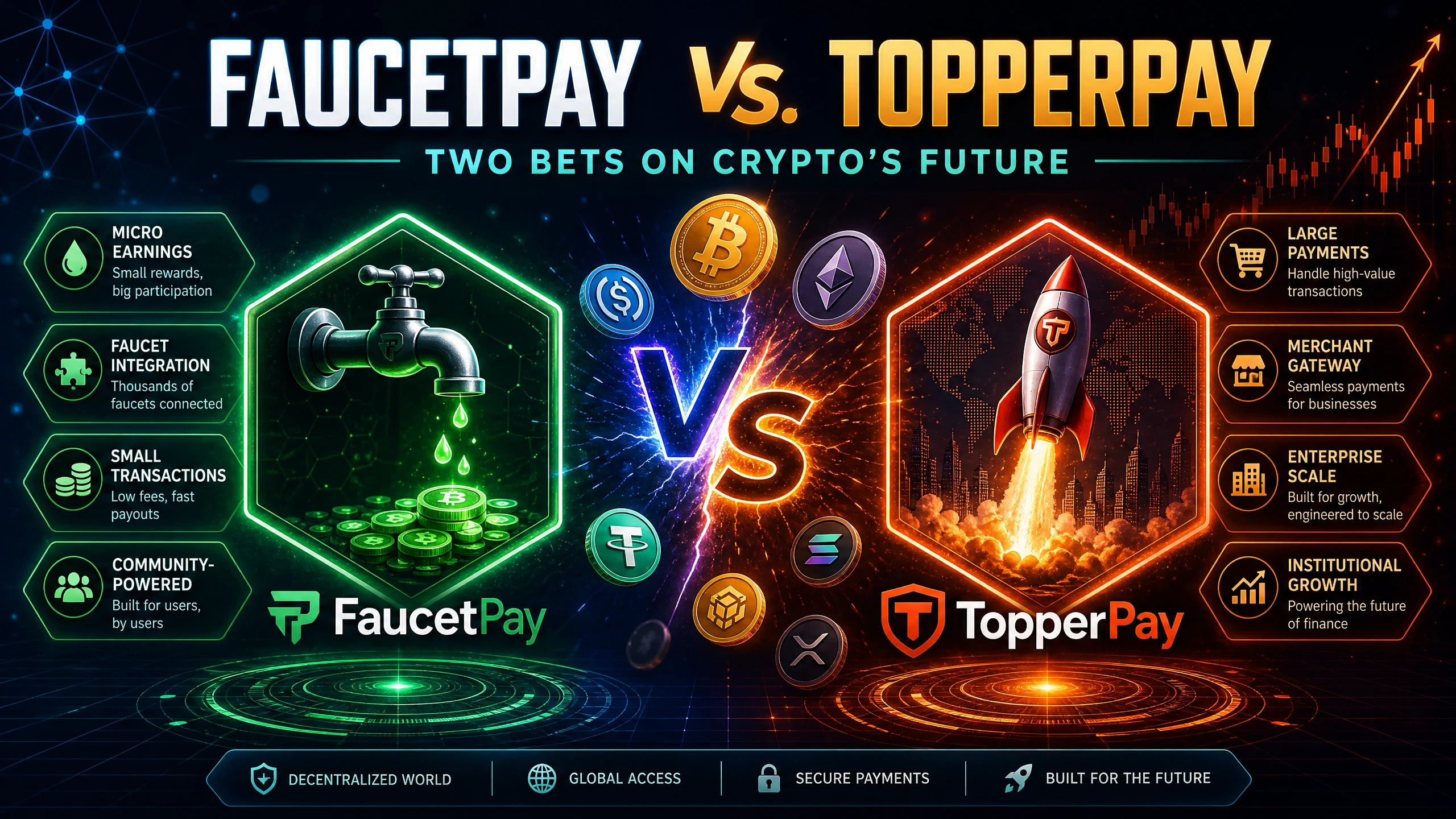
Crypto is being built from two different directions at once. On one side, platforms are turning small crypto rewards into a habit-forming earning economy. On the other, payment infrastructure is being rebuilt so merchants in tough industries can actually accept money. FaucetPay and TopperPay sit on opposite ends of that spectrum, and comparing them says a lot about where crypto payments are headed next.
FaucetPay is a crypto micro-wallet built for faucet users, PTC earners, and small-scale crypto trading, not a payment gateway for businesses. TopperPay is a high-risk payment gateway built for merchant accounts in tough verticals like Casino Payment, iGaming Payment, and forex payment. One bets on mass crypto adoption through micro-earning; the other bets on crypto and card payment processing becoming standard for offshore merchants. Pick based on whether you’re earning crypto or accepting it.
What Is FaucetPay?
FaucetPay is a cryptocurrency micro-wallet and micro-payment platform built around one core job: consolidating tiny crypto rewards into one place. It was designed for people who earn small amounts of crypto from faucets, paid-to-click (PTC) sites, surveys, and simple games, then want to store, swap, or withdraw those earnings without losing most of the value to network fees.
The platform supports a wide range of cryptocurrencies, including Bitcoin, Ethereum, Litecoin, Dogecoin, and several altcoins, alongside a built-in exchange for quick swaps between them. It’s positioned less as a business-facing tool for online payments and more as an entry point into digital payments for crypto beginners.
Core FaucetPay features:
- Multi-currency wallet supporting major coins and several altcoins
- Instant crediting of micro-earnings from partner faucets and PTC sites
- Built-in exchange for swapping between supported coins
- API integration for faucet operators and earning-site developers
- Two-factor authentication and IP-based security layers
- Affiliate program with referral commissions
FaucetPay isn’t built for merchants, invoicing, or checkout flows. It’s a consumer-side tool for people dipping into crypto trading and micro-earning rather than a payment provider for e-commerce.
What Is TopperPay?
TopperPay operates on the opposite side of the payments stack. It’s a high-risk payment gateway built for businesses, particularly those that traditional processors turn away. TopperPay markets itself around fast merchant services onboarding, multi-currency support across 150+ currencies, and fraud protection tools suited to volatile, chargeback-heavy industries.
Where FaucetPay helps individuals collect crypto, TopperPay helps companies get paid, through cards, digital wallets, and, in some setups, crypto rails, while managing the compliance load that comes with high-risk merchants and offshore merchants account structures.
Core TopperPay features:
- PCI DSS Level 1 certified transaction processing
- Support for 150+ currencies, local and international cards, and digital wallets
- API, SDK, and plugin integrations for platforms like Shopify, WooCommerce, and Magento
- Fraud tools: 3D Secure 2.0, risk scoring, velocity checks, geo-fencing, device fingerprinting
- Fast onboarding for high-risk merchant account categories
- Support for cross-border payments and multi-region settlement
TopperPay’s positioning leans heavily into verticals other payment providers avoid, Casino Payment, iGaming Payment, forex payment and forex trading platforms, and other regulated or reputationally sensitive sectors where finding a stable merchant account is the real bottleneck.
FaucetPay vs TopperPay: Core Differences
| Category | FaucetPay | TopperPay |
|---|---|---|
| Primary user | Individual crypto earners | Merchants and platform operators |
| Core function | Micro-wallet + micro-payments | Payment gateway + processing |
| Payment types | Crypto only (BTC, ETH, LTC, etc.) | Cards, wallets, multi-currency, optional crypto |
| Risk focus | Low-value personal transactions | High-risk, high-chargeback business verticals |
| Compliance | Basic 2FA, IP verification | PCI DSS Level 1, KYC/KYB-driven onboarding |
| Best for | Faucet users, PTC earners, hobbyist crypto | Casino, iGaming, forex, offshore merchants |
| Business use case | Minimal, not built for checkout | Core use case, built for payment processing at scale |
The comparison isn’t really “which is better.” They solve different problems inside the same broader crypto economy, one is consumer-facing alternative payment methods, the other is business-facing infrastructure.
Which One Fits Your Crypto Strategy?
If You’re Earning, Not Selling
FaucetPay fits people accumulating small crypto amounts from faucets, offerwalls, or referral programs. It’s not a tool for running a business, there’s no invoicing, no merchant dashboard, and no support for payment gateways-style checkout integration. Think of it as a holding tank for micro-earnings before a larger withdrawal.
If You’re Running a High-Risk or Offshore Business
TopperPay is built for the other side of the table. Businesses in Casino Payment, iGaming Payment, forex, and other high-chargeback categories often get declined by mainstream payment providers. TopperPay’s pitch is fast approval, multi-currency online payments support, and fraud tooling designed specifically for that risk profile, plus the cross-border payments infrastructure needed to serve international customers from an offshore merchants setup.
If You Need Both
Some businesses, particularly those touching crypto payments directly, like exchanges or trading platforms, may need consumer-side crypto tools and a compliant merchant account simultaneously. In that case, the two aren’t competitors; they’d sit in different parts of the stack entirely.
The Bigger Picture: Two Bets on Crypto’s Future
FaucetPay is betting that mass crypto adoption grows from the bottom up, small, frequent, low-friction earnings that get people comfortable holding and trading digital assets. TopperPay is betting that crypto’s future is decided from the top down, by whether merchants in difficult industries can find reliable payment processing and stop being locked out of the financial system.
Both bets are reasonable. Micro-earning platforms build familiarity with digital payments at the consumer level, while high-risk payment gateways determine whether entire industries, gambling, forex, adult, nutraceuticals, can operate with any financial stability at all. Neither model replaces the other; together they represent two different layers of the same maturing crypto economy.
FAQ
Is FaucetPay a payment gateway for businesses?
No. FaucetPay is a consumer-facing crypto micro-wallet built for individuals earning small amounts from faucets and PTC sites, not a payment gateway for merchant checkout.
Can I use TopperPay for crypto payments specifically?
TopperPay’s core offering is card and multi-currency payment processing, with crypto support offered as an optional add-on rather than the primary rail.
Which platform works for high-risk merchants like casinos or forex brokers?
TopperPay is built for that use case, offering high-risk merchant account onboarding, fraud tooling, and multi-currency support for Casino Payment, iGaming Payment, and forex payment businesses.
Does FaucetPay charge high fees?
FaucetPay is generally positioned around low, flexible withdrawal fees, since it’s designed for micro-transactions where high fees would erode small earnings.
Is TopperPay suitable for offshore merchants?
Yes. TopperPay markets fast onboarding and multi-currency, cross-border processing aimed at offshore merchants account structures that mainstream processors typically decline.
Do either of these platforms support fiat currency?
TopperPay supports fiat cards and 150+ currencies alongside optional crypto. FaucetPay operates primarily in cryptocurrency, though it supports swapping between coins internally.
Which is safer to use?
Both apply layered security, FaucetPay uses 2FA and IP verification for individual accounts, while TopperPay applies PCI DSS Level 1 standards and KYC/KYB checks for merchant onboarding, reflecting their different risk exposure.
Comments
No comments yet. Be the first to share your thoughts.
Leave a comment