
TL;DR:
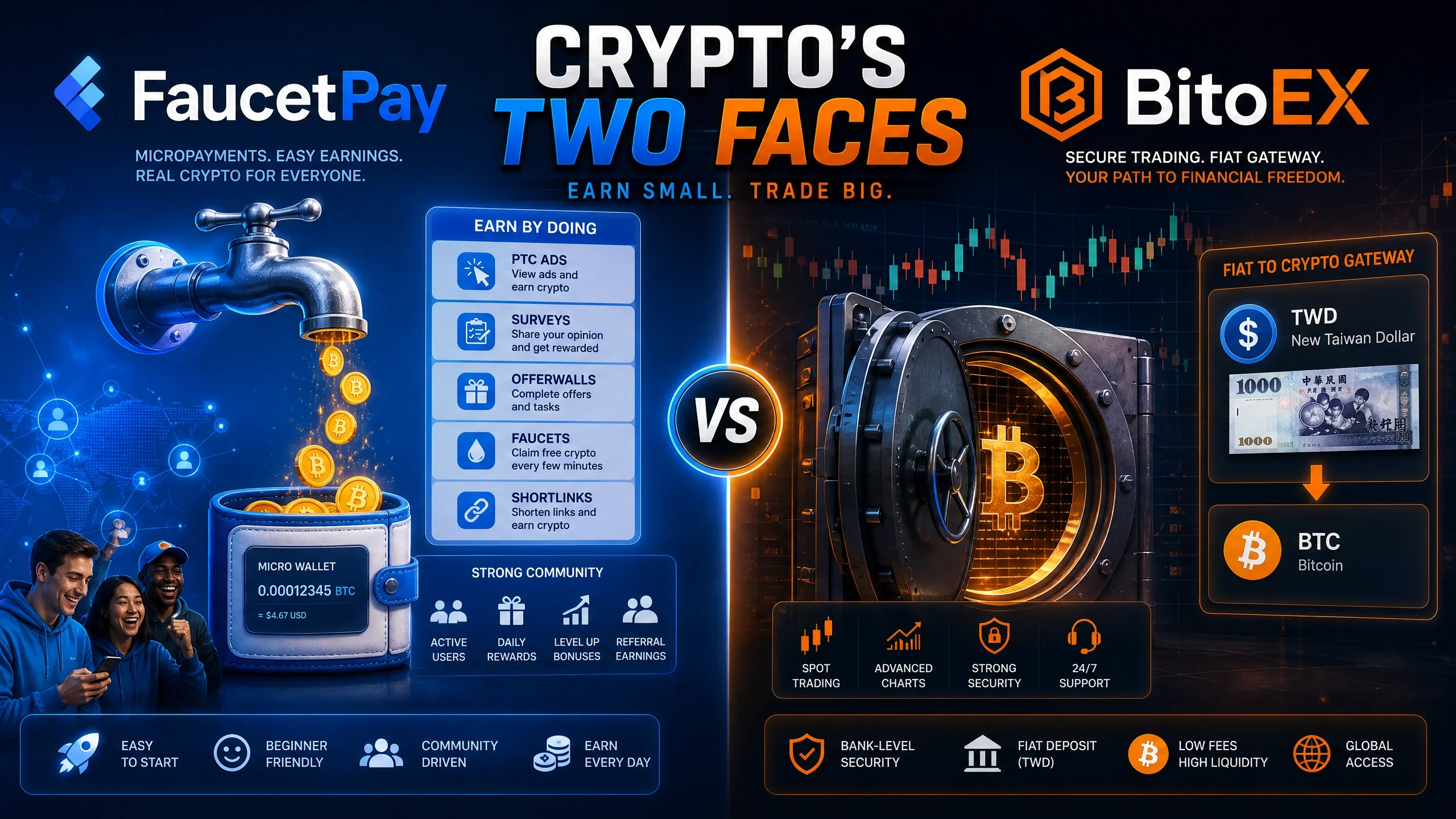
FaucetPay pays users in fractions of a cent. BitoEX moves tens of millions a day on one of Taiwan’s largest exchanges. Same asset class, two entirely different economies.
A student collecting 40 satoshis from a captcha and a Taipei trader moving six figures are both “using crypto payments”, but almost nothing else about their experience matches. That gap is what makes FaucetPay and BitoEX worth comparing: not as competitors, but as proof that crypto payment infrastructure quietly runs two parallel markets, penny-scale and national-scale, served by payment providers with almost nothing in common.
What FaucetPay Actually Is
FaucetPay is a web-based cryptocurrency micro-wallet, launched in 2018 and built specifically for users earning small amounts of crypto from faucets, paid-to-click sites, offerwalls, and other microtask platforms. Its core job is aggregation: instead of a faucet site sending you a fraction of a cent directly to your personal wallet, where blockchain network fees can exceed the value of the payment itself, FaucetPay collects those drips in one account and lets you withdraw the accumulated balance in a single transaction once it’s worth moving.
A few verifiable facts about how it works:
- FaucetPay supports multiple cryptocurrencies including Bitcoin, Ethereum, Litecoin, Dogecoin, Dash, Bitcoin Cash, and Tether, among others.
- It offers instant micropayments from hundreds of partner sites, with no wait time, and includes a built-in exchange so users can swap between supported coins without leaving the platform.
- Its fee structure is deliberately flexible, letting users choose between withdrawal speed and lower fees depending on what they’re optimizing for.
- The platform isn’t purely passive: users can earn beyond faucets through tasks, referrals, and affiliated programs, and reviewers note a referral program paying meaningful commission on referred users’ earnings.
What FaucetPay is not is a licensed exchange, a bank, or a merchant services provider in any conventional sense. It’s infrastructure for an economy built on volume rather than value, where the unit of measure is thousands of transactions worth fractions of a cent, not a handful of transactions worth thousands of dollars.
What BitoEX Actually Is
BitoEX sits at the other end of the spectrum entirely. BitoGroup operates both the BitoPro crypto exchange and the BitoEX crypto wallet, and together they represent one of Taiwan’s most established digital-asset businesses. BitoEX has been ranked number one in Bitcoin market share in Taiwan, and its footprint extends well beyond online trading:
- The company reports more than 20% monthly growth in Bitcoin trades conducted via convenience stores, a distribution channel that has no real equivalent in most Western crypto markets, where 7-Eleven and FamilyMart locations function as informal on-ramps for cash-to-crypto conversion.
- BitoPro has over 800,000 users and holds an ISO 27001 certification for its security infrastructure, with daily trading volumes that fluctuated between $10 million and $60 million in mid-2025.
- The exchange states it has completed Taiwan’s anti-money-laundering declaration process as part of its push toward regulatory compliance.
- Taiwan itself occupies a middle ground regulatory-wise: the island has not imposed formal cryptocurrency regulation, but its Financial Supervisory Commission actively monitors exchange operators, and the newer standard framework requires exchanges to be licensed and regulated for anti-money-laundering and know-your-customer compliance.
One disputed-claim flag worth stating plainly: some third-party security scoring sites rank BitoPro respectably but not at the top tier of global exchanges (one cites a CertiK Skynet score placing it around 52nd among rated exchanges), a data point worth knowing, but sourced from a single ranking methodology rather than a regulatory finding, so it shouldn’t be read as a definitive safety verdict.
BitoEX, in short, is built for online payments and trading at real economic scale, closer in spirit to a national payment gateway than to a wallet app.
The Core Argument: Crypto Payments Aren’t One Market
1. Micro-earning economies solve a problem legacy finance never bothered with
FaucetPay’s entire reason for existing is a problem that traditional payment processing systems never had to solve: how do you pay someone a fraction of a cent, thousands of times, without the transaction fee eating the payment? Card networks and bank rails aren’t built for that use case at all, a $0.001 payout isn’t just unprofitable to process, it’s often technically impossible below certain minimums. Crypto, and specifically a micro-wallet layer like FaucetPay sitting on top of it, makes that kind of payment mathematically viable for the first time. That’s not a niche curiosity; for users in regions with weak currencies or limited access to conventional merchant accounts, faucet and offerwall earnings can be a genuine, if modest, source of income.
2. National-scale exchanges solve a completely different problem: trust at volume
BitoEX’s challenge is the opposite one. When you’re moving $10-60 million a day, the question isn’t “can this micro-payment clear cheaply”, it’s “can users trust that their funds, custody, and compliance obligations are handled correctly at scale.” That’s why BitoEX invests in ISO certification, AML declarations, and physical distribution through convenience stores rather than in shaving fractions of a cent off transaction costs. It’s playing in the same regulatory conversation as cross-border payments infrastructure and licensed payment wallets, not the micro-earning space FaucetPay occupies.
3. “High-risk” means something different at each end
Both platforms carry risk labels that outsiders often lump together as “crypto risk,” but the actual risks are distinct:
- FaucetPay’s risk profile: is mostly about the surrounding ecosystem: faucet and offerwall sites vary wildly in legitimacy, and a wallet aggregating from hundreds of third-party sources inherits some of that variance. It’s a pattern familiar from high-risk payment gateway territory generally, the platform itself can be sound while some upstream sources are not.
- BitoEX’s risk profile: is closer to that of any exchange operating in a market without a fully formalized licensing regime: strong on operational security, but operating in a jurisdiction where, as of recent reporting, the rules are still catching up to the market’s size.
Neither risk profile is disqualifying, but they call for different due diligence, checking a faucet site’s reputation before linking it to FaucetPay versus checking an exchange’s compliance history before depositing meaningfully large sums into BitoEX.
4. The pain point crypto-curious readers actually have
For most people exploring crypto payments for the first time, the practical question isn’t “which platform is bigger”, it’s “which platform matches what I’m actually trying to do.” That’s the user-facing problem both companies solve, just for opposite audiences:
- If your problem is “I earn tiny amounts and fees eat my earnings,” a micro-wallet aggregation model like FaucetPay’s is the solution: pool small payments, withdraw once.
- If your problem is “I need to trade or hold meaningful value and want regulatory-grade infrastructure,” a national-scale exchange like BitoEX’s BitoPro is the solution: licensed-adjacent compliance, large liquidity, and mainstream distribution.
Mixing the two up, treating a micro-earning wallet like a trading exchange, or expecting a national exchange to handle sub-cent digital payments efficiently, is where most crypto-curious users get frustrated.
The Counterpoint
The steelman case against this whole “two economies” framing: maybe it’s overstated, and crypto payments are actually converging rather than splitting. Stablecoins, faster settlement layers, and platforms that increasingly blend earning, wallet, and trading functions (BitoEX itself offers both a wallet and a full exchange under one group) suggest the line between “micro-earning tool” and “national trading platform” could blur over time as infrastructure improves and fees keep dropping industry-wide.
That’s a fair point about the direction of travel, infrastructure genuinely is converging. But convergence in the plumbing doesn’t erase convergence in the audience, at least not yet. A user earning fractions of a cent from a faucet site isn’t, in practice, migrating toward six-figure trades any time soon, and a Taiwan-based day trader using BitoPro has no reason to route earnings through a micro-wallet built for offerwall aggregation. The rails may eventually merge; the economic classes using them, for now, remain distinct, which is exactly why both platforms exist as separate products rather than one company doing both jobs.
Comparison Table
| Dimension | FaucetPay | BitoEX (BitoGroup / BitoPro) |
|---|---|---|
| Core offering | Crypto micro-wallet and earning aggregator | Crypto wallet + licensed-adjacent trading exchange |
| Typical transaction size | Fractions of a cent to a few dollars | Hundreds to hundreds of thousands of dollars |
| Primary geography | Global, concentrated among faucet/PTC users | Taiwan-based, expanding regionally |
| Regulatory posture | Wallet-level service; no formal exchange license disclosed | AML-declared exchange operating under Taiwan’s evolving VASP framework |
| Distribution channel | Faucet sites, PTC ads, offerwalls, referrals | Web/app trading plus convenience-store cash-to-crypto on-ramps |
| Security signal | User-controlled balances, low-value exposure by design | ISO 27001 certified, ~800,000 users, no disclosed major hack |
| Best fit for | Users earning small, frequent crypto rewards | Users trading or holding meaningful crypto value |
Takeaway for Crypto-Curious Readers
Don’t evaluate FaucetPay and BitoEX by the same yardstick, they’re not solving the same problem, and neither is “better” in the abstract. If your entry point into crypto is earning small amounts through faucets, PTC ads, or offerwalls, a micro-wallet aggregator solves the fee problem that would otherwise make those earnings worthless. If your entry point is trading, holding, or moving meaningful value, especially across borders, you want the kind of licensing, liquidity, and security posture that a national-scale exchange like BitoPro is built around. Match the platform to the actual size and purpose of your transaction, and most of the friction crypto-curious readers run into disappears.
Open question worth sitting with: as crypto payment infrastructure matures, will micro-earning platforms and national exchanges keep serving separate economic classes indefinitely, or will falling fees and better settlement rails eventually pull the “penny economy” and the “trading economy” onto the same platforms? If you’ve used either type of service, we’d like to hear where you think that line actually sits.
Comments
No comments yet. Be the first to share your thoughts.
Leave a comment