
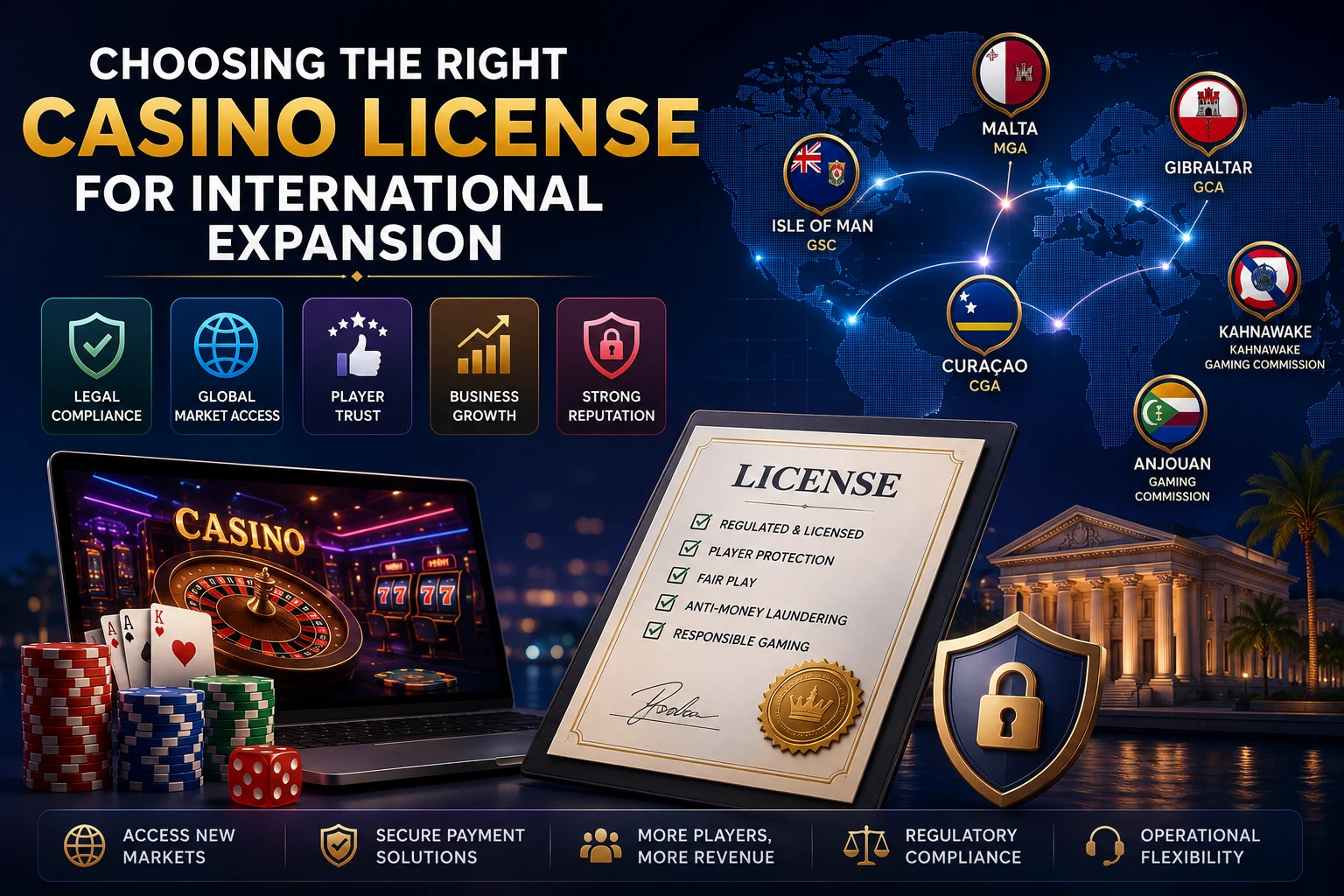
Choosing a casino license for international expansion is really two decisions in one: which jurisdiction lets you legally operate, and which one actually supports live dealer content and gets you working payment gateways. Some markets go further than most operators expect, Connecticut, for instance, requires live dealer games to be conducted from a studio physically located within the state. Get the license-to-infrastructure fit wrong, and you can end up legally operational but functionally unable to run the live dealer product your business is built around.
If you’re researching this, you’re likely past “should we expand internationally” and into the harder question: which license actually supports the specific product, live dealer casino, you’re planning to scale, and which one will get you a working merchant account rather than a legal status with no functioning payment infrastructure behind it. That’s a more specific question than most licensing guides answer, and it’s the one this article is built around.
Why Live Dealer Content Changes the Licensing Calculus
A license that’s perfectly adequate for RNG slots can be genuinely insufficient for live dealer content, because several jurisdictions impose additional, live-specific requirements that don’t apply to standard digital casino games. Some US states restrict live dealer content outright or impose additional certification requirements beyond standard RNG game testing. Connecticut’s regulations go further still, requiring all live online casino gaming to be conducted in a secure live game environment physically located within the state itself, a studio-location requirement that has no equivalent for RNG content. Italy requires ADM (Agenzia delle Dogane e dei Monopoli) certification specifically for live dealer operations, a separate compliance track from general online casino licensing. This means the “which license” question for a live-dealer-focused operator isn’t just about legal market access, it’s about whether the jurisdiction’s technical standards and studio requirements are even compatible with how you plan to deliver the product.
The Major Jurisdictions Compared for Live Dealer Expansion
Malta (MGA) – Broadest Live Dealer Studio Compatibility
The Malta Gaming Authority remains the most globally recognized regulator, and its Licensee Obligations framework is one of the standard references vendors and operators use for live dealer compliance specifically. As of 2026, a single MGA license can cover casino, betting, and poker under one umbrella rather than requiring separate licenses per game type.
- Cost: Roughly €25,000-€100,000+ in direct fees, often €150,000-€300,000+ including legal, compliance, and banking setup.
- Timeline: 6-12 months.
- Live dealer fit: Strong, major studio operators (Evolution, Pragmatic Play Live, Playtech Live, Ezugi) build compliance references around MGA standards by default, meaning studio and content availability is rarely a bottleneck here.
United Kingdom (UKGC) – Required for UK Market Access, With Its Own Live Dealer Standards
The UK Gambling Commission publishes its own Remote Technical Standards with live-specific compliance requirements, and it’s the strictest license on this list, not optional if the UK market is part of your expansion plan.
- Cost: $100K+, with a 21% gaming duty.
- Live dealer fit: Strong technical framework, but higher compliance overhead than Malta specifically for live studio operations.
United States – Fragmented, State-by-State, and Genuinely Restrictive for Live Dealer
Online casino gaming, including live dealer, is legal in only about seven US states as of the most recent count, New Jersey, Pennsylvania, Michigan, West Virginia, Connecticut, Delaware, and Rhode Island, each with its own licensing authority, game certification requirements, and in some cases studio-location rules. This is the most operationally demanding jurisdiction group on this list for live dealer specifically, given requirements like Connecticut’s in-state studio mandate, and it requires configuring content libraries differently per state rather than treating US expansion as a single market.
Curaçao – Accessible, But Currently in Regulatory Transition
Curaçao has issued online gaming licenses since 1993 and remains one of the most cost-effective options, but its framework changed under a new National Ordinance on Games of Chance (LOK) effective December 24, 2024, and application processing has been reported as intermittently affected during the transition. This is worth verifying directly with current Curaçao licensing channels before building a timeline around it, particularly if live dealer studio approval is part of your plan.
- Cost: Roughly €65,000-€90,000, reported elsewhere as $50,000-$200,000 post-reform.
- Live dealer fit: Workable, but less consistently referenced in major studio vendors’ compliance documentation compared to Malta or the UK.
Anjouan and Similar Fast/Budget Jurisdictions – Speed at the Cost of Studio and Banking Fit
Anjouan offers the fastest, cheapest path to a license among major jurisdictions, but independent comparisons consistently note payment-processor friction as a real trade-off, a factor that compounds for live dealer operators, since studio vendors and payment providers alike weigh jurisdiction reputation into their own risk models.
Payment Infrastructure Fit: The Factor Most Licensing Guides Skip
Your license doesn’t just determine legal market access, it directly shapes which payment gateways and merchant services providers will actually work with you. Premium jurisdictions like Malta and the UK typically open relationships with mainstream-adjacent acquirers and established high-risk payment gateway providers. Budget or fast-track jurisdictions often mean leaning more heavily on crypto payments and specialist offshore merchants account relationships from day one, since some payment providers weigh jurisdiction reputation directly into their own underwriting.
This matters even more for live dealer than for RNG-only operations: live dealer’s higher average transaction values and real-time settlement expectations mean your payment infrastructure needs to work reliably from launch, not after a licensing-to-payments mismatch gets discovered mid-scale.
Pros and Cons Summary
Premium jurisdictions (Malta, UKGC):
- Strongest live dealer studio compatibility and banking/payment relationships
- Highest credibility with investors, studio vendors, and enterprise partners
- High cost and long timelines, not viable pre-revenue for most startups
US state-by-state licensing:
- Access to a large, high-value regulated market
- Genuinely fragmented, separate compliance, content certification, and in some cases studio-location requirements per state
- Limited to roughly seven states currently, requiring careful market prioritization
Curaçao and similar mid-tier jurisdictions:
- Reasonable cost-to-credibility ratio
- Currently in regulatory transition (LOK reform), verify current application status directly before planning around it
Budget/speed jurisdictions (Anjouan and similar):
- Fastest, cheapest path to legal operation
- Real payment-processor friction reported across independent sources, plan your cross-border payments strategy around this limitation from day one
Playing Strategy for International Expansion
- Map your product to jurisdiction requirements first: If live dealer is core to your offering, filter out jurisdictions with studio-location or certification requirements incompatible with your operational plan before evaluating cost or timeline.
- Treat payment infrastructure fit as a licensing criterion, not a downstream detail: Ask prospective payment providers directly which jurisdictions they support before finalizing a license choice, not after.
- Consider a two-license sequencing strategy: Many operators use a fast, affordable license to reach revenue quickly, then add a premium license (Malta, UK) once the business can absorb the cost, specifically to unlock stronger studio partnerships and banking relationships.
- Verify jurisdiction-specific technical standards early: especially for live dealer, Italy’s ADM certification and Connecticut’s studio-location rule are the kind of requirements that are far cheaper to plan for upfront than to retrofit after a studio is already built.
- Build payment redundancy into your expansion plan from the start: since a single offshore merchant account or acquiring relationship tied to one jurisdiction creates the same single-point-of-failure risk as relying on one license for your entire global strategy.
Practical Takeaway
For live dealer operators specifically, the right casino license isn’t just the one that’s fastest or cheapest to obtain, it’s the one whose technical standards, studio requirements, and payment-provider relationships actually match how you plan to deliver the product. Malta and the UK offer the broadest compatibility with major live studio vendors and established payment infrastructure; US state licensing offers access to a lucrative but genuinely fragmented market with real studio-location requirements in some states; and budget jurisdictions trade speed for payment-processor friction that shows up later if it isn’t planned for upfront. Map your product requirements to jurisdiction fit before cost or timeline, and the rest of the expansion decision gets considerably clearer.
Comments
No comments yet. Be the first to share your thoughts.
Leave a comment