
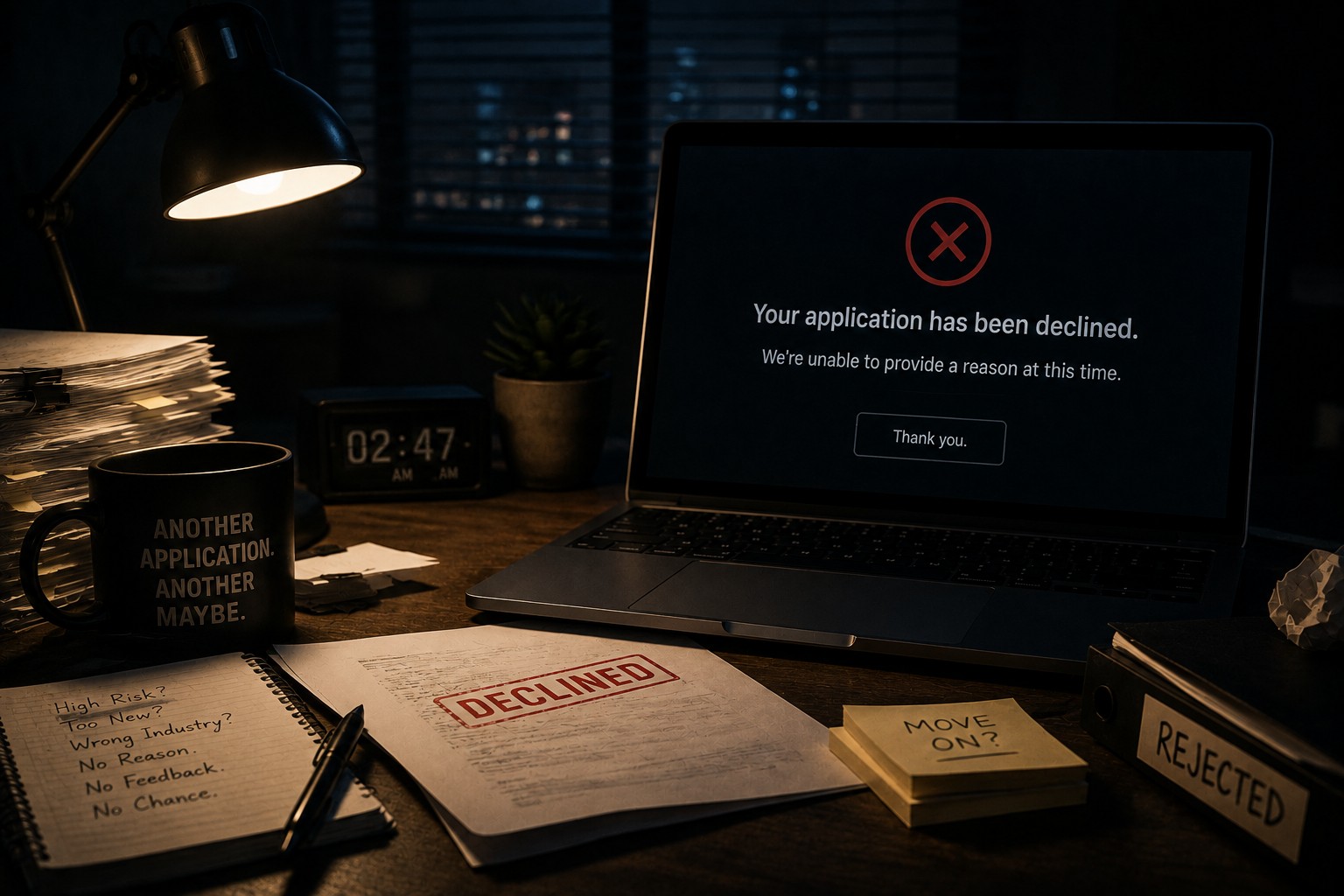
The email arrives on a Thursday. It’s four sentences long. It says the account has been placed under review. It says funds will be held pending the outcome of that review. It says the merchant will be notified of any updates. It does not say what triggered the review, what the actual concern is, or what — if anything — the merchant could do differently to resolve it.
This is not a rare email. Versions of it land in inboxes across the payments industry every single day, and the strangest part isn’t that it happens. It’s that it’s almost always, technically, allowed to happen exactly this way.
The Silence Is a Feature, Not a Bug
Here’s the thing nobody tells merchants going in: payment processors are, in most jurisdictions and under most contracts, under no legal obligation to explain a hold or termination in detail. The contract you signed — the one you skimmed past on your way to the “I agree” button — almost certainly contains language granting the processor broad discretion to review, hold, or close an account for “risk management purposes,” full stop, no further explanation required.
This isn’t necessarily malicious. There’s a real, defensible reason the industry operates this way: detail invites gaming. If a processor told every flagged merchant exactly which fraud signal tripped the alarm — “your IP-to-billing-address mismatch rate crossed 4%” or “your late-night transaction clustering pattern resembles known card-testing behavior” — bad actors would simply adjust their behavior to avoid that exact signal next time, while legitimate businesses gain almost nothing from the specificity beyond peace of mind. Fraud detection, at scale, depends partly on the fraudster not knowing precisely what the detector is looking for.
So the industry has settled into a kind of institutionalized vagueness. “Under review” can mean an actual fraud pattern was detected. It can also mean a risk model flagged a false positive. It can mean a compliance officer had a slow afternoon and decided to double-check a file that had been sitting untouched for months. From the outside, every one of these looks identical: four sentences, no specifics, a hold on the money.
What This Does to a Business
Put yourself in the merchant’s position for a second, because the abstraction of “an account got reviewed” undersells what this actually feels like in practice. Revenue that was supposed to arrive doesn’t. Payroll might be due in six days. A vendor is expecting payment in ten. And the only information available is a four-sentence email that offers nothing actionable — no checklist, no timeline commitment beyond vague reassurance, no name of a specific person to call who actually has authority to move things faster.
The instinct, understandably, is to escalate — call support, email a manager, ask pointed questions. Sometimes this works. Often, the answer that comes back is a slightly longer, equally uninformative version of the original email: “our team is actively reviewing your account, we appreciate your patience, we will update you as soon as we have more information.” This is not necessarily a lie. It might be the literal, honest truth — the review genuinely might not be finished — but it’s also functionally indistinguishable from a stall, and the merchant has no way to tell the difference from where they’re sitting.
The Asymmetry Nobody Talks About
Here’s the part of this story that’s genuinely worth sitting with: the processor holds all the information, and the merchant holds all the consequences. The processor knows exactly what triggered the review. The processor knows roughly how long these reviews typically take. The processor knows whether this is a routine periodic check or a serious red-flag investigation. The merchant knows none of this, and is the only party actually bleeding cash flow while it gets sorted out.
This asymmetry isn’t evenly distributed across the industry, either. Larger merchants — the ones processing meaningful volume, the ones a processor genuinely doesn’t want to lose — tend to get faster answers, named contacts, and real timelines. Smaller merchants, the ones easiest to deprioritize, are far more likely to get the four-sentence email and then silence. The system isn’t designed this way explicitly, but it behaves this way in practice, because attention, like everything else in a business, gets allocated toward whoever represents the bigger number.
What Actually Helps (And What Doesn’t)
Threatening legal action rarely accelerates anything and can sometimes slow it down, since it often triggers a formal legal-review process that’s even slower than the original compliance review. Escalating loudly and repeatedly, without new information to offer, mostly just adds noise to a queue that’s already processing on its own timeline.
What tends to actually help: providing more documentation than was asked for, proactively — transaction records, customer communications, anything that could plausibly address a concern the merchant doesn’t even know exists yet, on the theory that more relevant information shortens a review faster than more pressure does. It also helps, uncomfortably, to have maintained a genuinely clean processing history before this moment — because reviews of merchants with strong track records tend to resolve faster than reviews of merchants without one, precisely because there’s more evidence already on file working in their favor.
The Uncomfortable Truth This Points To
The real lesson of “the account that never got a reason” isn’t a tactic. It’s a recognition: in this industry, opacity is structural, not incidental. It exists because transparency has real costs (easier fraud evasion) alongside its obvious benefits (merchant trust and clarity), and the industry has, collectively, decided the trade-off favors opacity most of the time.
That doesn’t make it feel any better at 11pm on day four of a hold, watching a payroll deadline get closer with no real information to act on. But it does reframe the experience slightly — from “something is uniquely wrong with my business” to “this is what the system looks like from the inside, for almost everyone, almost every time.” Cold comfort, maybe. But comfort that at least points toward the right question, which isn’t “why me,” but “how do I make my file the kind that resolves quickly, before I ever need to find out.”
Comments
No comments yet. Be the first to share your thoughts.
Leave a comment