
Introduction
The rapid rise of digital banking, mobile wallets, online payments, embedded finance, and cryptocurrency has created enormous opportunities for financial innovation. However, this digital transformation has also expanded the opportunities for cybercriminals. Fraud schemes have become increasingly sophisticated, targeting financial institutions, payment providers, merchants, and consumers through identity theft, account takeover, payment fraud, phishing attacks, synthetic identities, and money laundering. Traditional rule-based fraud detection systems often struggle to keep pace with these evolving threats, resulting in delayed detection, false positives, and financial losses.Fintech Fraud Detection AI is transforming the way financial institutions identify and prevent fraud. By using artificial intelligence and machine learning, these systems continuously analyze millions of transactions, detect suspicious behavior in real time, and adapt to emerging fraud patterns without relying solely on predefined rules. AI enables organizations to respond faster, reduce operational costs, improve customer experiences, and strengthen overall financial security.
As digital finance continues to expand globally, AI-powered fraud detection is becoming an essential component of modern fintech infrastructure.
What Is Fintech Fraud Detection AI?
Fintech Fraud Detection AI refers to the use of artificial intelligence, machine learning, and advanced data analytics to identify, prevent, and investigate fraudulent financial activities.
Unlike traditional fraud prevention systems that depend primarily on static rules, AI continuously learns from transaction data, customer behavior, historical fraud cases, and evolving attack patterns.
The technology can recognize subtle anomalies that human analysts or conventional systems may overlook, allowing financial institutions to detect fraud with greater speed and accuracy.
Why AI Is Essential for Fraud Detection
Financial fraud is becoming increasingly complex as criminals use automation, stolen identities, social engineering, and artificial intelligence to bypass conventional security measures.
Rule-based systems are effective for known fraud patterns but often struggle when new attack techniques emerge.
AI solves this challenge by continuously learning from new information. Machine learning models improve over time, enabling them to identify unknown fraud patterns, reduce false alarms, and respond more effectively to changing criminal behavior.
This adaptability makes AI an indispensable tool for modern financial security.
How Fintech Fraud Detection AI Works
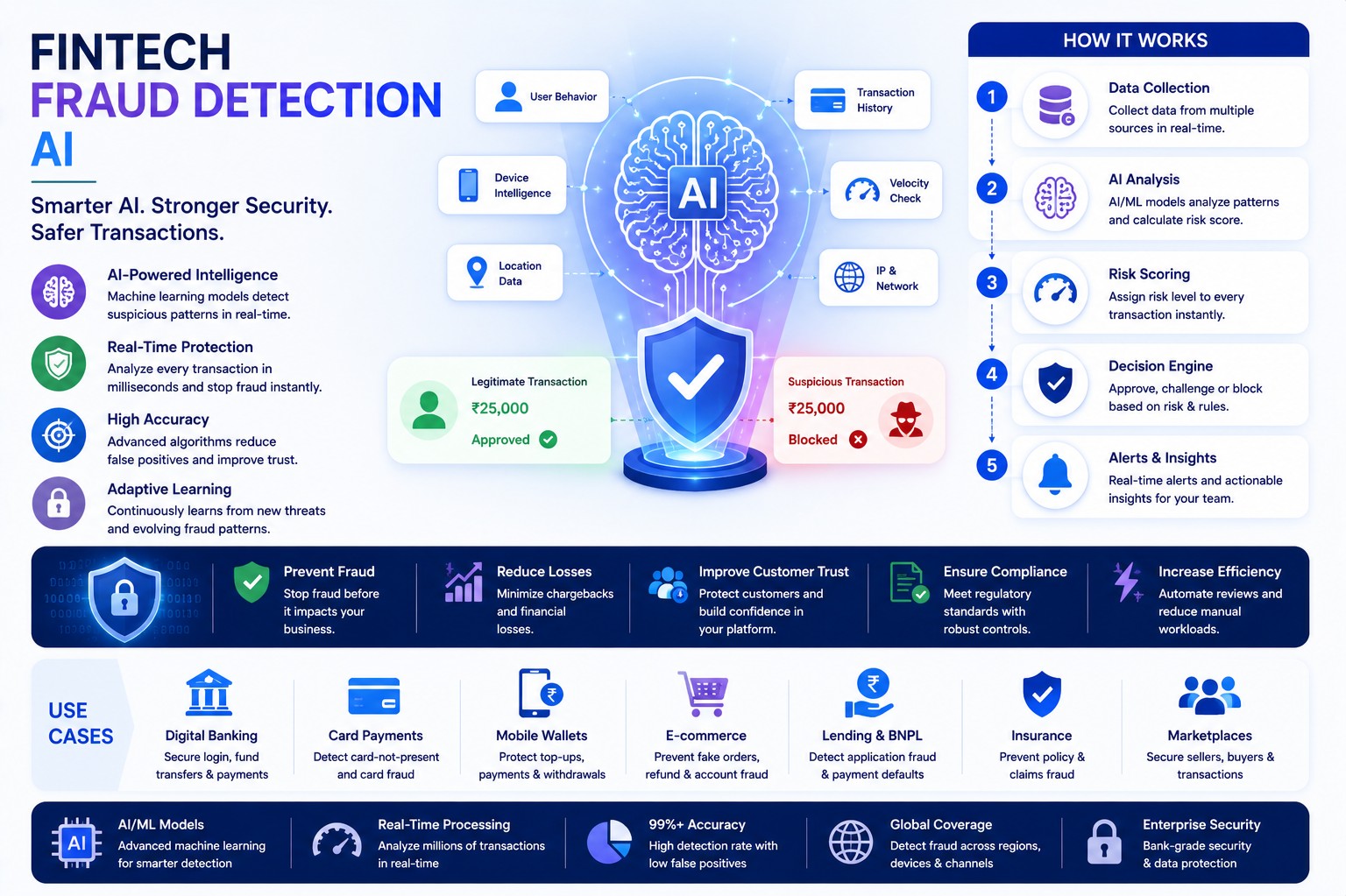
AI-powered fraud detection begins by collecting large volumes of data from payment systems, banking platforms, customer accounts, mobile devices, and transaction histories.
Machine learning algorithms analyze this information in real time, evaluating hundreds of variables such as transaction amount, location, device type, login behavior, spending history, merchant category, IP address, and account activity.
The AI assigns a risk score to each transaction based on detected anomalies. If suspicious activity exceeds predefined thresholds, the system can automatically block the transaction, request additional authentication, or alert fraud analysts for further investigation.
This entire process often occurs within milliseconds, allowing organizations to prevent fraud before financial losses occur.
Key Technologies Behind AI Fraud Detection
Several advanced technologies work together to power fintech fraud detection.
Machine learning enables systems to recognize complex fraud patterns through continuous learning. Behavioral analytics studies how customers normally interact with financial services and identifies unusual activities. Natural language processing helps analyze customer communications for fraud indicators, while computer vision can verify identity documents during onboarding.
Graph analytics identifies hidden relationships between fraudulent accounts, and predictive analytics estimates the likelihood of future fraud based on historical behavior.
These technologies create a comprehensive and intelligent fraud prevention ecosystem.
Common Types of Fraud AI Can Detect
AI helps financial institutions combat a wide range of fraudulent activities.
Payment fraud involving stolen cards or unauthorized transactions can be detected through unusual spending behavior. Account takeover attempts are identified by monitoring abnormal login patterns and device changes. AI also helps identify identity theft, synthetic identity fraud, phishing attacks, money laundering activities, merchant fraud, chargeback abuse, and suspicious peer-to-peer transfers.
By monitoring multiple fraud scenarios simultaneously, AI provides comprehensive protection across the financial ecosystem.
Real-Time Transaction Monitoring
One of the greatest strengths of Fintech Fraud Detection AI is its ability to monitor transactions in real time.
Every payment, transfer, withdrawal, or account update is analyzed within milliseconds. The system compares each activity against historical customer behavior, known fraud indicators, and industry-wide threat intelligence.
Instant risk assessments allow organizations to stop suspicious transactions before they are completed, reducing financial losses and protecting customer accounts.
Real-time monitoring also enables financial institutions to respond quickly to emerging fraud campaigns.
Behavioral Analytics and Risk Scoring
Every customer has unique financial behavior.
AI learns spending habits, preferred devices, login locations, payment frequencies, transaction sizes, and other behavioral characteristics over time.
When unusual activity occurs such as a large transfer from an unfamiliar device or multiple failed login attempts from another country the AI assigns a higher fraud risk score.
Risk-based authentication enables organizations to apply additional verification only when necessary, balancing strong security with a smooth customer experience.
Benefits for Financial Institutions
Fintech Fraud Detection AI delivers significant operational and financial advantages.
Banks, payment providers, fintech companies, and digital platforms can reduce fraud losses while improving detection accuracy. Automated fraud monitoring decreases the need for manual reviews, allowing fraud teams to focus on high-risk cases.
AI also helps improve regulatory compliance by supporting Anti-Money Laundering (AML) monitoring, Know Your Customer (KYC) verification, and suspicious activity reporting.
Higher detection accuracy and lower false positives ultimately improve customer trust and operational efficiency.
Benefits for Customers
Customers benefit from stronger protection without sacrificing convenience.
AI continuously safeguards accounts against unauthorized access while allowing legitimate transactions to proceed quickly.
Because intelligent systems reduce unnecessary payment declines, customers experience fewer interruptions during online purchases or banking activities.
Faster fraud detection also minimizes financial losses and increases confidence in digital financial services.
AI and Regulatory Compliance
Financial institutions must comply with strict regulations designed to combat financial crime.
AI supports compliance by automating customer due diligence, monitoring suspicious transactions, identifying money laundering patterns, screening sanctions lists, and generating regulatory reports.
Regulatory technology (RegTech) solutions powered by AI reduce compliance costs while improving reporting accuracy and audit readiness.
This allows organizations to manage regulatory obligations more efficiently as financial regulations continue to evolve.
Challenges of AI Fraud Detection
Despite its many advantages, AI implementation requires careful planning.
Machine learning models depend on high-quality data to produce accurate results. Organizations must ensure data privacy, eliminate algorithmic bias, maintain transparent decision-making, and regularly update models as fraud techniques evolve.
Financial institutions also need skilled professionals to manage AI systems and interpret complex fraud analytics.
Balancing automation with human oversight remains essential for effective fraud management.
The Future of Fintech Fraud Detection AI
Artificial intelligence will continue reshaping financial security over the coming years.
Future fraud detection platforms will combine generative AI, explainable AI, blockchain analytics, biometric authentication, digital identity verification, and advanced behavioral intelligence into unified fraud prevention systems.
Real-time collaboration between banks, payment providers, regulators, and fintech companies will improve fraud intelligence sharing across the financial ecosystem.
As cyber threats become increasingly sophisticated, AI will remain at the center of financial crime prevention and digital trust.
Choosing the Right AI Fraud Detection Solution
Organizations selecting an AI fraud detection platform should evaluate detection accuracy, machine learning capabilities, real-time monitoring, API integration, scalability, regulatory compliance support, reporting tools, explainable AI features, cloud compatibility, and customer support.
A reliable solution should integrate seamlessly with existing banking and payment infrastructure while adapting continuously to new fraud threats.
Investing in the right AI platform strengthens security, improves operational efficiency, and supports long-term digital growth.
Conclusion
Fintech Fraud Detection AI is revolutionizing financial security by enabling organizations to detect and prevent fraud with greater speed, intelligence, and accuracy than traditional systems. Through machine learning, behavioral analytics, real-time monitoring, and automated risk assessment, AI helps financial institutions protect customers while reducing operational costs and regulatory risks.
As digital banking, online payments, and embedded finance continue to evolve, AI-powered fraud detection will become even more critical for maintaining trust, preventing financial crime, and ensuring secure digital transactions. Organizations that embrace intelligent fraud prevention today will be better equipped to navigate the increasingly complex landscape of modern financial services.
Comments
No comments yet. Be the first to share your thoughts.
Leave a comment