
Introduction
The rapid growth of e-commerce, digital banking, and online payment platforms has created unprecedented convenience for consumers and businesses alike. However, this digital transformation has also opened the door to increasingly sophisticated forms of payment fraud. Among the most common and costly threats facing merchants today are carding attacks.
While many cyberattacks focus on stealing sensitive information, carding attacks are designed to validate stolen payment card details before they are used for larger fraudulent transactions. Often operating behind the scenes, these attacks can generate significant financial losses, increase chargebacks, damage customer trust, and overwhelm payment systems.
As digital transactions continue to rise globally, understanding carding attacks has become essential for merchants, payment service providers, fintech companies, and financial institutions seeking to protect their payment ecosystems.
What Are Carding Attacks?
Carding attacks are a form of payment fraud in which criminals test stolen credit or debit card information by attempting a large number of small online transactions.
The goal is not necessarily to make immediate purchases. Instead, fraudsters want to determine which stolen card credentials remain active and valid. Once a card is successfully verified, it can be used for larger fraudulent purchases, sold on underground marketplaces, or incorporated into broader cybercrime operations.
These attacks are typically automated and executed at scale, allowing criminals to test thousands of compromised cards within a short period.
How Carding Attacks Work
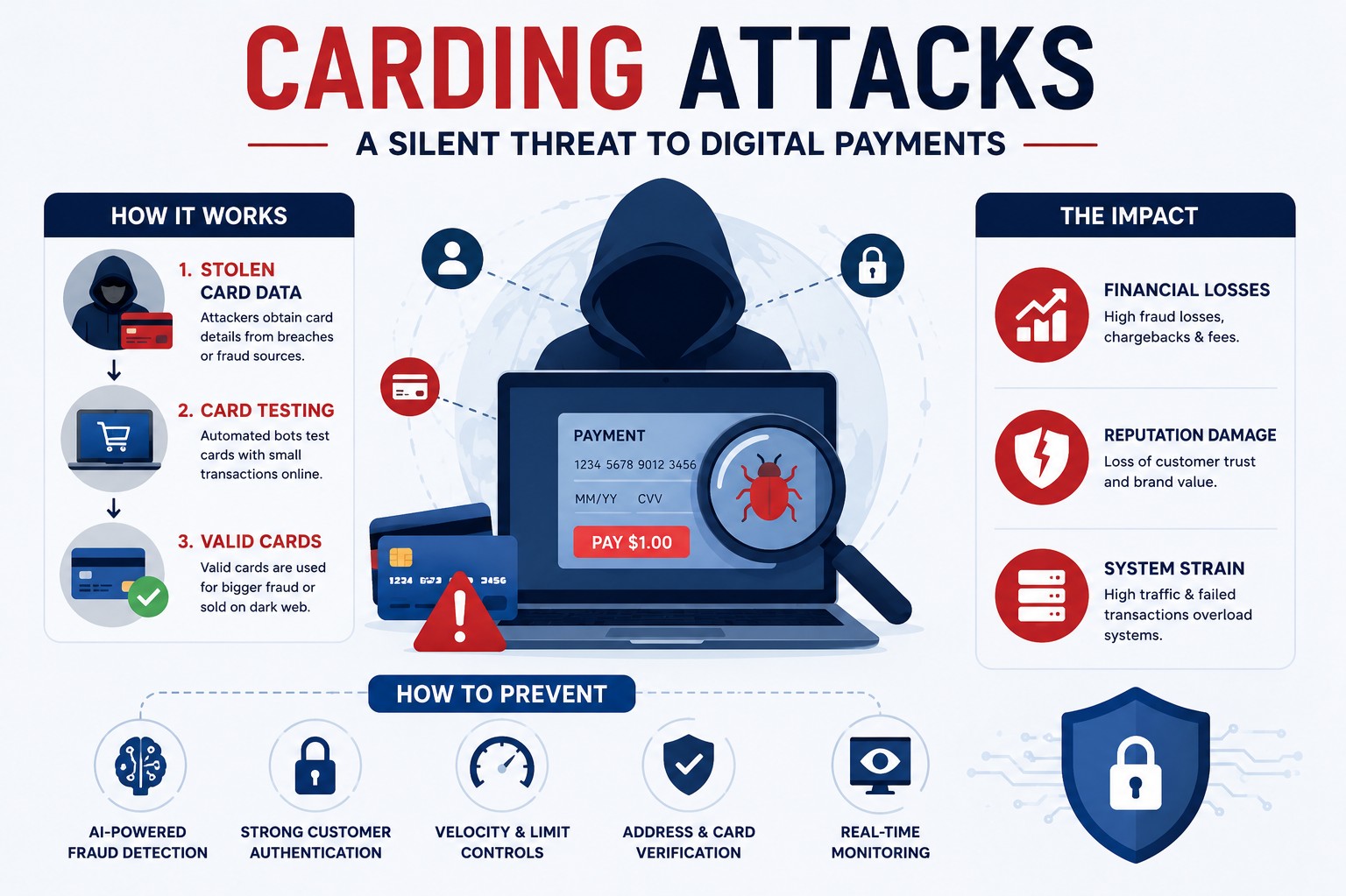
A typical carding attack begins when cybercriminals obtain stolen payment card information through data breaches, phishing campaigns, malware infections, or illicit online marketplaces.
Rather than immediately attempting large purchases, attackers first verify whether the card details are still functional. This is usually done by initiating small-value transactions on websites that lack robust fraud detection mechanisms.
If the transaction is approved, the attacker confirms that the card remains active. Once validated, the card can be exploited for more substantial fraudulent activity.
Because these transactions often involve low amounts, they may initially appear harmless. However, when thousands of transactions are executed simultaneously, the impact can become significant.
Why Carding Attacks Are Increasing
Several factors have contributed to the rise of carding attacks.
The expansion of e-commerce has provided attackers with a vast number of potential targets. Online merchants often prioritize seamless customer experiences, which can sometimes create vulnerabilities in payment processes.
Automation tools have also made carding attacks easier to execute. Fraudsters can deploy bots capable of testing thousands of card numbers rapidly while rotating IP addresses and disguising malicious activity.
Additionally, large-scale data breaches continue to expose payment information, creating a steady supply of compromised credentials that criminals can exploit.
The increasing sophistication of cybercriminal networks has further accelerated the growth of carding activity across global payment ecosystems.
The Impact on Businesses
Carding attacks can create substantial financial and operational challenges for businesses.
One immediate consequence is increased payment processing costs. Even failed transactions often incur fees, meaning merchants may face significant expenses during large-scale attacks.
Businesses may also experience higher chargeback rates when fraudulent transactions succeed. Excessive chargebacks can lead to penalties from payment processors and damage relationships with acquiring banks.
Beyond financial losses, carding attacks can strain website infrastructure and negatively affect customer experiences. Automated transaction attempts may overload systems, resulting in slower performance or service disruptions.
Perhaps most importantly, successful attacks can erode customer trust. Consumers expect businesses to safeguard their payment information, and security incidents can damage brand reputation for years.
Warning Signs of a Carding Attack
Organizations should monitor payment activity for indicators that may signal a carding attack.
Common warning signs include:
- A sudden surge in low-value transactions
- Multiple payment attempts from a single IP address
- High volumes of declined transactions
- Unusual traffic patterns from automated sources
- Repeated attempts using different card numbers
- Increased chargeback activity
Early detection is critical because attackers often move quickly once valid cards are identified.
Preventing Carding Attacks
Preventing carding attacks requires a multi-layered approach that combines technology, monitoring, and security best practices.
One of the most effective defenses is implementing advanced fraud detection systems capable of identifying suspicious transaction patterns in real time. Machine learning models can analyze behavioral indicators and flag potentially fraudulent activity before transactions are completed.
Strong customer authentication mechanisms also help reduce fraud risks. Multi-factor authentication and risk-based verification processes make it more difficult for attackers to exploit stolen card information.
Additional protective measures may include:
- Velocity checks to limit transaction frequency
- CAPTCHA verification to block automated bots
- Address Verification Service (AVS)
- Card Verification Value (CVV) validation
- Device fingerprinting technologies
- Transaction monitoring and analytics
Businesses should continuously review and update security controls as fraud tactics evolve.
The Role of Payment Providers
Payment gateways, acquiring banks, and fintech companies play a crucial role in combating carding attacks.
Modern payment providers increasingly deploy artificial intelligence and machine learning technologies to identify suspicious behavior across large transaction networks. These systems can detect anomalies that individual merchants may overlook.
Collaboration among financial institutions, payment processors, and merchants is also becoming increasingly important. Sharing threat intelligence helps organizations respond more effectively to emerging fraud trends.
As digital payments continue to grow, fraud prevention capabilities are becoming a key differentiator for payment service providers.
Carding Attacks in the Age of AI
Artificial intelligence is reshaping both fraud prevention and fraud execution.
While businesses use AI to strengthen transaction monitoring and threat detection, cybercriminals are also leveraging automation to improve the scale and sophistication of attacks.
This evolving landscape requires organizations to invest in adaptive security solutions capable of responding to increasingly complex threats. Static fraud rules alone are no longer sufficient to address modern attack techniques.
The future of fraud prevention will likely depend on advanced analytics, behavioral intelligence, and real-time risk assessment technologies.
Conclusion
Carding attacks have become one of the most persistent threats facing the digital payments industry. By testing stolen payment credentials through automated low-value transactions, cybercriminals can validate compromised cards and launch larger fraudulent schemes.
For merchants, fintech providers, banks, and payment processors, the consequences extend beyond direct financial losses to include operational disruption, increased chargebacks, and reputational damage. Combating this threat requires a combination of advanced fraud detection tools, strong authentication measures, transaction monitoring, and ongoing security vigilance.
As digital commerce continues to expand, organizations that proactively strengthen their payment security frameworks will be better positioned to protect customers, maintain trust, and defend against the growing sophistication of carding attacks.
Comments
No comments yet. Be the first to share your thoughts.
Leave a comment