
Introduction
As digital payments continue to dominate global commerce, the challenge of managing fraud, chargebacks, and transaction disputes has become increasingly complex. Every day, millions of card transactions are processed across e-commerce platforms, mobile applications, subscription services, and traditional retail channels. While this growth creates opportunities for businesses, it also increases exposure to payment fraud and operational risks.To maintain trust and security within its payment network, Visa continuously develops programs that monitor transaction quality and encourage responsible payment practices. One of the most significant initiatives in this area is the Visa Acquirer Monitoring Program (VAMP).
VAMP serves as a risk management framework that helps Visa identify excessive fraud and dispute activity across acquiring institutions and their merchant portfolios. By encouraging proactive fraud prevention and chargeback management, the program plays a crucial role in maintaining the integrity of the global payment ecosystem.
For merchants, payment service providers, fintech companies, and acquiring banks, understanding VAMP has become essential in today’s increasingly regulated payments environment.
What Is the Visa Acquirer Monitoring Program?
The Visa Acquirer Monitoring Program is a monitoring and compliance framework designed to identify acquiring banks and merchant portfolios that exceed Visa’s acceptable thresholds for fraud and disputes.
The program evaluates payment performance metrics across the acquiring ecosystem. If fraud rates or dispute volumes exceed established limits, the affected acquiring institution may enter the monitoring program and become subject to additional oversight.
The primary goal of VAMP is not punishment. Instead, it is designed to encourage stronger fraud controls, better merchant management practices, and improved transaction quality throughout the Visa network.
By identifying risk early, Visa helps participants take corrective action before problems escalate into larger systemic issues.
Why VAMP Matters in Modern Payments
The payments industry faces constant threats from fraudsters seeking to exploit vulnerabilities within digital commerce systems. At the same time, growing transaction volumes have increased the number of customer disputes and chargebacks processed each year.
Excessive fraud and dispute activity create significant challenges for all participants in the payment ecosystem. Card issuers incur financial losses, merchants face operational costs, consumers lose confidence, and payment networks experience increased risk exposure.
VAMP was introduced to address these concerns through structured monitoring and accountability.
By establishing clear performance expectations, Visa encourages acquiring institutions to maintain stronger oversight of merchant activity while promoting more effective risk management strategies.
How VAMP Works
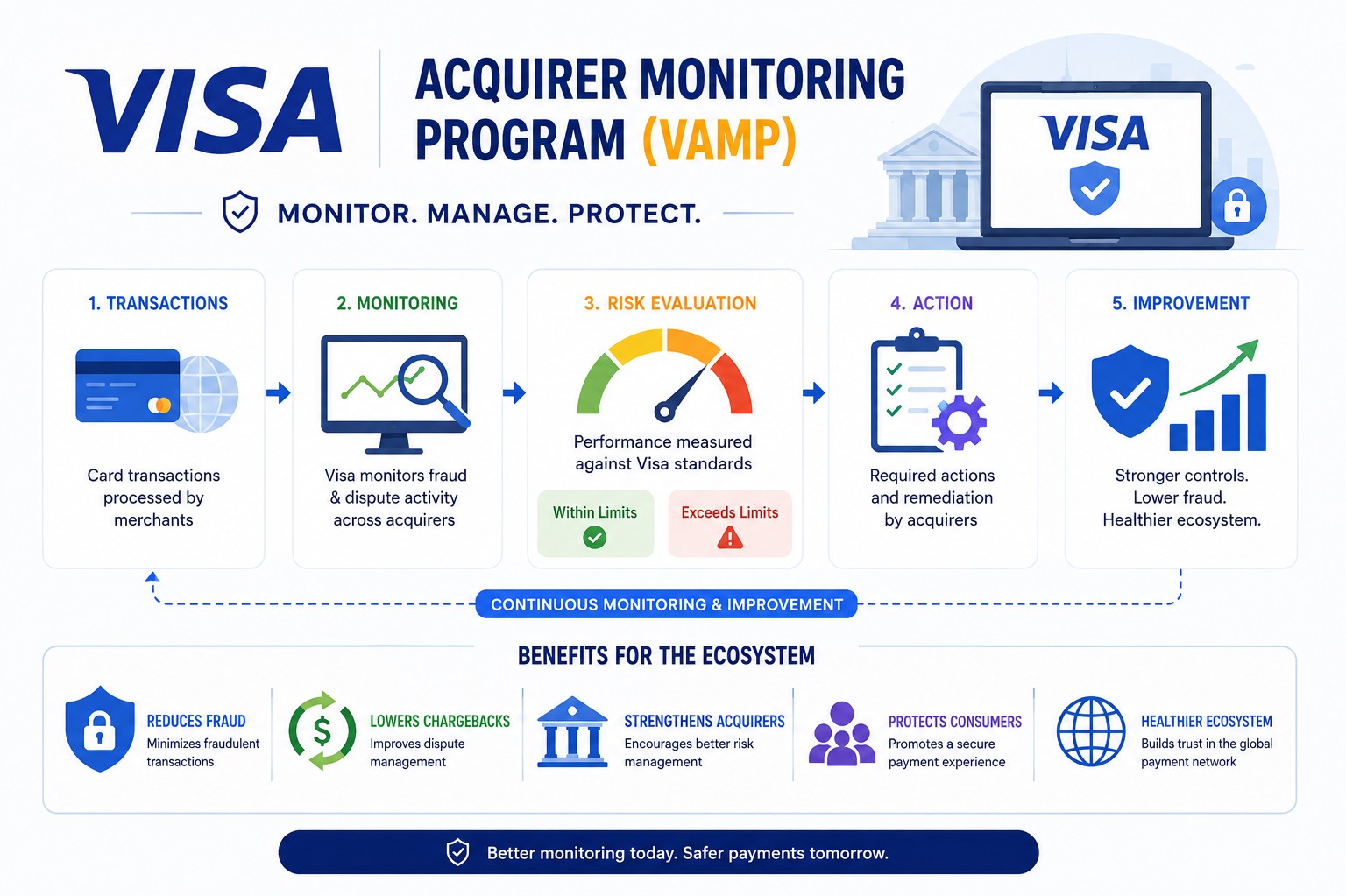
At its core, VAMP relies on continuous transaction monitoring and performance evaluation.
Visa analyzes transaction data, fraud reports, and dispute activity across acquiring institutions. Specific metrics are used to determine whether an acquirer or merchant portfolio exceeds acceptable performance levels.
When thresholds are breached, the acquiring institution may enter the monitoring program. At this stage, Visa expects the acquirer to investigate the underlying causes and implement remediation measures.
These corrective actions often focus on strengthening merchant oversight, improving fraud detection systems, enhancing transaction monitoring, and reducing dispute volumes.
The program creates an environment where risk management becomes a shared responsibility among acquirers, merchants, and payment providers.
The Relationship Between Acquirers and Merchants
Acquiring banks play a critical role in the payment ecosystem because they sponsor merchant access to card networks.
As a result, Visa expects acquirers to actively monitor merchant behavior and ensure compliance with network rules and security standards.
When merchants generate excessive fraud or dispute activity, the impact extends beyond the individual business. The acquiring institution may also face scrutiny under VAMP because it bears responsibility for managing the associated risk.
This relationship encourages acquirers to implement rigorous merchant onboarding procedures, continuous risk assessments, and ongoing performance monitoring.
For merchants, maintaining healthy payment metrics is therefore essential not only for business success but also for preserving strong acquiring relationships.
Fraud Monitoring Under VAMP
Fraud remains one of the primary focus areas within the Visa Acquirer Monitoring Program.
Digital commerce has created new opportunities for fraudsters, including card-not-present fraud, account takeover attacks, synthetic identity fraud, and card testing schemes. These threats can quickly increase fraud rates if not addressed effectively.
Visa monitors fraud performance to identify patterns that indicate elevated risk levels. Acquirers whose merchant portfolios consistently generate excessive fraud may be required to strengthen controls and implement additional security measures.
Organizations that invest in advanced fraud prevention technologies are often better positioned to maintain compliance and reduce risk exposure.
Dispute and Chargeback Monitoring
Chargebacks are another critical component of VAMP.
Although chargebacks serve as an important consumer protection mechanism, excessive dispute activity can indicate operational weaknesses within merchant businesses. Common causes include poor customer service, unclear billing descriptions, fulfillment issues, and fraudulent transactions.
High dispute rates create administrative costs and operational burdens for merchants, issuers, and payment networks alike.
By monitoring chargeback activity, Visa encourages businesses to improve customer experiences and resolve issues before they escalate into formal disputes.
Effective dispute management strategies often contribute significantly to overall VAMP compliance.
Best Practices for Maintaining Compliance
Organizations seeking to minimize VAMP-related risks should adopt a proactive approach to fraud prevention and transaction management.
Several strategies can significantly improve payment performance:
- Implement advanced fraud detection solutions.
- Use real-time transaction monitoring systems.
- Strengthen customer authentication processes.
- Monitor merchant risk indicators regularly.
- Improve customer support responsiveness.
- Ensure transparent billing practices.
- Analyze chargeback trends continuously.
- Conduct regular compliance reviews.
These measures help reduce both fraud and dispute activity while supporting healthier payment operations.
Technology’s Growing Role in Risk Management
The complexity of modern payment ecosystems makes manual monitoring increasingly difficult.
Artificial intelligence and machine learning technologies are now playing a central role in helping organizations manage VAMP-related requirements. These systems can analyze vast transaction datasets and identify suspicious behavior patterns that would be difficult to detect manually.
Behavioral analytics, device intelligence, risk scoring models, and predictive fraud detection tools are becoming standard components of modern payment security infrastructures.
As cybercriminal tactics continue evolving, technology-driven monitoring capabilities will remain essential for maintaining compliance and protecting payment ecosystems.
The Future of VAMP
The Visa Acquirer Monitoring Program will continue evolving alongside broader industry trends.
As digital payments expand, Visa is expected to place even greater emphasis on proactive risk management, fraud reduction, and ecosystem integrity. Future monitoring frameworks may incorporate more advanced analytics, real-time performance tracking, and predictive risk assessment capabilities.
The growth of instant payments, embedded finance, open banking, and artificial intelligence will create new opportunities and challenges for payment networks. Monitoring programs such as VAMP will play a vital role in helping the industry navigate this increasingly complex environment.
Organizations that prioritize fraud prevention and operational excellence today will be best positioned to adapt to future compliance requirements.
Conclusion
The Visa Acquirer Monitoring Program (VAMP) is a cornerstone of Visa’s efforts to maintain trust, security, and operational integrity across the global payments ecosystem. By monitoring fraud levels, chargeback activity, and transaction performance, the program encourages acquiring institutions and merchants to adopt stronger risk management practices.
For merchants, fintech providers, payment service companies, and acquiring banks, VAMP is more than a compliance requirement it is a framework that promotes healthier payment operations and stronger customer trust. As digital commerce continues to grow, organizations that proactively manage fraud and disputes will be better equipped to succeed in an increasingly competitive and regulated payments landscape.
Comments
No comments yet. Be the first to share your thoughts.
Leave a comment