
Introduction
In today’s digital economy, businesses process more transactions than ever before. From global marketplaces and SaaS providers to financial institutions and multinational corporations, organizations are handling payments across multiple customers, currencies, regions, and channels. While digital transformation has improved with virtual accounts the speed of transactions, it has also introduced new challenges related to reconciliation, cash flow visibility, and operational efficiency.
Traditional banking structures often struggle to keep pace with these growing complexities. Managing numerous physical bank accounts can be costly, time-consuming, and operationally inefficient. Finance teams frequently spend countless hours matching incoming payments with invoices, customers, or business units, creating unnecessary administrative burdens.
This is where Virtual Accounts have emerged as a powerful solution. By providing unique account identifiers that route payments into a central account, virtual accounts help businesses simplify collections, automate reconciliation, and gain greater visibility into their financial operations. As organizations continue embracing automation and digital banking, virtual accounts are becoming a cornerstone of modern payment infrastructure.
What Are Virtual Accounts?
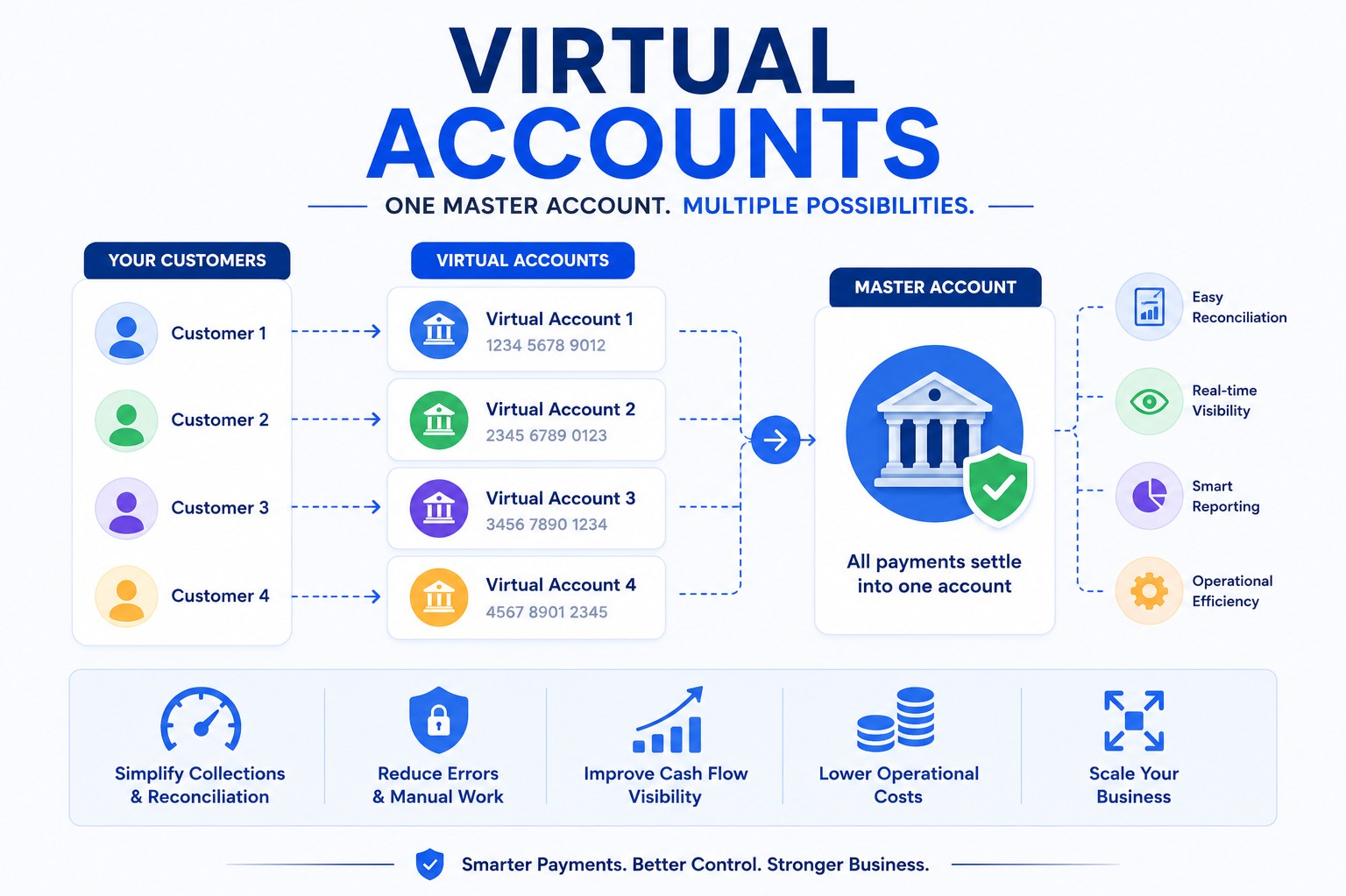
A virtual account is a unique account number assigned to a customer, supplier, department, product line, or transaction category while remaining linked to a central physical bank account.
Unlike traditional bank accounts, virtual accounts do not hold funds independently. Instead, they function as digital identifiers that help businesses track and categorize incoming payments more efficiently.
When a payment is made to a virtual account, the funds are automatically routed to the master account. The virtual account number serves as a reference that enables businesses to instantly identify the source and purpose of the payment.
This structure allows organizations to create thousands of virtual accounts without the need to open multiple physical banking relationships.
Why Virtual Accounts Are Gaining Popularity
The increasing volume and complexity of payment transactions have made manual reconciliation processes unsustainable for many businesses.
Organizations often receive payments from hundreds or even thousands of customers every day. When payment references are incomplete, incorrect, or missing altogether, finance teams must spend significant time investigating and matching transactions.
Virtual accounts solve this problem by assigning dedicated account numbers to specific customers or payment types. As a result, businesses can identify incoming funds immediately without relying solely on payment descriptions or invoice references.
The growing adoption of digital banking, real-time payments, and treasury automation has further accelerated demand for virtual account solutions.
How Virtual Accounts Work
The process begins when a bank, fintech provider, or payment institution creates a master account for a business. Within this structure, multiple virtual accounts can be generated and assigned according to business requirements.
For example, an organization may assign:
- One virtual account to each customer
- Separate accounts for different business units
- Dedicated accounts for geographic regions
- Unique accounts for individual projects or transactions
When payments are sent to these virtual accounts, the funds are automatically consolidated into the master account.
Because each payment arrives through a specific virtual account identifier, businesses can immediately determine where the payment originated and how it should be allocated.
This automation dramatically reduces manual intervention while improving accuracy and operational efficiency.
The Role of Virtual Accounts in Payment Reconciliation
One of the most valuable applications of virtual accounts is payment reconciliation.
Traditional reconciliation often involves reviewing bank statements, cross-checking invoices, and manually matching payments with customer records. This process becomes increasingly difficult as transaction volumes grow.
Virtual accounts simplify reconciliation by providing built-in payment identification. Every incoming transaction carries its own unique account reference, allowing systems to automatically match payments to the correct customer or invoice.
The result is faster reconciliation, fewer errors, and reduced administrative costs.
For organizations handling large transaction volumes, this capability can generate substantial operational savings.
Improving Cash Flow Visibility
Effective cash flow management requires accurate and timely financial information.
Virtual accounts provide businesses with a more detailed view of payment activity by enabling organizations to track collections across customers, products, business units, and regions.
Rather than viewing all incoming payments as part of a single account balance, finance teams can gain granular insights into revenue streams and collection performance.
This enhanced visibility supports better forecasting, liquidity management, and strategic decision-making.
For treasury teams, access to real-time financial data is becoming increasingly important in a rapidly changing economic environment.
Virtual Accounts and Cross-Border Payments
International business operations often create additional payment complexities.
Companies operating globally must manage collections from customers across multiple countries, currencies, and banking systems. Establishing physical bank accounts in every market can be expensive and administratively burdensome.
Virtual accounts offer a more efficient alternative.
Many providers now offer virtual IBANs and local account solutions that enable businesses to receive payments in different jurisdictions without maintaining separate physical banking relationships.
Customers can make payments using local banking infrastructure, while businesses benefit from centralized cash management and improved payment visibility.
This capability has become particularly valuable for e-commerce companies, marketplaces, fintech firms, and multinational enterprises pursuing international growth.
Industry Applications of Virtual Accounts
The versatility of virtual accounts has driven adoption across a wide range of industries.
Marketplaces use virtual accounts to track merchant payments and facilitate settlement processes. Financial institutions leverage them to enhance corporate cash management services. SaaS providers utilize virtual accounts to automate subscription payment reconciliation and improve customer payment tracking.
In the logistics sector, virtual accounts help companies manage payments across multiple clients and shipping operations. Educational institutions use them to simplify fee collection and student payment management.
Regardless of industry, the underlying objective remains the same: improving financial efficiency through automation and visibility.
Benefits of Virtual Accounts
The growing popularity of virtual accounts is driven by their ability to solve multiple operational challenges simultaneously.
Key advantages include:
- Automated payment reconciliation
- Improved cash flow visibility
- Faster payment identification
- Reduced operational costs
- Enhanced reporting capabilities
- Simplified treasury management
- Greater scalability
- Better customer payment tracking
These benefits enable organizations to focus more resources on strategic initiatives rather than administrative processes.
Challenges and Considerations
While virtual accounts offer significant advantages, successful implementation requires careful planning.
Businesses must ensure that virtual account solutions integrate seamlessly with enterprise resource planning systems, accounting platforms, and treasury management tools.
Regulatory compliance is also an important consideration, particularly for organizations operating across multiple jurisdictions. Financial institutions and payment providers must maintain robust anti-money laundering controls and customer verification procedures.
Cybersecurity remains another critical factor. As financial infrastructures become increasingly digital, organizations must invest in strong security measures to protect transaction data and payment systems.
The Future of Virtual Accounts
The future of virtual accounts is closely connected to broader trends in financial technology.
As embedded finance, open banking, and real-time payment networks continue to expand, virtual accounts are expected to play an even greater role in digital financial ecosystems.
Artificial intelligence and machine learning will likely enhance transaction categorization, reconciliation, and forecasting capabilities. Businesses will gain access to increasingly sophisticated insights that support better financial decision-making.
The growing demand for automation, efficiency, and financial transparency will continue driving adoption across industries.
Conclusion
Virtual Accounts have become one of the most effective tools for modern payment management. By providing unique identifiers that simplify collections, automate reconciliation, and improve cash flow visibility, they help businesses overcome many of the operational challenges associated with traditional banking structures.
As organizations continue embracing digital transformation and global expansion, virtual accounts will play an increasingly important role in supporting efficient, scalable, and intelligent financial operations. For businesses seeking greater control over payments and treasury management, virtual accounts are no longer simply an innovation—they are rapidly becoming a necessity.
Comments
No comments yet. Be the first to share your thoughts.
Leave a comment