
Introduction
Every business relies on accurate financial records to manage cash flow, monitor transactions, and make informed decisions. One of the most critical yet time-consuming financial tasks is processing bank statements. Traditionally, finance teams spend countless hours reviewing statements, extracting transaction details, matching payments, and reconciling accounts.
As transaction volumes grow and businesses operate across multiple banks, currencies, and payment channels, manual bank statement processing becomes increasingly inefficient. Errors, delays, and reconciliation challenges can impact reporting accuracy and operational productivity.
To address these challenges, organizations are turning to Automated Bank Statement Processing, a technology-driven approach that uses automation, artificial intelligence, and data integration to streamline financial workflows.
By eliminating repetitive manual tasks and improving data accuracy, automated bank statement processing is transforming how businesses manage financial operations.
What Is Automated Bank Statement Processing?
Automated Bank Statement Processing refers to the use of software and intelligent technologies to capture, extract, classify, and reconcile transaction data from bank statements without manual intervention.
Instead of finance professionals manually reviewing each transaction, automation tools can automatically import bank statements, identify transaction details, categorize entries, and match them with invoices, payments, and accounting records.
The goal is to accelerate financial processes while reducing operational costs and human errors.
Modern solutions often integrate directly with accounting platforms, ERP systems, treasury management software, and banking networks, creating a seamless financial workflow.
Why Traditional Bank Statement Processing Is Challenging
Manual bank statement processing presents several operational difficulties.
Finance teams often receive statements in different formats, including PDFs, spreadsheets, CSV files, and bank-specific formats. Extracting data from these documents can be labor-intensive and prone to errors.
As businesses scale, transaction volumes increase significantly. Reconciling thousands of transactions manually requires substantial resources and can delay month-end closing processes.
Additional challenges include:
- Data entry errors
- Duplicate transactions
- Missing references
- Delayed reconciliation
- Limited visibility into cash positions
- Increased operational costs
These challenges have accelerated demand for automation solutions.
How Automated Bank Statement Processing Works
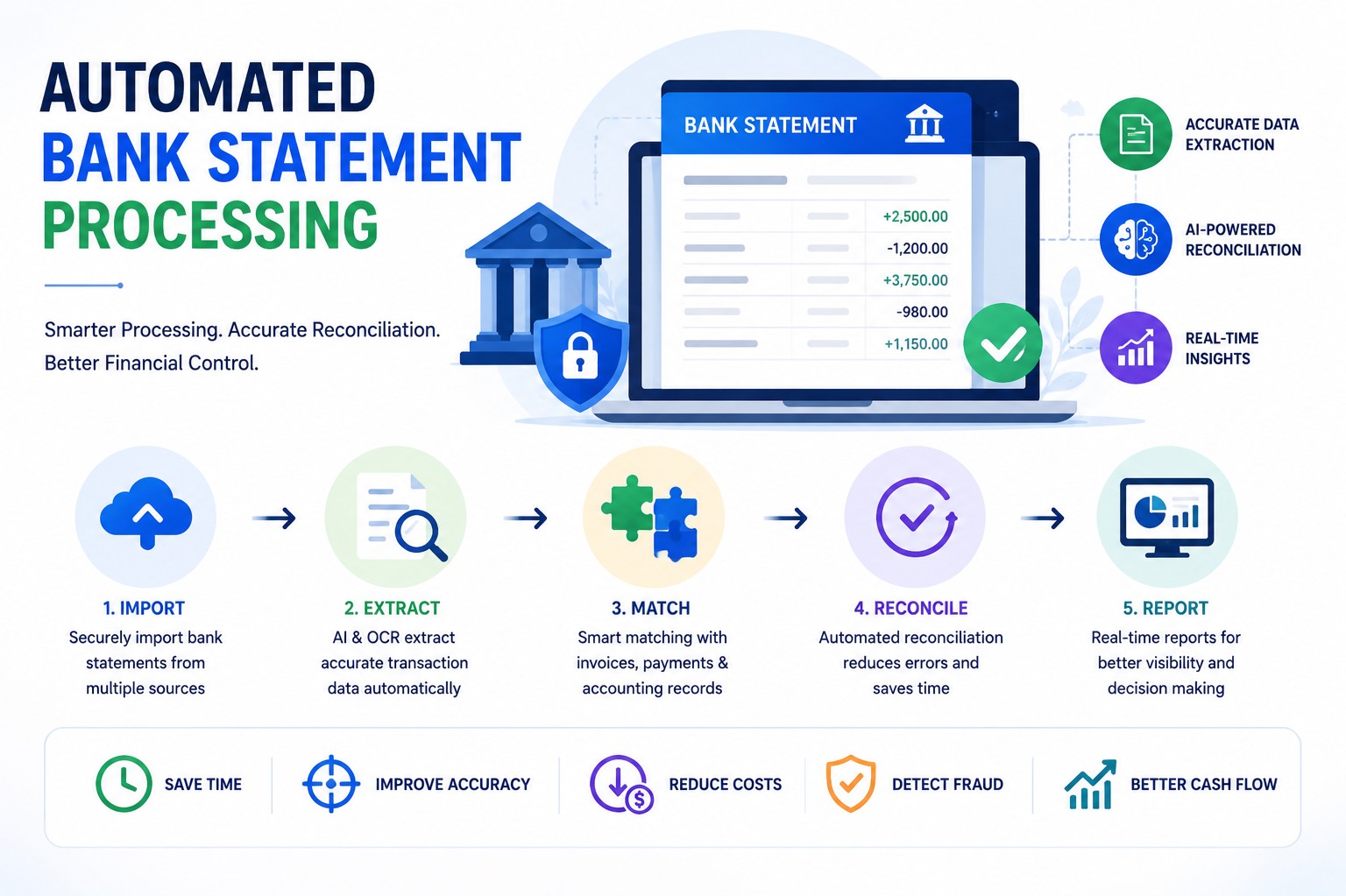
The process begins by importing bank statements from financial institutions through secure integrations, APIs, file uploads, or direct banking connections.
The system then extracts transaction data using technologies such as Optical Character Recognition (OCR), machine learning, and intelligent document processing.
Key information typically extracted includes:
- Transaction dates
- Payment references
- Account numbers
- Beneficiary details
- Transaction amounts
- Currency information
The extracted data is then validated, categorized, and matched against accounting records or ERP systems.
Once reconciliation is completed, the system generates reports and updates financial records automatically.
This significantly reduces manual effort while improving accuracy.
The Role of Artificial Intelligence
Artificial intelligence is becoming a major driver of automated bank statement processing.
Traditional automation follows predefined rules, but AI-powered systems can learn from historical transaction patterns and continuously improve their accuracy.
Machine learning algorithms can:
- Identify transaction categories
- Detect anomalies
- Predict reconciliation matches
- Flag suspicious transactions
- Improve data extraction accuracy
As more data is processed, AI systems become increasingly effective at handling complex financial scenarios.
This capability allows organizations to automate processes that previously required significant human involvement.
Benefits of Automated Bank Statement Processing
The adoption of automated bank statement processing delivers numerous advantages for businesses.
Improved Efficiency
Automation dramatically reduces the time required to process and reconcile transactions. Tasks that once took days can often be completed within minutes.
Higher Accuracy
Automated systems minimize human errors associated with manual data entry and transaction matching.
Faster Financial Closing
Organizations can accelerate month-end and year-end closing activities by reducing reconciliation delays.
Better Cash Flow Visibility
Real-time transaction processing provides finance teams with more accurate insights into liquidity and cash positions.
Reduced Operational Costs
Automation lowers administrative workloads, enabling finance professionals to focus on strategic initiatives.
These benefits contribute to stronger financial performance and improved decision-making.
Automated Reconciliation and Matching
One of the most valuable applications of bank statement automation is reconciliation.
Matching incoming and outgoing transactions with invoices, customer payments, and accounting records is often a labor-intensive process.
Automated reconciliation systems use predefined rules and AI-driven matching algorithms to identify corresponding records automatically.
For example, when a customer payment appears on a bank statement, the system can instantly match it with the relevant invoice and update accounting records.
This capability significantly improves efficiency and reduces outstanding reconciliation items.
Enhancing Fraud Detection
Automated bank statement processing also supports stronger financial controls.
By continuously monitoring transaction activity, intelligent systems can identify unusual patterns and anomalies that may indicate fraud or operational issues.
Examples include:
- Duplicate payments
- Unexpected account activity
- Unusual transaction amounts
- Suspicious payment destinations
- Unauthorized transfers
Early detection allows organizations to investigate potential issues before they escalate into larger financial risks.
Integration with Modern Financial Systems
Modern automated bank statement solutions integrate seamlessly with various business applications.
Common integrations include:
- ERP platforms
- Accounting software
- Treasury management systems
- Payment gateways
- Business intelligence tools
- Banking APIs
These integrations create a connected financial ecosystem where information flows automatically between systems.
As a result, organizations gain greater visibility and control over their financial operations.
Industry Applications
Automated bank statement processing is used across numerous industries.
Banks utilize automation to improve operational efficiency and customer service. Corporations rely on automated reconciliation to manage large transaction volumes. E-commerce companies use these systems to process payments from multiple channels.
Financial institutions, insurance companies, logistics providers, healthcare organizations, and government agencies also benefit from enhanced financial automation capabilities.
Regardless of industry, the objective remains the same: improving accuracy, efficiency, and visibility within financial processes.
Future Trends in Automated Bank Statement Processing
The future of bank statement automation will be increasingly intelligent and connected.
Artificial intelligence will continue enhancing transaction categorization, anomaly detection, and predictive reconciliation capabilities. Open banking initiatives will enable real-time access to financial data, reducing dependence on traditional statement formats.
Cloud-based financial platforms will further improve accessibility, scalability, and collaboration across finance teams.
Meanwhile, advanced analytics will provide deeper insights into cash flow trends, spending behavior, and financial performance.
Organizations that embrace these innovations will gain significant competitive advantages in financial management.
Conclusion
Automated Bank Statement Processing is transforming how businesses manage financial data, reconciliation, and reporting. By leveraging automation, artificial intelligence, and system integration, organizations can reduce manual workloads, improve accuracy, accelerate financial closing processes, and strengthen cash flow visibility.
As financial operations become increasingly complex, automation is no longer simply a productivity enhancement it is becoming a strategic necessity. Businesses that invest in automated bank statement processing solutions today will be better positioned to improve efficiency, reduce costs, and navigate the future of digital finance with confidence.
Comments
No comments yet. Be the first to share your thoughts.
Leave a comment