
Introduction
Behind every successful payment platform, digital bank, marketplace, or fintech solution lies a sophisticated system responsible for tracking money movement accurately and efficiently. While customers see account balances, payment confirmations, and transaction histories, the real financial intelligence often operates behind the scenes through a Virtual Ledger.
As businesses process millions of transactions daily across multiple payment channels, currencies, and customer accounts, traditional accounting structures alone are no longer sufficient. Organizations require flexible, scalable systems capable of providing real-time visibility into financial activities while simplifying reconciliation and operational management.
Virtual ledgers have emerged as a critical component of modern financial infrastructure. They help businesses organize, allocate, track, and reconcile funds without requiring separate physical bank accounts for every customer, transaction stream, or business unit.
From fintech platforms and payment service providers to marketplaces and corporate treasury departments, virtual ledgers are transforming how financial operations are managed in the digital age.
What Is a Virtual Ledger?
A virtual ledger is a digital accounting framework that records, tracks, and manages financial transactions within a centralized financial system.
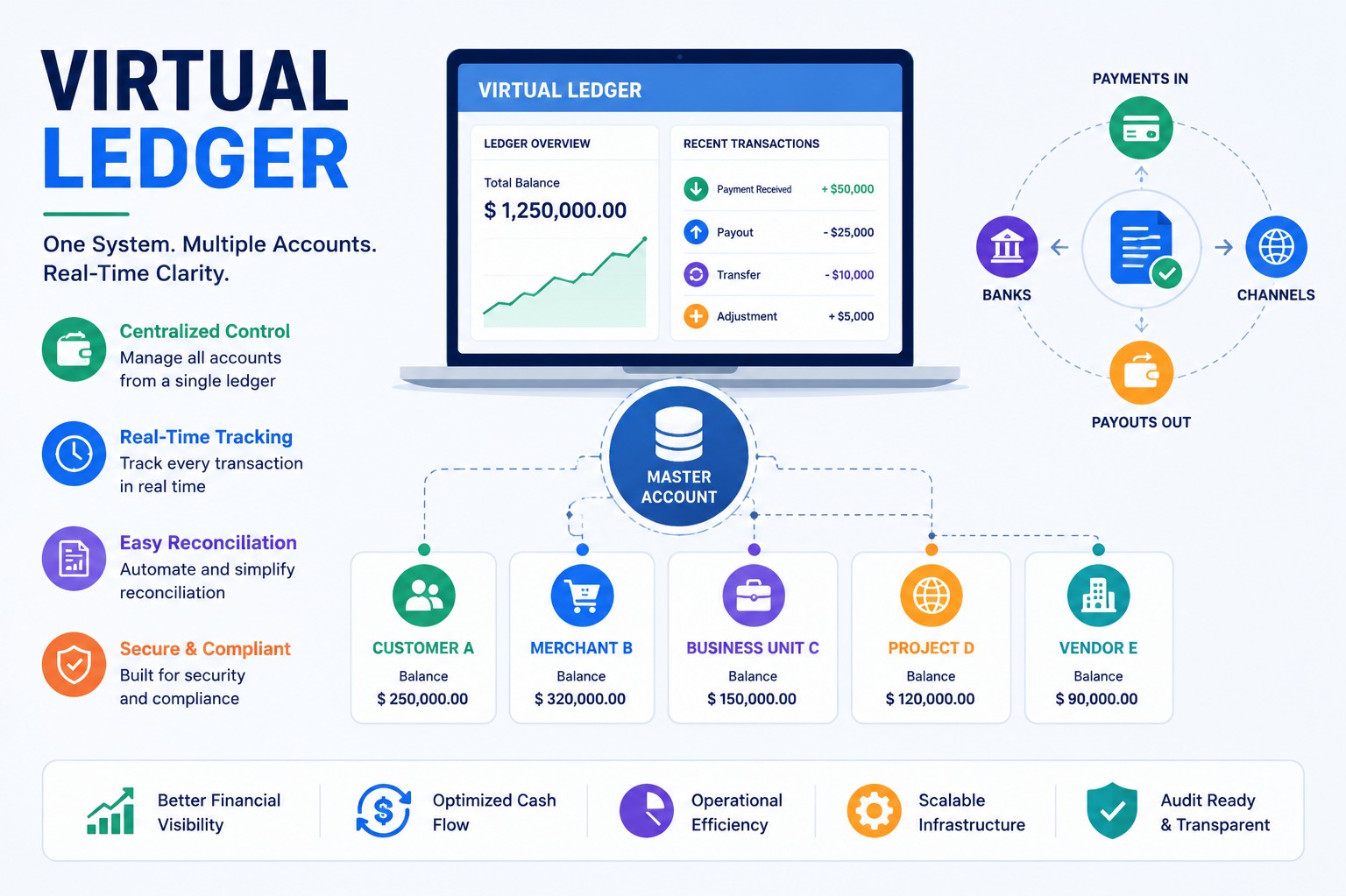
Unlike traditional bank accounts, which require separate account structures for different users or departments, a virtual ledger creates individual balance records within a single master account environment.
Each ledger can represent:
- A customer
- A merchant
- A business unit
- A marketplace seller
- A project
- A payment channel
- A subsidiary
The system records every credit, debit, transfer, adjustment, and settlement while maintaining complete visibility into fund movements.
In simple terms, a virtual ledger functions like a highly sophisticated internal bookkeeping system that mirrors financial activities in real time.
Why Virtual Ledgers Have Become Essential
The rise of digital finance has dramatically increased transaction complexity.
Businesses today may receive payments from multiple channels, operate across several countries, support thousands of customers, and manage numerous payment workflows simultaneously.
Maintaining separate bank accounts for each activity would be costly, inefficient, and operationally difficult.
Virtual ledgers solve this problem by enabling organizations to create logical account structures without increasing banking complexity.
They provide:
- Better financial visibility
- Simplified fund allocation
- Faster reconciliation
- Reduced operational costs
- Improved reporting capabilities
- Greater scalability
As transaction volumes continue growing, virtual ledgers have become essential for efficient financial management.
How Virtual Ledgers Work
A virtual ledger operates on top of an underlying banking or payment infrastructure.
Instead of opening multiple physical accounts, organizations maintain a master account while creating virtual balances for different entities within the ledger system.
For example, when a marketplace receives a customer payment, the funds may enter a single bank account. The virtual ledger then records how much belongs to each seller, platform fee account, tax account, or reserve balance.
The system automatically updates balances and transaction histories whenever funds move.
This approach allows businesses to track ownership and allocation of funds with precision while minimizing banking complexity.
The Relationship Between Virtual Ledgers and Virtual Accounts
Virtual ledgers are often closely associated with virtual accounts, but they are not identical.
A virtual account typically acts as a unique payment identifier that helps route incoming payments to the correct recipient or business unit.
The virtual ledger records and manages the financial balances associated with those virtual accounts.
Together, they create a powerful infrastructure for payment collection, reconciliation, and reporting.
For example, a company may assign unique virtual account numbers to customers while using a virtual ledger to maintain individual customer balances behind the scenes.
This combination improves payment visibility and operational efficiency.
Virtual Ledgers in Payment Processing
Payment providers use virtual ledgers extensively to manage transaction flows.
Every payment entering or leaving a system must be tracked accurately to ensure transparency and financial integrity.
Virtual ledgers support:
- Payment allocation
- Fund segregation
- Merchant settlement
- Customer balance tracking
- Transaction reporting
- Fee management
Without virtual ledgers, managing high transaction volumes would require significantly more manual intervention and operational resources.
As payment ecosystems become increasingly sophisticated, ledger technology plays a crucial role in maintaining efficiency.
Improving Reconciliation Through Virtual Ledgers
One of the most valuable benefits of virtual ledgers is automated reconciliation.
Traditional reconciliation often involves manually matching bank transactions with invoices, customer records, and accounting entries.
This process can be time-consuming and prone to errors.
Virtual ledgers automatically record transaction details and maintain clear audit trails, making it easier to identify and reconcile financial activities.
Benefits include:
- Faster reconciliation
- Reduced manual work
- Improved accuracy
- Better audit readiness
- Enhanced reporting capabilities
Organizations handling large transaction volumes often experience significant operational improvements after implementing virtual ledger solutions.
Virtual Ledgers and Treasury Management
Treasury teams require real-time visibility into cash positions, liquidity, and financial activities.
Virtual ledgers help achieve this by providing detailed insights into fund allocation and movement.
Finance teams can monitor balances across departments, projects, subsidiaries, and payment channels without maintaining numerous physical accounts.
This centralized approach improves:
- Cash flow management
- Liquidity forecasting
- Financial planning
- Working capital optimization
- Treasury reporting
As organizations expand globally, virtual ledgers become increasingly valuable for managing complex financial operations.
Supporting Embedded Finance and Fintech Innovation
The rapid growth of embedded finance has accelerated adoption of virtual ledger technology.
Fintech companies use virtual ledgers to manage customer balances, digital wallets, lending products, and payment services.
Embedded finance platforms rely on virtual ledgers to support:
- Wallet infrastructure
- Marketplace settlements
- Card programs
- Merchant accounts
- Lending platforms
- Banking-as-a-Service solutions
By providing flexible balance management capabilities, virtual ledgers enable innovative financial products without requiring extensive banking infrastructure.
This makes them a foundational component of modern fintech ecosystems.
Security and Compliance Considerations
Because virtual ledgers manage financial information, security and compliance are critical.
Organizations must ensure that ledger systems maintain:
- Accurate transaction records
- Data integrity
- Access controls
- Audit trails
- Regulatory compliance
- Financial reporting accuracy
Many virtual ledger platforms incorporate automated controls and monitoring capabilities to support regulatory requirements.
Strong governance ensures that financial records remain reliable and transparent.
Emerging Trends in Virtual Ledger Technology
Several innovations are shaping the future of virtual ledgers.
Artificial intelligence is improving transaction classification and reconciliation. Real-time payment systems are increasing demand for instant ledger updates. Open banking integrations are creating more connected financial ecosystems.
Additional trends include:
- API-driven ledger infrastructure
- Cloud-native financial platforms
- Embedded finance solutions
- Automated treasury management
- Real-time financial reporting
- Multi-currency ledger systems
These developments are expanding the role of virtual ledgers across modern finance.
The Future of Virtual Ledgers
As financial ecosystems become increasingly digital, virtual ledgers will play an even more important role.
Businesses will require greater transparency, automation, and scalability to manage growing transaction volumes. Virtual ledgers will continue evolving into intelligent financial management systems capable of supporting real-time payments, automated reconciliation, predictive analytics, and advanced treasury operations.
Organizations that adopt modern ledger infrastructure will be better positioned to improve operational efficiency and support future growth.
Conclusion
Virtual Ledgers have become one of the most important components of modern financial infrastructure. By providing real-time transaction tracking, automated reconciliation, fund allocation, and enhanced financial visibility, they enable businesses to manage increasingly complex payment operations efficiently.
From fintech platforms and marketplaces to corporate treasury departments and embedded finance providers, virtual ledgers support the digital financial experiences that businesses and consumers rely on every day.
As payment ecosystems continue evolving, virtual ledger technology will remain a critical driver of innovation, transparency, and operational excellence across the global financial industry.
Comments
No comments yet. Be the first to share your thoughts.
Leave a comment