
Introduction
In an increasingly interconnected world, businesses are no longer confined by geographical borders. Whether it’s a startup selling products internationally, a SaaS company serving customers worldwide, or a multinational enterprise managing operations across continents, global commerce has become the norm rather than the exception.However, operating internationally introduces financial complexities that traditional domestic bank accounts often struggle to address. Businesses must manage multiple currencies, process cross-border payments, handle foreign exchange risks, and maintain efficient cash flow across various markets.This is where International Business Accounts play a crucial role. These specialized banking solutions are designed to help companies manage global financial operations efficiently while supporting international growth.
As globalization, digital commerce, and cross-border trade continue expanding, international business accounts have become essential tools for organizations seeking to compete in the global economy.
What Are International Business Accounts?
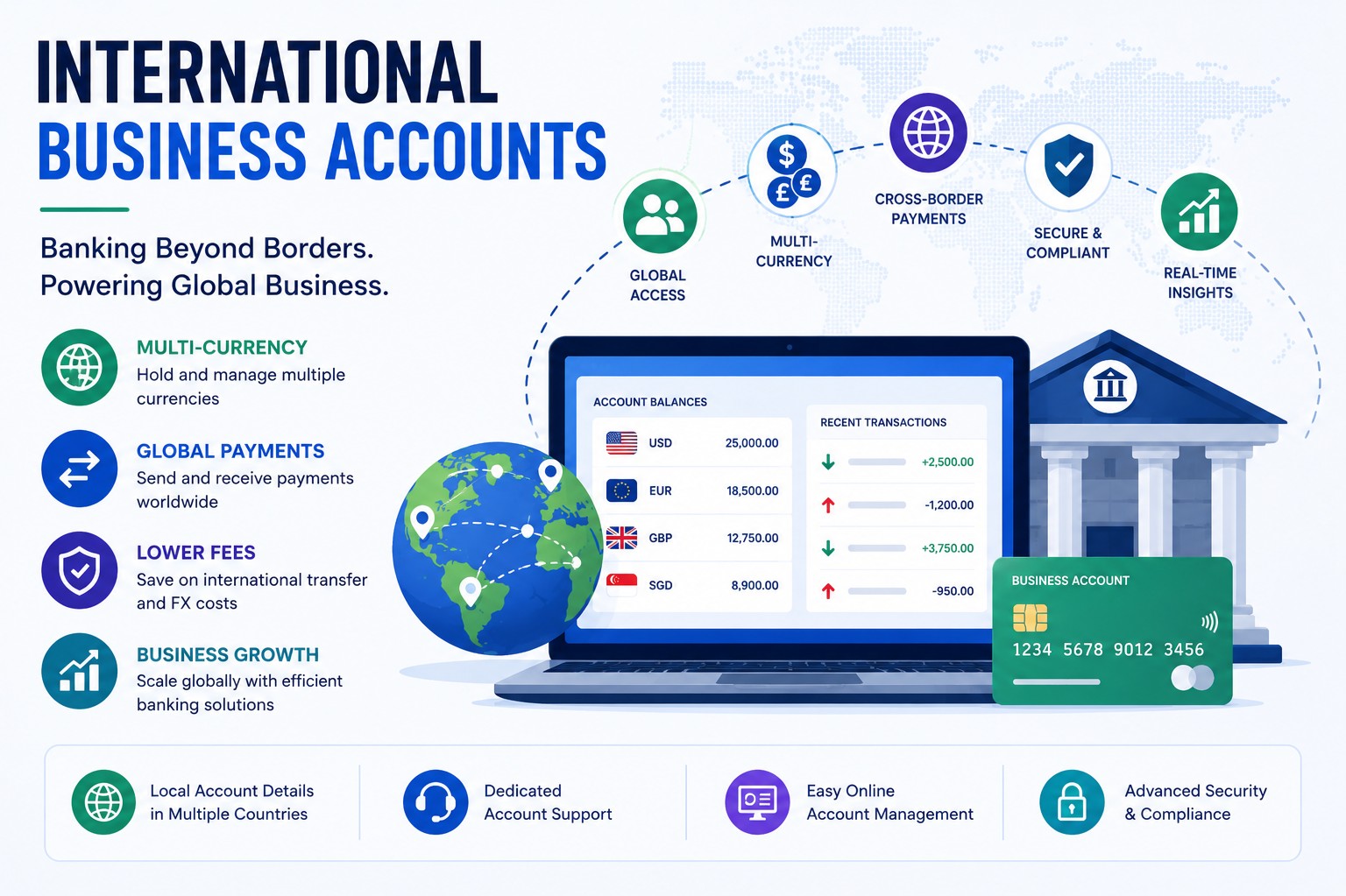
International Business Accounts are banking solutions specifically designed to support companies operating across multiple countries and currencies.
Unlike standard business bank accounts, international accounts provide capabilities that facilitate global transactions and international financial management.
These accounts often support:
- Multiple currencies
- International wire transfers
- Cross-border payment collection
- Foreign exchange services
- Global account management
- International payroll processing
- Supplier payments
- Treasury management
By consolidating international financial activities within a single banking framework, businesses can simplify operations and improve financial visibility.
Why Businesses Need International Business Accounts
The rise of global commerce has created new opportunities for companies of all sizes.
Businesses selling products internationally, hiring remote teams, managing overseas suppliers, or expanding into new markets frequently encounter challenges related to payments and banking.
Without international banking capabilities, organizations may face:
- High foreign exchange costs
- Payment delays
- Limited currency support
- Complex banking relationships
- Cash flow inefficiencies
- Increased operational expenses
International business accounts help solve these challenges by providing financial infrastructure tailored to global operations.
For growing companies, these accounts often become a critical component of expansion strategies.
How International Business Accounts Work
International business accounts function similarly to traditional corporate accounts but offer enhanced global capabilities.
A company can receive funds from customers located in different countries, hold balances in multiple currencies, and make payments to international suppliers through a centralized banking platform.
Many providers offer local account details in various countries, allowing businesses to collect payments as if they had a local banking presence.
For example, a company based in Europe may receive payments from customers in the United States, the United Kingdom, and Asia without opening separate bank accounts in each region.
This simplifies financial management while improving customer and supplier experiences.
Multi-Currency Account Capabilities
One of the most valuable features of international business accounts is multi-currency support.
Traditional banking often requires businesses to convert currencies immediately upon receipt, potentially increasing foreign exchange costs.
International business accounts allow organizations to:
- Hold multiple currencies
- Receive international payments
- Make payments in local currencies
- Reduce conversion expenses
- Manage exchange rate exposure
This flexibility enables businesses to optimize financial operations and improve profitability in global markets.
As international trade grows, multi-currency functionality is becoming increasingly important.
Supporting Cross-Border Payments
Cross-border payments remain one of the most important use cases for international business accounts.
Global businesses routinely send and receive payments involving different banking systems, currencies, and regulatory environments.
International accounts streamline these transactions by providing access to global payment networks and local clearing systems.
Benefits include:
- Faster payment settlements
- Reduced transaction costs
- Improved payment tracking
- Enhanced payment transparency
- Greater operational efficiency
Efficient cross-border payment capabilities can significantly improve supplier relationships and customer satisfaction.
International Business Accounts and Foreign Exchange
Foreign exchange management is a major consideration for businesses operating internationally.
Currency fluctuations can affect profitability, pricing strategies, and financial planning. International business accounts often include integrated foreign exchange services that help organizations manage currency risks more effectively.
These solutions may provide:
- Competitive exchange rates
- Currency conversion tools
- FX risk management services
- Automated currency exchanges
- Hedging support
By improving foreign exchange efficiency, businesses can better protect margins and optimize global transactions.
Virtual Accounts and Global Collections
Modern international banking providers increasingly offer virtual account capabilities.
Virtual accounts enable businesses to assign unique account numbers to customers, subsidiaries, regions, or business units while maintaining centralized account management.
This improves:
- Payment reconciliation
- Financial reporting
- Cash flow visibility
- Customer payment tracking
- Operational efficiency
For organizations processing large transaction volumes, virtual accounts can significantly simplify financial operations.
Benefits for Global Businesses
International business accounts provide several strategic advantages.
Improved Global Reach
Businesses can expand into new markets without establishing extensive local banking relationships.
Better Cash Flow Management
Real-time visibility across multiple currencies and regions supports stronger financial decision-making.
Lower Banking Costs
Consolidated international banking services can reduce transaction fees and foreign exchange expenses.
Enhanced Customer Experience
Customers can pay using local currencies and familiar payment methods.
Simplified Operations
Centralized account management reduces administrative complexity and improves efficiency.
These benefits make international business accounts valuable assets for companies pursuing global growth.
Compliance and Regulatory Considerations
International financial operations require compliance with multiple regulatory frameworks.
Providers offering international business accounts typically support compliance requirements related to:
- Know Your Customer (KYC)
- Anti-Money Laundering (AML)
- Sanctions screening
- Tax reporting
- Transaction monitoring
Businesses must provide documentation verifying ownership structures, business activities, and operational legitimacy.
Strong compliance frameworks help protect organizations while supporting secure international banking operations.
Emerging Trends in International Business Banking
Technology is transforming international banking rapidly.
Digital-first banking platforms are replacing traditional paper-based processes, while fintech innovation is creating more accessible global banking solutions.
Key trends include:
- Embedded finance
- Banking as a Service (BaaS)
- Open banking integrations
- AI-powered financial management
- Real-time international payments
- Virtual account infrastructure
- Automated treasury solutions
These innovations are helping businesses manage international finances more efficiently than ever before.
The Future of International Business Accounts
The future of international business banking will be increasingly digital, automated, and interconnected.
Businesses will expect seamless access to global financial services through unified platforms capable of handling payments, treasury management, foreign exchange, and compliance requirements.
Artificial intelligence will improve cash flow forecasting and risk management, while real-time payment networks will accelerate international transactions.
As global commerce continues expanding, international business accounts will become even more important in supporting business growth and financial agility.
Conclusion
International Business Accounts have become essential tools for organizations operating in today’s global economy. By enabling multi-currency management, cross-border payments, foreign exchange optimization, and centralized financial control, these accounts provide the infrastructure businesses need to expand internationally and operate efficiently.
As digital banking, fintech innovation, and global commerce continue evolving, companies that leverage modern international banking solutions will be better positioned to manage complexity, reduce costs, and unlock new opportunities in international markets.
For businesses seeking sustainable global growth, an international business account is no longer a luxury it is a strategic necessity.
Comments
No comments yet. Be the first to share your thoughts.
Leave a comment