
Introduction
As businesses and individuals increasingly conduct financial transactions across borders, the need for accurate and secure payment systems has never been greater. International transfers often involve multiple banks, different currencies, and complex routing requirements. Without standardized account identification, payment errors, delays, and failed transactions can become common challenges.To solve this problem, the banking industry introduced the International Bank Account Number (IBAN). Today, IBAN is one of the most widely used standards for identifying bank accounts in cross-border transactions. It helps financial institutions process payments accurately, reduces errors, and improves the efficiency of international fund transfers.
Whether sending money to another country, receiving overseas payments, or managing global business operations, understanding IBAN numbers is essential in today’s interconnected financial environment.
What Is an IBAN Number?
An IBAN (International Bank Account Number) is a standardized format used to identify bank accounts across international borders. It provides a unique identifier that helps banks route payments correctly to the intended account.
The IBAN system was developed to simplify international banking transactions and reduce payment errors caused by incorrect account details. Instead of relying solely on local account numbers, financial institutions use IBANs to verify and process payments more efficiently.
Today, IBANs are used in more than 70 countries and are a critical component of international payment infrastructure.
Why IBAN Was Created
Before IBAN adoption, international payments often faced delays due to inconsistent account numbering systems across different countries. Banks had difficulty verifying account information, resulting in failed transactions and manual processing requirements.
The IBAN standard was introduced to create a uniform approach to bank account identification. By providing a standardized structure, it enables automated validation and improves payment accuracy.
As international commerce and cross-border transactions expanded, IBAN became an essential tool for supporting global financial connectivity.
Structure of an IBAN Number
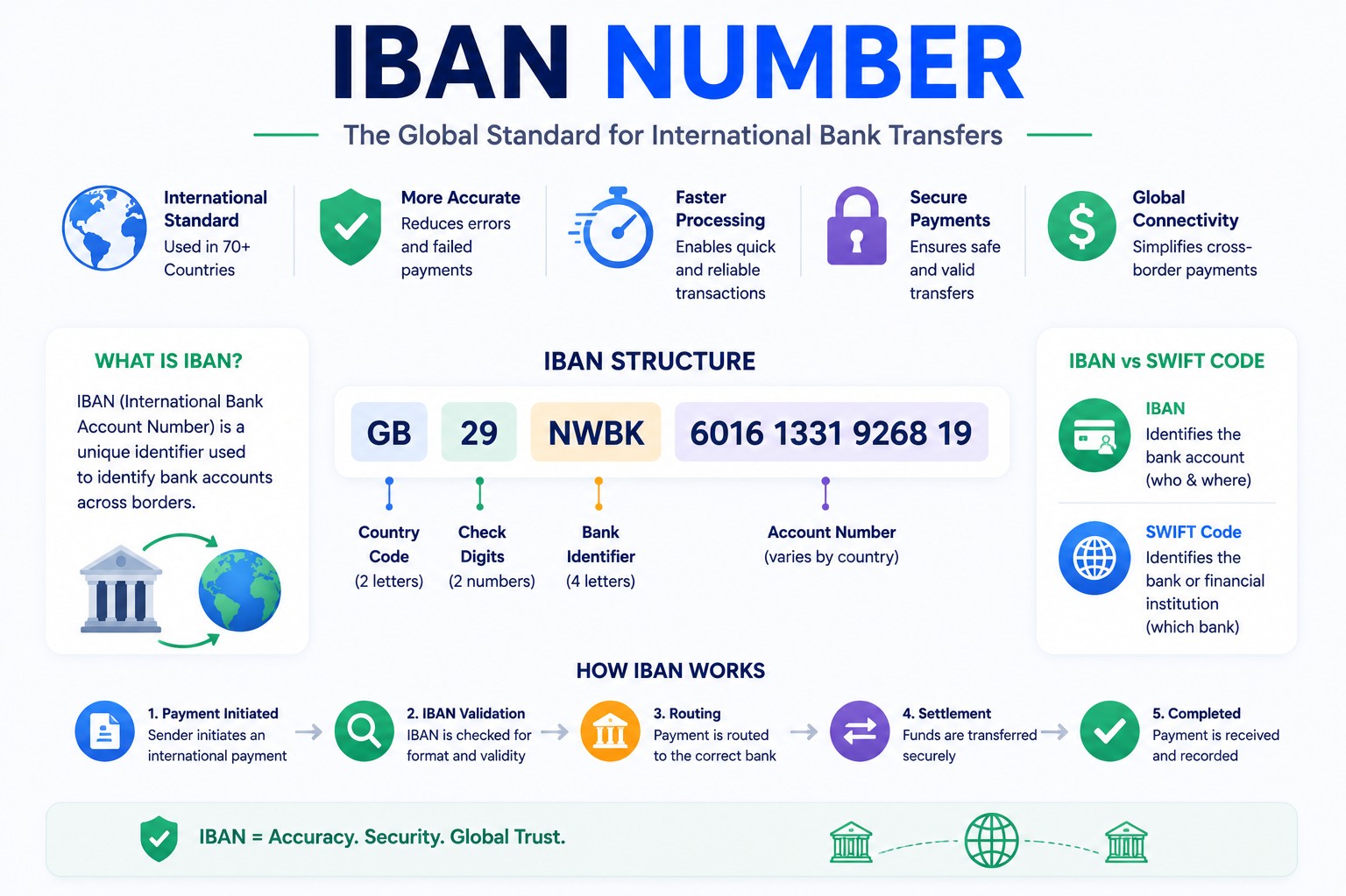
An IBAN consists of a combination of letters and numbers that uniquely identify a bank account. While the exact length varies by country, every IBAN follows a standardized format.
A typical IBAN contains:
- A two-letter country code
- Two check digits used for validation
- A bank identifier
- The customer’s account number
For example:
GB29 NWBK 6016 1331 9268 19
In this example:
- GB = Country Code (United Kingdom)
- 29 = Check Digits
- NWBK = Bank Identifier
- Remaining digits = Account Information
The structure ensures consistency while allowing countries to maintain their own banking systems.
How IBAN Validation Works
One of the key benefits of IBAN is its built-in validation mechanism. The check digits included in the IBAN help banks determine whether the account number format is valid before processing a payment.
When a payment is initiated, banking systems automatically verify the IBAN structure. If the number contains errors or invalid characters, the transaction can be flagged before funds are transferred.
This validation process significantly reduces payment failures and improves operational efficiency.
IBAN vs SWIFT Code
IBAN and SWIFT codes are often used together but serve different purposes.
An IBAN identifies a specific bank account and payment recipient. A SWIFT code identifies the financial institution involved in the transaction.
Think of an IBAN as the recipient’s address and a SWIFT code as the bank’s international identifier.
For many international transfers, both pieces of information are required to ensure accurate payment routing and delivery.
Benefits of Using IBAN Numbers
The widespread adoption of IBAN has brought significant advantages to both financial institutions and customers.
One major benefit is improved accuracy. Standardized account identification reduces the likelihood of payment errors and rejected transactions.
IBANs also support faster processing because banking systems can automatically validate account information. This reduces manual intervention and improves operational efficiency.
For businesses managing international payments, IBANs help simplify reconciliation, treasury management, and cross-border financial operations.
As global payment volumes continue growing, these advantages become increasingly valuable.
IBAN in Cross-Border Payments
Cross-border payments often involve multiple intermediaries and banking networks. Accurate account information is critical to ensuring that funds reach the intended recipient.
IBANs provide a consistent framework that enables banks to process international transfers more efficiently. By reducing errors and improving payment routing accuracy, IBANs help minimize delays and transaction costs.
Many European and international payment systems require IBANs for processing transfers, making them a fundamental component of global payment infrastructure.
For businesses operating internationally, maintaining accurate IBAN records is essential for smooth financial operations.
IBAN and Business Banking
Businesses involved in international trade frequently rely on IBANs for supplier payments, payroll processing, treasury management, and customer collections.
Using IBANs simplifies payment workflows by providing a standardized format for account identification across multiple countries. This reduces administrative complexity and improves transaction reliability.
Many multinational organizations maintain IBAN-enabled accounts to support global operations and facilitate cross-border fund movement.
As international business activity continues expanding, IBAN usage remains a key enabler of efficient global banking.
Common IBAN Challenges
Although IBANs improve payment accuracy, challenges can still arise. Entering incorrect account details, using outdated information, or misunderstanding country-specific formats can lead to transaction delays.
Businesses processing large volumes of international payments often implement automated IBAN validation tools to reduce errors and improve operational efficiency.
Another challenge is that not all countries use the IBAN standard. Organizations conducting global transactions must understand local payment requirements and alternative account identification systems where applicable.
Effective payment management requires a combination of IBAN validation and broader payment verification processes.
The Role of Technology in IBAN Management
Modern banking platforms increasingly automate IBAN validation, verification, and payment processing. Advanced software solutions can check account details in real time and identify potential issues before transactions are initiated.
Artificial intelligence and payment automation technologies are further improving payment accuracy and operational efficiency.
For businesses managing international payments at scale, automated IBAN management tools help reduce risks, lower costs, and improve transaction success rates.
Technology continues to strengthen the value of IBAN as a cornerstone of global banking infrastructure.
Future of IBAN in Global Finance
As digital payments, open banking, and real-time financial services continue evolving, IBAN will remain an important component of international payment ecosystems.
Future developments are expected to focus on greater automation, enhanced verification capabilities, and improved integration with emerging payment technologies. Financial institutions are also exploring ways to combine IBAN validation with real-time payment systems to create faster and more secure transaction experiences.
While payment technologies continue advancing, the need for standardized account identification will remain essential for global financial connectivity.
Conclusion
The IBAN number has become a cornerstone of modern international banking. By providing a standardized method for identifying bank accounts across borders, it improves payment accuracy, reduces errors, and supports efficient global transactions.
For individuals, businesses, banks, and payment providers, IBANs play a vital role in facilitating secure and reliable cross-border payments. As international commerce and digital finance continue growing, understanding and effectively using IBAN numbers will remain critical for successful global financial operations.
In an increasingly connected world, the IBAN standard continues to serve as one of the most important foundations of international payment infrastructure.
Comments
No comments yet. Be the first to share your thoughts.
Leave a comment