
Introduction
The modern business landscape is increasingly global. Companies hire remote employees across continents, marketplaces onboard international sellers, fintech platforms serve customers worldwide, and digital businesses process transactions in dozens of countries simultaneously. While global commerce has unlocked unprecedented growth opportunities, it has also created significant challenges when it comes to moving money across borders efficiently.
Traditional international payment methods often involve multiple intermediary banks, high transaction fees, lengthy settlement times, and limited transparency. Businesses making large volumes of payments frequently struggle with operational inefficiencies, reconciliation challenges, and foreign exchange complexities.
To solve these problems, organizations are increasingly turning to Global Payout Platforms. These platforms provide the infrastructure needed to send funds quickly, securely, and efficiently to recipients around the world. Whether supporting freelancers, suppliers, affiliates, marketplace sellers, or employees, global payout platforms have become an essential component of modern financial operations.
As cross-border commerce continues to expand, these solutions are transforming how businesses manage international disbursements and financial relationships.
What Are Global Payout Platforms?
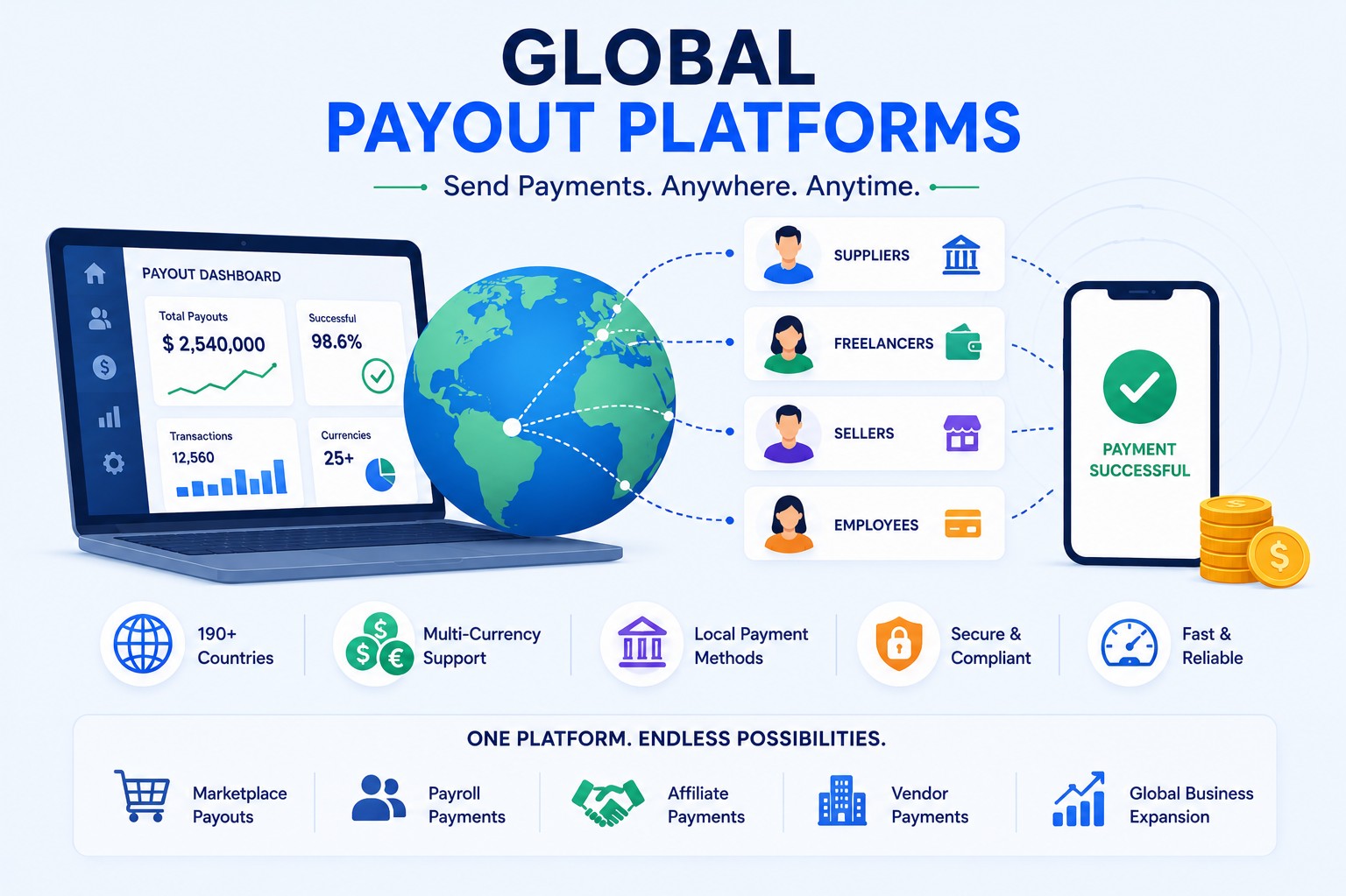
Global payout platforms are technology-driven solutions that enable businesses to distribute funds to recipients across multiple countries through a single integrated system.
Rather than relying on separate banking relationships in every market, companies can use one platform to manage international payments, currency conversions, recipient onboarding, and payout tracking.
These platforms typically support a wide range of payment methods, including bank transfers, digital wallets, local payment networks, prepaid cards, and real-time payment systems. This flexibility allows businesses to reach recipients using their preferred payment channels.
The primary goal of a global payout platform is to simplify international fund distribution while reducing costs and improving payment efficiency.
Why Global Payout Platforms Are Growing in Importance
The rise of the digital economy has dramatically increased demand for international payment capabilities. Businesses are no longer limited by geography and increasingly operate across multiple jurisdictions.
Marketplaces must pay sellers in different countries. Gig economy platforms need to compensate freelancers globally. Software companies process affiliate commissions internationally. Enterprises manage payroll for distributed workforces.
Without specialized payout infrastructure, these payment processes can become slow, expensive, and difficult to manage. Global payout platforms address these challenges by centralizing payment operations and automating many of the tasks traditionally associated with international transfers.
As businesses continue expanding globally, efficient payout management has become a competitive necessity.
How Global Payout Platforms Work
Global payout platforms connect businesses to a network of banking partners, payment providers, and local payment systems around the world. Instead of initiating individual international transfers through multiple banks, companies access a centralized platform that manages the payment process on their behalf.
The business uploads recipient information and payment instructions through an API, dashboard, or automated workflow. The platform validates the details, performs compliance checks, converts currencies if necessary, and routes the payment through the most efficient available channel.
Recipients receive funds through local banking systems or preferred payment methods, often reducing settlement times compared to traditional international wire transfers.
This streamlined process improves efficiency while providing greater visibility into payment status and transaction history.
Supporting Multiple Payment Methods
One of the key advantages of global payout platforms is their ability to support diverse payment options.
Different regions have different payment preferences. While bank transfers remain common in many countries, digital wallets, mobile payment systems, and instant payment networks are rapidly gaining popularity.
A robust payout platform enables businesses to accommodate these preferences without integrating multiple providers individually. This flexibility improves recipient satisfaction and increases the likelihood of successful payment delivery.
By supporting local payment methods, businesses can create more seamless international payment experiences.
Multi-Currency Capabilities
Managing multiple currencies is one of the most complex aspects of cross-border payments. Exchange rate fluctuations, conversion fees, and settlement delays can significantly impact financial performance.
Global payout platforms often provide integrated foreign exchange services that simplify currency management. Businesses can send payments in local currencies while maintaining centralized control over international financial operations.
Many platforms also offer competitive exchange rates and transparent pricing structures, helping organizations reduce overall payment costs.
As international business activity grows, effective currency management becomes increasingly important.
Global Payout Platforms and Marketplace Payments
Marketplace businesses are among the largest users of global payout platforms. Online marketplaces frequently facilitate transactions between buyers and sellers located in different countries.
After collecting customer payments, the marketplace must distribute earnings to sellers while deducting commissions, taxes, and service fees. Managing these payouts manually can be extremely challenging as transaction volumes increase.
Global payout platforms automate seller onboarding, payment calculations, fund distribution, and reconciliation processes. This enables marketplaces to scale efficiently while maintaining a positive seller experience.
Fast and reliable payouts often play a major role in attracting and retaining marketplace participants.
Payroll and Workforce Payments
The rise of remote work has transformed payroll operations. Organizations increasingly employ contractors, freelancers, and full-time employees located across multiple countries.
Global payout platforms simplify international payroll by providing centralized infrastructure for workforce payments. Businesses can manage compensation through a single system while ensuring compliance with local payment requirements.
Employees benefit from receiving payments in their preferred currencies and payment methods, while employers gain greater operational efficiency and payment transparency.
This capability has become particularly valuable as distributed workforces continue expanding worldwide.
Compliance and Regulatory Considerations
Cross-border payments are subject to extensive regulatory oversight. Financial institutions and payment providers must comply with requirements related to Anti-Money Laundering (AML), Know Your Customer (KYC), sanctions screening, and transaction monitoring.
Global payout platforms typically incorporate compliance processes directly into their infrastructure. Automated verification, screening, and reporting capabilities help businesses manage regulatory obligations more effectively.
This integrated approach reduces operational complexity while supporting secure and compliant international payments.
As global regulations continue evolving, compliance automation is becoming increasingly important.
Benefits of Global Payout Platforms
Businesses adopting global payout solutions often experience significant operational improvements. Payments can be processed faster, costs can be reduced, and financial visibility can be enhanced.
Automation minimizes manual workloads and reduces the risk of payment errors. Centralized reporting simplifies reconciliation and treasury management, while flexible payout options improve recipient experiences.
Perhaps most importantly, global payout platforms allow organizations to expand internationally without building extensive banking infrastructure in every market they serve.
This scalability makes them highly attractive for growth-focused businesses.
Emerging Trends in Global Payouts
The global payouts landscape is evolving rapidly. Real-time payment networks are reducing settlement times, while open banking initiatives are creating new opportunities for payment innovation.
Artificial intelligence is improving fraud detection, payment routing, and transaction monitoring. Embedded finance solutions are integrating payout capabilities directly into business platforms, making international payments more accessible than ever before.
Additional trends include digital wallets, blockchain-based settlement systems, and automated treasury management tools.
These innovations are helping create faster, more transparent, and more efficient global payment ecosystems.
The Future of Global Payout Platforms
As businesses become increasingly international, the demand for sophisticated payout infrastructure will continue growing. Future platforms will offer even greater automation, real-time processing, and financial intelligence capabilities.
Organizations will expect seamless access to global payment networks through APIs and embedded financial services. Compliance functions will become increasingly automated, while artificial intelligence will optimize payment routing and risk management.
Global payout platforms will evolve from payment tools into comprehensive financial operating systems that support every aspect of international fund movement.
Conclusion
Global payout platforms have become a critical component of modern financial infrastructure. By enabling businesses to send payments across borders efficiently, support multiple currencies, automate compliance, and improve recipient experiences, these solutions help organizations operate effectively in the global economy.
Whether supporting marketplace sellers, remote employees, suppliers, affiliates, or customers, global payout platforms provide the scalability and flexibility required for international growth. As digital commerce, remote work, and cross-border business continue expanding, these platforms will play an increasingly important role in shaping the future of global payments.
Comments
No comments yet. Be the first to share your thoughts.
Leave a comment