
Introduction
International business and global banking have become an essential part of modern commerce. Companies send payments to overseas suppliers, receive funds from international customers, and manage bank accounts across multiple countries. As cross-border transactions increase, ensuring that payments reach the correct destination quickly and securely has become more important than ever. This is where IBAN Codes play a crucial role.
An International Bank Account Number (IBAN) is a globally recognized standard that helps identify bank accounts involved in international payments. Instead of relying solely on account numbers that may vary in format from one country to another, IBAN codes provide a standardized structure that minimizes errors and speeds up payment processing.
Today, IBAN codes are used by banks, payment providers, businesses, and individuals across numerous countries to facilitate secure domestic and international transfers. Understanding how they work is essential for anyone involved in global payments.
What Are IBAN Codes?
An IBAN Code (International Bank Account Number) is a standardized bank account identifier used to process domestic and international bank transfers accurately.
Each IBAN uniquely identifies a customer’s bank account within a participating country. It contains information about the country, financial institution, and individual account, allowing banks to route payments correctly.
Unlike a simple bank account number, an IBAN follows an internationally agreed format, making cross-border payment processing more reliable and efficient.
IBANs are widely used throughout Europe, the Middle East, parts of Africa, and many other regions participating in the IBAN system.
Why IBAN Codes Were Introduced
Before the introduction of IBANs, international bank transfers often faced delays due to inconsistent account numbering systems.
Different countries used different account formats, increasing the likelihood of payment errors and manual processing. Incorrect account information frequently resulted in rejected transfers, additional banking fees, and delayed settlements.
The IBAN standard was introduced to create a common international format that improves payment accuracy, reduces processing errors, and enables faster cross-border transactions.
Today, IBAN codes have become an essential part of the global banking infrastructure.
Structure of an IBAN Code
Every IBAN follows a standardized format, although the total length varies by country.
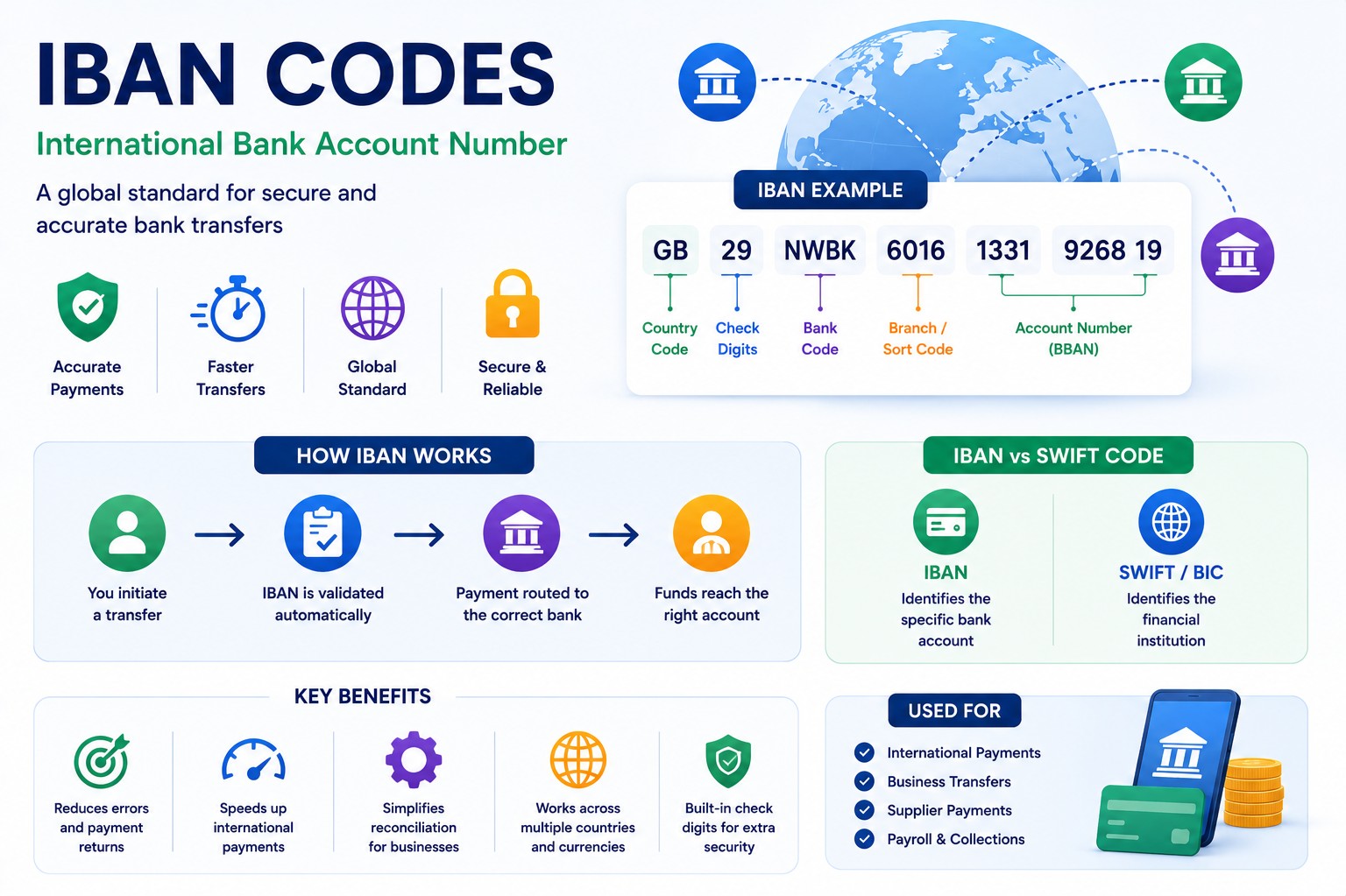
An IBAN typically begins with a two-letter country code that identifies the country where the account is held. This is followed by two check digits that help validate the accuracy of the IBAN.
The remaining characters include the bank identifier and the customer’s account number according to the country’s banking structure.
Because every country has its own banking format, IBAN lengths can range from approximately 15 to 34 alphanumeric characters.
The standardized structure enables banks to automatically validate account information before processing payments.
How IBAN Codes Work
When a customer initiates an international bank transfer, the sending bank uses the IBAN to identify the recipient’s account.
The payment system first validates the IBAN using its built-in check digits. If the IBAN is valid, the payment is routed through the appropriate banking network to the receiving financial institution.
The receiving bank then uses the account information contained within the IBAN to credit the funds to the correct account.
This automated validation process significantly reduces payment errors and accelerates transaction processing.
IBAN vs SWIFT Code
IBANs and SWIFT codes are often used together but serve different purposes.
An IBAN identifies the specific bank account receiving the funds, while a SWIFT (or BIC) code identifies the financial institution responsible for processing the payment.
In many international transfers, both the IBAN and SWIFT code are required. The SWIFT code directs the payment to the correct bank, while the IBAN ensures it reaches the correct customer account.
Together, these identifiers enable secure and accurate international money transfers.
Benefits of Using IBAN Codes
IBAN codes provide several advantages for businesses and individuals making international payments.
The standardized format reduces manual entry errors, improving payment accuracy and minimizing rejected transfers. Automated validation also speeds up payment processing by allowing banks to verify account information before initiating transactions.
Businesses benefit from simplified reconciliation, improved operational efficiency, and greater confidence when sending or receiving international funds.
For customers, IBANs create a more reliable and transparent payment experience.
IBAN Codes in Business Banking
Businesses that operate internationally rely heavily on IBAN codes.
Exporters receive payments from overseas buyers, while importers use IBANs to pay foreign suppliers. Multinational corporations manage payroll, treasury operations, and vendor payments using international banking infrastructure built around IBAN standards.
E-commerce companies, marketplaces, SaaS providers, and financial institutions also depend on IBANs to support cross-border payment operations efficiently.
As global commerce continues expanding, IBAN adoption becomes increasingly important for business success.
Dedicated IBANs and Virtual IBANs
Modern financial institutions now offer additional IBAN-based solutions beyond traditional bank accounts.
A dedicated IBAN provides a unique account number assigned exclusively to one customer or business, simplifying payment tracking and reconciliation.
A virtual IBAN functions as a payment collection identifier linked to an underlying bank account. Businesses can assign multiple virtual IBANs to different customers while maintaining centralized fund management.
These innovations improve payment automation and operational efficiency for high-volume businesses.
Security and Validation
Security is one of the major strengths of the IBAN system.
The check digits included in every IBAN allow banks to detect many common data-entry mistakes before payments are processed.
Banks also use secure payment networks, encryption, fraud monitoring, and regulatory compliance procedures to protect international transactions.
Although IBAN validation confirms that the account number is correctly formatted, businesses should still verify recipient details carefully before sending funds.
Common Mistakes When Using IBAN Codes
One of the most common mistakes is confusing the IBAN with the SWIFT code or local account number.
Typing errors, missing characters, or using an IBAN from the wrong country can cause payment failures or delays.
Businesses should always copy IBANs carefully, validate them before initiating transfers, and confirm banking details directly with trusted recipients.
Modern banking platforms often include automatic IBAN validation tools that reduce these risks.
IBAN Codes and Digital Banking
Digital banking platforms increasingly automate international payments using IBAN standards.
Customers can initiate transfers through mobile apps, online banking portals, ERP systems, and payment APIs without manually entering complex routing information.
Open Banking APIs further simplify payment initiation while improving automation and integration across financial systems.
These innovations are making international banking faster, more accessible, and easier to manage.
Future of IBAN Codes
As international commerce continues expanding, IBAN codes will remain a fundamental part of global payment infrastructure.
Real-time payments, embedded finance, API-driven banking, and artificial intelligence will further enhance how IBAN-based transactions are processed and monitored.
Financial institutions are investing in automation, payment intelligence, and fraud prevention technologies that improve the efficiency of international transfers while maintaining strong security standards.
IBANs will continue supporting reliable cross-border banking in an increasingly connected financial ecosystem.
Conclusion
IBAN Codes have become an essential component of modern international banking. By providing a standardized way to identify bank accounts, they improve payment accuracy, reduce errors, accelerate cross-border transfers, and simplify global financial operations.
Whether used by individuals sending money abroad or multinational businesses managing international payments, IBAN codes provide the consistency and reliability needed for secure global banking.
As digital payments and international commerce continue growing, understanding how IBAN codes work will remain essential for businesses and consumers participating in the global financial system.
Comments
No comments yet. Be the first to share your thoughts.
Leave a comment