
Introduction
Operating a business in a high-risk industry often brings unique banking challenges. While these businesses may be fully legitimate and compliant, they frequently encounter difficulties opening bank accounts, obtaining IBANs, or accessing payment services due to the perceived financial, regulatory, or reputational risks associated with their industries. Traditional financial institutions often apply stricter underwriting policies, making it harder for businesses to manage international payments and daily banking operations.
High-Risk IBAN & Banking solutions are designed to bridge this gap. They provide specialized banking services, international IBAN accounts, multi-currency capabilities, and payment infrastructure tailored to businesses operating in industries that require enhanced compliance and risk management.
As global commerce continues to expand, specialized banking providers are helping high-risk businesses gain access to secure, compliant, and scalable financial services.
What Is High-Risk IBAN & Banking?
High-Risk IBAN & Banking refers to banking services specifically designed for businesses operating in industries considered higher risk by financial institutions.
These solutions often include dedicated or virtual IBAN accounts, international payment capabilities, multi-currency support, treasury services, and business banking features that help companies manage domestic and cross-border transactions efficiently.
Providers typically combine flexible banking services with robust compliance procedures to support legitimate businesses while managing financial risk.
Why Some Businesses Are Classified as High Risk
Banks assess risk using several factors, including industry type, transaction volumes, geographic markets, regulatory requirements, chargeback history, and fraud exposure.
Businesses involved in sectors such as gaming, forex, cryptocurrency, CBD products, nutraceuticals, travel, digital subscriptions, adult entertainment, and international trading are often classified as high risk because they may experience higher transaction volumes, cross-border activity, or increased regulatory scrutiny.
Being categorized as high risk does not necessarily indicate wrongdoing—it simply means additional due diligence is required.
How High-Risk IBAN & Banking Works
Businesses begin by applying with a banking provider that specializes in serving higher-risk industries.
The provider conducts Know Your Customer (KYC), Anti-Money Laundering (AML), and business verification checks before approving the account.
Once approved, the business receives an IBAN account that can be used to receive payments, send international transfers, manage multiple currencies, and integrate with payment platforms or treasury systems.
Many providers also offer online banking portals, APIs, and automated payment management tools.
Key Features of High-Risk Banking Solutions
Modern high-risk banking platforms provide far more than a standard business account.
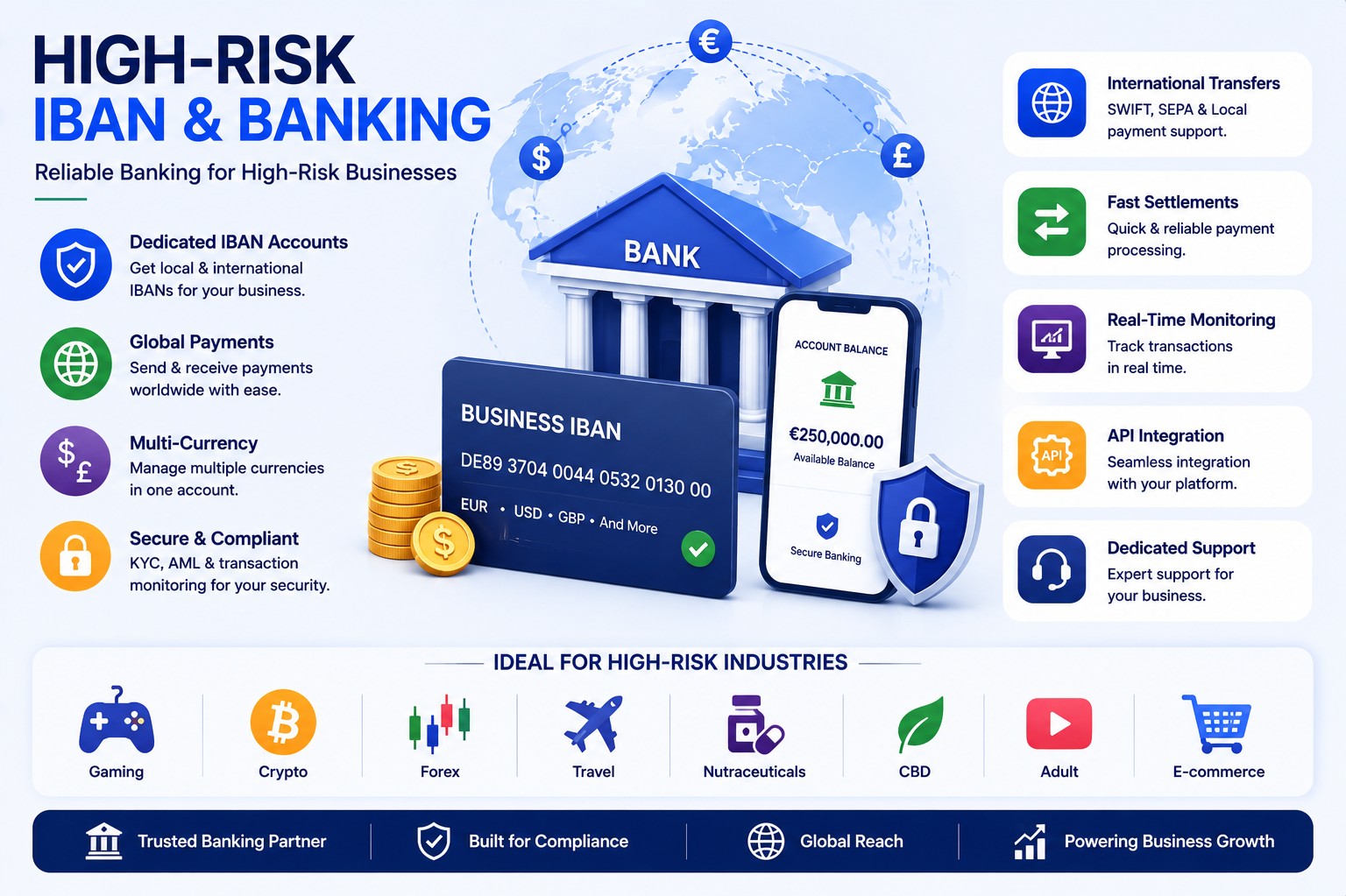
Businesses often gain access to dedicated or virtual IBANs, international wire transfers, SEPA and SWIFT payments, multi-currency accounts, API integrations, payment reconciliation, transaction monitoring, role-based account management, and real-time reporting.
Many providers also support embedded finance capabilities that simplify financial operations for global businesses.
Benefits for Businesses
High-risk banking solutions enable businesses to operate more efficiently despite traditional banking limitations.
Access to dedicated IBAN accounts improves payment collection and supplier settlements while supporting international expansion.
Multi-currency capabilities reduce foreign exchange complexity, and automated payment tools streamline treasury management.
Businesses also benefit from faster payment processing, improved financial visibility, and stronger relationships with banking partners that understand their industry.
Security and Regulatory Compliance
Security and compliance are central to high-risk banking.
Specialized providers implement robust KYC and AML procedures, transaction monitoring, sanctions screening, fraud detection, and secure payment authentication to meet regulatory obligations.
Advanced encryption, access controls, and continuous risk assessments help protect customer funds and sensitive financial information.
These measures allow legitimate businesses to operate securely while maintaining compliance with international regulations.
High-Risk IBAN vs Standard Business Banking
Traditional business banking often serves companies operating in lower-risk sectors with straightforward financial profiles.
High-risk banking providers, on the other hand, are equipped to manage businesses with more complex transaction patterns, international operations, and enhanced compliance requirements.
They typically offer more flexible onboarding processes, specialized risk management expertise, and financial products tailored to industries that may be underserved by conventional banks.
Industries That Benefit from High-Risk Banking
Many industries rely on specialized IBAN and banking solutions.
These include online gaming, cryptocurrency services, foreign exchange providers, travel agencies, subscription businesses, nutraceutical companies, CBD merchants, digital marketplaces, financial technology companies, international trading businesses, and software platforms with global customer bases.
For these organizations, specialized banking services provide the financial infrastructure needed to support sustainable growth.
Artificial Intelligence in High-Risk Banking
Artificial intelligence is improving high-risk banking by enhancing fraud detection, transaction monitoring, and compliance automation.
AI-powered systems analyze payment behavior in real time, identify suspicious activity, automate risk scoring, and assist with AML investigations.
Machine learning also helps reduce false positives while improving operational efficiency and regulatory reporting.
These capabilities allow providers to manage risk more effectively without compromising customer experience.
Challenges and Considerations
Businesses seeking high-risk banking services should prepare for enhanced due diligence, detailed documentation requirements, and ongoing compliance reviews.
Providers may evaluate company ownership structures, business models, transaction flows, customer profiles, and source of funds before approving accounts.
Maintaining transparent business practices and accurate financial records significantly improves the likelihood of successful onboarding.
Choosing an experienced banking partner also helps simplify compliance obligations.
Future of High-Risk IBAN & Banking
The future of high-risk banking is closely tied to digital transformation.
Open Banking, embedded finance, real-time payments, API-driven banking, artificial intelligence, and digital identity verification are making specialized financial services more accessible and efficient.
As financial institutions adopt more advanced risk assessment technologies, legitimate high-risk businesses are expected to gain broader access to secure and scalable banking solutions.
This evolution will support innovation while maintaining strong regulatory standards.
Choosing the Right High-Risk Banking Provider
When selecting a high-risk banking provider, businesses should evaluate IBAN availability, supported jurisdictions, multi-currency capabilities, payment network access, compliance expertise, API integrations, reporting tools, security standards, onboarding process, customer support, and pricing.
A trusted provider should understand the unique requirements of high-risk industries while delivering reliable banking infrastructure that supports long-term growth.
Conclusion
High-Risk IBAN & Banking solutions provide legitimate businesses with access to the financial tools needed to operate confidently in today’s global economy. By offering dedicated IBANs, international payment capabilities, enhanced compliance support, and modern banking technology, these providers help businesses overcome traditional banking barriers.
As international commerce, digital payments, and regulatory expectations continue to evolve, specialized high-risk banking services will play an increasingly important role in enabling secure, compliant, and scalable financial operations for businesses worldwide.
Comments
No comments yet. Be the first to share your thoughts.
Leave a comment