
Introduction
The rapid growth of digital marketplaces has transformed the way businesses and consumers buy and sell products and services. From e-commerce platforms and food delivery apps to ride-sharing services, freelance marketplaces, travel booking platforms, and B2B exchanges, online marketplaces have become a central part of the digital economy. Unlike traditional online stores that process payments for a single merchant, marketplaces must manage transactions involving multiple buyers, sellers, service providers, and financial institutions simultaneously.
A Marketplace Payment Gateway is specifically designed to support these complex payment flows. It enables platforms to securely collect payments from customers, split funds among multiple vendors, manage commissions, automate payouts, and ensure compliance with financial regulations. Instead of manually handling thousands of individual transactions, marketplace operators can automate payment operations while providing a seamless experience for both buyers and sellers.
As global e-commerce continues to expand, choosing the right marketplace payment gateway has become essential for scalability, security, and long-term business success.
What Is a Marketplace Payment Gateway?
A Marketplace Payment Gateway is a specialized payment solution that enables online marketplaces to process payments involving multiple vendors within a single transaction.
Unlike a standard payment gateway that transfers funds directly from a customer to one merchant, a marketplace payment gateway can collect the customer’s payment, allocate funds according to predefined rules, deduct platform commissions, hold payments when necessary, and distribute payouts to multiple sellers.
The gateway acts as the financial bridge connecting buyers, marketplace operators, payment processors, banks, and vendors while ensuring secure and efficient payment processing.
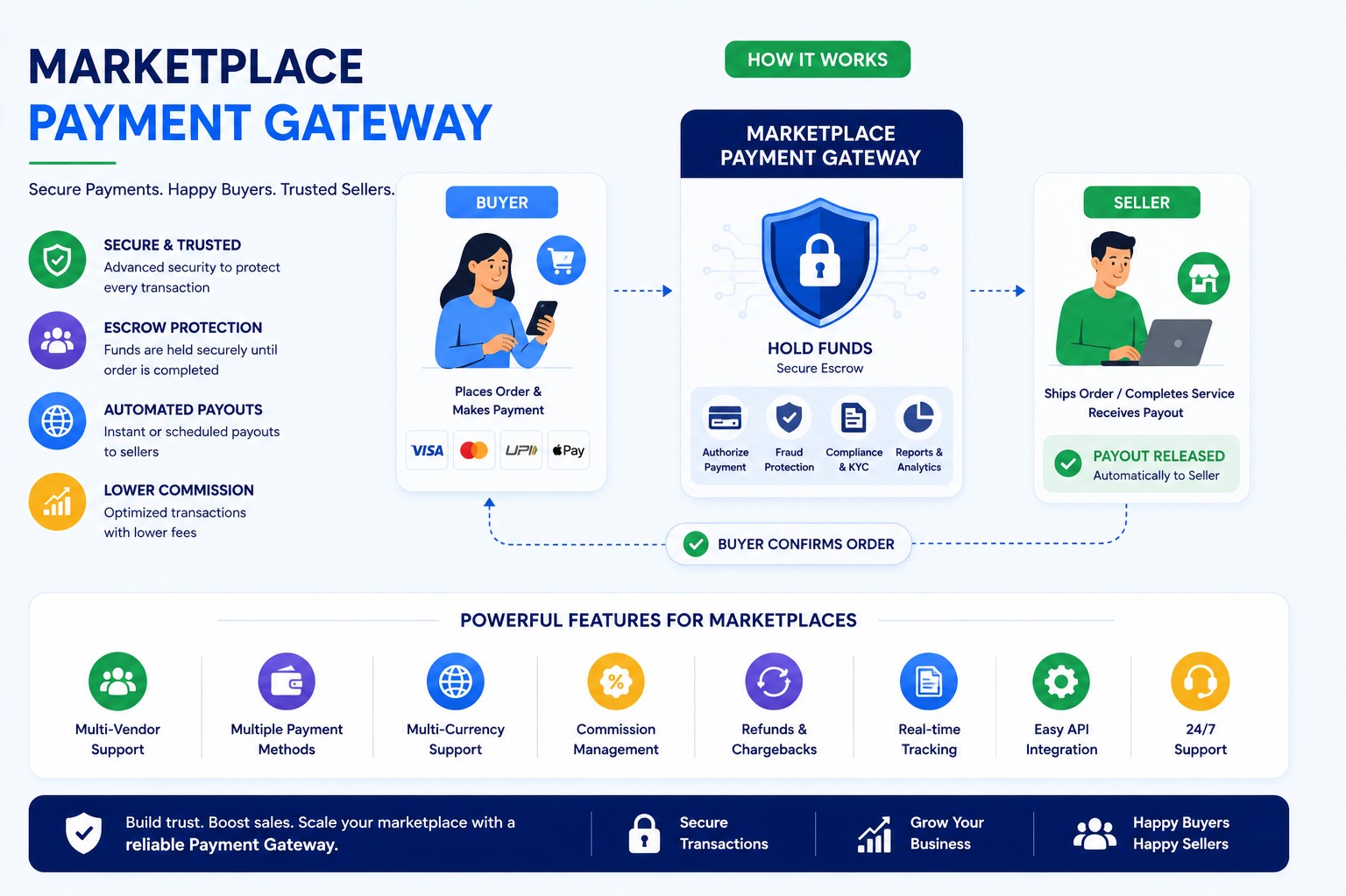
How a Marketplace Payment Gateway Works
When a customer places an order on a marketplace, the payment gateway securely captures the payment information and encrypts the transaction data.
The payment request is sent to the acquiring bank and the customer’s issuing bank for authorization. Once approved, the gateway receives the funds and automatically applies the marketplace’s payment rules.
The platform commission is deducted, while the remaining amount is allocated to the appropriate vendors. Depending on the marketplace model, payouts may be released immediately, scheduled for later, or held in escrow until the transaction is completed successfully.
All payment activities are recorded automatically for reporting and reconciliation.
Why Marketplaces Need Specialized Payment Gateways
Managing payments for multiple independent sellers is significantly more complex than processing payments for a single business.
Marketplace operators must calculate commissions, process refunds, distribute vendor payouts, handle disputes, support multiple currencies, comply with financial regulations, and maintain detailed transaction records.
Traditional payment gateways often lack these advanced capabilities.
A marketplace payment gateway simplifies these operations through built-in automation, reducing administrative work while improving payment accuracy and operational efficiency.
Key Features of a Marketplace Payment Gateway
Modern marketplace payment gateways provide features specifically designed for multi-vendor businesses.
These include split payments, automated vendor payouts, escrow functionality, commission management, multi-currency support, recurring billing, refund processing, API integration, fraud detection, payment reporting, and real-time transaction monitoring.
Many platforms also offer customizable payment workflows that adapt to different marketplace business models.
These features allow marketplaces to manage complex payment operations from a centralized platform.
Split Payments
One of the defining capabilities of a marketplace payment gateway is split payment processing.
When a customer completes a purchase involving multiple vendors, the payment gateway automatically divides the funds according to predefined business rules.
Each seller receives their allocated amount, while the marketplace retains its commission.
Automated split payments eliminate manual calculations and reduce accounting errors, making them essential for scalable marketplace operations.
Vendor Onboarding and Payouts
Successful marketplaces rely on efficient vendor management.
Marketplace payment gateways often include onboarding tools that verify seller identities through Know Your Customer (KYC) procedures and collect required business information.
Once approved, vendors receive payments through automated payout systems using bank transfers, digital wallets, or other supported payment methods.
Scheduled payouts improve financial planning while reducing administrative effort for marketplace operators.
Multi-Currency and Cross-Border Payments
Many online marketplaces serve buyers and sellers across multiple countries.
Marketplace payment gateways support international transactions by accepting payments in various currencies and settling funds according to vendor preferences.
Localized payment methods, currency conversion, and cross-border payment processing improve customer experiences while expanding global market opportunities.
These capabilities enable marketplaces to operate internationally without maintaining separate payment systems for each region.
Security and Fraud Prevention
Payment security is critical for maintaining trust in online marketplaces.
Marketplace payment gateways use encryption, tokenization, secure authentication, and PCI DSS compliance to protect sensitive payment information.
Advanced fraud prevention systems leverage artificial intelligence, behavioral analytics, device fingerprinting, and real-time risk scoring to identify suspicious transactions before they are completed.
These security measures help protect buyers, sellers, and marketplace operators from financial fraud.
Compliance and Regulatory Requirements
Marketplace operators must comply with a wide range of financial regulations.
Payment gateways support compliance through Know Your Customer (KYC) verification, Anti-Money Laundering (AML) monitoring, sanctions screening, tax reporting, and transaction record management.
Compliance capabilities help marketplaces meet legal requirements while reducing operational risks.
As regulations continue evolving, automated compliance tools become increasingly valuable.
Integration with Marketplace Platforms
Modern payment gateways provide APIs, SDKs, and plug-ins that integrate with marketplace software, ERP platforms, accounting systems, CRM applications, and e-commerce platforms.
These integrations automate payment collection, vendor management, reconciliation, reporting, and customer notifications.
Cloud-based architecture enables marketplaces to scale payment operations efficiently as transaction volumes increase.
Flexible integration options support both startups and enterprise-level marketplace platforms.
Industries That Use Marketplace Payment Gateways
Marketplace payment gateways support businesses across numerous industries.
E-commerce marketplaces use them to manage seller payments and commissions. Freelance platforms automate payouts to contractors, while food delivery services distribute earnings to restaurants and delivery partners.
Travel booking websites process payments for hotels, airlines, and tour operators. Ride-sharing platforms pay drivers, and B2B procurement marketplaces manage supplier settlements.
Any platform connecting multiple buyers and sellers can benefit from marketplace payment technology.
Artificial Intelligence in Marketplace Payments
Artificial intelligence is transforming marketplace payment management.
AI-powered systems optimize payment routing, identify fraudulent transactions, automate compliance monitoring, predict payment failures, and improve payout scheduling.
Machine learning continuously analyzes transaction behavior to increase payment approval rates while reducing operational risks.
These intelligent capabilities help marketplaces deliver faster, more reliable payment experiences.
Future of Marketplace Payment Gateways
Marketplace payments are evolving rapidly alongside digital commerce.
Real-time payment networks, Open Banking, embedded finance, blockchain technology, and digital identity verification are reshaping payment infrastructure.
Future marketplace gateways will provide faster settlements, intelligent payment orchestration, automated compliance, and enhanced financial analytics through AI-driven platforms.
As global marketplaces continue expanding, payment technology will play an increasingly important role in supporting secure, scalable, and efficient business growth.
Choosing the Right Marketplace Payment Gateway
Selecting the right payment gateway requires evaluating several important factors.
Businesses should consider support for split payments, vendor onboarding, automated payouts, multi-currency capabilities, API quality, fraud prevention, compliance tools, settlement speed, pricing, reporting features, scalability, and customer support.
A reliable gateway should support both current operational needs and future marketplace expansion.
Choosing the right payment partner helps improve customer satisfaction while simplifying financial management.
Conclusion
A Marketplace Payment Gateway is the foundation of successful multi-vendor commerce. By automating payment collection, fund splitting, vendor payouts, fraud prevention, and regulatory compliance, it enables marketplace operators to manage complex financial operations with greater efficiency and security.
Whether operating an e-commerce marketplace, gig economy platform, travel booking service, freelance marketplace, or B2B exchange, businesses need payment infrastructure that can scale with growth while delivering seamless payment experiences for buyers and sellers alike.
As digital marketplaces continue to expand globally, investing in a secure and intelligent marketplace payment gateway will remain essential for sustainable growth, operational excellence, and long-term success.
Comments
No comments yet. Be the first to share your thoughts.
Leave a comment