
Introduction
The global iGaming industry has grown into one of the fastest-expanding sectors in digital entertainment. Online casinos, sports betting platforms, poker rooms, fantasy sports operators, esports platforms, and skill-based gaming websites process millions of transactions every day from players around the world. Behind every successful deposit and withdrawal lies a reliable payment infrastructure that keeps funds moving securely and efficiently.Unlike traditional e-commerce businesses, iGaming payment gateway operators face unique challenges. They process high transaction volumes, manage multiple currencies, comply with strict regulations, and operate in an environment where fraud prevention and responsible gaming are critical. These factors make payment processing significantly more complex than standard online retail.
An iGaming Payment Gateway addresses these challenges by providing specialized payment solutions designed specifically for the gaming industry. It enables operators to accept deposits, process withdrawals, reduce fraud, and deliver seamless payment experiences while remaining compliant with regulatory requirements.
As competition intensifies, choosing the right payment gateway has become a strategic decision that directly influences player satisfaction, operational efficiency, and long-term business growth.
What Is an iGaming Payment Gateway?
An iGaming Payment Gateway is a payment processing platform designed to facilitate secure financial transactions between players and online gaming operators.
It acts as the bridge connecting gaming platforms with banks, card networks, digital wallets, payment providers, and alternative payment methods. The gateway authorizes deposits, verifies payment information, manages settlements, and supports withdrawals while maintaining strong security and compliance standards.
Unlike general payment gateways, iGaming payment solutions are built to handle the specific requirements of gaming businesses, including higher transaction volumes, international payments, fraud monitoring, and regulatory reporting.
Why iGaming Is Considered High Risk
Most financial institutions classify iGaming as a high-risk industry due to its transaction characteristics and regulatory environment.
Operators frequently process large payment volumes, serve customers across multiple jurisdictions, and experience higher-than-average chargeback rates. Fraud attempts, identity verification requirements, and varying legal frameworks further increase operational complexity.
Because of these factors, many traditional payment providers are reluctant to support gaming businesses.
Specialized iGaming payment gateways are designed to manage these risks while providing stable payment infrastructure for licensed operators.
How an iGaming Payment Gateway Works
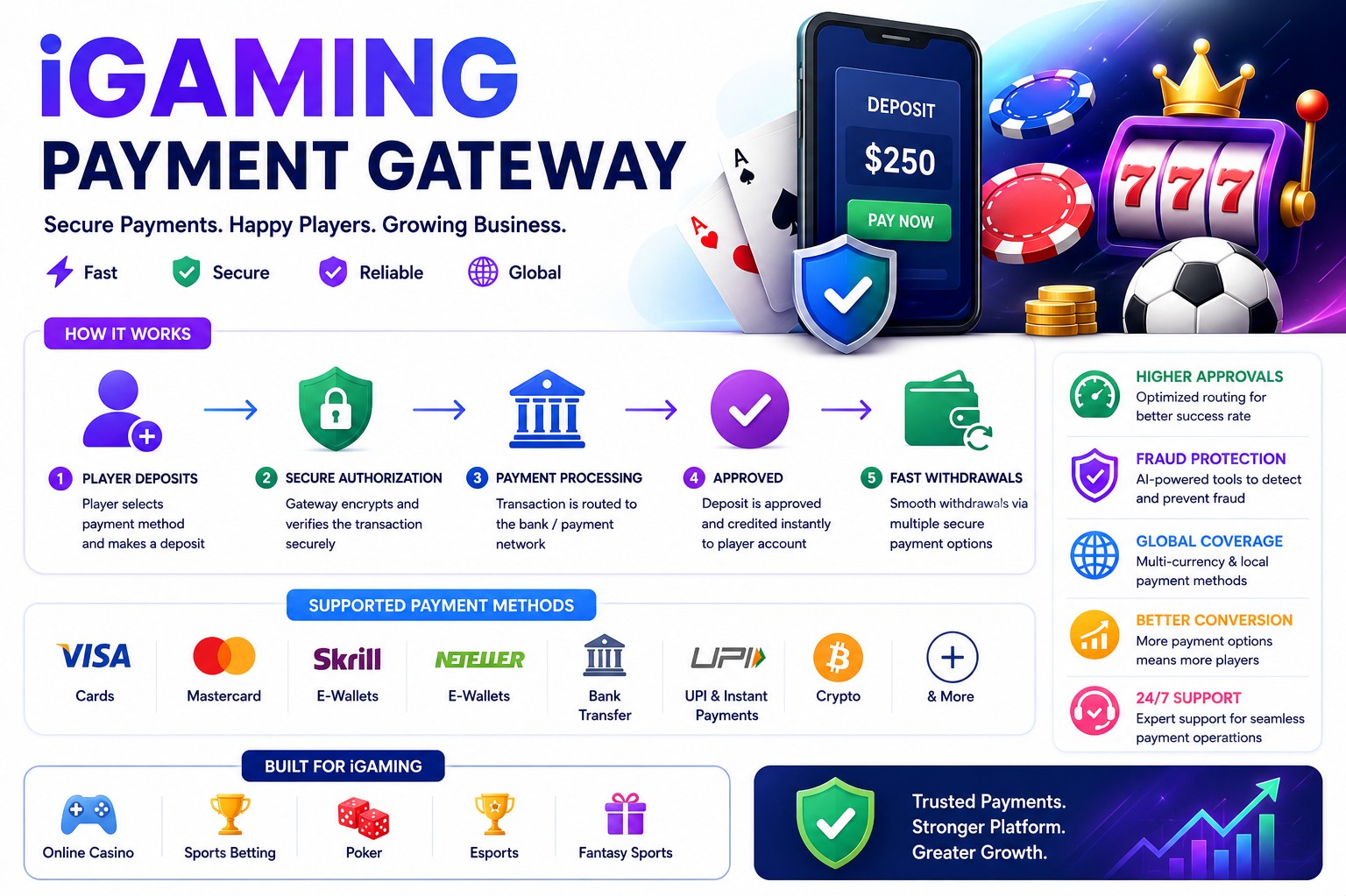
When a player deposits funds, the payment gateway securely captures the transaction request and transmits it to the appropriate payment processor or acquiring bank.
The payment provider verifies the transaction, performs fraud and compliance checks, and requests authorization from the issuing bank or payment network.
If approved, the funds are credited to the player’s gaming account almost immediately. Withdrawal requests follow a similar process, with additional verification to ensure regulatory compliance and fraud prevention.
Throughout every transaction, encryption, authentication, and real-time monitoring help maintain security and reliability.
Supporting Multiple Payment Methods
Modern players expect flexibility when making deposits and withdrawals.
A high-quality iGaming payment gateway supports a broad range of payment methods, including credit cards, debit cards, bank transfers, digital wallets, instant bank payments, prepaid solutions, and alternative local payment methods.
Providing localized payment options improves player convenience and increases deposit conversion rates, particularly in international markets.
Operators that support multiple payment preferences often experience higher customer satisfaction and stronger player retention.
Multi-Currency and Cross-Border Payments
Many gaming platforms serve players from multiple countries, making international payment capabilities essential.
An advanced payment gateway supports multiple currencies, allowing players to deposit and withdraw funds in their local currency while minimizing foreign exchange friction.
Cross-border payment capabilities also simplify international expansion by enabling operators to process transactions efficiently across different jurisdictions.
Localized payment experiences contribute significantly to player trust and engagement.
Security Features
Security is one of the most important aspects of any iGaming payment gateway.
Modern gateways use encryption, tokenization, secure authentication, and continuous fraud monitoring to protect sensitive payment information.
Advanced fraud detection systems analyze transaction behavior, device information, geographic patterns, and player activity to identify suspicious behavior before fraudulent transactions are completed.
These technologies help safeguard both operators and players while maintaining smooth payment experiences.
Compliance and Regulatory Requirements
The iGaming industry operates under strict regulatory oversight.
Payment providers must support Know Your Customer (KYC) verification, Anti-Money Laundering (AML) procedures, sanctions screening, responsible gaming requirements, and transaction monitoring.
Compliance obligations vary by jurisdiction, making regulatory expertise an important consideration when selecting a payment partner.
A gateway with built-in compliance capabilities reduces operational complexity while helping operators maintain regulatory approval.
Fraud Prevention and Chargeback Management
Fraud prevention is critical in online gaming.
Cybercriminals may attempt account takeovers, stolen card transactions, bonus abuse, identity fraud, or payment manipulation.
Modern iGaming payment gateways combine artificial intelligence, behavioral analytics, velocity checks, and machine learning to detect unusual activity in real time.
Chargeback management tools also help operators reduce disputes by improving transaction visibility, maintaining detailed records, and supporting rapid response processes.
Lower fraud rates contribute directly to profitability and payment stability.
Benefits for Gaming Operators
An iGaming payment gateway offers much more than payment acceptance.
Fast deposits improve the player experience and encourage gameplay. Efficient withdrawal processing builds trust and strengthens customer loyalty.
Automation reduces manual workloads while improving financial reconciliation and reporting.
Scalable infrastructure enables operators to expand internationally without rebuilding their payment systems.
By combining security, compliance, and operational efficiency, specialized gateways support sustainable business growth.
Choosing the Right iGaming Payment Gateway
Selecting the right payment provider requires careful evaluation.
Operators should consider payment method coverage, international reach, processing speed, fraud prevention capabilities, compliance support, API integration, reporting tools, customer support, and overall reliability.
The ideal gateway should scale alongside business growth while maintaining excellent transaction approval rates and minimizing operational risk.
A flexible, secure, and compliant payment solution can significantly improve both operational performance and player satisfaction.
Artificial Intelligence in Gaming Payments
Artificial intelligence is transforming payment processing within the gaming industry.
AI systems monitor player behavior, identify unusual transaction patterns, improve fraud detection, optimize payment routing, and reduce false payment declines.
Machine learning algorithms continuously improve risk assessment based on historical payment data, helping operators make faster and more accurate decisions.
As payment volumes continue increasing, AI-driven automation will become even more valuable.
Future Trends in iGaming Payments
The future of gaming payments is increasingly digital, intelligent, and real-time.
Open Banking, Account-to-Account (A2A) payments, embedded finance, digital wallets, and instant payment networks are expanding payment options for gaming platforms.
Blockchain-based settlement, biometric authentication, and AI-powered compliance solutions are also gaining attention as the industry evolves.
Operators that adopt modern payment technologies will be better positioned to meet changing player expectations while maintaining regulatory compliance.
Conclusion
An iGaming Payment Gateway is a critical component of every successful online gaming business. It enables secure deposits, fast withdrawals, multi-currency support, fraud prevention, and regulatory compliance while delivering the seamless payment experiences players expect.
As the global gaming industry continues expanding, operators need payment solutions that combine reliability, scalability, and advanced security. Investing in the right payment gateway not only improves operational efficiency but also enhances player trust and long-term business growth.
In an increasingly competitive iGaming market, a robust payment infrastructure is no longer just a technical necessity it is a strategic advantage.
Comments
No comments yet. Be the first to share your thoughts.
Leave a comment