
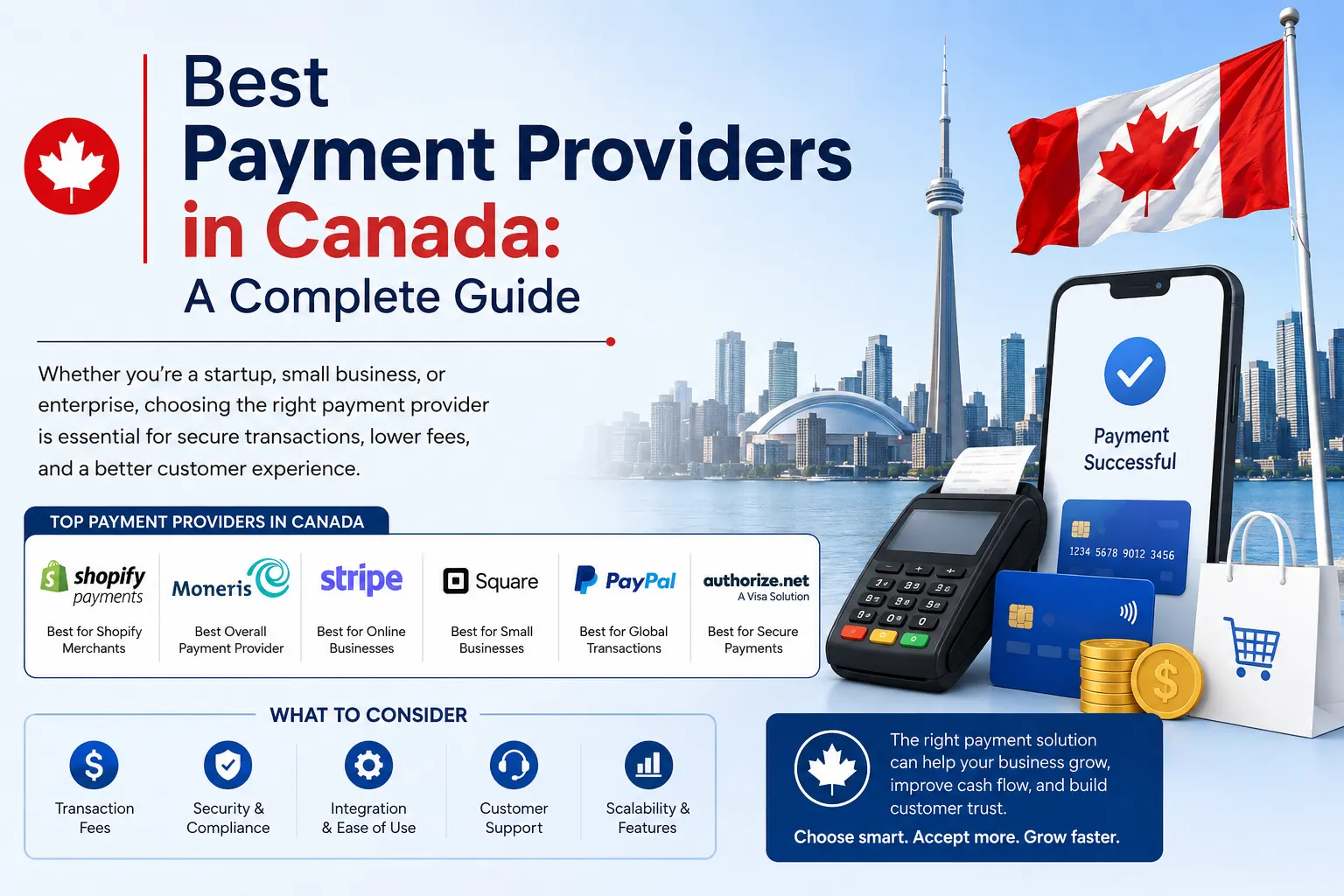
Canada’s payment landscape looks deceptively simple on the surface, a handful of familiar names, similar-looking pricing pages, and a shared reliance on Interac and the major card networks. In practice, choosing the right payment provider Canada businesses can rely on long-term means understanding how interchange, contract terms, and underwriting risk actually differ between providers, especially after the interchange changes that reshaped Canadian processing economics in the last two years.
TL;DR
Canada’s leading payment providers in 2026 include Moneris, the country’s largest processor jointly owned by RBC and BMO, alongside Stripe, Square, Helcim, Elavon Canada, and TD Merchant Services. The average effective processing rate for Canadian small businesses runs roughly 2.4% to 2.8%, though qualifying businesses on interchange-plus pricing can pay closer to 1.8% to 2.1% following the October 2024 interchange reduction, a saving that flat-rate providers aren’t required to pass through. Beyond pricing, Canadian businesses should weigh contract flexibility, underwriting stability, and cross-border capability, since not every provider handles USD transactions or international customers equally well. Travel companies face a narrower shortlist than most Canadian businesses, given how FINTRAC’s regulatory environment and elevated chargeback exposure push many mainstream payment providers to decline high-risk travel accounts outright.
How Canadian Payment Processing Actually Works
A payment provider in the Canadian context typically bundles several distinct functions: the payment gateway that encrypts and transmits transaction data, the merchant account that holds settled funds, and the underlying payment processing infrastructure connecting to card networks and Interac. Most Canadian providers combine all three into a single service, though enterprise-grade providers sometimes separate gateway and acquiring functions for larger, more complex merchants.
Domestically, Interac Debit remains the most-used payment method by transaction count, while Visa leads as the top credit card network, followed by Mastercard. Contactless payments now account for more than 70% of in-store card transactions, which shapes what Canadian businesses need their in-person processing to support. Digital payments made up the vast majority of total payment transactions and value in Canada in the most recent Payments Canada data, with payment wallets like Apple Pay and Google Pay increasingly standard alongside Interac e-Transfer for account-to-account transfers.
What Changed in Canadian Processing Economics
The single biggest shift affecting Canadian merchant pricing in recent years was the October 2024 interchange reduction, which lowered rates to approximately 0.95% for qualifying small businesses. This matters enormously for how providers should be evaluated:
- Interchange-plus providers pass the savings through automatically: since their pricing separates the non-negotiable interchange rate from the provider’s own markup.
- Flat-rate and tiered providers are not required to pass the reduction through: and some prominent providers, including Stripe, have been publicly criticized by Canadian small business advocacy groups for not adjusting pricing downward despite the interchange cut.
- Businesses on tiered or flat-rate pricing should audit their statements: to confirm whether their effective rate actually reflects current interchange levels, since the gap between what a provider could charge and what it does charge has widened.
This makes pricing model, not just headline rate, one of the most important factors in choosing a Canadian payment provider in 2026.
Leading Payment Providers in Canada
Moneris
Moneris is Canada’s largest payment processor, jointly owned by RBC and BMO, and processes more Canadian card volume than any other single provider. It offers a full suite of merchant services, including e-commerce gateways, POS systems, and next-day settlement, making it a common default for established and growing retailers that want national infrastructure and deep transaction reporting.
Stripe
Stripe remains a leading choice for developer-led online businesses in Canada, with broad API flexibility and strong e-commerce integration. Its flat-rate pricing (commonly cited around 2.9% + $0.30 CAD) offers simplicity, though Canadian merchants should note that Stripe did not pass through the 2024 interchange reduction, making it comparatively less cost-effective at scale than interchange-plus alternatives.
Square
Square continues to serve small businesses and pop-up or in-person sellers well, with free POS hardware options, flat-rate pricing, and fast onboarding. Its simplicity comes at the cost of higher effective rates for growing businesses compared to interchange-plus providers, and customer support is more limited than some Canadian-based alternatives.
Helcim
Helcim is a Canadian company offering interchange-plus pricing with CAD processing and bilingual support, and has historically been considered one of the most cost-transparent Canadian payment providers. Following its Series B funding in early 2024, some merchant reviews note increased underwriting friction, including account holds tied to risk classification, worth factoring in for businesses with less predictable transaction patterns.
Elavon Canada
Elavon supports businesses with international operations, handling over 130 currencies and local payment methods across dozens of countries. For Canadian merchants expanding into cross-border payments, it offers consolidated reporting and multi-region support that smaller domestic-only providers typically can’t match.
TD Merchant Services
TD Merchant Services combines Canadian banking infrastructure with standard processing capabilities, appealing to businesses that prefer working with a familiar national bank for both banking and payments. Pricing tends to be less transparent than dedicated payment specialists, and businesses should request a detailed quote rather than relying on advertised rates.
Payline
Payline offers flexible, month-to-month contracts with transparent interchange-plus pricing, positioning itself as a Canadian-focused alternative for businesses wanting flexibility without long-term lock-in. It’s a reasonable fit for merchants who want to test a provider before committing to a longer relationship.
Comparison Snapshot
| Provider | Pricing Model | Best For |
|---|---|---|
| Moneris | Custom, volume-based | Established retailers, national infrastructure |
| Stripe | Flat-rate (~2.9% + 30¢) | Developer-led online businesses |
| Square | Flat-rate | Small and pop-up businesses, in-person sales |
| Helcim | Interchange-plus | Cost-conscious SMBs wanting transparency |
| Elavon Canada | Custom, multi-currency | Businesses with international operations |
| TD Merchant Services | Custom, bank-integrated | Businesses wanting bank-integrated payments |
| Payline | Interchange-plus, month-to-month | Merchants wanting flexibility without contracts |
What to Evaluate Beyond the Headline Rate
- Pricing model fit: interchange-plus pricing is generally more cost-effective for businesses processing over roughly $30,000/month, while flat-rate suits early-stage or lower-volume merchants prioritizing simplicity
- Contract flexibility: many modern providers now operate month-to-month, though some traditional processors still require multi-year commitments
- Digital wallet and Interac e-Transfer support: increasingly expected alongside standard card acceptance, with pay-by-bank options reducing chargeback risk for some transaction types
- PCI DSS v4.0 compliance: now requiring continuous vulnerability monitoring rather than one-time confirmation, a meaningful operational shift for merchants handling card data directly
- Cross-border and multi-currency support: critical for any Canadian business accepting online payments or digital payments from customers outside Canada
- Chargeback and dispute support: providers vary significantly in how much fraud and dispute-management tooling comes bundled in versus billed as an add-on, which matters more as transaction volume grows
Why Travel Companies Need a Different Shortlist
The providers above serve mainstream, low-to-medium risk Canadian businesses well, but travel companies typically don’t fit that profile. Several factors narrow the realistic options considerably:
- FINTRAC’s regulatory environment adds scrutiny: Travel businesses handling advance deposits and cross-border transactions face closer AML and compliance review than standard retail merchants, which some mainstream providers aren’t set up to handle efficiently.
- Chargeback rates run structurally higher in travel: Cancellations and itinerary disputes push dispute ratios above what many standard payment gateways are underwritten to absorb.
- Delayed service delivery increases underwriting caution: Customers often pay months before a trip occurs, a pattern mainstream processors, including several listed above, tend to treat conservatively or decline outright.
- Multi-currency supplier payouts are the norm: A Canadian travel agency booking overseas hotels and tours needs cross-border payments infrastructure built in from the start, not bolted on as an afterthought.
For Canadian travel businesses, the practical path typically combines a specialized high-risk payment gateway provider for customer-facing acceptance with a multi-currency payout solution for supplier payments, since few mainstream Canadian processors are built to handle both sides of that equation well for a high-risk vertical.
Final Thoughts
There’s no single best payment provider for every Canadian business, Moneris suits established retailers wanting national scale, Stripe and Square serve online and small in-person sellers respectively, and Helcim remains a strong choice for cost-conscious businesses prioritizing transparent interchange-plus pricing. The October 2024 interchange reduction makes pricing model comparison more important than ever, since not every provider passes those savings through automatically. Travel companies and other high-risk categories should expect to look beyond this mainstream list entirely, toward providers built specifically for their compliance and cross-border payment needs.
FAQs
Who is the largest payment processor in Canada?
Moneris, jointly owned by RBC and BMO, processes more Canadian card volume than any other single provider.
Did the October 2024 interchange reduction lower fees for all Canadian businesses?
Only automatically for businesses on interchange-plus pricing. Flat-rate and tiered providers aren’t required to pass the savings through, and some have not adjusted pricing accordingly.
What’s the average payment processing rate for Canadian small businesses?
Roughly 2.4% to 2.8% on average, though interchange-plus pricing can bring qualifying businesses closer to 1.8% to 2.1%.
Can travel companies use mainstream Canadian payment providers?
Often with difficulty. FINTRAC compliance requirements, delayed service delivery, and elevated chargeback rates lead many mainstream providers to decline or restrict travel merchant accounts.
What’s the difference between a payment gateway and a merchant account?
A payment gateway handles the technical processing and encryption of a transaction, while a merchant account is where settled funds are held before transferring to a business bank account.
Should Canadian businesses prioritize interchange-plus or flat-rate pricing?
Interchange-plus is generally more cost-effective for businesses processing above roughly $30,000/month, while flat-rate suits early-stage or lower-volume merchants prioritizing simplicity over optimization.
Do Canadian payment providers support cross-border transactions?
It varies significantly. Providers like Elavon support extensive multi-currency and international operations, while others are built primarily for domestic Canadian transactions.
Comments
No comments yet. Be the first to share your thoughts.
Leave a comment