
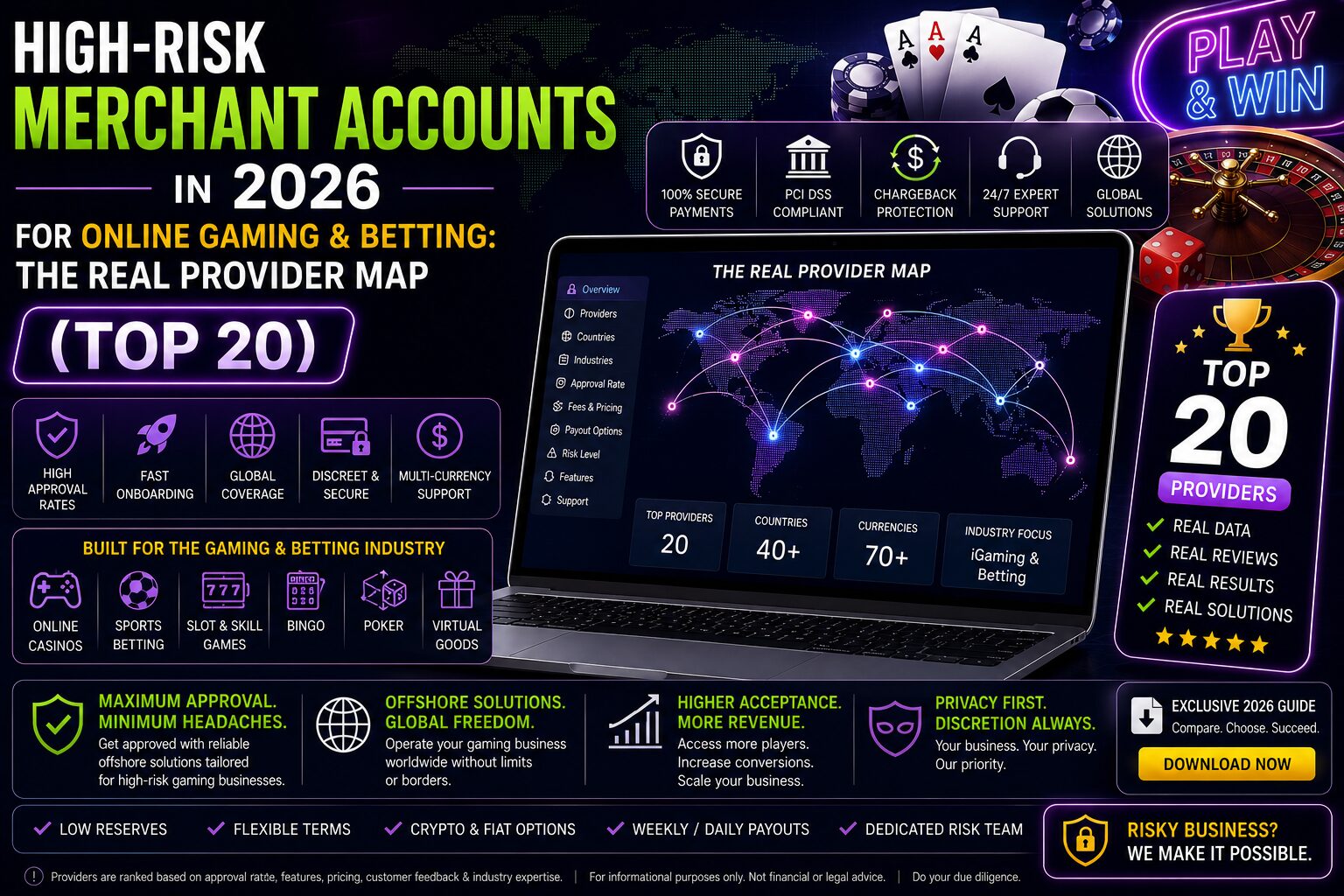
Every “best payment gateway for online casinos” article treats this like a merchant-account shopping decision. It isn’t, and treating it that way costs operators real players. Research across the iGaming sector consistently shows that payment friction at the deposit stage is one of the single biggest reasons players abandon a betting platform before ever placing a bet — many operators lose 15-30% of potential active players simply because the deposit process fails or doesn’t offer a payment method the player actually recognizes. In gambling and betting specifically, your payment provider isn’t a back-office cost center. It’s a front-line acquisition and retention lever, and the providers that understand that distinction look meaningfully different from the ones that don’t.
This piece maps 20 real providers serving the online gaming and betting vertical by the specific layer of the problem each one actually solves — because in iGaming more than almost any category in this series, “picking a payment gateway” is genuinely a stack decision, not a single vendor choice.
Why Gaming and Betting Payment Processing Works Differently
The stack has two distinct layers, and conflating them is the most common mistake operators make. The “cashier” is the player-facing layer — the screen a player actually sees and clicks through to deposit. The PSPs underneath are who actually move the money. An operator can have a beautiful, high-converting cashier UX sitting on top of a fragile, under-diversified PSP layer that fails silently the moment one acquiring relationship gets nervous about chargeback ratios — and the player experience looks fine right up until deposits start failing.
Underwriting is genuinely slower and deeper here than in most other high-risk verticals covered in this series. Applying for a high-risk iGaming merchant account isn’t like signing up for Stripe — acquiring banks conduct full underwriting, reviewing corporate structure, gambling license, business plan, chargeback history, and the backgrounds of company principals. The process typically takes 4 to 8 weeks per application, and rejection rates for new operators without operational history are meaningfully high.
A valid gambling license is close to a hard prerequisite, not a nice-to-have. Most processors require a live or near-live gaming license before serious underwriting even begins — a pattern consistent with what’s covered across this guide series’ country-specific gambling regulations, where “offshore-licensed but serving a jurisdiction requiring domestic authorization” is treated very differently than genuinely properly licensed operation.
Payment aggregators make the most sense early, direct integrations make sense once volume justifies it. For most operators, a payment aggregator is the right choice during the first two years — the operational efficiency and speed-to-market advantage outweigh the slightly higher per-transaction cost until monthly volume justifies the cost and complexity of direct acquiring integrations.
Crypto betting has grown from a niche option to a mainstream deposit method. Cryptocurrency betting activity has grown significantly between 2022 and 2026, and many online betting platforms now process a substantial share of transactions through crypto specifically because it lets players in markets with weaker local banking infrastructure (Nigeria, Thailand, Brazil, among others) deposit without depending on domestic banking rails at all — a genuinely different value proposition than crypto acceptance offers in most other high-risk verticals in this series.
A single point of failure can shut down an entire operation over a weekend. Once classified as high-risk, any single point of failure in the payment stack — a frozen reserve, a terminated corporate account, a single acquiring bank exiting the category — can block player deposits entirely, which is precisely why the aggregator-first, multi-PSP approach isn’t caution for its own sake, it’s the only realistic way to avoid a single relationship taking down the whole business.
The Five Models in Gaming and Betting Payment Processing
- The Player-Facing Cashier/Orchestration Layer. Sits on top of multiple underlying PSPs, presenting players with a single, consistent deposit experience while routing transactions intelligently across acquiring relationships underneath — solving the “cashier versus PSP” stack problem directly rather than being just one more single-relationship processor.
- The Veteran Offshore Gaming Specialist. Deep, long-standing acquiring bank relationships specifically built around gambling’s chargeback and licensing complexity, for operators who need a genuinely durable placement rather than a fast but shallow approval.
- The Licensed EU/Regional Gaming PSP. Payment institutions holding genuine regional licensing (PCI DSS Level 1, ISO 27001, EU payment institution status) rather than purely offshore acquiring — relevant for operators whose own gambling license requires demonstrating a payment partner with comparable regulatory standing.
- The Crypto-Native Betting Gateway. Built around crypto deposits specifically as a way to reach players in markets with weak domestic banking infrastructure, sidestepping card network gambling restrictions entirely in jurisdictions where crypto betting occupies a different regulatory position than card-based betting.
- The Fast-Onboarding Generalist. Markets speed and approval simplicity — useful for smaller or newer operators getting to market quickly, with the same trade-off flagged throughout this guide series: confirm what’s given up (reserve terms, contract length, fee structure) in exchange for the faster yes.
Here’s how 20 real providers sort into that structure.
Model 1: Player-Facing Cashier/Orchestration Layers
Fluid frames the entire iGaming payment decision correctly as a two-layer stack problem — the cashier players see, and the PSPs underneath that actually move money — and positions itself specifically as the orchestration layer sitting on top of whichever combination of underlying processors an operator’s geo and risk profile call for. This model matters enormously for operators running in multiple jurisdictions simultaneously, since it means adding or swapping an underlying PSP (because one acquirer tightened its risk appetite, or a new region requires a locally preferred payment method) doesn’t require rebuilding the player-facing deposit experience from scratch.
Model 2: Veteran Offshore Gaming Specialists
Instabill is among the most frequently cited providers specifically for gaming, supporting online casinos, sportsbooks, and fantasy sports platforms with a genuinely long operating history in offshore gaming placement, particularly strong for offshore gaming operators and North American market access where domestic banking options are limited.
Shark Processing specializes hardest in iGaming specifically among the multi-vertical high-risk providers, with a global banking network built around the operational reality that gambling operators need genuine banking redundancy — if one acquiring relationship becomes unavailable due to a regulatory shift, having a second one already active matters more here than in almost any other vertical.
Durango Merchant Services lists online gaming among its named hardest-to-place specialties, backed by decades of offshore banking relationships, a genuine option for operators who’ve already been declined elsewhere or carry MATCH list history from a prior processor termination.
eMerchantBroker (EMB) covers gaming alongside forex and adult, with a broad acquiring network useful for operators whose platform blends gambling with adjacent categories (skill-gaming, fantasy sports, prediction markets) that a purely gambling-focused specialist might classify differently.
MerchantScout, operating from the UK and Netherlands, runs a global acquiring network specifically for gambling and adult verticals, with reported gambling-merchant monthly volume in the tens of millions of euros — a genuinely deep, gambling-specific broker relationship rather than a generalist high-risk provider that happens to accept gaming.
Offshore Gateways positions itself directly as a leading online casino payment processing firm, with a specific emphasis on avoiding shutdowns — a direct response to the single-point-of-failure risk that defines so much of the operator anxiety in this category.
SMB Global and GlobalPay both list gaming among broader high-risk portfolios, useful for operators with an internationally distributed player base wanting multi-currency settlement alongside gaming-specific underwriting.
Model 3: Licensed EU/Regional Gaming PSPs
RoxPay, the Italian, OAM-registered, PCI DSS Level 1 and ISO 27001-certified payment institution covered elsewhere in this guide series, offers gambling processing with genuine EU regulatory standing rather than purely offshore acquiring — directly relevant for operators licensed under frameworks (MGA Malta, or increasingly ADM Italy following its 2025-2026 reset covered in this series’ Italy guide) that place real weight on a payment partner’s own regulatory credibility during the operator’s own licensing review.
Nuvei, publicly traded and processing for top-tier sportsbooks and regulated casino operators, brings genuinely enterprise-scale infrastructure — instant deposits and withdrawals, multi-currency transactions, AI-powered fraud prevention specifically tuned to reduce chargebacks and unauthorized transactions — positioned for operators who’ve scaled past the “which processor will even approve me” question into needing enterprise-grade approval rates and fraud tooling.
Payed, a UK-registered provider (Amvey Ltd) targeting iGaming, esports, and adjacent alternative markets specifically, emphasizes PCI DSS Level 1 compliance and direct banking-partner connections for immediate settlement, with a notably fast onboarding claim of roughly one week to start trading — worth weighing against the 4-8 week underwriting timeline cited as standard elsewhere in this category, and a reasonable candidate for the “confirm what’s traded for speed” scrutiny that applies throughout this guide series.
Model 4: Crypto-Native Betting Gateways
NOWPayments is the most frequently cited crypto-specific option in gaming and betting, supporting 300-plus cryptocurrencies with non-custodial processing — meaning funds settle directly to the operator’s own wallet rather than passing through an intermediary that could freeze them — a genuinely distinct value proposition from card-based gaming processors, and particularly relevant for operators specifically targeting players in markets (Nigeria, Thailand, Brazil, among others cited) where crypto deposit flexibility solves a real domestic banking access gap rather than just being a payment method preference.
Model 5: Fast-Onboarding Generalists
PayKings and eLotPay provide dedicated iGaming and online casino merchant accounts bundled with a full feature set — 3D Secure authentication, tokenization, recurring billing for subscription-based gaming services, and 24/7 support — years of specific experience with online sportsbooks and gambling merchants, positioned as a comprehensive single-provider solution for operators wanting merchant account, gateway, and fraud tooling from one relationship rather than assembling a multi-vendor stack.
Merchant One rounds out this tier with gaming named among its broader high-risk portfolio, a reasonable option for operators whose platform mixes gaming with other high-risk product lines under one brand.
The Fit Framework: Question, Not Rank
| Your gaming/betting situation | Model to start with |
| Running in multiple jurisdictions, want one deposit UX across many PSPs underneath | Cashier/Orchestration Layer (Fluid) |
| Already declined or MATCH-listed elsewhere | Veteran Offshore Specialist (Durango, EMB, Instabill) |
| Need genuine banking redundancy across acquirers | Veteran Offshore Specialist (Shark Processing, MerchantScout) |
| Licensed under MGA, ADM, or another EU framework requiring a credible payment partner | Licensed EU/Regional PSP (RoxPay) |
| Enterprise scale, regulated sportsbook/casino, need top-tier fraud tooling | Licensed EU/Regional PSP (Nuvei) |
| Targeting players in markets with weak domestic banking (Nigeria, Thailand, Brazil, etc.) | Crypto-Native Gateway (NOWPayments) |
| New operator, want one bundled provider covering account + gateway + fraud tools | Fast-Onboarding Generalist (PayKings) |
| Considering a “1-week onboarding” claim against the standard 4-8 week underwriting timeline | Verify the trade-off in reserve terms or fee structure directly (Payed and similar) |
Red Flags Specific to Gaming and Betting Payment Processing
A cashier that looks polished can mask a fragile PSP layer underneath. If your provider conversation only ever covers the player-facing deposit page and never gets into which specific acquiring banks sit behind it, how many there are, and what happens if one exits the category, you’re evaluating the wrong layer of the stack.
A “no gambling license required” pitch is a genuine warning sign, not a convenience. Given how consistently license verification shows up as a real underwriting requirement across this category, a provider willing to skip it entirely is either operating with meaningfully less compliance rigor than this vertical typically demands, or setting you up for exactly the kind of sudden termination this guide series has documented repeatedly in country-specific gambling enforcement (Australia’s ACMA, Spain’s DGOJ, and others).
Fast onboarding claims (one week, versus the standard 4-8 weeks) deserve the same scrutiny applied throughout this entire guide series — ask directly what’s different about the underlying underwriting depth, reserve structure, or contract terms that makes the faster timeline possible.
Single-PSP operators are taking on real, well-documented single-point-of-failure risk. Given how routine acquiring bank exits from the gambling category are — driven by regulatory shifts, chargeback ratio changes, or a bank’s own risk appetite review — an aggregator or orchestration-layer approach isn’t excess caution in this vertical, it’s closer to standard operating practice for anyone past the very earliest stage.
Crypto betting gateways promising to sidestep licensing and compliance scrutiny entirely deserve the same skepticism flagged throughout this guide series. Crypto settlement can genuinely solve a domestic banking access problem for players in specific markets — that’s a real and legitimate use case — but it doesn’t exempt an operator from the underlying gambling licensing requirements that determine whether serving those players is legal in the first place.
What Actually Determines a Good Fit
Does the provider actually distinguish between the cashier layer and the PSP layer in how it talks about your setup, or does it treat “payment gateway” as a single undifferentiated product?
How many underlying acquiring relationships does your setup actually have, and what’s the documented process if one exits the category?
Does the provider require your gambling license as part of underwriting, and if not, why not — given how consistently license verification shows up as standard practice elsewhere in this vertical?
What’s the real underwriting timeline you should expect (4-8 weeks is the documented norm), and if a provider quotes something dramatically faster, what specifically explains the difference?
If your player base includes markets with weak domestic banking infrastructure, does the provider offer genuine crypto deposit capability, or does its coverage stop at traditional card and bank transfer rails that leave a meaningful share of your addressable market unable to fund an account at all?
Conclusion
Gaming and betting payment processing isn’t a single-provider decision — it’s a two-layer stack problem, where the cashier players see and the PSPs actually moving money underneath need to be evaluated separately, and where a single point of failure in that PSP layer can shut down deposits (and therefore the business) over a single weekend. Fluid solves the orchestration layer directly. Instabill, Shark Processing, Durango, EMB, MerchantScout, and Offshore Gateways bring the deep, veteran offshore banking relationships this category has always depended on. RoxPay and Nuvei offer the licensed, enterprise-grade regulatory standing that increasingly matters as gambling licensing frameworks (MGA, ADM, and others covered throughout this guide series) tighten their own expectations of payment partners. NOWPayments solves the specific problem of reaching players in markets where domestic banking infrastructure itself is the barrier, not preference. And PayKings offers a genuinely bundled, faster-onboarding option for operators earlier in their growth. The right starting point isn’t the name at the top of a ranked list — it’s an honest assessment of which layer of your payment stack is actually fragile, and building outward from there.
Comments
No comments yet. Be the first to share your thoughts.
Leave a comment