
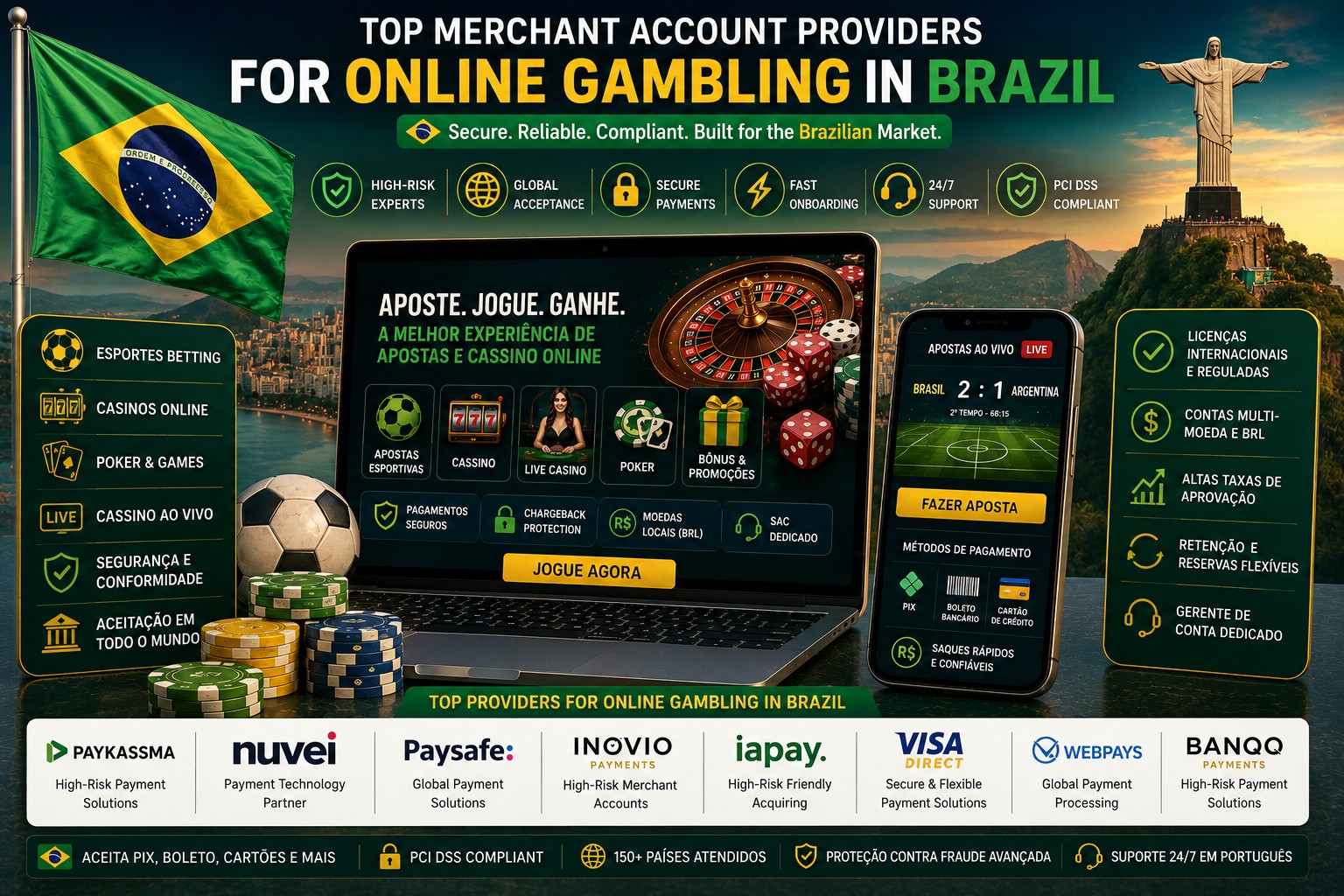
Brazil just closed the door on two payment methods that would otherwise be the default choice almost anywhere else in this guide series: credit cards and cryptocurrency are now fully, unambiguously banned for iGaming deposits, with the regulatory grace period that tolerated legacy integrations ending in April 2026. If a payment gateway is still rendering a credit card logo or generating a crypto deposit address for a Brazilian IP address today, that backend is actively violating the operator’s license. What’s left — PIX, debit cards, and Boleto Bancário, all running through Central Bank-authorized institutions with real-time CPF identity matching — is the actual, mandatory payment architecture for this market. This piece ranks the top providers relevant to SPA-licensed gambling operators in Brazil in 2026.
Why Brazilian Gambling Payment Processing Is Unusually Restrictive
Credit cards are banned specifically to prevent player insolvency, and crypto is banned to block money-laundering exposure — these are explicit legal prohibitions, not payment method preferences. Under Law 14.790/2023, the SPA explicitly restricts iGaming deposits and payouts to electronic transfers authorized by the Banco Central do Brasil — a payment provider offering credit card or crypto processing for this market isn’t offering a legacy option, it’s offering a way to violate an operator’s license.
PIX carries roughly 72% of all deposits, making it the market’s actual default rail, not one option among several. Brazil’s instant payment system, run by the Central Bank, delivers 24/7 transfers at near-zero cost, and PIX’s total transaction value hit R$26.4 trillion in 2024 — a payment provider without genuine, deep PIX integration is missing the core infrastructure this entire market runs on.
Real-time CPF matching is a mandatory, synchronous technical requirement, not a batch-reconciliation nicety. Every PIX deposit’s sender CPF must be validated against the registered player’s identity in real time — a mismatch triggers an instant, synchronous block at the gateway level before a single Real is credited to the betting wallet, specifically to prevent third-party deposits tied to money-laundering schemes known as “Contas Laranja.” A payment provider without this exact capability isn’t just offering a weaker product; it’s offering infrastructure that can directly cost an operator its license.
Boleto Bancário extends reach to Brazil’s meaningfully large unbanked and underbanked population, processing over several business days with low, flat fees — a genuinely important secondary rail for market reach beyond PIX’s instant-transfer, fully-banked user base.
SIGAP integration is mandatory, covering both self-exclusion and payment platform certification. Operators must integrate with SIGAP (operated jointly by the Central Bank and Ministry of Finance) alongside submitting to SPA’s technical platform audit, which specifically reviews PIX API integration, CPF validation layer, LGPD-compliant data residency, and geolocation controls as part of licensing itself.
Capital requirements are genuinely enormous compared to most other markets in this guide series. The BRL 30 million authorization fee plus roughly BRL 35 million in required capital and reserve commitments represent approximately USD 12-13 million in minimum committed capital before a single player is accepted — Brazil is explicitly a high-conviction market entry, not a low-cost market test.
Grey market activity persists despite active domain-blocking enforcement, with VPN usage among Brazilian gamblers up 35% in Q1 2026 alone — a reminder that a licensed operator’s payment infrastructure needs to reinforce legitimacy against a genuinely active illegal-market backdrop, not just satisfy a checklist.
The Top Payment Providers for Brazilian Online Gambling
- EBANX
EBANX is one of the most established Brazil- and broader LatAm-native payment infrastructure providers, with deep genuine PIX integration built specifically around the Brazilian regulatory environment.
Strengths: Genuinely deep, long-established PIX infrastructure specifically built for the Brazilian market; strong understanding of Brazil’s broader digital payment ecosystem including Boleto Bancário; established track record across multiple regulated Brazilian verticals beyond gambling specifically.
Weaknesses: Confirm direct, gambling-specific CPF real-time matching and SIGAP integration capability explicitly rather than assuming general Brazilian payment infrastructure automatically covers gambling-specific compliance requirements.
- dLocal
dLocal offers genuine LatAm-wide payment infrastructure with strong Brazilian PIX capability, useful for operators building a broader Latin American strategy alongside their core Brazilian licensing.
Strengths: Genuine multi-country LatAm payment depth, useful for operators expanding beyond Brazil into other regulated LatAm gambling markets; established PIX processing capability.
Weaknesses: Confirm gambling-vertical-specific underwriting and CPF-matching infrastructure directly, since dLocal’s core strength is broader LatAm payment infrastructure rather than gambling-specific compliance tooling.
- RoxPay
RoxPay’s genuine EU-licensed payment institution status (PCI DSS Level 1, ISO 27001 certified) offers real regulatory credibility, though Brazilian-market-specific PIX and CPF-matching capability needs direct confirmation.
Strengths: Genuine EU regulatory credibility and gambling-processing experience broadly.
Weaknesses: Confirm direct PIX integration and CPF-matching infrastructure explicitly — general EU licensing and gambling experience doesn’t automatically translate to Brazil’s specific, mandatory technical requirements.
- EMS Ltd Global
EMS’s deep regulatory understanding of gambling frameworks across the UK and Europe is relevant background, though Brazil’s specific PIX-and-CPF-centric requirements need direct, independent confirmation.
Strengths: Genuine European regulatory depth and gambling-vertical experience.
Weaknesses: Brazil-specific PIX/CPF/SIGAP integration isn’t documented — confirm directly before assuming general gambling experience transfers to this market’s specific requirements.
- Fibonatix
Fibonatix’s European gambling merchant processing experience is relevant context, though Brazil-specific infrastructure requires direct verification given how distinct the PIX-first, card-and-crypto-banned model is from European payment norms.
Strengths: Genuine gambling-vertical positioning and multi-currency infrastructure broadly.
Weaknesses: No documented Brazil-specific PIX/CPF infrastructure — this market’s requirements differ meaningfully enough from European norms that direct confirmation is essential.
- WebPays
WebPays’ dedicated gambling merchant account infrastructure is relevant context, though Brazil-specific PIX and CPF-matching capability needs direct, explicit confirmation given how technically specific this market’s requirements are.
Strengths: Genuine gambling-vertical specialization broadly.
Weaknesses: No documented Brazil-specific technical infrastructure — confirm directly before assuming general gambling experience covers PIX/CPF/SIGAP requirements.
- Instabill
Instabill’s international acquiring relationships offer general gambling-placement experience, though Brazil’s specific bank-account-based, card-and-crypto-banned model requires direct confirmation of relevant local infrastructure.
Strengths: Long institutional track record in gambling-specific placement broadly.
Weaknesses: Brazil’s requirements (PIX-native, no cards, no crypto) differ substantially from Instabill’s typical offshore card-and-crypto-oriented model — confirm applicability directly rather than assuming standard offshore infrastructure fits this market.
- Amald
Amald’s dedicated MID structure and gambling-inclusive high-risk experience are general positives, though Brazil-specific PIX infrastructure needs direct confirmation.
Strengths: Explicit dedicated MID offering; broad gambling-inclusive experience.
Weaknesses: No documented Brazil-specific PIX/CPF infrastructure — confirm directly.
- Inquid
Inquid’s named Casino & Betting specialization is relevant context broadly, though its crypto payment support — a stated feature elsewhere in this guide series — has no legal application to Brazilian gambling specifically given the explicit crypto ban.
Strengths: Explicit betting-vertical specialization broadly.
Weaknesses: Its crypto capability is inapplicable to Brazil specifically; confirm genuine PIX/CPF infrastructure directly rather than assuming general Casino & Betting specialization covers Brazil’s unique requirements.
- eLotPay
eLotPay’s hybrid card-and-crypto settlement model — a genuine strength in several other markets covered throughout this guide series — is explicitly not applicable to Brazilian gambling, given the outright ban on both credit card processing and cryptocurrency for iGaming deposits under Law 14.790/2023.
Strengths: None directly applicable to this specific market’s payment requirements.
Weaknesses: Its core differentiator (crypto and card hybrid settlement) is fully banned for Brazilian gambling deposits — not a viable option for this market under current law, regardless of its strengths elsewhere.
Comparison Table
| Rank | Provider | Standout Strength | PIX/CPF-Native? |
| 1 | EBANX | Deep Brazilian PIX infrastructure | Strong, confirm gambling-specific tooling |
| 2 | dLocal | LatAm-wide payment depth | Strong, confirm gambling-specific tooling |
| 3 | RoxPay | EU regulatory credibility | Confirm directly |
| 4 | EMS Ltd Global | UK/EU regulatory expertise | Confirm directly |
| 5 | Fibonatix | European gambling positioning | Confirm directly |
| 6 | WebPays | Gambling vertical specialization | Confirm directly |
| 7 | Instabill | International placement experience | Model mismatch — confirm carefully |
| 8 | Amald | Dedicated MID | Confirm directly |
| 9 | Inquid | Named betting vertical | Crypto feature inapplicable to Brazil |
| 10 | eLotPay | Crypto-hybrid (elsewhere) | Not applicable — banned in Brazil |
What to Genuinely Look For as a Brazilian Gambling Operator
Confirm your payment provider has zero card or crypto processing exposed to Brazilian IP addresses. This isn’t a preference to weigh — it’s an active, enforced legal requirement as of April 2026, and any gateway still offering these options for Brazilian players is putting the operating license at direct risk.
Verify genuine, real-time CPF-matching capability, not batch or delayed reconciliation. Given that a mismatch must trigger an instant, synchronous block before funds credit, this needs to be a demonstrated, tested technical capability, not a claimed feature.
Confirm SIGAP integration is genuinely built and certified, since this is part of SPA’s formal technical platform audit, not an optional add-on.
Budget for the genuinely substantial capital requirement (~USD 12-13 million combined) as a market-entry reality, and weigh processing fee efficiency accordingly given the scale of committed capital involved.
Prioritize providers with demonstrated Brazilian PIX depth specifically over generalist offshore or European gambling processors whose core infrastructure was built around card and crypto rails Brazil doesn’t permit.
Frequently Asked Questions
Q1: Can Brazilian gambling operators accept credit card payments?
A: No — credit cards are explicitly banned under Law 14.790/2023 specifically to prevent player insolvency and debt cycles, with regulatory grace periods for legacy integrations ending in April 2026.
Q2: Is cryptocurrency permitted for Brazilian gambling deposits?
A: No — crypto is banned alongside credit cards, with all deposits and payouts restricted to transfers, credits, or remittances through accounts at Central Bank-authorized Brazilian institutions.
Q3: What percentage of Brazilian iGaming deposits go through PIX?
A: Approximately 72%, making it the market’s dominant payment rail by a wide margin over debit cards and Boleto Bancário.
Q4: What happens if a third-party PIX deposit doesn’t match the registered player’s CPF?
A: The system must execute an instant, synchronous block at the gateway level before any funds credit to the betting wallet — this is a mandatory anti-money-laundering control, and failure to enforce it risks severe fines and potential license revocation.
Q5: How much capital does an operator need to enter the Brazilian gambling market?
A: Approximately USD 12-13 million combined, covering the BRL 30 million authorization fee plus roughly BRL 35 million in required capital and reserve commitments
Comments
No comments yet. Be the first to share your thoughts.
Leave a comment