
Almost every guide to “creator subscription payment processing” answers the wrong question, because it assumes there’s only one decision-maker. There isn’t. There are two entirely different audiences searching this exact phrase: someone building the next OnlyFans, Fansly, or Patreon — a genuine platform operator who needs merchant account infrastructure capable of absorbing payment risk for potentially millions of individual creators — and an individual creator who’s decided to leave a platform’s 20% commission behind and run their own site with their own merchant account instead. These are structurally different problems, and a provider genuinely built for one usually isn’t the right answer for the other.
OnlyFans itself is instructive here specifically because of how it solves its own version of this problem: creators don’t set up individual merchant accounts at all — they operate under OnlyFans’s own master merchant account, and OnlyFans itself doesn’t rely on just one payment processor, but runs several high-risk merchant services providers simultaneously to handle its transaction volume across subscriptions, tips, and pay-per-view content. That single fact — a platform this size still needs multi-processor redundancy for its own survival — tells you almost everything about how seriously payment infrastructure risk should be treated by anyone building in this space, whether at platform scale or as an individual creator going independent.
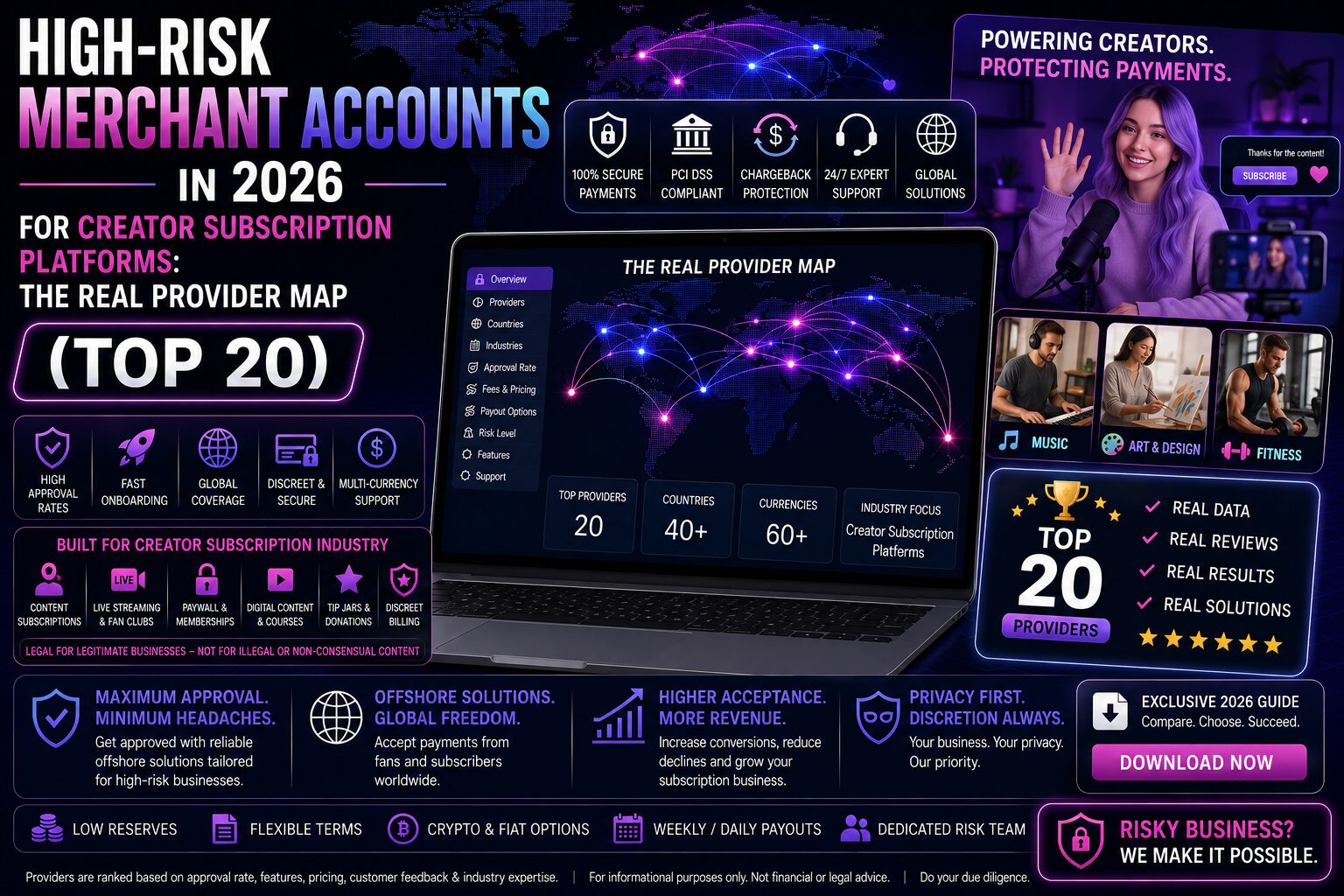
This piece maps 20 real providers and infrastructure approaches across both audiences: platform operators and independent creators.
Why Creator Subscription Platform Payment Processing Is a Distinct Problem
The master merchant account model concentrates payment risk at the platform level, and that risk is genuinely existential. When creators sign up under a platform’s master merchant account rather than their own, the platform absorbs payment risk on their behalf — meaning a single processor deciding to withdraw service, or a compliance review freezing funds, doesn’t just affect one creator, it can threaten the entire platform’s ability to pay out anyone. Subscription platforms reserve the right to freeze creator accounts during compliance reviews, chargeback investigations, or risk-management triggers, and held funds during these freezes can run from days to months, with the individual creator having limited recourse during that window.
Country exclusions are inherited from the underlying processor, not chosen by the platform. Subscription platforms inherit the supported-country lists of their underlying payment processors — meaning creators in many countries can’t use platform payout systems directly at all without routing through intermediary services like Wise, Payoneer, or Paxum, each adding their own fees and restrictions. This is a genuinely underappreciated structural fact: a creator being excluded from direct payout isn’t necessarily a platform policy decision, it’s often just which countries the platform’s specific processor mix happens to support.
Chargebacks in this category come from a genuinely mixed set of drivers, some platform-side and some subscriber-side. Some subscribers make what they consider a discreet or private purchase and later regret the transaction appearing on a shared credit card statement, filing a dispute specifically to remove the record — a privacy-driven dispute pattern structurally similar to the “friendly fraud” mechanic covered in this series’ adult and dating guides. Subscription billing itself, charged automatically on a weekly or monthly basis, generates its own separate recurring-charge dispute pattern layered on top of that.
Chargeback history follows accounts in both directions, and this is a distinctive wrinkle worth understanding. If a subscriber has issued chargebacks against a platform before, the platform may decline that subscriber’s subsequent transactions as a risk control measure. The reverse also applies: creators whose subscriber base generates high chargeback rates can experience their own payment instability as a result — meaning an individual creator’s payment stability is partly determined by the dispute behavior of people paying them, a genuinely unusual dynamic compared to most other high-risk categories in this guide series.
Payout timing varies significantly by method, and platforms hold funds for a defined period regardless of urgency. Most subscription platforms hold creator earnings for 7-30 days before releasing them, with longer holds applied to higher-risk creator categories specifically — this is typically non-negotiable, without exceptions, even for established creators. Among payout methods once funds are released, ACH within the U.S. typically takes 1-2 days, e-wallets like Paxum can be as fast as 1 day, and wire transfers run the slowest at 5-10 days.
Platform commission rates vary widely and reflect the underlying payment-risk absorption each platform is providing. OnlyFans and Fansly both take approximately 20% of subscription and tip revenue; Patreon runs 5-12% (though notably restricted to safe-for-work content, which is precisely why its payment risk profile — and therefore its commission — looks different); Ko-fi runs 0-5%. The commission gap isn’t arbitrary — it roughly tracks how much payment and compliance risk the platform itself is absorbing on the creator’s behalf.
Going off-platform trades commission savings for direct payment-risk ownership. Creators wanting their own checkout, their own branding, and their own merchant account need to leave the closed payment system entirely and work with a high-risk payment processor directly — at which point every principle covered in this series’ adult industry guide (billing descriptor sophistication, dedicated MID structures, chargeback-pattern-specific fraud tooling) applies directly, since an independent creator subscription site is, from a payments perspective, functionally an adult or subscription content business.
The Five Models in Creator Subscription Platform Payment Processing
- The Multi-Processor Platform Infrastructure Model. Not a single provider, but the structural approach itself — running several high-risk acquiring relationships simultaneously to avoid the single-point-of-failure risk inherent to the master-merchant-account model, exactly as OnlyFans does for its own platform.
- The Off-Platform Creator-Native Specialist. Providers built specifically to give individual creators their own dedicated merchant account once they leave a platform’s closed payment system, with subscription billing and discreet descriptor infrastructure carried over from this guide series’ adult industry piece.
- The Offshore/Broker Generalist. Broader high-risk providers listing adult/creator subscription content among several supported verticals, useful for creators or smaller platforms already declined by a native specialist.
- The Payout/E-Wallet and Country-Exclusion Workaround. Solves specifically for creators in countries excluded from direct platform payout, or wanting faster settlement than standard ACH or wire timing.
- The Dedicated-MID/Chargeback-History Structural Specialist. Solves specifically for the risk that another creator’s — or another subscriber’s — dispute behavior affects your own account standing.
Here’s how 20 real providers and approaches sort into that structure.
Model 1: The Multi-Processor Platform Infrastructure Model
This is the single most important structural lesson for anyone building a creator subscription platform rather than working as an individual creator. OnlyFans’s own approach — never relying on just one processor, running several high-risk merchant services providers simultaneously across subscriptions, tips, and pay-per-view content — isn’t a nice-to-have redundancy measure, it’s the specific mechanism that lets a platform absorb the kind of sudden processor withdrawal that would otherwise threaten its ability to pay out any creator at all. Any new platform being built in this space should treat multi-acquirer redundancy as a day-one architectural decision, not something retrofitted after a first processor relationship sours — a lesson that echoes the multi-PSP standard practice covered in this series’ gaming and forex guides, applied here at platform-operator scale.
Model 2: Off-Platform Creator-Native Specialists
PaymentCloud is explicitly named as the recommended path for creators wanting their own checkout, branding, and merchant account outside a platform’s closed system — a solid general high-risk specialist option covered elsewhere in this guide series for CBD, dating, and general subscription businesses, extending naturally to independent creator subscription sites.
PayCly offers specific guidance and infrastructure around “OnlyFans alternative payment methods” for creators building independent, stable payment ecosystems, with its broader multi-currency and alternative-payment-method infrastructure (covered throughout this guide series) directly relevant to creators diversifying beyond card-only acceptance.
CCBill, Epoch, Segpay, Verotel, NetBilling, CommerceGate, and Vendo Services — the adult-native facilitators covered in depth in this series’ adult industry guide — are all directly relevant here too, since an independent creator subscription site is functionally the same payment problem as any other adult subscription content business: recurring billing, discreet descriptors, and age-verification infrastructure all apply identically.
ZenPayments and SecureGlobalPay, both covered elsewhere in this guide series (adult and general high-risk pieces respectively), specifically publish guidance around OnlyFans-style payment processing and closed-system alternatives, useful starting points for creators researching what independent processing actually involves before committing.
Model 3: Offshore/Broker Generalists
Instabill, eMerchantBroker (EMB), Durango Merchant Services, and SMB Global, all covered throughout this guide series, extend their broader high-risk and offshore banking relationships to creator subscription and adult-adjacent content businesses, useful for independent creators or smaller platforms already declined by a native specialist above.
GSPay and WebPays, covered in this series’ adult and dating pieces for their chargeback protection tooling built around the “unrecognized charge” dispute pattern, extend directly to creator subscription content given how closely that dispute mechanic mirrors the privacy-driven chargeback pattern documented above.
RoxPay, the Italian, OAM-registered, PCI DSS Level 1 and ISO 27001-certified payment institution covered throughout this series, is genuinely relevant for creators or platforms serving European subscriber bases, offering the regulatory standing of a licensed EU payment institution rather than a purely offshore acquirer.
Model 4: Payout/E-Wallet and Country-Exclusion Workarounds
Paxum, covered in this series’ adult industry guide as a creator payout specialist, is directly relevant here again given its role in both platform payout infrastructure (as one of the faster settlement options, at roughly 1 day) and as a workaround for creators in countries excluded from a platform’s direct payout system.
Wise and Payoneer, both widely used intermediary services specifically for creators in countries subscription platforms don’t directly support, solve the country-exclusion problem described above — worth understanding as a genuinely separate cost layer (each adds its own fees and restrictions) rather than a free bridge over the exclusion gap.
Model 5: Dedicated-MID/Chargeback-History Structural Specialists
2Accept, covered throughout this guide series, applies its dedicated-Merchant-ID model directly to creator subscription content as well — particularly relevant given the documented two-directional chargeback-history risk described above, where an account’s payment stability can be affected by either its own subscriber base’s dispute behavior or, in reverse, a subscriber’s own prior dispute history with the platform. A dedicated MID at least isolates an individual creator or smaller platform from the compounding effect of a shared aggregator account absorbing dispute activity from unrelated merchants on top of these already-present risks.
The Fit Framework: Question, Not Rank
| Your situation | Model to start with |
| Building a new creator subscription platform (the next OnlyFans/Fansly) | Multi-Processor Infrastructure Model — architect for redundancy from day one |
| Individual creator leaving a platform’s closed payment system | Off-Platform Creator-Native Specialist (PaymentCloud, PayCly, CCBill, Epoch, Segpay, Verotel) |
| Already declined or need offshore banking depth | Offshore/Broker Generalist (Durango, EMB, Instabill, SMB Global) |
| Serving European subscribers specifically | RoxPay |
| Located in a country excluded from direct platform payout | Payout/E-Wallet Workaround (Paxum, Wise, Payoneer) |
| Want faster settlement than standard ACH/wire timing | Paxum (roughly 1-day settlement) |
| Worried about chargeback-history spillover from your subscriber base or a shared aggregator | 2Accept’s dedicated MID model |
Red Flags Specific to Creator Subscription Platform Payment Processing
If you’re building a platform, never architect around a single processor relationship. OnlyFans’s own multi-processor approach exists specifically because a single acquiring relationship withdrawing service can threaten payout ability for every creator on the platform simultaneously — this is not excess caution, it’s the documented survival strategy of the largest player in the category.
Understand clearly that country exclusions on a platform are usually processor-driven, not platform-chosen. If you’re a creator in an excluded country, the fix generally isn’t lobbying the platform — it’s routing through an intermediary service (Wise, Payoneer, Paxum) and accounting for the additional fees that involves.
Recognize that payout holds (7-30 days, longer for higher-risk categories) are mandatory and non-negotiable on most platforms. Don’t build a cash-flow plan around the assumption that an exception will be made for urgent need — plan working capital around the hold period as a fixed constraint.
If you’re going off-platform, treat this exactly like launching an adult subscription business — because that’s what it structurally is. Every principle from this series’ adult industry guide applies directly: dedicated MID status, billing descriptor sophistication, and chargeback tooling built around the “unrecognized charge” and privacy-driven dispute patterns.
Understand that your own chargeback exposure can be affected by your subscriber base’s dispute behavior, not just your own. This is a genuinely distinctive risk in creator subscription platforms — a sudden spike in subscriber-initiated disputes (even ones you’d consider unfair or privacy-driven rather than legitimate) can affect your account’s standing regardless of your own conduct.
What Actually Determines a Good Fit
Are you a platform operator or an individual creator — since these are genuinely different infrastructure decisions, and a provider or approach built for one audience typically isn’t the right answer for the other?
If building a platform, have you architected for multi-processor redundancy from the outset, rather than treating it as something to add after a first processor relationship sours?
If going off-platform as a creator, does your chosen provider offer genuinely deep subscription billing and discreet descriptor infrastructure, the same criteria covered in this series’ adult industry guide?
Do you understand your specific payout timeline and any country-exclusion implications before you need the funds, rather than discovering a 7-30 day hold or an exclusion gap under financial pressure?
Is your merchant account structure a dedicated MID, or are you exposed to a shared aggregator’s broader dispute activity — particularly consequential given how directly subscriber-side chargeback behavior can affect your own account standing?
Conclusion
Creator subscription platform payment processing isn’t one problem — it’s two, depending on whether you’re building the platform or working as an individual creator on one, and the single biggest lesson from how OnlyFans itself handles this (running several high-risk processors simultaneously rather than depending on one) applies at both scales: payment infrastructure redundancy isn’t optional in this category, it’s existential. For platform operators, the multi-processor infrastructure model is the architecture to build around from day one. For individual creators going independent, PaymentCloud, PayCly, and the adult-native specialists covered throughout this guide series (CCBill, Epoch, Segpay, Verotel, Vendo) offer the subscription billing and discreet descriptor infrastructure this category genuinely needs. Instabill, EMB, Durango, SMB Global, GSPay, WebPays, and RoxPay extend broader high-risk and international banking depth. Paxum, Wise, and Payoneer solve the payout-speed and country-exclusion problems that are more consequential here than in almost any other vertical in this guide series. And 2Accept’s dedicated-MID model directly addresses the two-directional chargeback-history risk that makes an individual creator’s payment stability partly dependent on the dispute behavior of the people paying them. The right starting point isn’t a single “best” processor — it’s an honest identification of which side of this two-sided market you’re actually on, and building your payment infrastructure around the specific risk that role carries.
Comments
No comments yet. Be the first to share your thoughts.
Leave a comment