
Here’s what most CBD payment guides leave out: your account isn’t usually frozen by a human underwriter reading your website and making a judgment call. It’s frozen by a bot. Mainstream payment aggregators run automated risk-detection software that continuously crawls merchant websites looking for specific flagged keywords — “CBD,” “hemp,” “cannabinoid,” “gummies” — and the moment one of those terms is detected, the account gets flagged for review, which almost always ends in a sudden shutdown, often with no warning and funds held for weeks. Understanding that the trigger is mechanical, not judgment-based, changes what you should actually look for in a payment provider — because the right CBD processor isn’t the one that “understands your business is legal.” It’s the one whose underwriting was never built around treating “CBD” as an automatic keyword rejection in the first place.
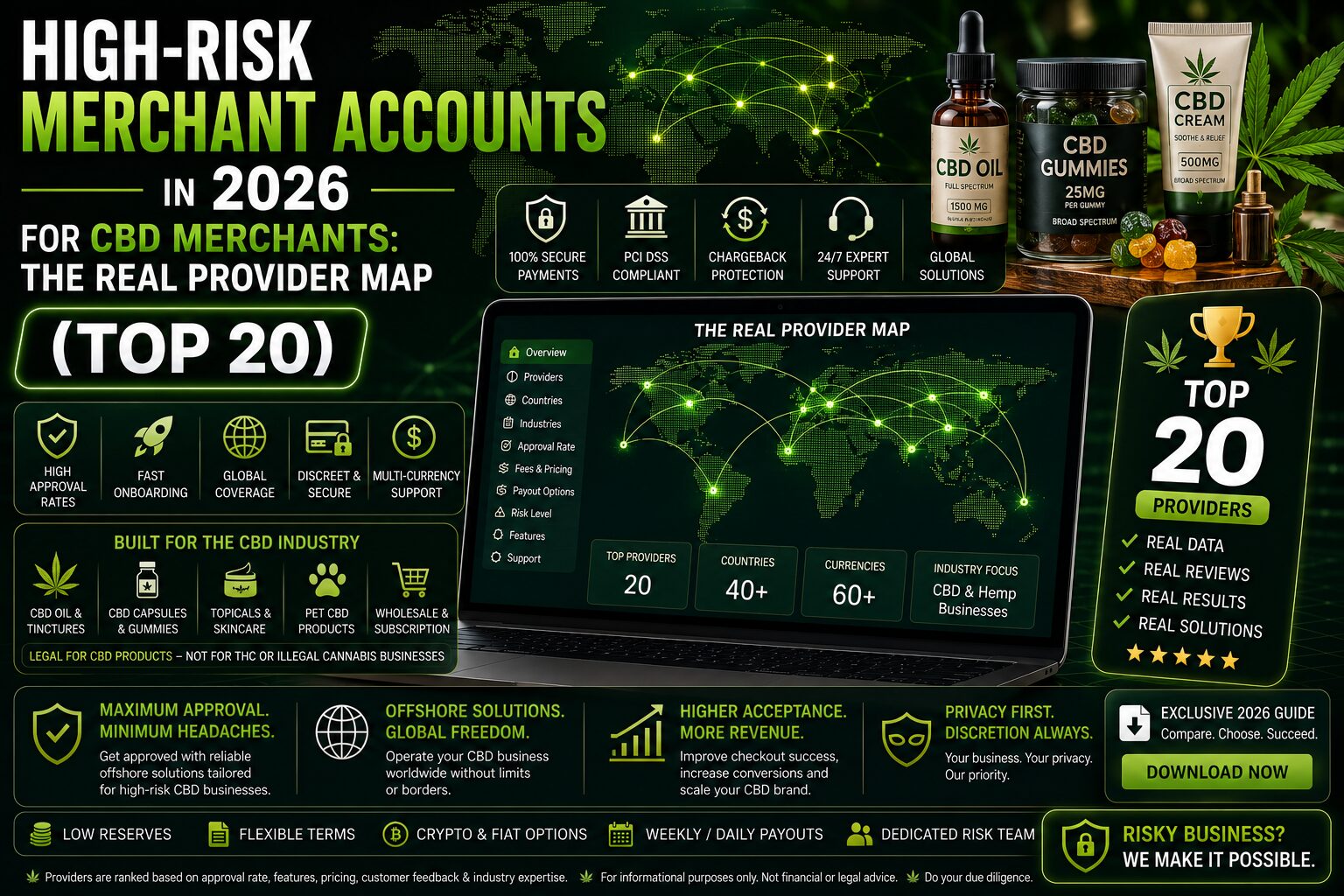
This piece maps 20 real providers serving the CBD and hemp vertical by the specific problem each one solves — starting from why this category breaks the way it does, not from a repeated list of the same handful of names.
Why CBD Payment Processing Is a Distinct Problem
Federal legality didn’t solve the payment problem — it just relocated where the difficulty comes from. Hemp-derived CBD has been federally legal since the 2018 Farm Bill, provided products stay under 0.3% Delta-9 THC on a dry-weight basis. And yet CBD merchants routinely wake up to frozen accounts and held funds years later. The problem was never legality — it’s perception, automated detection, and a regulatory landscape that stayed genuinely complicated even after federal legalization.
Visa has a specific program for this category, and it changes how underwriting works. Visa classifies hemp-derived CBD merchants as high-risk, often requiring registration under the Visa Integrity Risk Program (VIRP), with merchants required to use the correct Merchant Category Code — typically MCC 5912 or 5499 — to avoid termination. This is a genuinely different mechanism than most high-risk categories in this guide series: it’s not just banks being cautious, it’s a formal card-network registration and monitoring program built specifically around this vertical.
FDA marketing restrictions create rejections that have nothing to do with your actual product. The FDA strictly prohibits CBD brands from making unapproved medical or therapeutic claims — and underwriters will immediately reject an application if a website claims a product can “cure anxiety,” “treat depression,” or “relieve chronic pain,” regardless of how compliant the actual product formulation is. This means a genuinely compliant CBD product can still get declined purely because of website copy, which makes pre-application marketing language review one of the single highest-value things a specialized CBD processor can help with before you ever submit an application.
State-by-state regulatory fragmentation adds a layer most high-risk categories don’t have. Some states allow full retail distribution of hemp-derived cannabinoids; others strictly limit them or ban specific product types like inhalables or edibles outright — meaning a genuinely compliant business in one state can be operating in a legal gray zone the moment it ships to another, a distinct compliance burden underwriters increasingly expect merchants to actively monitor rather than assume is settled once and for all.
Pending federal legislation (the SAFER Banking Act, among others) means the regulatory ground is still moving, not settled. CBD merchants need to treat regulatory monitoring as a continuous operational function rather than a one-time compliance check completed at launch.
A dedicated Merchant ID, not a shared aggregator account, is the single biggest determinant of long-term stability. Mainstream aggregators pool thousands of unrelated merchants under one shared master merchant account specifically to offer instant, frictionless onboarding — but that convenience comes paired with automated underwriting systems that trigger the keyword-bot freeze problem described above, and with the risk that another merchant’s chargeback spike or compliance flag can take your account down too, regardless of your own standing.
The Five Models in CBD Payment Processing
- The CBD-Native Specialist. Built specifically around hemp and CBD underwriting, with teams that genuinely understand THC threshold documentation, Certificate of Analysis (COA) requirements, and FDA marketing-claim compliance — the providers most likely to help you fix a rejection-causing website before you apply, not just process after approval.
- The Offshore/Broker Generalist. Broader high-risk providers listing CBD among several supported verticals, offering deeper banking relationships for merchants already declined by a CBD-native specialist or operating internationally.
- The Mainstream-Adjacent Limited Program. A small but genuinely notable category: mainstream payment brands that have built a specific, narrower CBD program rather than excluding the category entirely — useful for smaller, straightforwardly compliant businesses, but with real limits on what product types and THC content they’ll accept.
- The Placement/Consultancy Service. Providers whose core value is application guidance, LegitScript certification support, and matching your specific CBD sub-category (topicals, oils, ingestibles, subscriptions) with the acquiring bank actually built to underwrite it.
- The Dedicated-MID Structural Specialist. Solves specifically for the shared-aggregator freeze risk described above by guaranteeing individual, non-pooled merchant IDs.
Here’s how 20 real providers sort into that structure.
Model 1: CBD-Native Specialists
Easy Pay Direct operates its own EPD Gateway specifically built to serve CBD, cannabis, and hemp businesses alongside low-risk companies in other sectors, linking account holders with credit card processors or domestic banks based on their specific requirements — a genuinely flexible, CBD-experienced option covered elsewhere in this guide series for its load-balanced multi-account model, which is particularly relevant here given the category’s documented sudden-freeze risk.
Vector Payments has built a genuinely detailed body of CBD-specific guidance and underwriting infrastructure, explicitly naming the automated keyword-bot detection problem, the FDA marketing-claim rejection pattern, and the 2018 Farm Bill’s specific THC thresholds as the core issues its underwriting is built to navigate — a strong signal of real category depth rather than a generalist processor that happens to list CBD among dozens of accepted verticals.
VERIFIED Credit Card Processing positions itself specifically around helping CBD merchants get approved and stay approved, explicitly stating that “approval is not the finish line” — its underwriting approach evaluates COAs, website claims, refund policies, subscription disclosures, and advertising plans together rather than treating product compliance and marketing compliance as separate questions. It also offers qualifying merchants a discounted annual LegitScript fee with no application fee, a genuinely useful bundled benefit given how much LegitScript certification strengthens both underwriting files and advertising eligibility for CBD brands specifically.
BestMerchantRates (formerly PayWize), a smaller provider that’s been serving CBD oil merchants and medical cannabis dispensaries since 2017, offers a longer, CBD-specific operating history than many newer entrants in this space — a reasonable option for merchants wanting an established, if less widely known, specialist.
Bankful offers a dedicated high-risk merchant account and payment gateway specifically for CBD alongside broader e-commerce business types, a solid general-purpose CBD option for merchants who also run adjacent, lower-risk product lines under the same brand.
Corepay, covered elsewhere in this guide series for its nutraceutical and continuity-billing expertise, extends that same underwriting depth naturally into CBD specifically, given how closely the two categories overlap in FDA labeling scrutiny and subscription-based revenue models.
Model 2: Offshore/Broker Generalists
Instabill, eMerchantBroker (EMB), Durango Merchant Services, and SMB Global all list CBD among their broader high-risk portfolios, with genuinely deep offshore banking relationships useful for CBD merchants who’ve already been declined by a domestic CBD-native specialist, carry MATCH list history from a prior termination, or operate internationally in markets with different hemp regulatory frameworks than the U.S.
PayCly and GlobalPay both name CBD and nutraceutical underwriting among their core specialties, with GlobalPay in particular building specific experience in the broader health and wellness e-commerce space that extends usefully to CBD sellers navigating the same “research use only”-style labeling caution covered elsewhere in this guide series’ peptide piece.
WebPays rounds out this tier, listing CBD alongside forex, gaming, and adult in its broader high-risk vertical coverage — a reasonable option for CBD businesses that also touch an adjacent high-risk category under one brand.
RoxPay, the Italian, OAM-registered, PCI DSS Level 1 and ISO 27001-certified payment institution covered throughout this guide series, extends its genuinely EU-licensed regulatory standing to CBD processing as well — relevant specifically for CBD brands selling into European markets where hemp regulation varies by country in ways that benefit from a payment partner with real EU compliance credentials rather than a purely offshore acquirer.
Model 3: Mainstream-Adjacent Limited Programs
The Square CBD program is worth naming specifically because it represents a genuinely different model than every other provider in this guide: a mainstream, widely recognized payment brand that built a narrower, specific carve-out program for hemp- and hemp-derived CBD products containing no more than 0.3% THC, rather than excluding the category outright the way Stripe and PayPal generally do. For small CBD businesses selling straightforwardly compliant topicals or tinctures in states where the program is available, this can be a genuinely simpler onboarding path than a full high-risk specialist relationship — but the trade-off is real: coverage is narrower, product-type restrictions are stricter, and it won’t extend to the full range of CBD sub-categories (certain ingestibles, higher-complexity subscription models, or multi-state retail with varying local restrictions) that a dedicated CBD-native specialist would underwrite.
Model 4: Placement/Consultancy Services
Payment Nerds functions specifically as a comparison and matching resource for CBD merchants, explicitly noting that the right provider “depends on what you actually sell” — a CBD topical brand, an oil merchant, a hemp flower retailer, and a recurring-ingestible subscription brand all face genuinely different underwriting questions, and Payment Nerds’ value is specifically in helping match your sub-category to the acquiring relationship actually built for it, rather than assuming one processor fits every CBD business model equally.
VERIFIED Credit Card Processing (also listed under Model 1 above) straddles both categories genuinely — it’s simultaneously a direct high-risk payments specialist and a guidance resource specifically for merchants pursuing compliant advertising through LegitScript certification, established brands scaling across subscriptions and multi-channel sales, and hard-to-place merchants needing more than a standard processor referral.
Model 5: The Dedicated-MID Structural Specialist
2Accept, covered throughout this guide series, applies the same core value proposition to CBD that it does across every other high-risk vertical: every merchant gets a dedicated Merchant ID rather than being pooled under a shared master account — directly relevant given how explicitly this guide series’ research identified pooled-aggregator accounts as the specific structural weakness behind CBD’s automated keyword-bot freeze problem. 2Accept’s own CBD-specific guidance explicitly walks through the Visa Integrity Risk Program registration requirement and correct MCC classification (5912 or 5499), a genuine signal of category-specific underwriting depth rather than a generic dedicated-MID pitch applied uniformly across verticals.
The Fit Framework: Question, Not Rank
| Your CBD business situation | Model to start with |
| Need help fixing marketing language before applying | CBD-Native Specialist (Vector Payments, VERIFIED Credit Card Processing) |
| Want LegitScript certification support bundled in | VERIFIED Credit Card Processing |
| Established CBD business, want load-balanced redundancy | Easy Pay Direct |
| Longer-established, smaller specialist with dispensary experience | BestMerchantRates |
| Already declined or MATCH-listed elsewhere | Offshore/Broker Generalist (Durango, EMB, Instabill, SMB Global) |
| Selling into European markets with varying hemp regulation | RoxPay |
| Small business, straightforwardly compliant topicals/tinctures under 0.3% THC | Square CBD program (check state/product eligibility first) |
| Not sure which provider fits your specific CBD sub-category | Payment Nerds |
| Recurring/subscription ingestible model specifically | Corepay |
| Worried specifically about the keyword-bot aggregator freeze problem | 2Accept’s dedicated MID model |
Red Flags Specific to CBD Payment Processing
Any processor that doesn’t ask detailed questions about your website’s marketing language during underwriting likely hasn’t built genuine CBD-specific expertise. Given how consistently FDA therapeutic-claim language triggers rejections independent of actual product compliance, a provider that reviews your copy for “cure,” “treat,” or “relieve”-style claims before you apply is doing you a genuine favor, not adding unnecessary friction.
Mainstream payment aggregators are a structural liability specifically because of automated keyword scanning, not just general high-risk caution. If a provider’s onboarding is instant and frictionless with minimal underwriting, understand clearly that the same automation making onboarding fast is the mechanism that will likely flag and freeze your account later — the trade-off is real and documented, not theoretical.
Confirm correct MCC classification explicitly (5912 or 5499) rather than assuming your processor has assigned it correctly. Misclassification under a generic e-commerce MCC is a documented cause of unnecessary card-network scrutiny and account termination in this category specifically.
Ask whether your provider requires or supports Visa Integrity Risk Program (VIRP) registration where applicable. A provider unfamiliar with VIRP is a signal of shallower CBD-specific underwriting depth than one that proactively discusses it.
LegitScript certification is worth pursuing even when a specific processor doesn’t strictly require it, since it strengthens your underwriting file across every provider model in this guide and directly enables compliant advertising — several providers above (VERIFIED specifically) offer bundled support for exactly this reason.
State-by-state product restrictions mean a “nationally compliant” claim from any provider deserves a follow-up question about your specific product types and shipping states, given how significantly hemp regulation varies below the federal level.
What Actually Determines a Good Fit
Does the provider proactively review your website’s marketing claims for FDA compliance risk before submission, rather than simply processing an application as-is and letting a later automated flag catch the problem?
Is this a dedicated MID, or are you being pooled under a shared aggregator account that exposes you to the exact keyword-bot freeze risk this entire category is defined by?
Does the provider understand which specific CBD sub-category you’re in — topicals, oils, ingestibles, subscriptions, multi-state retail — and underwrite accordingly, rather than treating “CBD” as one undifferentiated risk bucket?
Does the provider support or actively facilitate LegitScript certification, given how much it strengthens both underwriting and advertising eligibility?
What’s the provider’s actual track record helping merchants recover after a prior CBD-specific termination, given how documented the sudden-shutdown pattern is in this category?
Conclusion
CBD payment processing isn’t solved by finding a provider willing to “accept” the category — it’s solved by understanding that the real mechanism behind most CBD account freezes is automated keyword detection on shared aggregator accounts, combined with FDA marketing-claim scrutiny that can reject a genuinely compliant product over website copy alone. Vector Payments, VERIFIED Credit Card Processing, Easy Pay Direct, BestMerchantRates, Bankful, and Corepay have built genuine CBD-specific underwriting depth, with several offering direct LegitScript support. Instabill, EMB, Durango, SMB Global, PayCly, GlobalPay, WebPays, and RoxPay extend broader high-risk banking relationships to CBD as one of several supported categories. Square’s CBD program offers a genuinely simpler path for smaller, straightforwardly compliant businesses within its narrower coverage limits. Payment Nerds helps match your specific CBD sub-category to the right underwriting relationship. And 2Accept’s dedicated-MID model directly solves the structural problem — shared aggregator accounts — that causes most of this category’s documented sudden freezes in the first place. The right starting point isn’t whichever provider claims to “understand CBD is legal” — every provider says that. It’s whichever provider can specifically explain how its
Comments
No comments yet. Be the first to share your thoughts.
Leave a comment