
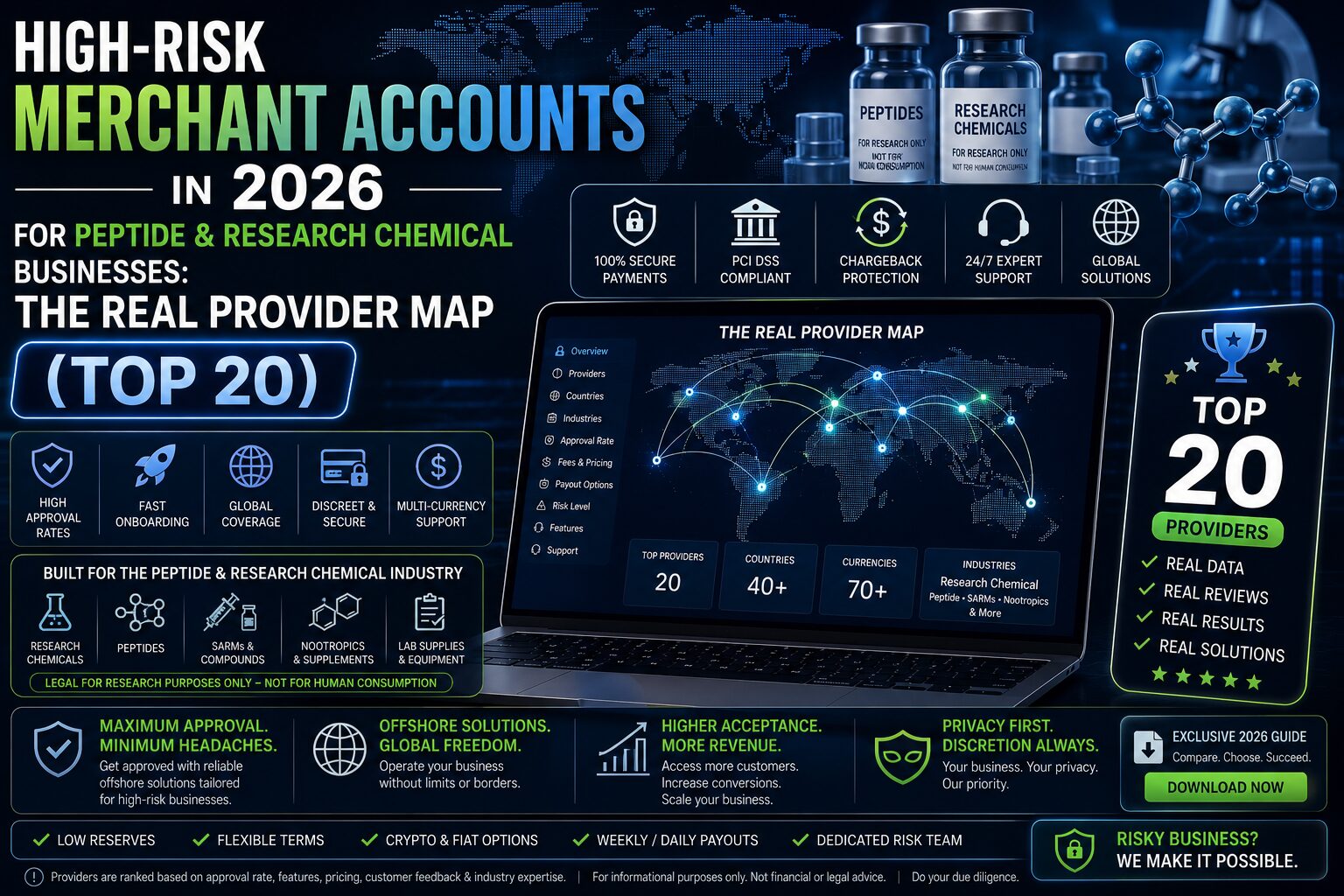
Every peptide payment processing article follows the same script now: open with a horror story about a frozen account, cite Mastercard’s BRAM program, and land on a pitch for a crypto settlement gateway that claims to make the entire underwriting problem disappear. Some of that framing is genuinely accurate. Peptide businesses really do get declined by mainstream processors, really do face elevated chargeback fees and long reserve holds, and really have been hit by sudden, category-wide processor terminations with only 30 days’ notice. But “the solution is always crypto settlement” is exactly the kind of oversimplification this guide is designed to correct — because for a meaningful share of peptide businesses, a properly underwritten domestic or offshore merchant account is still the more durable answer, and understanding why requires understanding what actually makes this category difficult in the first place.
This piece maps 20 real providers serving the peptide and research chemical vertical by the specific problem each is built to solve — not by a ranked list that treats every peptide business as identical.
Why Peptide Payment Processing Is a Genuinely Distinct Problem
Peptide merchants get declined for a reason that’s structurally different from most other high-risk categories covered in this series, and it’s worth naming clearly: the rejection is classification-based, not risk-based.
Card networks assign Merchant Category Codes tied to nutraceuticals, research chemicals, or “health products not elsewhere classified,” and a processor’s underwriting algorithm typically rejects on the MCC itself — it doesn’t evaluate whether the specific merchant is GMP-certified, whether its chargeback rate is actually well below industry average, or whether its lab results and “for research use only” labeling are fully compliant. It sees the category and declines, full stop, the same way Stripe and PayPal categorically exclude adult content regardless of an individual merchant’s actual risk profile.
Mastercard’s BRAM program is the single most important compliance fact in this space right now. BRAM (Business Risk Assessment and Mitigation) specifically flags research peptides and nutraceuticals as monitored high-risk categories, and 2026’s GLB 11691.1 update tightened that monitoring further — meaning even merchants processing through a nominally approved high-risk provider can find themselves re-flagged and terminated mid-relationship if the underlying acquiring bank decides to re-evaluate its exposure to the category.
Chargeback rates in this specific vertical have moved sharply in a bad direction. Industry sources cite peptide-related chargeback rates surging as much as 800% between 2023 and 2024 — a genuinely dramatic shift that’s made acquiring banks meaningfully more cautious about the category than they were even two years ago, regardless of any individual merchant’s own clean history.
Sudden, category-wide termination is a real and recurring pattern, not a rare edge case. Multiple industry surveys cite roughly 40% of peptide merchants experiencing at least one involuntary processor termination — not because of their own chargeback behavior, but because the processor or its acquiring bank exited the peptide category entirely, taking every merchant on that book down simultaneously with as little as 30 days’ notice.
LegitScript certification has become an increasingly important credibility signal. Some peptide processors require it; others work with research-only sellers under alternative compliance frameworks. Either way, LegitScript approval — the same certification pharmacy and nutraceutical businesses use to demonstrate regulatory legitimacy — meaningfully strengthens an underwriting file regardless of which provider you eventually choose.
The Five Models in Peptide Payment Processing
- The Nutraceutical-Native Specialist. Built specifically around peptides, supplements, and research chemicals as a core vertical, with underwriting teams that actually understand FDA labeling distinctions (“research use only” vs. therapeutic claims) and can help structure compliant product descriptions before an application is submitted.
- The Offshore/Broker Generalist. Broader high-risk providers that list nutraceuticals and research chemicals among several supported categories, offering deeper offshore banking relationships and MATCH-list recovery options the nutraceutical-native specialists sometimes can’t match.
- The Placement/Matching Service. Doesn’t underwrite directly — routes your application across a network of acquiring banks to find the one already comfortable with your specific product line, useful specifically because peptide underwriting appetite varies so much bank to bank.
- The ACH-First Alternative. Sidesteps card network MCC classification entirely by building the payment relationship around bank-to-bank transfers instead of card processing — genuinely useful given how much of the peptide category’s risk exposure comes specifically from card network monitoring programs like BRAM.
- The Crypto/Hybrid Settlement Gateway. Markets itself as bypassing the entire MCC and underwriting problem by settling in crypto rather than through a card-network-monitored acquiring relationship — a genuinely useful option for some merchants, but also the category where marketing claims deserve the most scrutiny in this entire guide.
Here’s how 20 real providers sort into that structure.
Model 1: Nutraceutical-Native Specialists
These providers have built underwriting frameworks specifically around peptides and adjacent categories, rather than accepting the vertical as one line item among dozens of unrelated high-risk businesses.
Paycron has built dedicated infrastructure specifically for nutraceutical and research-chemical merchants, including peptide companies, with chargeback mitigation tools and a compliance-focused onboarding process. Its team’s familiarity with FDA regulatory distinctions is a genuine differentiator — Paycron can help structure compliant product descriptions and terms before submission, which meaningfully strengthens an underwriting file compared to a generalist provider that doesn’t know what “research use only” labeling actually needs to say to avoid triggering compliance flags.
AllayPay offers fully domestic U.S. peptide merchant accounts with a notably higher authorization rate — 96%-plus as of early 2026 — than the 50-70% range typical of international/offshore processors serving this category. The trade-off is a genuinely steep rolling reserve: 10%, held for 3-6 months, meaning a merchant processing $100,000 monthly has roughly $10,000 permanently tied up in reserve. Funding also runs on a 2-day cycle rather than next-day, a real cash-flow consideration for merchants relying on tight working capital.
Easy Pay Direct offers what it calls a “load-balanced processing” model specifically relevant to peptide merchants — spreading transaction volume across multiple merchant accounts simultaneously, which reduces the impact of any single account being flagged, reviewed, or terminated, since volume automatically continues flowing through the remaining accounts rather than stopping entirely.
Corepay has built a specific reputation working with continuity billing and research-chemical-adjacent categories, known for moving quickly through underwriting and communicating clearly about exactly what documentation is required — a meaningful advantage in a category where documentation quality (lab certifications, clear “research use only” labeling, GMP compliance where applicable) directly determines approval odds.
Model 2: Offshore/Broker Generalists
These providers list nutraceuticals and research chemicals among a broader high-risk portfolio, and their value is specifically in offshore banking depth and MATCH-list recovery capability that the nutraceutical-native specialists above sometimes can’t match.
Instabill functions best in this category as a backup arrangement rather than a primary processor — a long track record in nutraceuticals, supplements, and research chemicals, with international acquiring relationships that can sometimes unlock card processing domestic banks won’t support, though typically at lower authorization rates than a domestic specialist like AllayPay. Its real value is as a second processing account that keeps a store operational if the primary processor freezes or terminates.
eMerchantBroker (EMB) covers peptides and CBD alongside forex and adult, with a broad acquiring network genuinely useful for peptide businesses that also touch adjacent nutraceutical or supplement product lines a pure peptide specialist might not underwrite.
Durango Merchant Services explicitly lists pharmaceutical-adjacent categories among its hardest-to-place specialties, backed by offshore banking relationships built over decades — a strong option specifically for merchants who’ve already been declined by domestic nutraceutical specialists or who’ve landed on the MATCH list following a prior category-wide termination.
PayCly and GlobalPay both list CBD and nutraceutical underwriting among their named specialties, with GlobalPay in particular building specific experience in the broader health e-commerce space that extends usefully to peptide sellers navigating similar “research use only” labeling and marketing compliance questions.
SMB Global rounds out this tier with exclusive high-risk and international processing focus, useful for peptide merchants with meaningfully international customer bases rather than a purely domestic U.S. operation.
Model 3: Placement/Matching Services
PaymentCloud operates specifically as a merchant account placement service rather than a direct processor — routing your application to whichever banking partner in its network is already comfortable underwriting your specific peptide product line, rather than underwriting the risk itself. For peptide companies that have already been rejected by one or two providers, this matching model can meaningfully improve approval odds, since peptide underwriting appetite genuinely varies bank to bank in a way that makes “shop the application around” a legitimately useful strategy rather than just a fallback.
Model 4: The ACH-First Alternative
SeamlessChex takes a genuinely different approach worth understanding on its own terms: building payment infrastructure around ACH (bank-to-bank) transfers rather than card processing, which sidesteps Merchant Category Code classification and the card-network monitoring programs (like Mastercard’s BRAM) that drive most of the peptide category’s processing difficulty in the first place. Its next-day deposit cycle is notably faster than AllayPay’s 2-day card-based funding, making it a genuinely strong option specifically for peptide merchants whose customers are comfortable paying via bank transfer rather than card — though it’s worth being clear that ACH isn’t a universal substitute for card acceptance if your checkout conversion depends on customers being able to pay with a credit or debit card directly.
Model 5: Crypto and Hybrid Settlement Gateways — Read This Section Carefully
This is the category where the loudest marketing claims in the entire peptide payment space live, and it deserves more scrutiny than any other section in this guide.
NOWPayments is the most frequently cited legitimate crypto acceptance option for peptide merchants specifically, offering straightforward cryptocurrency payment acceptance for businesses whose customer base is genuinely comfortable paying in crypto directly — a real, useful option for a segment of peptide buyers, though it doesn’t solve card acceptance for the (likely larger) segment of customers who want to pay with Visa or Mastercard.
A wave of newer “card-to-crypto” gateways market themselves specifically at peptide merchants with claims worth treating skeptically: no application process, no MCC classification, no rolling reserve, no fund freezes, instant settlement, and fees as low as 1-3% versus the 5-8% typical of traditional high-risk processors. These claims aren’t necessarily false on a technical level — a gateway that converts card payments to crypto and settles instantly into a merchant-controlled wallet genuinely can sidestep MCC-based rejection and the freeze risk that comes with a traditional acquiring relationship. But a few things are worth thinking through honestly before treating this as the obvious answer over a properly underwritten merchant account: regulatory compliance obligations (AML, KYC, sanctions screening) don’t disappear just because the settlement rail is crypto rather than card networks — they’re a function of moving money at all, not of which rail moves it. A provider marketing the explicit absence of an application process or underwriting review as a core feature is either operating with less compliance rigor than a business handling real payment volume typically needs, or is a genuinely lighter-weight product not yet built to handle the scale or scrutiny a growing peptide business will eventually attract. Treat “no KYC, no freeze risk, ever” claims specifically as a signal to research the provider’s actual operating history and independent reviews carefully — not as a reason to skip that research.
The Fit Framework: Question, Not Rank
| Your peptide business situation | Model to start with |
| Established, domestic U.S. operation, want the highest authorization rate | Nutraceutical-Native Specialist (AllayPay) |
| Need help structuring compliant “research use only” product language | Nutraceutical-Native Specialist (Paycron) |
| Already declined once, need documentation guidance | Nutraceutical-Native Specialist (Corepay) |
| Want redundancy across multiple accounts to survive a single termination | Easy Pay Direct’s load-balanced model |
| Already MATCH-listed or previously terminated category-wide | Offshore/Broker Generalist (Durango, EMB, Instabill as backup) |
| International customer base | Offshore/Broker Generalist (PayCly, GlobalPay, SMB Global) |
| Not sure which bank would actually approve you | Placement Service (PaymentCloud) |
| Customers comfortable paying via bank transfer | ACH-First Alternative (SeamlessChex) |
| Customer base genuinely wants to pay in crypto directly | NOWPayments |
| Considering a “no KYC, no freeze, ever” crypto gateway | Research the provider’s independent track record thoroughly before committing revenue to it |
Red Flags Specific to Peptide Payment Processing
“96% approval” and similarly high authorization-rate claims are usually real but come with a trade-off worth naming upfront — in AllayPay’s case specifically, that trade-off is a 10% rolling reserve held for 3-6 months. Ask directly what’s traded for the higher approval rate before treating it as an unambiguous win.
A single-processor strategy is genuinely riskier in peptides than in most other high-risk verticals covered in this series, given how documented the pattern of sudden, category-wide terminations is. Providers offering load-balanced, multi-account processing (Easy Pay Direct) or an explicit backup-account strategy (using Instabill alongside a primary domestic processor) are addressing a real, well-documented failure mode rather than upselling an unnecessary add-on.
LegitScript certification is worth pursuing even if a given processor doesn’t strictly require it, since it strengthens your underwriting file across every provider model in this guide and signals a level of regulatory seriousness that meaningfully differentiates a compliant peptide business from the unlicensed operations that make acquiring banks cautious about the category in the first place.
Watch specifically for the Mastercard BRAM re-flagging risk even after approval. Getting approved once doesn’t mean your account is permanently safe — BRAM’s ongoing monitoring means an acquiring bank can re-evaluate its appetite for the peptide category at any time, which is precisely why a backup processing relationship, not just a good initial approval, is the more durable long-term strategy.
Be honestly skeptical of crypto settlement gateways marketing the total absence of underwriting, KYC, and freeze risk as a core selling point. As covered above, this is the section of the peptide payments landscape where independent verification matters most before committing meaningful transaction volume.
What Actually Determines a Good Fit
Does the provider’s underwriting team actually understand FDA labeling distinctions for research chemicals, or does it just accept the category name without helping you structure compliant product descriptions? This single difference — genuine vertical expertise versus a broad “we accept nutraceuticals” listing — often determines whether an application is approved cleanly or bounces between declines.
Is your strategy built around one processor, or do you have a genuine backup in place? Given how documented the category-wide termination pattern is in this specific vertical, a single-processor strategy is a real business continuity risk, not just a theoretical one.
What’s the actual reserve percentage and hold period, and does it improve over time with a clean processing history? A 10% reserve held for 3-6 months with no path to improvement is a meaningfully worse long-term deal than one with a documented reduction schedule.
If considering a crypto settlement alternative, what’s the provider’s actual regulatory posture and independent track record — not just its marketing claims about what it doesn’t require of you?
Conclusion
Peptide and research chemical payment processing isn’t solved by a single “best” answer, whether that answer is a traditional high-risk specialist or a crypto settlement gateway claiming to make the whole problem disappear — it’s five genuinely different approaches to a category that gets rejected on classification rather than individual risk, and that faces a documented, recurring pattern of sudden, category-wide terminations under Mastercard’s BRAM monitoring. Paycron, AllayPay, Easy Pay Direct, and Corepay have built genuine nutraceutical-specific underwriting expertise. Instabill, EMB, Durango, PayCly, and GlobalPay offer offshore banking depth and MATCH-list recovery for merchants who’ve already hit a wall domestically. PaymentCloud’s placement model helps when you don’t know which bank will actually say yes. SeamlessChex’s ACH-first approach sidesteps card network classification entirely. And the crypto settlement gateways — genuinely useful for some merchants, genuinely overstated by others — deserve the most careful independent verification of any category in this guide. The right starting point isn’t whichever name appears most persuasively in a sponsored article; it’s an honest read of your own business’s authorization needs, cash flow tolerance for reserves, and appetite for running a backup processing relationship alongside your primary one.
Comments
No comments yet. Be the first to share your thoughts.
Leave a comment