
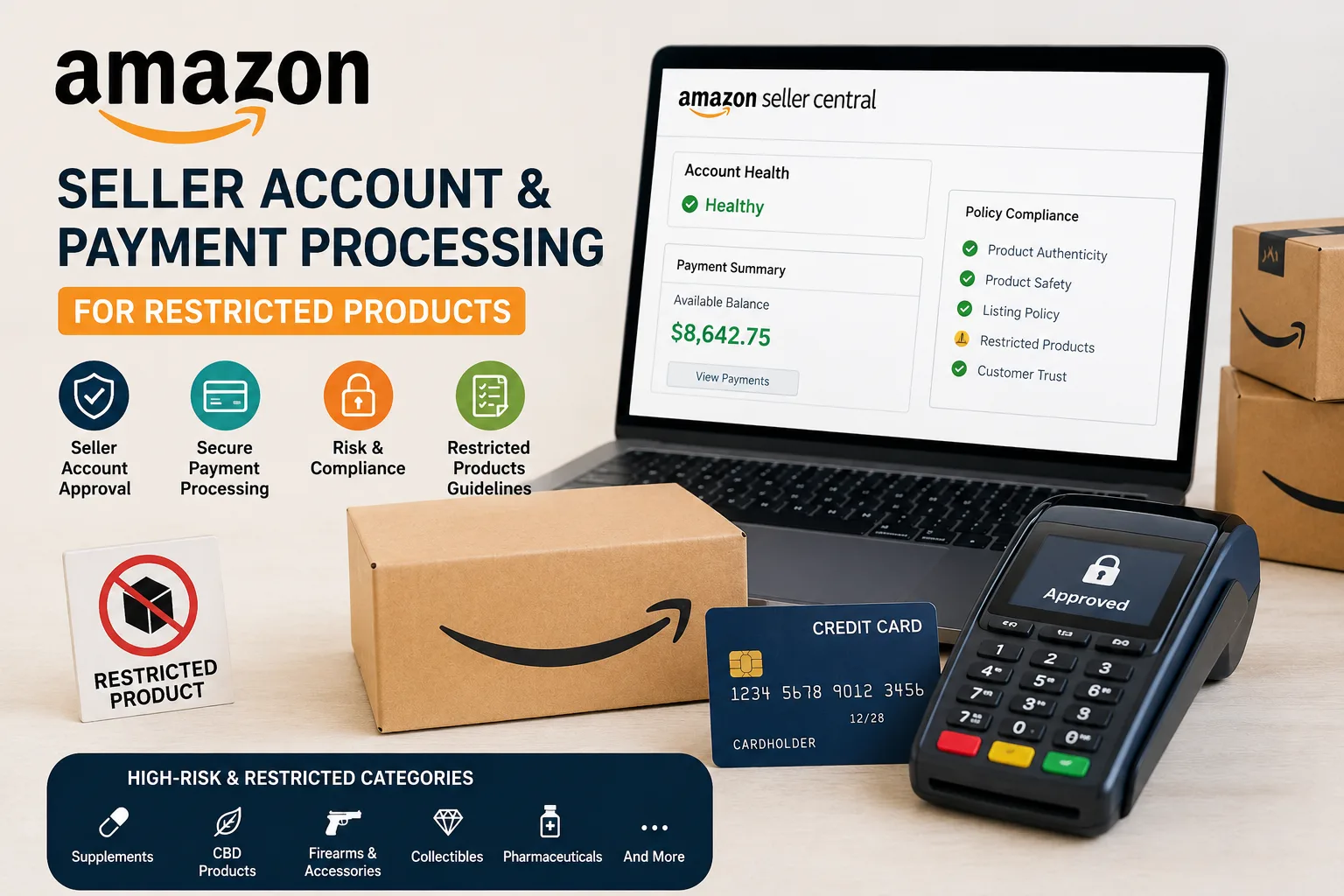
Amazon is the world’s largest e-commerce marketplace, but it is also one of the most restrictive platforms for sellers operating in sensitive or regulated product categories. Getting approved to sell restricted products on Amazon is one challenge. Keeping your account active while managing payment processing behind the scenes is an entirely different battle.
This blog covers what restricted product sellers need to know about Amazon seller accounts, how payment processing actually works on the platform, what gets accounts suspended, and, critically, what payment infrastructure you need outside Amazon to protect your business in 2026.
How Amazon Classifies Restricted Products
Amazon divides its product catalog into categories that are either open to all sellers, require approval, or are outright prohibited. Understanding the difference matters because the payment processing and merchant account implications vary significantly across each tier.
Categories That Require Approval
- Dietary supplements and nutraceuticals: require documentation, lab testing proof, and labeling compliance
- CBD and hemp products: permitted in limited form but heavily scrutinized by state and federal regulation
- Alcohol: approved sellers only; strict licensing requirements
- Medical devices: FDA clearance documentation required
- Firearms and accessories: magazines, cleaning kits, and certain parts permitted with restrictions
- Adult products: gated category with content restrictions and age-targeting rules
- Pesticides and chemicals: EPA registration numbers required
Categories That Are Fully Prohibited
- Illegal drugs and drug paraphernalia
- Counterfeit goods
- Certain weapons and explosives
- Stolen goods
- Products that violate intellectual property rights
The line between restricted and prohibited is not always obvious, and Amazon’s enforcement is algorithm-driven, meaning legitimate sellers get caught in automated sweeps regularly.
Amazon Payment Processing: How It Actually Works
Most sellers do not think about payment processing on Amazon because Amazon handles it invisibly. But understanding the mechanics matters, especially when your account gets flagged or suspended.
Amazon operates its own internal payment infrastructure. When a customer buys from your listing, Amazon collects the payment, holds it in your seller account balance, and disburses to your linked bank account on a rolling schedule, typically every 14 days for new sellers, with faster disbursement available for established accounts.
What This Means for Restricted Product Sellers
Amazon is both your marketplace and your de facto payment provider. You do not have an independent merchant account with Amazon, you have access to Amazon’s payment rails, and that access can be revoked instantly.
This creates a structural vulnerability that high-risk merchants operating on Amazon often underestimate:
- Account suspension = immediate payment freeze: Funds in your seller balance can be held for 90 days or longer during a suspension review
- No independent payment gateway: You cannot route transactions elsewhere while suspended
- Chargeback liability sits with the seller: Amazon’s A-to-Z Guarantee means disputes often resolve in the buyer’s favor regardless of seller evidence
- Reserve policies apply: Amazon holds a percentage of disbursements as a reserve on accounts with elevated risk signals
For sellers in restricted categories, these vulnerabilities are not hypothetical. They are operational realities that demand a backup payment processing strategy outside Amazon.
Why Amazon Suspends Seller Accounts for Restricted Products
Amazon account suspensions in restricted categories follow predictable patterns. Understanding them helps sellers build compliance before enforcement catches up.
Common Suspension Triggers in 2026
- Policy violations on listing content: health claims on supplements, misleading product titles, unverified certifications
- Intellectual property complaints: brand registry conflicts, counterfeit flags, ASIN hijacking accusations
- High order defect rate (ODR): above 1% ODR triggers automated review; restricted product sellers face higher dispute rates
- Customer complaint velocity: multiple complaints in a short window trigger algorithmic flags
- Document verification failures: restricted category approvals require ongoing documentation; expired certificates trigger suspension
- Related account flags: Amazon’s systems link accounts by device, IP, bank account, and address; a banned related account can pull down active ones
Suspension by the Numbers (2026)
| Metric | Data |
|---|---|
| Amazon active third-party sellers globally | 9.7 million (2026 estimate) |
| Sellers suspended at least once | Approximately 25% annually |
| Average fund hold during suspension | 90 days |
| Appeal success rate (first submission) | Approximately 30% |
| Restricted category listings removed daily | Tens of thousands (algorithm-driven) |
These numbers highlight why restricted product sellers cannot treat Amazon as their sole payment processing infrastructure. A 90-day fund hold on a business generating $50K monthly is an existential event without backup merchant services in place.
Building Payment Infrastructure Outside Amazon
This is where high-risk merchants operating on Amazon need to think differently from standard sellers. Amazon’s payment rails are convenient but fragile. Independent payment infrastructure is non-negotiable for restricted product businesses.
What You Need Outside Amazon
1. A Dedicated High-Risk Merchant Account
A high-risk merchant account from a specialist payment provider gives you independent card processing that operates regardless of your Amazon account status. Providers like PaymentCloud, Durango Merchant Services, and PayKings specialize in restricted categories including supplements, CBD, adult products, and firearms accessories.
Unlike Amazon’s internal processing, a dedicated merchant account gives you:
- Direct relationship with an acquiring bank
- Independent chargeback management tools
- Negotiated rolling reserve terms
- Processing continuity during Amazon suspensions
2. A Standalone Payment Gateway
A payment gateway connects your independent storefront, whether Shopify, WooCommerce, or a custom build, to your merchant account. For restricted product sellers, the gateway needs to be configured for your specific product category. Standard gateways like Stripe and PayPal explicitly prohibit many restricted categories.
High-risk compatible payment gateways in 2026 include:
- NMI (Network Merchants Inc.): widely used for high-risk e-commerce
- Authorize.Net: supports a broad range of restricted categories with proper merchant account pairing
- Durango’s proprietary gateway: built specifically for high-risk payment processing
- PayKings gateway: designed for supplement, CBD, and nutraceutical sellers
3. An Independent Storefront
Amazon should be a sales channel, not your entire business infrastructure. Restricted product sellers need a direct-to-consumer storefront that processes payments independently. This protects revenue continuity when Amazon enforcement hits.
Payment Infrastructure Comparison for Restricted Product Sellers
| Solution | Amazon Only | Amazon + Independent Setup |
|---|---|---|
| Payment Processing Control | None | Full |
| Fund Access During Suspension | Frozen up to 90 days | Unaffected |
| Chargeback Management | Amazon-controlled | Merchant-controlled |
| Offshore Merchant Account Option | Not available | Available through specialist providers |
| Monthly Processing Continuity | Dependent on Amazon status | Independent |
| Suitable for High-Risk Merchants | Partial | Yes |
High-Risk Payment Providers That Work With Restricted Product Sellers
Not every payment provider will work with Amazon restricted product categories. Here is how the major options stack up for sellers building independent payment infrastructure in 2026.
Provider Comparison
| Provider | Restricted Categories Supported | Rolling Reserve | Best For |
|---|---|---|---|
| PaymentCloud | Supplements, CBD, adult, firearms accessories | 5–10% | SMB restricted sellers |
| Durango Merchant Services | Broadest high-risk coverage including offshore | Negotiable | Complex high-risk categories |
| PayKings | Nutraceuticals, supplements, e-cigarettes | 5–10% | Supplement and wellness brands |
| Soar Payments | CBD, firearms, adult | Varies | Mid-market restricted sellers |
| Paysafe | iGaming, digital goods, large high-risk | Custom | High-volume restricted merchants |
Pros and Cons of Building Independent Payment Infrastructure
Pros
- Full payment processing continuity regardless of Amazon account status
- Direct chargeback management and dispute tools
- Access to offshore merchant accounts for categories restricted in certain jurisdictions
- Negotiated rates that improve with volume
- Multiple acquiring relationships reduce single-point-of-failure risk
Cons
- Additional setup cost and integration time
- Rolling reserves of 5–10% held by acquiring banks
- Underwriting process can take 5–14 business days
- Higher per-transaction fees than standard merchant accounts
- Requires ongoing compliance documentation
Amazon vs. Independent Channel: Where Restricted Sellers Should Focus in 2026
The smartest restricted product sellers in 2026 treat Amazon as a discovery and volume channel, not a payment processing infrastructure. Here is the strategic split that makes sense.
Use Amazon for:
- Product discovery and organic search traffic
- FBA fulfillment logistics
- Social proof through reviews
- Scaling initial volume in approved categories
Use independent merchant services for:
- Direct-to-consumer payment processing
- Subscription and recurring billing
- International and cross-border sales
- Categories that Amazon restricts but are legal in target markets
- Business continuity when Amazon enforcement hits
The merchants who get hurt most are those who built their entire payment processing dependency on Amazon and had no independent infrastructure when suspension came. In restricted categories, suspension is not a question of if, it is a question of when and how prepared you are.
Pros and Cons of Selling Restricted Products on Amazon
Pros
- Access to 300+ million active Amazon customers globally
- FBA handles fulfillment, reducing operational complexity
- Amazon’s brand trust increases conversion rates for new sellers
- Restricted category approval creates a barrier to entry that limits competition
Cons
- Zero payment processing independence, Amazon controls all funds
- Account suspension freezes funds for up to 90 days
- Algorithm-driven enforcement catches legitimate sellers regularly
- A-to-Z Guarantee disputes heavily favor buyers
- Policy changes can make previously approved categories non-compliant overnight
- No direct customer relationship, Amazon owns the buyer data
Final Verdict
Selling restricted products on Amazon in 2026 is viable, but only if you treat it as one channel in a diversified business, not your entire payment processing infrastructure. The platform’s reach and fulfillment capabilities are genuine advantages. Its payment control and enforcement unpredictability are genuine risks.
Build your independent merchant account and payment gateway before you need them. When Amazon suspends your account, and in restricted categories, the odds are significant, your business continues processing payments, your customers can still buy directly, and your cash flow does not freeze for 90 days.
The restricted product sellers who scale successfully in 2026 are the ones who understand that Amazon is a marketing channel. Payment processing independence is what keeps them in business.
Frequently Asked Questions
Can restricted product sellers get a high-risk merchant account? Yes. Specialist payment providers including PaymentCloud, Durango, and PayKings specifically serve restricted product categories. Approval depends on your product type, chargeback history, and compliance documentation.
How long does Amazon hold funds during a suspension? Amazon typically holds seller funds for 90 days during a suspension review. In some cases, particularly with intellectual property or fraud flags, holds can extend further. This is why independent payment processing infrastructure is essential for restricted product sellers.
What payment gateways work for restricted product sellers? Standard gateways like Stripe and PayPal prohibit many restricted categories. High-risk compatible options in 2026 include NMI, Authorize.Net paired with a high-risk merchant account, Durango’s proprietary gateway, and PayKings for supplement and wellness categories.
Do restricted product sellers need an offshore merchant account? Not always, but offshore merchant accounts become relevant when your product category faces domestic acquiring restrictions. Certain CBD formulations, adult products, and firearms accessories can be processed through offshore acquiring banks in jurisdictions with more permissive frameworks.
Comments
No comments yet. Be the first to share your thoughts.
Leave a comment