
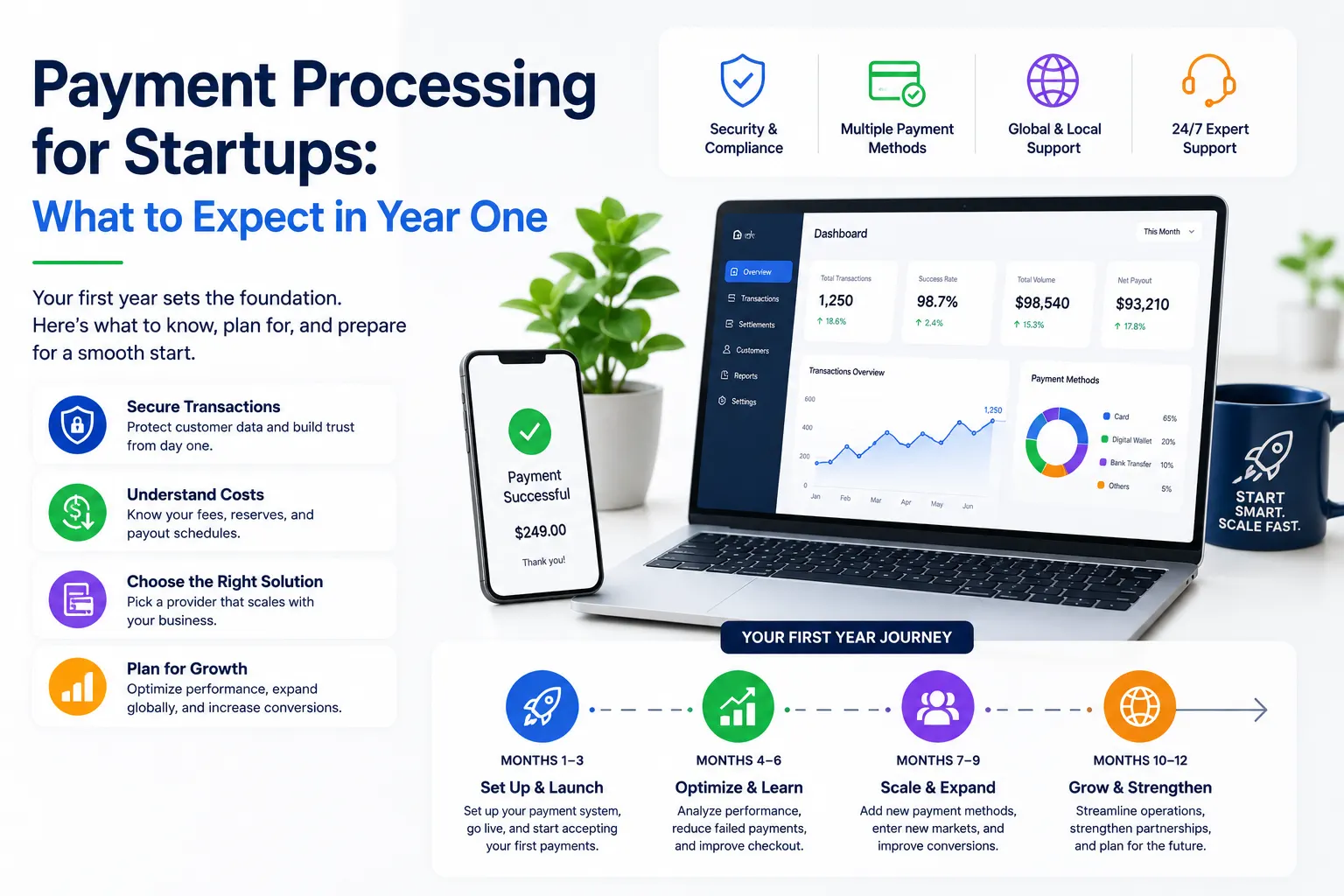
Most first-time founders assume the hardest part of accepting payments is picking a provider. The real friction usually shows up later, in underwriting questions they didn’t expect, a contract clause nobody explained, or a fee that only appears on the first real statement. Getting payment processing for startups right in year one means knowing what’s coming before it happens, not reacting to it after the fact.
TL;DR
Startups face a specific payment processing challenge: no processing history for underwriters to evaluate. Most new businesses start with a payment aggregator like Stripe, Square, or PayPal for fast approval and simple flat-rate pricing, then migrate to a dedicated merchant account once volume grows past roughly $30,000-$50,000 a month. The biggest first-year risks are unexpected account holds, hidden fees like PCI non-compliance charges, and contracts that don’t clearly disclose reserve or termination terms. Travel and other high-risk startups face a narrower, slower path from day one, since limited processing history compounds with industry risk classification.
Why Startups Get a Different Underwriting Conversation
Every payment provider evaluates risk the same basic way: by looking at what a business sells, how customers pay, when the product or service is delivered, and how consistent past transaction patterns have been. Established merchants can hand over months of statements, chargeback ratios, and average ticket data. A startup usually has none of that, just a business plan, a website, and a revenue projection.
This doesn’t mean approval is unlikely. It means the quality of the application matters more than it would for an established business. Underwriters are essentially asking whether the business model is easy to understand and whether the rest of the operation, website, policies, documentation, gives them enough confidence to approve without a processing track record.
What Underwriters Actually Ask For
Startups applying for payment processing should expect to provide:
- Business formation documents: incorporation paperwork, EIN, and business bank account details
- Owner identification: personal ID for anyone with significant ownership stake
- Website and product details: a live, functional site with clear product or service descriptions
- Realistic volume projections: estimated monthly transaction volume and average ticket size, used to set appropriate limits and reserves
- Refund, shipping, and chargeback policies: clearly published and easy for underwriters (and customers) to find
- Fraud control measures: even basic tools and documented policies signal operational maturity to an underwriter
A startup that arrives with all of this ready to go will generally move through underwriting faster than one still assembling documentation mid-application.
Aggregator vs. Merchant Account: The First Real Decision
Nearly every startup faces the same fork early on: use a payment aggregator or apply for a dedicated merchant account.
Payment aggregators: (Stripe, Square, PayPal, and similar platforms) let a business start processing within minutes as a sub-merchant under the aggregator’s master account. The appeal for startups is real:
- Fast onboarding, often live within a day
- Light documentation requirements compared to a traditional merchant account
- Simple, predictable flat-rate pricing with few or no monthly fees
- Built-in fraud tools and developer-friendly integrations
The tradeoff shows up at scale. Aggregators can be more aggressive about funding holds, account reviews, and sudden freezes if transaction patterns look unusual, and negotiating custom rates is generally not possible.
Dedicated merchant accounts: take longer to set up and involve upfront underwriting, but they typically offer better pricing and more stability as volume grows, especially valuable for higher-ticket or B2B online payments. Most startups aren’t ready for this route on day one, but it becomes the better option once volume and consistency justify it.
A reasonable rule of thumb: startups should consider migrating from an aggregator to a dedicated merchant account once monthly volume consistently reaches somewhere between $30,000 and $50,000, or once aggregator fees, reserves, and funding holds start meaningfully cutting into margins.
Hidden Costs That Surprise First-Time Founders
The advertised rate on a payment gateway or processor’s homepage rarely reflects the full first-year cost. Common surprises include:
- PCI compliance fees: typically modest, but non-compliance penalties can be significant if a business doesn’t complete required security questionnaires on time
- Rolling reserves: a percentage of revenue held back for a set period, more common for startups without processing history and often invisible until the first statement
- Chargeback fees: charged per dispute regardless of outcome, and startups with limited fraud tooling early on tend to see more disputes than they expect
- Early termination fees: a real cost if a startup outgrows its first provider and wants to switch before a contract term ends
- FX markups: relevant for any startup with international customers, since currency conversion costs can quietly erode margin on cross-border payments
Reading the full fee schedule before signing, not just the advertised headline rate, is the single most effective way to avoid first-year surprises.
Contract Terms Worth Reading Twice
- Reserve terms: what percentage is held, for how long, and under what conditions it changes
- Termination clauses: whether there’s a fee for closing the account early, and how much notice is required
- Rate change provisions: whether and how the provider can adjust pricing after signing
- Volume commitments: whether the contract assumes a minimum monthly volume, and what happens if the startup falls short
- Auto-renewal terms: a common source of unexpected multi-year lock-in if not cancelled within a narrow window
Startups working with an aggregator typically avoid most of these concerns, since aggregator terms are usually simpler and month-to-month. Traditional merchant account contracts require closer reading.
Building a Payment Stack That Scales With You
Most successful startups don’t pick one processor and stay there forever, they evolve their setup as the business matures:
- Early stage: an aggregator for speed and simplicity, prioritizing fast approval over the lowest possible rate
- Growth stage: a dedicated merchant account with interchange-plus pricing once volume justifies the switch, alongside a proper payment gateway integration if the business has outgrown a plug-and-play checkout
- Scaling stage: multiple merchant services relationships, stronger fraud tooling, and, for startups with international customers, dedicated cross-border payments infrastructure and support for local payment wallets relevant to target markets
Treating payment infrastructure as something that evolves with the business, rather than a one-time setup decision, avoids the common trap of outgrowing a provider and scrambling to switch under pressure.
Payment Processing Pain Points for Travel Startups
Travel startups face a distinctly harder version of the year-one payment processing challenge, since high-risk classification compounds with the lack of processing history that already complicates approval for any new business.
- Approval takes longer and options are fewer: Many mainstream aggregators and processors are cautious about, or outright decline, travel merchants regardless of processing history, pushing travel startups toward specialized high-risk payment gateway providers from day one.
- Reserves are higher and more common: While standard startups might see modest reserve requirements, high-risk travel startups commonly see 5-10% of revenue held back for 90-180 days, a meaningful cash flow consideration for an early-stage business.
- Effective processing costs run higher across the board: High-risk businesses in 2026 often see total effective processing costs between 3.5% and 7% once every fee is factored in, well above what a typical low-risk startup would pay.
- Delayed service delivery adds underwriting complexity: A travel startup collecting deposits months before a trip occurs needs to explain that model clearly to underwriters, since it’s a pattern that increases perceived risk regardless of the startup’s actual chargeback history.
- Documentation expectations are more rigorous from the start: Travel startups should expect to provide detailed cancellation and refund policies, supplier agreements, and realistic volume projections that clearly account for seasonal booking patterns.
For travel startups specifically, working with a payment provider experienced in the vertical from the outset, rather than starting with a generalist aggregator and hoping to migrate later, usually saves significant time and reduces the risk of a sudden account freeze during the startup’s most vulnerable early months.
What to Monitor in the First 90 Days
Once processing is live, the first three months matter more than founders often expect. Weekly monitoring during this window catches problems before they compound:
- Approval and decline rates: a sudden shift can signal a fraud pattern, a technical issue, or an underwriter flag worth addressing early
- Refund and dispute volume: tracked weekly rather than monthly, so a spike gets caught before it affects the account’s risk profile
- Actual settlement timing: confirming funds arrive when promised, since delays can indicate a reserve or review has been triggered without clear notice
- Effective rate versus advertised rate: calculating the real cost per transaction after 60-90 days gives a far more accurate picture than the headline rate quoted at signup
This kind of early monitoring is what turns payment processing from a source of anxiety into a predictable, manageable part of running the business.
Final Thoughts
Payment processing in year one is rarely about finding the cheapest rate, it’s about choosing a setup that won’t create a cash flow crisis the first time volume spikes or a dispute pattern shifts. Starting with an aggregator for speed, reading contracts and fee schedules closely, and planning the migration to a dedicated merchant account before it becomes urgent will save most startups real money and real stress. For travel startups and other high-risk categories, that planning matters even more, since the margin for error on reserves, fees, and account stability is considerably thinner from day one.
FAQs
Can a startup get payment processing without any sales history?
Yes. Approval without processing history is common, provided the business model is clear, documentation is complete, and volume projections are realistic.
Should a startup begin with an aggregator or a merchant account?
Most startups begin with an aggregator like Stripe or Square for speed and simplicity, then migrate to a dedicated merchant account once monthly volume consistently reaches roughly $30,000-$50,000.
What documents does a startup need to apply for payment processing?
Business formation documents, owner identification, a live website with product details, realistic volume projections, and published refund and chargeback policies.
Why do startups face rolling reserves?
Reserves protect processors against the higher uncertainty of a business with no processing history, and they’re more common for startups than for established merchants with a proven low-dispute track record.
Are travel startups treated differently during underwriting?
Yes. Travel’s high-risk classification combines with a startup’s lack of processing history, often resulting in higher reserves, higher effective rates, and a narrower pool of willing providers.
When should a startup switch from an aggregator to a merchant account?
Common triggers include consistent monthly volume above $30,000-$50,000, repeated funding delays or account reviews, or a need for custom interchange-plus pricing as margins get squeezed.
What’s the biggest hidden cost startups overlook in year one?
Rolling reserves and PCI compliance fees are the most commonly overlooked costs, since neither typically appears clearly on a provider’s advertised pricing page.
Comments
No comments yet. Be the first to share your thoughts.
Leave a comment