
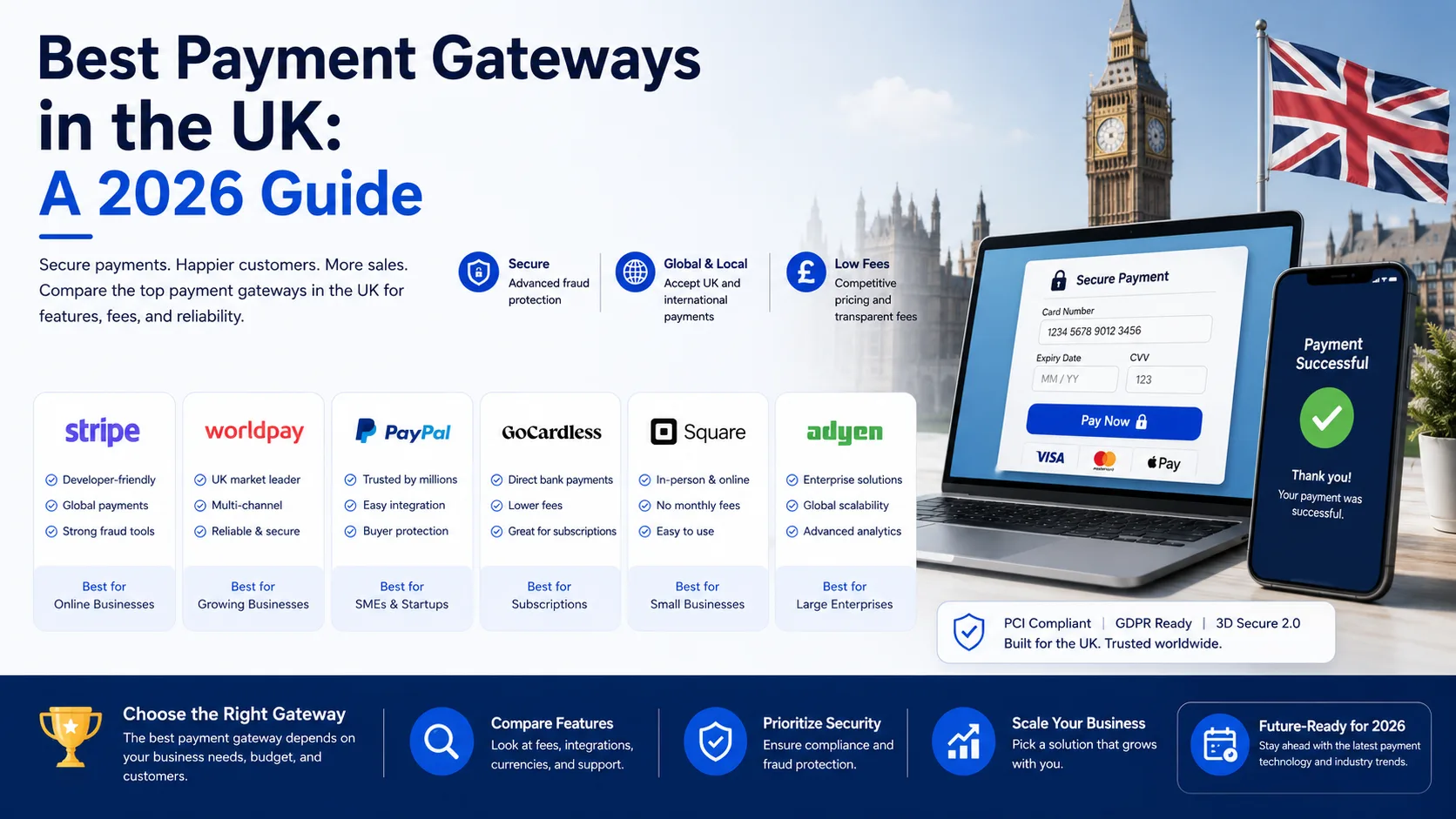
With more than 2,000 payment service providers competing for UK merchants, finding the right payment gateway UK businesses actually need has become less about brand recognition and more about matching pricing, integrations, and risk tolerance to how a business really operates. The wrong choice shows up in cart abandonment, declined transactions, or fees that quietly erode margin as volume grows.
TL;DR
The UK payment gateway market in 2026 is dominated by a mix of developer-first platforms like Stripe, enterprise-grade acquirers like Adyen and Worldpay, and UK-based specialists like Opayo and Revolut, each suited to a different business profile. Pricing generally ranges from around 1.2% to 2.9% plus a fixed fee per UK card transaction, with international cards typically costing more. FCA regulation, PSD2 strong customer authentication, and Open Banking integration are now baseline expectations rather than differentiators. Travel companies face a narrower shortlist than most UK businesses, since delayed service delivery and elevated dispute rates push many mainstream gateways to decline or restrict travel merchant accounts, making specialized high-risk providers a necessary part of the conversation.
What a Payment Gateway Actually Does
A payment gateway is the technology layer connecting a customer’s chosen payment method to a business’s merchant account, encrypting card details and routing the transaction to the card network for authorisation. It’s distinct from a merchant account, which holds settled funds, and from payment processing more broadly, which covers the full transaction lifecycle from authorisation through settlement. Many UK providers now bundle gateway, acquiring, and processing into a single service, which is why the lines between these terms blur in practice even though they describe different parts of the payment stack.
What UK Businesses Should Evaluate in 2026
Before comparing specific providers, score every candidate against the same criteria:
- Pricing transparency: flat-rate, blended, or interchange++ pricing, and whether the quoted rate reflects the true cost once international and non-qualified transactions are included
- FCA regulation: confirm the provider (or its acquiring partner) is properly authorised, since this underpins fund safeguarding and dispute handling
- PSD2 and Strong Customer Authentication support: 3D Secure 2 and SCA exemptions handled cleanly reduce checkout friction without compromising compliance
- Digital wallet and Open Banking support: Apple Pay, Google Pay, and Open Banking-based account-to-account payments are increasingly expected at checkout, not optional add-ons
- Settlement speed: next-business-day payouts are now common; weekend or same-day settlement remains a differentiator
- Contract terms: many modern gateways operate pay-as-you-go with no minimum volume, while others still require 12-month minimum terms
Leading Payment Gateways for UK Businesses in 2026
Stripe
Stripe remains one of the most widely used payment gateways among UK online and technology-focused businesses, with UK card pricing typically around 1.5% + 20p and no monthly fees on standard plans. Its strength is API flexibility and integration breadth, over 250 platform integrations, which suits businesses with development resources. Support is primarily online rather than UK-based phone support, which is worth weighing for less technical teams.
PayPal
PayPal remains one of the most recognisable payment providers globally, and that brand recognition still measurably improves checkout confidence for many UK shoppers. PayPal Checkout offers competitive card rates with no coding required, making it accessible for non-technical merchants, though costs can be less predictable across different payment types and micropayments.
Worldpay
Worldpay is a long-established UK gateway supporting payment processing for established retailers and higher-value transactions, with bespoke fee structures that tend to favour businesses with higher annual card turnover. It’s a common choice for merchants that have outgrown flat-rate pricing and want negotiated rates tied to volume.
Adyen
Adyen combines gateway, acquiring, and risk management into a single global infrastructure, built for high-volume businesses operating across multiple countries and currencies. Its direct banking connections can improve authorisation rates for large multinational merchants, though its pricing and onboarding are generally better suited to enterprise-scale operations than small businesses.
Checkout.com
Checkout.com offers a modular, enterprise-grade payments stack designed for global reach and complex compliance needs, making it a fit for larger merchants managing cross-border payments across multiple markets rather than single-market UK retailers.
GoCardless
GoCardless is a UK-focused specialist in bank payments and direct debit rather than traditional card processing, commonly used for subscriptions, memberships, and instalment-based purchases. It’s a strong fit for recurring billing models rather than one-off transaction-heavy businesses.
Revolut Business
Revolut combines payment processing with business banking, offering pricing from around 1% plus a fixed fee and strong support for international transactions. It particularly suits startups and businesses with international customers, especially those already banking with Revolut.
Opayo
Opayo is a UK-based gateway known for reliability and security, typically combining a monthly fee with transaction charges. It suits small to medium UK businesses prioritising local stability over the lowest possible headline rate.
Comparison Snapshot
| Provider | Typical UK Pricing | Best For |
|---|---|---|
| Stripe | ~1.5% + 20p | Developer-led, online businesses |
| PayPal | ~1.2%-2.9% + fixed fee | Non-technical merchants, brand trust |
| Worldpay | Custom, volume-based | Established retailers, higher-value transactions |
| Adyen | Interchange++ | Enterprise, multi-country businesses |
| Checkout.com | Custom, enterprise | Global, complex compliance needs |
| GoCardless | Percentage per direct debit | Subscriptions and recurring billing |
| Revolut Business | ~1% + fixed fee | International-facing startups |
| Opayo | Monthly fee + transaction fee | Small to medium UK businesses |
Compliance and Infrastructure Shaping 2026
A few developments are directly relevant to any UK business choosing a gateway this year:
- PSD2 and SCA remain baseline requirements: 3D Secure 2 authentication is now standard across UK gateways, and providers handling exemptions well can meaningfully reduce checkout abandonment.
- Open Banking adoption continues climbing: Account-to-account payments initiated directly from a customer’s bank offer lower processing costs and instant confirmation, and more gateways are integrating this alongside traditional card acceptance.
- PCI DSS compliance costs remain a real line item: Typical monthly PCI compliance fees run £5-£15, and providers charging significantly more deserve scrutiny.
- AI-driven fraud detection is now standard, not premium: Tokenisation combined with real-time fraud scoring has become an expected feature across mainstream payment gateways rather than a paid add-on.
- Cart abandonment remains directly tied to payment choice: A meaningful share of UK shoppers still abandon checkout due to limited payment options or security concerns, which makes wallet and Open Banking support a conversion factor, not just a compliance checkbox.
Payment Gateway vs. Full-Stack Merchant Services
Some UK providers, like Adyen and Checkout.com, bundle gateway, acquiring, and risk management into a single platform, while others, like Stripe or Opayo, function more narrowly as the gateway layer connecting to a separate acquiring relationship. Neither approach is inherently better, a bundled platform can simplify vendor management for larger merchants, while a modular setup gives smaller businesses more flexibility to swap components as they grow. Businesses evaluating merchant services more broadly should clarify which model a provider actually uses before assuming feature parity across quotes.
Why Travel Companies Face a Narrower Shortlist
This guide covers mainstream, low-to-medium risk UK businesses, but travel companies sit outside that category almost by default. Several of the providers above are unlikely to approve travel merchants at all, or will apply restrictive terms if they do:
- Delayed service delivery increases risk exposure: Customers often pay months before travel occurs, which most mainstream gateways underwrite conservatively or avoid entirely.
- Chargeback rates run higher in travel: Cancellations, schedule changes, and itinerary disputes push dispute ratios above what standard payment gateways are built to absorb.
- Multi-currency, cross-border payments are the norm, not the exception: Travel businesses paying overseas suppliers while accepting customer payments in multiple currencies need infrastructure built for that complexity from the start.
- Standard merchant services often cap volume too conservatively: for agencies running seasonal campaigns or group bookings.
For UK travel businesses, the realistic path is usually a high-risk payment gateway provider or specialised merchant services partner experienced in travel underwriting, rather than attempting to force volume through a mainstream gateway built for lower-risk retail. Providers in that space typically offer clearer chargeback tooling, rolling reserve transparency, and support for payment wallets and cross-border settlement suited to how travel businesses actually collect and pay out funds.
Final Thoughts
There’s no single best payment gateway for every UK business, the right choice depends on transaction volume, technical resources, and risk profile. Stripe and PayPal suit most online and technology-led businesses, Worldpay and Adyen fit higher-volume and enterprise operations, and specialists like GoCardless and Opayo serve more specific use cases well. Travel companies and other high-risk categories need to look beyond this mainstream shortlist entirely, toward providers built specifically for their risk profile and cross-border payment needs.
FAQs
What’s the best payment gateway for a UK small business?
It depends on the business model. Stripe suits developer-led online businesses, PayPal works well for non-technical merchants, and Opayo suits businesses prioritising UK-based support and stability.
Do UK payment gateways require a long-term contract?
Many modern gateways, including Stripe and PayPal, operate on a pay-as-you-go basis with no minimum term, though some traditional providers still require 12-month contracts.
How much do UK payment gateways typically charge?
Rates generally range from around 1.2% to 2.9% plus a small fixed fee per UK card transaction, with international cards usually costing more.
Can travel companies use standard UK payment gateways?
Often not easily. Travel’s high-risk classification, driven by delayed delivery and elevated chargeback rates, leads many mainstream gateways to decline or heavily restrict travel merchant accounts.
Is FCA regulation required for UK payment gateways?
Providers operating in the UK payments space are generally regulated by the FCA or partner with an FCA-regulated acquirer, which underpins fund safeguarding and compliance.
What’s the difference between a payment gateway and a merchant account?
A payment gateway handles the technical processing and encryption of a transaction, while a merchant account is where settled funds are held before transferring to a business bank account.
Do UK gateways support Apple Pay and Google Pay?
Yes, this is now standard across mainstream UK payment gateways in 2026, alongside growing support for Open Banking-based account-to-account payments.
Comments
No comments yet. Be the first to share your thoughts.
Leave a comment