
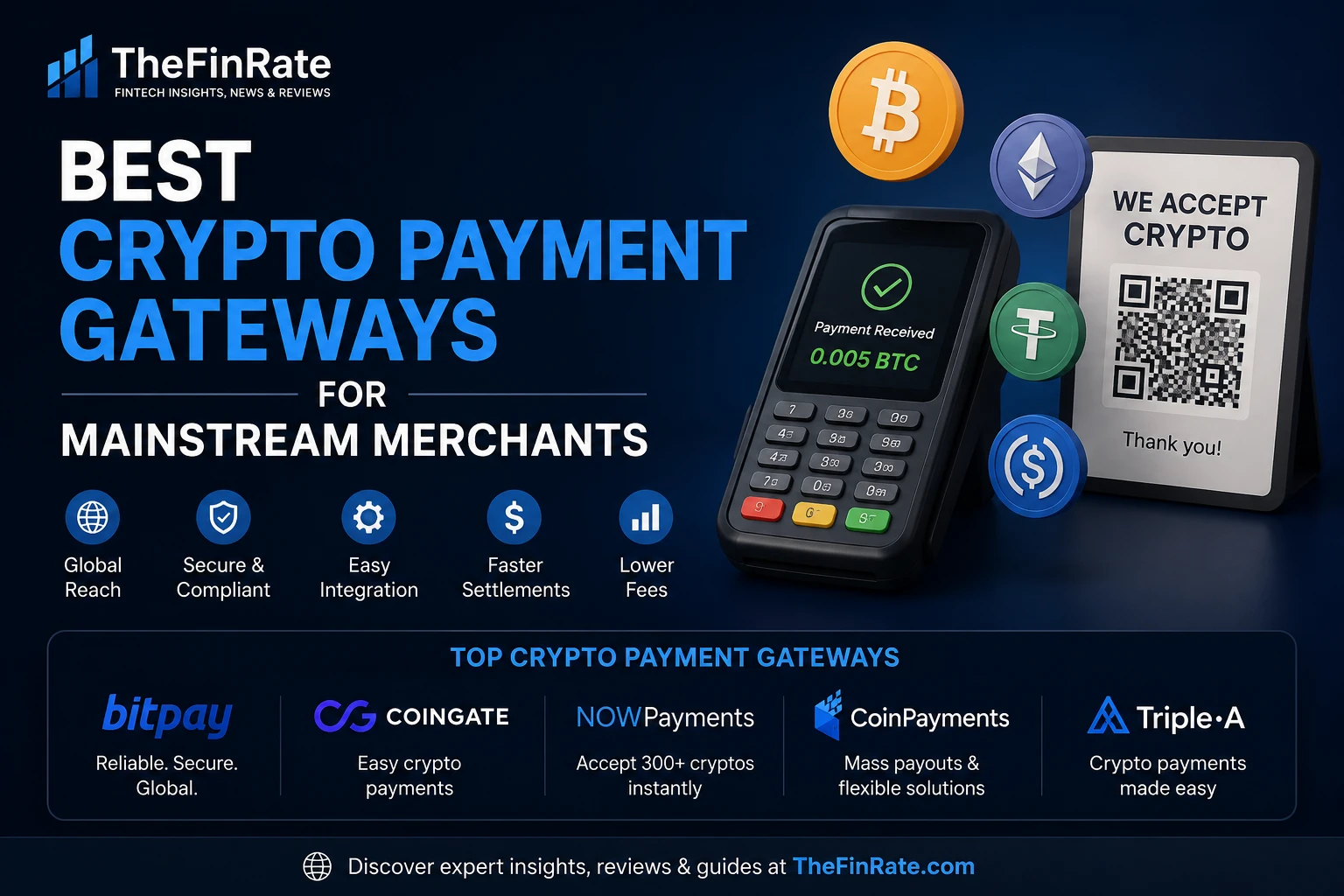
Crypto payments have crossed from niche to operational infrastructure. In 2026, global stablecoin settlement volume surpassed $31 trillion annually, and mainstream merchants are integrating crypto payment gateways alongside traditional card-based payment processing at a pace not seen before. The commercial case is direct: average transaction fees of 0.5-1% versus 2.3-3.5% for card payments, zero chargeback exposure, and cross-border settlement in minutes rather than days.
Whether you run an ecommerce store, a SaaS platform, or a business that has been declined by traditional payment providers, choosing the right crypto gateway in 2026 is a meaningful operational decision.
TL;DR:
Coinbase Commerce is the safest entry for mainstream merchants. BitPay leads on fiat conversion and global reach. NOWPayments is the top stablecoin-first processor at 0.5% fees. TripleA is best for regulated cross-border markets. CoinGate suits EU merchants wanting broad altcoin support.
Why Mainstream Merchants Are Adopting Crypto Payment Processing in 2026
The shift is not about Bitcoin speculation, it is about payment infrastructure. According to Statista, the global crypto payment market is projected to generate $2.8 billion in revenue by end-2026, up 38% from 2024. Merchant adoption has followed: over 18,500 businesses now use integrated crypto payment gateways globally, compared to roughly 12,000 in 2023.
Three structural forces are driving this:
- Fee compression: Crypto payment processing averages 0.5-1% per transaction. Card-based merchant services run 2.3-3.5% when interchange, scheme fees, and processor margins are included. For a merchant processing $500,000 monthly, that gap is $7,500-$12,500 per month.
- Chargeback elimination: Blockchain transactions are irreversible. Merchants in high-risk verticals, where fraudulent chargebacks are a recurring liability, gain a structural advantage using crypto rails over traditional payment gateways.
- Cross-border payment efficiency: A merchant in the UK can settle USD with a buyer in Mexico in under 10 minutes. Traditional cross-border payments via SWIFT take 3-5 business days and carry correspondent banking fees of 1-3%.
Stablecoins are the catalyst here. USDT and USDC now account for over 70% of all on-chain merchant payment volume, according to The Block Research (Q1 2026). The volatility problem that blocked merchant adoption for years is effectively solved.
How We Evaluated These Crypto Payment Gateways
Each gateway was assessed across five criteria: transaction fees (including setup and conversion), settlement options (crypto-only vs. fiat conversion vs. stablecoin), integration depth (APIs, ecommerce plugins, developer documentation), supported assets, and regulatory compliance. Results are based on publicly available 2026 pricing and verified provider documentation.
Crypto Payment Gateway Comparison Table (2026)
| Gateway | Transaction Fee | Settlement Options | Supported Assets | Best For |
|---|---|---|---|---|
| Coinbase Commerce | 1% | USDC + crypto | 12+ | Mainstream ecommerce |
| BitPay | 1% | Fiat (USD/EUR/GBP) + crypto | 16+ | Fiat-conversion merchants |
| NOWPayments | 0.3% | Stablecoin auto-convert + 350 cryptos | 350+ | Stablecoin-first businesses |
| TripleA | 0.8% | Fiat (local currency, 160+ countries) | BTC, ETH, USDT | Regulated cross-border |
| CoinGate | 1% | EUR bank transfer + crypto | 70+ | EU ecommerce merchants |
Best Crypto Payment Gateways for Merchants, Full Reviews
1. NOWPayments
Fee: From 0.3% | Standard service fee: 1% | Settlement: Flexible crypto conversion and settlement options
NOWPayments is one of the best crypto payment gateways for businesses seeking a flexible, all-in-one solution for digital asset payments. Its unified ecosystem enables merchants to accept, convert, manage, and pay out crypto through a single platform.
With support for 350+ cryptocurrencies, NOWPayments offers integrations through API, e-commerce plugins, invoices, payment links, subscriptions, point-of-sale tools, and white-label solutions. Beyond payment acceptance, it provides automatic conversion, flexible settlement, fund-management tools, custody and off-ramp options, and automated mass payouts. Businesses can also benefit from zero-fee crypto payouts through ChangeNOW Pro.
Customer experiences and feedback about the platform are also available on G2 and Trustpilot.
Pros:
- Fees starting from 0.3%
- Support for 350+ cryptocurrencies
- Automatic conversion and flexible settlement options
- API, plugins, invoices, payment links, POS, and white-label solutions
- Automated mass payouts, including zero-fee payouts through ChangeNOW Pro
Cons:
- The wide range of tools may require additional setup for some businesses
- Certain advanced features depend on the selected integration and settlement method
Best for: E-commerce businesses, crypto-native merchants, Web3 platforms, gaming companies, marketplaces, and businesses managing international crypto payments or payouts.
2. Coinbase Commerce
Fee: 1% per transaction | Settlement: USDC, BTC, ETH, LTC, and 8+ others
Coinbase Commerce is the most trusted entry point for mainstream merchants adding crypto to an existing payment stack. Built and backed by Coinbase, the largest US-regulated crypto exchange, it carries the institutional credibility that matters when presenting crypto acceptance to finance teams or compliance departments.
Setup is straightforward: merchants get a hosted payment page, native WooCommerce and Shopify plugins, and a clean REST API. Settlement defaults to USDC, removing crypto volatility without requiring fiat conversion infrastructure.
Pros:
- Regulatory credibility from Coinbase association, the strongest brand trust of any crypto gateway
- No minimum volume requirements, accessible to SMEs and early-stage merchants
- Native USDC settlement eliminates price exposure without fiat conversion complexity
- Strong developer documentation and plugin ecosystem
Cons:
- Only 12 supported cryptos, significantly below competitors
- No direct fiat bank account payouts, stablecoin is the settlement endpoint
- Limited support for high-risk merchant account categories in restricted verticals
Best for: Mainstream ecommerce brands, SaaS platforms, and businesses entering crypto payment acceptance for the first time.
3. BitPay
Fee: 1% per transaction | Settlement: USD, EUR, GBP bank transfer or crypto
BitPay is the longest-running crypto payment provider in the market, founded in 2011, it has processed over $5 billion in merchant payments across 229 countries. In 2026, it remains the dominant choice for businesses that want to accept crypto from customers but receive fiat currency in their bank account, with zero crypto held on the balance sheet.
Its fiat conversion pipeline is the defining feature: merchants receive USD, EUR, or GBP directly, typically within 1-2 business days. BitPay also explicitly serves high-risk merchant categories that are routinely declined by card-network-dependent payment processors.
Pros:
- Full fiat settlement to bank accounts, no crypto treasury management required
- Widest geographic reach of any crypto gateway (229 countries)
- Accessible to high-risk merchants where traditional payment gateways are unavailable
- Proven chargeback elimination, all crypto transactions are final
Cons:
- $3,000 monthly volume minimum applies to some premium settlement tiers
- Higher compliance and KYC requirements than newer gateways
- No native stablecoin auto-conversion option
Best for: Established businesses wanting crypto acceptance without crypto balance sheet exposure; merchants in high-risk verticals who cannot access standard card-based merchant accounts.
4. TripleA
Fee: 0.8% per transaction | Settlement: Fiat in local currency, 160+ countries
TripleA is headquartered in Singapore, holds a full MAS (Monetary Authority of Singapore) Payment Service License, and is purpose-built for regulated, cross-border payment infrastructure. Merchants receive local currency payouts directly to their bank accounts, TripleA manages all crypto-to-fiat conversion, making it the only gateway on this list designed around compliance-first architecture.
Clients include Wix, Lazada, and Singapore Airlines. If your business operates across multiple jurisdictions and needs a licensed payment provider that satisfies regulatory requirements, TripleA is the clear choice.
Pros:
- MAS-licensed, the highest compliance standard on this list
- Fiat settlement in local currency across 160+ countries, strongest cross-border capability
- Built for enterprise cross-border payment infrastructure
- Accepted by regulated industries that require licensed payment providers
Cons:
- Limited supported assets (Bitcoin, Ethereum, USDT), not suitable for altcoin merchants
- Highest onboarding friction due to full KYC/AML verification requirements
- Not designed for DeFi-adjacent or altcoin-diverse use cases
Best for: Enterprises, regulated businesses, and cross-border merchants needing a fully licensed crypto payment gateway in a compliance-sensitive environment.
5. CoinGate
Fee: 1% per transaction | Settlement: EUR bank transfer or crypto
CoinGate is a Lithuania-based, EU-licensed payment provider supporting over 70 cryptocurrencies with direct EUR settlement to bank accounts. It integrates natively with WooCommerce, Magento, PrestaShop, and OpenCart, the widest plugin coverage of any crypto gateway for standard ecommerce platforms. It also supports Bitcoin Lightning Network payments for microtransaction use cases.
Pros:
- 70+ supported cryptos with EU regulatory licensing
- EUR fiat payouts, directly to EU bank accounts
- Broadest ecommerce plugin library (WooCommerce, Magento, PrestaShop, OpenCart)
- Lightning Network support for fast, low-cost Bitcoin microtransactions
Cons:
- EUR-only fiat settlement, less suitable for USD-primary markets or LATAM operations
- Not specifically designed for high-risk or non-EU merchant categories
- Fee is mid-range, not the lowest option available
Best for: EU-based ecommerce merchants, WooCommerce and Magento operators, and businesses wanting altcoin acceptance with EUR bank account settlement.
Stablecoin-First Processors: The Defining 2026 Trend
The most significant development in crypto payment processing this year is not broader Bitcoin adoption, it is stablecoin rails becoming mainstream payment infrastructure. USDT and USDC together account for over 70% of on-chain merchant payment volume, per The Block Research (Q1 2026).
For merchants, stablecoins resolve the three historic objections to crypto payment acceptance:
- Volatility: USDT and USDC are pegged 1:1 to the USD. Merchants receive predictable value.
- Settlement clarity: stable pricing means no FX accounting complexity at month-end.
- Customer familiarity: major payment wallets including Coinbase Wallet, MetaMask, and Trust Wallet all support USDT/USDC natively.
Regulatory momentum is reinforcing this. The EU MiCA framework (effective January 2025) has established clear stablecoin issuance standards. US stablecoin legislation advancing through Congress in 2026 is further legitimising stablecoin-based payment processing for mainstream online payments. For merchants evaluating crypto gateways now, prioritising stablecoin settlement capability is not optional, it is the correct baseline requirement.
Crypto Gateways as a High-Risk Payment Gateway Alternative
Traditional payment gateways, operating on Visa and Mastercard rails, regularly decline merchants in verticals classified as high-risk: nutraceuticals, adult content, online gaming, forex, and crypto exchanges themselves. Crypto payment gateways are not subject to card network rules and operate under different risk frameworks.
BitPay and NOWPayments explicitly support high-risk merchant categories. The core advantages:
- No chargebacks: transaction finality removes the primary liability that leads banks to decline high-risk merchants
- Global online payments without card network dependency: no Visa/Mastercard rule constraints
- Fast approvals: most crypto gateways approve new merchant accounts within 48-72 hours, versus weeks for traditional high-risk payment processor applications
The most effective approach for high-risk merchants in 2026 is a hybrid stack: a specialist high-risk payment gateway for card transactions, supplemented by a crypto gateway for customers preferring digital payments. This diversifies payment processing risk and reduces dependency on any single payment provider.
What to Confirm Before Integrating a Crypto Payment Gateway
- Settlement currency: do you need fiat to a bank account, or is stablecoin the correct endpoint for your treasury?
- Regulatory requirements: are you in a licensed industry that needs a regulated provider (TripleA’s MAS license, CoinGate’s EU license)?
- Customer crypto usage: does your buyer base use Bitcoin primarily, or a broader range of digital currencies?
- Platform integration: does the gateway support your ecommerce or merchant services infrastructure natively?
- Volume thresholds: confirm whether your expected monthly processing volume meets minimum requirements for your preferred settlement tier.
Frequently Asked Questions
What is the best crypto payment gateway for mainstream merchants in 2026?
Coinbase Commerce is the strongest entry point for mainstream businesses due to regulatory credibility, simple integration, and USDC settlement. BitPay is the top choice for merchants requiring full fiat bank account payouts.
Can I accept crypto payments without holding cryptocurrency?
Yes. BitPay and TripleA both offer full fiat conversion, you receive USD, EUR, or local currency to your bank account with no crypto retained. NOWPayments auto-converts to USDC or USDT, which maintains dollar parity without traditional fiat settlement.
Are crypto payment gateways cheaper than card payment processing?
Yes, significantly. Crypto gateway fees average 0.5-1%, compared to 2.3-3.5% for card-based payment processing once interchange, scheme fees, and processor margins are included. For high-volume merchants, this difference is material.
Which crypto gateways support high-risk merchants?
BitPay and NOWPayments both explicitly support high-risk merchant categories. Unlike card network-dependent payment providers, crypto gateways are not governed by Visa or Mastercard operating rules, making them accessible to merchants routinely declined by standard processors.
What is the difference between a crypto payment gateway and a payment wallet?
A crypto payment gateway processes transactions at the point of sale, handling conversion, settlement routing, and merchant payouts. A payment wallet stores and manages digital assets for end users. They serve distinct functions, though providers like Coinbase offer both products.
Are stablecoins better than Bitcoin for merchant payments?
For most merchants, yes. Stablecoins like USDT and USDC are pegged to the US dollar, eliminating price volatility at settlement. In 2026, they represent over 70% of on-chain merchant payment volume precisely because they deliver the benefits of digital payments without balance sheet risk.
How do crypto gateways handle cross-border payments?
Crypto rails settle cross-border in minutes, with no correspondent banking intermediaries. TripleA supports local currency payouts to 160+ countries. BitPay operates across 229 countries. For cross-border payment operations, crypto settlement is consistently 40-60% cheaper than traditional SWIFT wire transfers.
Comments
No comments yet. Be the first to share your thoughts.
Leave a comment