
CBD merchants at least have a clean legal starting point — the 2018 Farm Bill settled federal legality, and the fights that remain are mostly about marketing claims and state fragmentation. Vape merchants don’t have that luxury. Products outside the FDA’s authorized list — which is most flavored e-liquids — remain in genuine regulatory limbo, with ongoing litigation still unresolved as of 2026. That single distinction changes everything about how you should evaluate a payment provider for this category: it’s not just about finding someone willing to accept “vape” as a business type, it’s about finding someone who actually understands where your specific product line sits on a spectrum from “FDA-authorized tobacco/menthol flavor, PACT Act compliant, low relative risk” to “flavored product still fighting litigation, elevated underwriter scrutiny regardless of how well you run the rest of the business.”
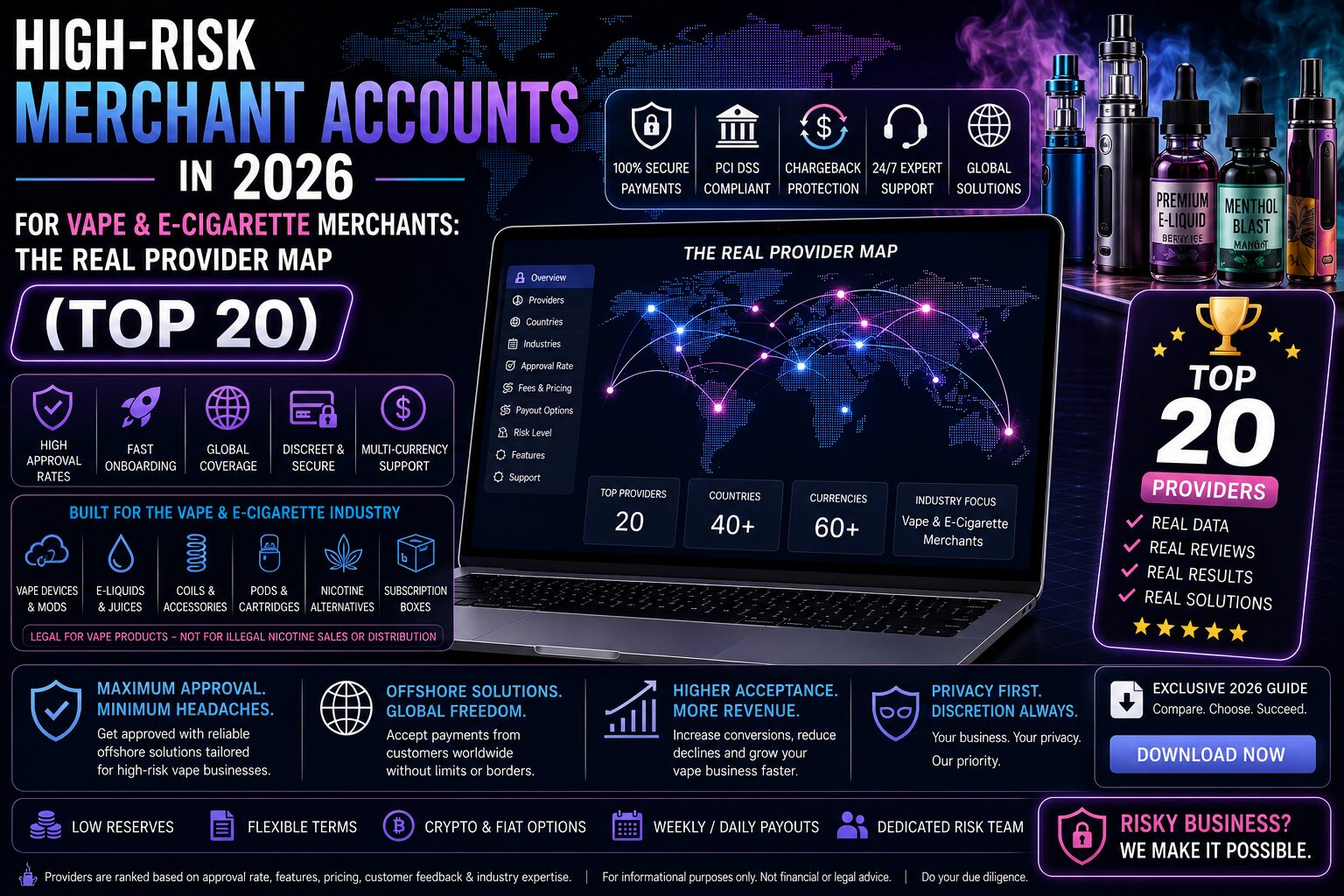
This piece maps 20 real providers serving the vape and e-cigarette vertical by the specific problem each is built to solve.
Why Vape Payment Processing Is a Distinct Problem
MCC misclassification is a specific, documented cause of automatic rejection in this category. Traditional processors often assign vape businesses the tobacco Merchant Category Code (5993), which triggers automatic rejections at many banks regardless of the merchant’s actual compliance posture — a genuinely fixable problem if your provider routes your transactions through a more accurately matched MCC based on your specific business model, but a real and recurring failure mode if it doesn’t.
The PACT Act is both the source of the compliance burden and the single biggest lever for reducing your risk profile. The Prevent All Cigarette Trafficking Act, amended in 2021 to explicitly cover e-cigarettes, imposes carrier registration, age verification at delivery, tax collection, and monthly sales reporting requirements on online sellers — and processors specifically view merchants who genuinely comply with these requirements as meaningfully lower risk than those who don’t. This means PACT Act compliance isn’t just a legal obligation, it’s the most direct thing you can do to strengthen your underwriting file.
How you describe your business in the application materially changes the outcome. Describing yourself as “FDA tobacco retailer registered, PACT Act compliant vaping merchant with integrated age verification” tells an underwriter a fundamentally different story than “online vape shop” — the same underlying business, framed around demonstrated compliance rather than product category alone, moves through underwriting very differently.
Card-present and card-not-present transactions carry genuinely different risk profiles in this category, more so than in most other high-risk verticals. Retail vape shops processing in-person, card-present transactions benefit from meaningfully lower interchange rates (2.5-4.0%) and lower chargeback risk than online, card-not-present sales (3.0-5.0%) — a distinction worth understanding clearly if your business runs both a physical storefront and an online store, since the two may genuinely warrant different processing setups rather than one blanket account.
Shopify allows the storefront but explicitly excludes Shopify Payments for vape. You can build and run your e-commerce presence on Shopify, but you cannot use Shopify Payments for vape transactions specifically — you’ll need a third-party high-risk gateway integrated at checkout instead, a technical detail worth confirming early if you’re building or migrating an online store.
Chargeback triggers in vape are specific and identifiable, not generic fraud. Age verification failures (a customer or a parent disputing on the customer’s behalf), PACT Act-driven shipping delays, product quality disputes over flavor or nicotine strength expectations, and subscription/auto-ship confusion are the documented dominant dispute drivers — meaning the right provider’s fraud tooling should be built around these specific mechanics, not generic e-commerce fraud scoring.
UK regulation takes a genuinely different posture than the U.S., worth knowing if you sell internationally. The UK’s Tobacco and Vapes Bill targets disposable vapes and flavored products marketed to minors specifically, while explicitly supporting adult access to legal vaping products as a smoking-cessation tool — and UK acquiring banks have generally been more permissive toward FCA-compliant merchants than U.S. processors are toward comparable American vape businesses, a genuinely different regulatory-to-underwriting relationship than the U.S. market’s more uniformly cautious posture.
The Five Models in Vape Payment Processing
- The Vape-Native Specialist. Built specifically around nicotine and vape products, with underwriting teams that understand FDA authorization status by flavor category, PACT Act documentation requirements, and correct MCC routing — the providers most likely to help you frame your application around demonstrated compliance rather than product category alone.
- The Offshore/Broker Generalist. Broader high-risk providers listing vape and tobacco-adjacent categories among several supported verticals, offering deeper banking relationships for merchants already declined by a vape-native specialist or carrying MATCH list history.
- The Gateway/Tech Layer Provider. Not a merchant account provider itself — a payment gateway (PayTrace, NMI, Authorize.net) that needs to be paired with a high-risk merchant account behind it, relevant specifically because the gateway and the underlying acquiring relationship are genuinely separate decisions in this category.
- The Crypto-Hybrid Settlement Specialist. Built around accepting crypto (Bitcoin, Ethereum, stablecoins) with instant fiat conversion, alongside modern age-verification integration — a genuinely useful option for vape merchants wanting to diversify beyond card-only acceptance while still managing the category’s specific compliance requirements.
- The Dedicated-MID/Load-Balanced Structural Specialist. Solves specifically for the sudden-shutdown risk documented repeatedly across this category, through either a dedicated Merchant ID or a multi-account load-balancing structure.
Here’s how 20 real providers sort into that structure.
Model 1: Vape-Native Specialists
Vector Payments has built genuinely detailed guidance around the specific mechanics of vape rejection — MCC misclassification, PACT Act compliance as a risk-reduction lever, and the “low-risk pricing for high-risk businesses” positioning that directly addresses a common merchant complaint about being overcharged simply for operating in a regulated category. Its stated approach emphasizes transparent rates and account longevity specifically, framing account stability (not just initial approval) as the actual goal.
Payment Nerds is explicitly named as a top pick specifically for vape shop merchant accounts, with its value built around matching a specific vape business model — retail storefront, online store, MOTO/phone orders, or a combination — to the underwriting and POS integration actually built for it, rather than assuming one processor configuration fits every vape retailer equally.
Model 2: Offshore/Broker Generalists
Instabill, eMerchantBroker (EMB), Durango Merchant Services, and SMB Global, all covered throughout this guide series, extend their broader high-risk and offshore banking relationships to vape and tobacco-adjacent categories, useful for vape merchants already declined by a domestic vape-native specialist or carrying prior MATCH list history from an earlier processor termination.
PayCly, GlobalPay, and WebPays round out the multi-vertical high-risk generalists relevant here, each supporting vape and adjacent nicotine-product categories within a broader high-risk portfolio — a reasonable option for vape businesses that also run adjacent product lines (CBD, smoke shop accessories) under one brand.
RoxPay, the Italian, OAM-registered, PCI DSS Level 1 and ISO 27001-certified payment institution covered throughout this series, is genuinely relevant here for vape merchants selling into European markets specifically, given how much vape regulation varies by individual EU country and how useful a genuinely EU-licensed payment partner can be in navigating that variation compared to a purely offshore acquirer.
Model 3: Gateway/Tech Layer Providers
This is a genuinely distinct category worth understanding on its own terms: PayTrace, NMI, and Authorize.net are payment gateways — the technical layer that processes the transaction data — not merchant account providers themselves. A vape merchant needs both a high-risk merchant account (from a provider in Model 1 or 2 above) and a gateway like one of these three that integrates with the merchant account and connects to the storefront platform (Shopify via a third-party payment integration, given Shopify Payments’ explicit exclusion of vape). Confirming which gateway your chosen merchant account provider actually integrates with — and whether that gateway has genuine, tested compatibility with your specific e-commerce platform — is a separate and necessary step from choosing the underlying acquiring relationship.
Model 4: Crypto-Hybrid Settlement Specialists
FastoPayments (Fasto) brings a genuinely distinctive combination to the vape category specifically: real-time ID verification and automated age-gating integrated directly into the checkout flow, paired with support for Bitcoin, Ethereum, and stablecoin acceptance with instant conversion to fiat to avoid volatility exposure. Its stated approach to MCC routing — directing vape transactions through more accurately matched category codes rather than defaulting to the tobacco MCC 5993 that triggers automatic rejections elsewhere — directly addresses one of this category’s most specific, documented failure points. Worth the same general scrutiny applied to crypto-forward providers throughout this guide series: verify the actual compliance depth behind claims of a decade of vape-specific processing experience through independent references, not marketing copy alone.
Model 5: Dedicated-MID/Load-Balanced Structural Specialists
2Accept, covered throughout this guide series, applies its dedicated-Merchant-ID model to vape specifically, relevant given how consistently this category’s guides describe standard processors terminating accounts “without warning” the moment automated systems flag a nicotine-adjacent business — a shared-aggregator MID structure is precisely the mechanism that makes this kind of sudden, no-notice termination possible in the first place.
Easy Pay Direct, covered in this series’ CBD and general high-risk pieces for its EPD Gateway and load-balanced multi-account processing model, extends that same redundancy approach usefully to vape — spreading transaction volume across multiple merchant accounts so that a single account being flagged, reviewed, or terminated doesn’t stop revenue entirely, a genuinely relevant mitigation given how documented the sudden-shutdown pattern is across this specific vertical.
The Fit Framework: Question, Not Rank
| Your vape business situation | Model to start with |
| Want help framing your application around demonstrated PACT Act compliance | Vape-Native Specialist (Vector Payments) |
| Mixed retail + online, need POS and gateway matched correctly | Vape-Native Specialist (Payment Nerds) |
| Already declined or MATCH-listed elsewhere | Offshore/Broker Generalist (Durango, EMB, Instabill, SMB Global) |
| Selling into EU markets with country-varying vape regulation | RoxPay |
| Need to pair a merchant account with the right technical gateway | Gateway/Tech Layer (PayTrace, NMI, Authorize.net) — paired with a Model 1/2 merchant account |
| Want crypto acceptance with built-in age-verification checkout tooling | FastoPayments |
| Worried specifically about MCC 5993 misclassification triggering rejection | FastoPayments or a provider that explicitly confirms correct MCC routing |
| Want redundancy across multiple accounts to survive a sudden termination | Easy Pay Direct’s load-balanced model, or 2Accept’s dedicated MID |
| Primarily brick-and-mortar retail (card-present) | Any Model 1/2 provider — confirm the lower card-present rate tier specifically |
Red Flags Specific to Vape Payment Processing
Confirm your MCC classification explicitly rather than assuming it’s been set correctly. The tobacco MCC (5993) triggering automatic rejection at many banks is a documented, specific failure mode in this category — ask directly which MCC your provider will assign and why.
“Online vape shop” as your entire application framing is a documented underwriting weakness. Leading with your actual compliance posture — FDA registration status, PACT Act compliance, integrated age verification — tells a materially different, stronger story to an underwriter than the product category alone.
Know exactly where your specific flavor category sits relative to FDA authorization. Tobacco and menthol flavors are broadly authorized; most other flavored e-liquids remain in ongoing litigation and regulatory limbo, and merchants selling those products should expect and plan for elevated underwriter scrutiny rather than being surprised by it.
Card-present and card-not-present risk (and pricing) genuinely differ in this category — don’t assume a single rate quote covers both channels if you run a hybrid retail-and-online business.
A single-account setup is a documented liability given how consistently this category’s own guides describe sudden, no-warning terminations. Load-balanced multi-account processing or a genuinely dedicated MID isn’t excess caution here — it’s a direct response to a well-documented failure pattern.
Confirm your gateway and merchant account are genuinely compatible before assuming a Shopify-based storefront will “just work.” Shopify Payments’ explicit exclusion of vape means this integration step is a real, separate technical decision, not an afterthought.
What Actually Determines a Good Fit
Does the provider help you frame your compliance posture (PACT Act, FDA registration, age verification) proactively in the application, rather than just processing whatever description you submit?
Does the provider correctly route your specific transactions to an accurate MCC, avoiding the documented tobacco-code (5993) rejection trigger?
Does the provider distinguish between your card-present and card-not-present risk and pricing, if you run both retail and online channels?
Is this a dedicated MID, or a load-balanced multi-account structure — or are you exposed to a single-account, single-point-of-failure setup given how documented sudden vape account terminations are?
Does the provider genuinely understand where your specific flavor category sits relative to current FDA authorization status, rather than treating all vape products as one undifferentiated risk bucket?
Conclusion
Vape and e-cigarette payment processing isn’t solved by finding a provider willing to say yes to “nicotine products” as a category — it’s solved by understanding that this vertical’s rejection and shutdown risk comes from specific, identifiable mechanisms: MCC misclassification under the tobacco code, an underwriting story built around product category instead of demonstrated PACT Act and FDA compliance, and a genuinely unsettled regulatory landscape for most flavored products specifically. Vector Payments and Payment Nerds have built vape-specific underwriting depth around exactly these issues. Instabill, EMB, Durango, SMB Global, PayCly, GlobalPay, WebPays, and RoxPay extend broader high-risk and offshore banking relationships to this category. PayTrace, NMI, and Authorize.net solve the separate but necessary gateway-layer decision. FastoPayments brings crypto acceptance with built-in age-verification tooling and MCC-aware routing. And Easy Pay Direct’s load-balancing and 2Accept’s dedicated-MID model directly address the sudden, no-warning shutdown pattern this category’s own guides describe repeatedly. The right starting point isn’t whichever provider claims the fastest approval — it’s whichever one can specifically explain how it avoids MCC misclassification and helps you frame genuine regulatory compliance as your underwriting story, rather than leaving “vape shop” to speak for itself.
Comments
No comments yet. Be the first to share your thoughts.
Leave a comment