
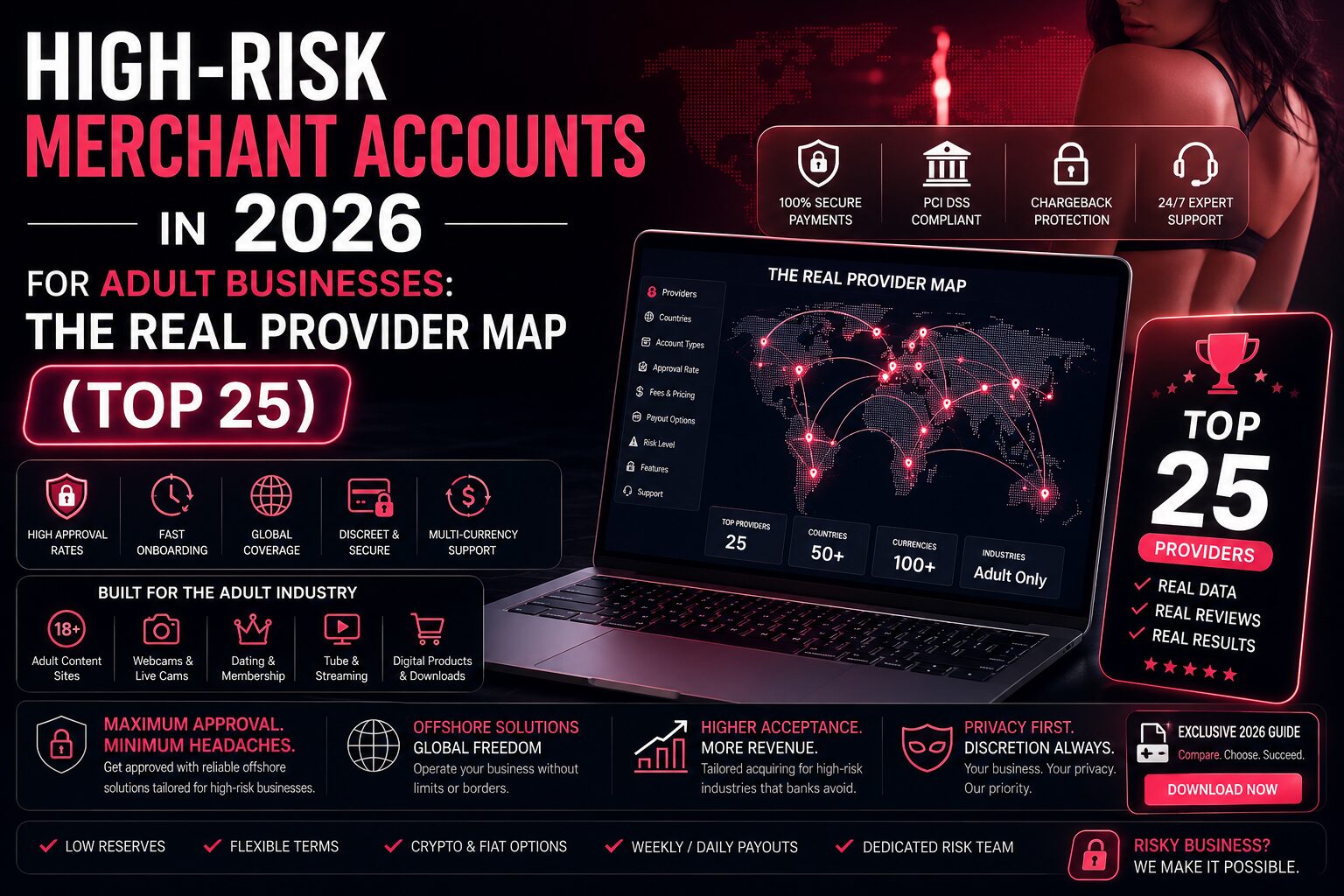
Every “best payment processor for adult websites” list on the internet reads the same way: CCBill, Epoch, Segpay, Verotel — repeated in a slightly reordered sequence across a hundred different domains, usually followed by a comparison table with suspiciously round star ratings. The four names aren’t wrong. They’re just incomplete, and treating them as the answer skips the actual decision that determines whether an adult business gets approved, stays approved, and keeps its revenue flowing without a sudden freeze six months in.
The adult industry isn’t one payment problem. A cam platform paying out thousands of individual models daily has almost nothing in common, payment-wise, with a subscription-based content site running recurring monthly billing, which has almost nothing in common with a physical adult retailer shipping product, which has almost nothing in common with a dating-and-adult crossover app managing both categories under one brand. Each of those business models breaks differently, gets flagged for different reasons, and needs a provider built around a different failure mode.
This piece maps 25 real providers serving the adult vertical by the actual business model and failure mode each one is built to solve — not by a ranked list pretending one processor is objectively “best” for an industry this varied.
Why Adult Payment Processing Breaks the Normal Rules
Before the map, it’s worth naming why adult sits in its own category even within high-risk generally.
Visa and Mastercard apply specific, elevated scrutiny to adult content as a card brand rule, not just a bank risk preference — meaning even a perfectly compliant, low-chargeback adult business faces underwriting requirements (age verification documentation, content moderation policies, 2257 record-keeping compliance for US-facing platforms, discreet billing descriptors) that don’t apply to almost any other high-risk category covered elsewhere in this series. Mainstream processors like Stripe and PayPal don’t just charge more for adult — they refuse it outright, categorically, regardless of the individual business’s actual risk profile.
That’s the first thing that makes adult different: the exclusion is total, not risk-adjusted. A dating app with a spotless chargeback history still can’t use Stripe if it involves adult content, in a way that a CBD seller with a spotless history sometimes can eventually get approved by a mainstream-adjacent processor.
The second thing is the dispute pattern itself. Adult subscription billing generates a specific, well-documented type of chargeback — the “I didn’t recognize this charge” dispute — driven far less by fraud than by discretion anxiety: a customer’s partner, family member, or employer seeing an unfamiliar or embarrassing line item on a shared statement and disputing it reflexively. This means the single most important technical feature an adult payment provider offers isn’t fraud scoring — it’s the billing descriptor system, and providers vary enormously in how sophisticated theirs actually is.
The third: payout structure matters as much as intake. Adult businesses built around content creators or cam models need to move money out to potentially thousands of individual payees, often internationally, often to people without traditional banking access — a genuinely different technical problem than accepting card payments from customers, and one that separates true adult-industry specialists from generalist high-risk processors that only solved half the problem.
The Five Models in Adult Payment Processing
- The Adult-Native Facilitator. Built from the ground up around adult content specifically — subscription billing, cam/tipping models, age verification workflows, and discreet billing descriptors as a core product feature rather than an add-on. These are the names that show up on every list, and for genuinely good reason: they’re the deepest, most battle-tested option if your business is squarely mainstream adult content.
- The Adult-Inclusive Offshore Generalist. High-risk specialists that explicitly accept adult as one of several verticals (alongside gambling, forex, CBD) rather than being built around it exclusively. Broader banking relationships and more flexibility for adult-adjacent business models the pure adult-native facilitators sometimes decline — adult retail, adult-dating crossover, adult SaaS tools.
- The Creator Payout Specialist. Solves the “pay thousands of individual content creators internationally” problem specifically, often as an e-wallet layered on top of or alongside a card processor rather than replacing it.
- The Crypto/Hybrid Settlement Gateway. For adult businesses wanting to accept crypto directly, or wanting a card-to-crypto settlement layer that removes the acquiring-bank freeze risk entirely by settling into a wallet the merchant controls.
- The Broad High-Risk Processor That Happens to Accept Adult. Generalist high-risk providers where adult is one line among CBD, travel, and subscription businesses — often a reasonable fit for adult e-commerce and retail specifically, less reliable for cam or subscription-heavy content platforms where deep vertical tooling matters more.
Here’s how 25 real providers sort into that structure.
Model 1: Adult-Native Facilitators
These are the names that dominate every adult processing conversation, and each has a genuinely distinct specialty within the category rather than being interchangeable.
CCBill is the most frequently cited name in this entire space for a reason: extensive developer documentation, mature APIs and webhooks, dynamic pricing tools, and a long institutional track record specifically underwriting membership sites, VOD platforms, and subscription adult content. It’s also known to conduct genuine audits of merchant sites and billing practices — a double-edged trait, since it means strong compliance expectations but also a more demanding relationship than some alternatives.
Epoch operates on a facilitator model built for rapid launch, with a notably useful feature most competitors lack: direct PayPal integration alongside standard card processing, ACH, and crypto support — genuinely useful for adult creator businesses trying to diversify payment options without running three separate systems.
Segpay has built a specific reputation for fast setup, particularly favored for dating-adjacent and lower-risk adult sites, with strong chargeback management and fraud prevention tooling that scales well for subscription-heavy models specifically.
Verotel, based in the Netherlands, brings genuinely global currency support and a payment infrastructure built around international adult content businesses from the outset — a strong choice specifically if your customer base skews heavily non-U.S. Its rates run steeper than some alternatives for certain verticals, a trade-off worth weighing against the currency flexibility it offers.
NetBilling rounds out this tier with solid recurring billing infrastructure and a longer operating history in the adult space, often mentioned alongside CCBill and Segpay as one of the “battle-tested” options specifically for subscription and membership models.
CommerceGate positions itself around minimizing chargebacks specifically through regulatory-aware underwriting — a useful option for adult businesses that have had chargeback ratio problems with a prior processor and need a provider that treats dispute prevention as the core product rather than an afterthought.
Vendo Services specializes specifically in subscription and membership billing infrastructure for adult platforms, with tooling built around the recurring-revenue mechanics (trial conversion, rebill logic, dunning management) that content subscription businesses depend on more heavily than one-time-purchase adult retail does.
Zen Payments and MyntPay both operate as newer entrants specifically targeting adult content creators and smaller adult businesses that might not meet the volume thresholds larger adult-native facilitators sometimes implicitly favor — a reasonable starting point for individual creators or early-stage adult platforms rather than established, high-volume operations.
Model 2: Adult-Inclusive Offshore Generalists
These providers don’t live and breathe adult exclusively, but they explicitly underwrite it alongside other high-risk categories, and they tend to offer broader banking flexibility — genuinely useful when your business sits at the edge of what a pure adult-native facilitator will approve.
Durango Merchant Services explicitly lists adult entertainment among its “hardest to place” specialties, backed by decades of offshore banking relationships — a strong option specifically if you’ve already been declined by an adult-native facilitator for MATCH-list history or a prior termination.
Instabill brings genuinely international acquiring bank relationships across Europe, Asia, and Latin America to adult merchants needing offshore processing specifically, rather than a domestic workaround.
eMerchantBroker (EMB) covers adult alongside CBD and forex with a broad acquiring network, useful for adult businesses that also touch adjacent categories (adult wellness products, adult-dating hybrid platforms) that a pure adult-native facilitator might decline as out-of-scope.
SMB Global focuses exclusively on high-risk and international processing broadly, with gateway integrations across more than 175 shopping carts — a solid fit for adult retail and e-commerce specifically, where broad platform compatibility matters more than deep subscription-billing tooling.
QuadraPay offers offshore account placement across jurisdictions like Cyprus and Mauritius with explicit crypto settlement alongside card processing — a specific, well-documented case study involves an adult e-commerce merchant securing a 3D Secure-enabled gateway with a fair rolling reserve structure after being declined elsewhere, illustrating the kind of workaround-focused placement this model specializes in.
WebPays and PayCly both explicitly list adult content and dating platforms among their supported verticals, with the broader multi-industry high-risk infrastructure (forex, CBD, gaming) that makes them useful if your adult business shares operational DNA with one of those adjacent categories — a dating app with adult-content elements, for instance.
GSPay specifically calls out dating and adult-adjacent crossover as a named specialty, with chargeback protection tooling built around the “unrecognized charge” dispute pattern that dominates both categories.
RoxPay stands out in this group as a genuinely European-licensed alternative rather than a purely offshore acquirer — PCI DSS Level 1 and ISO 27001 certified, OAM-registered in Italy — offering adult merchants the regulatory standing of a licensed EU payment institution, a meaningfully different risk and compliance profile than a Curaçao-based offshore acquirer.
Corepay has built a specific reputation working with continuity billing and adult content categories that many generalist processors avoid entirely, known for fast-moving underwriting and clear upfront communication about documentation requirements.
Model 3: Creator Payout Specialists
Paxum solves a distinctly different problem than every provider above: not accepting customer payments, but paying out to potentially thousands of individual adult content creators and cam models internationally — a genuinely specialized e-wallet infrastructure that most adult platforms need running alongside, not instead of, a customer-facing processor. If your business model involves paying creators rather than just billing customers, Paxum (or a comparable payout-specific tool) solves a problem none of the intake-focused processors above are built for.
Model 4: Crypto and Hybrid Settlement Gateways
eLotPay offers a genuinely distinctive hybrid model for adult merchants specifically: accepting both traditional cards and crypto, with automatic conversion to stablecoins or local currency — appealing for adult businesses wanting crypto optionality for privacy-conscious customers without running two entirely disconnected payment stacks.
NOWPayments is the most frequently cited pure-crypto option across adult industry guides specifically, offering a straightforward API and broad cryptocurrency acceptance for adult platforms whose customer base is comfortable paying in crypto directly — a meaningfully different customer experience than a card-to-crypto conversion layer, since the customer is paying in crypto from the start rather than swiping a card.
Model 5: Broad High-Risk Processors That Accept Adult
PaymentCloud explicitly lists adult entertainment among its supported categories alongside CBD, travel, and continuity subscriptions, with in-house underwriting producing faster approval windows (24 hours to five business days) than providers relying on third-party underwriting — a solid fit specifically for adult e-commerce and retail rather than subscription content platforms needing deep recurring-billing tooling.
2Accept is worth calling out specifically for a structural feature that matters enormously in adult processing: every merchant gets a dedicated Merchant ID rather than being pooled under a shared master account — directly relevant to adult businesses, since pooled-MID structures are a common cause of the sudden account freezes that plague adult merchants on generalist platforms specifically because chargeback spikes from other pooled merchants can freeze funds regardless of your own account’s standing.
Allied Wallet rounds out this category with broad multi-currency support and global payment processing reach, a reasonable large-scale option for adult businesses with genuinely international customer bases, though — as with any enterprise-scale generalist — worth confirming the specific depth of adult-vertical underwriting experience directly rather than assuming it from the marketing page.
The Fit Framework: Question, Not Rank
| Your adult business model | Model to start with |
| Subscription/membership content site (mainstream adult) | Adult-Native Facilitator (CCBill, Epoch, Segpay, Verotel, NetBilling) |
| Already declined elsewhere / MATCH-listed | Adult-Inclusive Offshore Generalist (Durango, Instabill, EMB, SMB Global) |
| Adult-dating crossover platform | Adult-Inclusive Generalist with dating specialty (GSPay, WebPays, PayCly) |
| Want EU-licensed regulatory standing, not purely offshore | RoxPay |
| Cam platform or creator model paying out to many individuals | Creator Payout Specialist (Paxum) alongside a customer-facing processor |
| Want crypto acceptance or card-to-crypto settlement | Crypto/Hybrid Gateway (eLotPay, NOWPayments) |
| Adult e-commerce/retail (physical products) | Broad High-Risk Processor (PaymentCloud, Allied Wallet) |
| Worried specifically about pooled-MID freeze risk | 2Accept (dedicated MID model) |
| Newer creator/small adult business, lower volume | Zen Payments, MyntPay |
Red Flags Specific to Adult Payment Processing
A few patterns are worth flagging that don’t show up in generic high-risk guides but matter enormously here.
Billing descriptor sophistication is not optional — it’s the single biggest lever you have. Ask any prospective provider exactly how their billing descriptor system works: can it be customized per-product-line, does it avoid obviously adult-related wording, and does the provider offer any tooling (like a customer-facing lookup portal) to help confused cardholders identify a charge before disputing it. A provider that treats this as a minor configuration detail rather than a core feature is underestimating the single largest driver of adult-industry chargebacks.
Age verification and content compliance documentation will be scrutinized, and providers vary in how proactively they help. Some adult-native facilitators (CCBill in particular) are known to actively audit merchant sites for compliance with age verification and record-keeping requirements — genuinely useful if you want a provider that helps you stay compliant rather than one that simply processes and hopes for the best.
Pooled Merchant IDs are a bigger risk in adult than almost any other vertical, because adult businesses collectively generate more disputes than most categories, meaning a shared-MID structure exposes you to other merchants’ chargeback spikes more consequentially here than it would in a lower-dispute-rate industry. Confirm dedicated MID status explicitly.
“No KYC” or “instant crypto settlement, funds can never be frozen” claims deserve real skepticism in adult specifically, precisely because adult content sits under some of the most active card-network and regulatory scrutiny of any vertical in this guide series — a provider marketing the explicit absence of standard compliance controls as a selling point is either operating in a way that will eventually attract exactly the kind of enforcement attention adult businesses can least afford, or overstating what it can deliver once volume scales.
Payout infrastructure deserves its own due diligence, separate from your customer-facing processor. If your business model involves paying creators or models, don’t assume your card processor also solves international payouts well — verify this as a genuinely separate capability, since it’s a different technical and compliance problem (KYC on payees, international remittance compliance, currency conversion) than accepting customer payments.
What Actually Determines a Good Fit in Adult Processing
Across all five models above, four questions matter more than any ranked list:
Does the provider’s billing descriptor and dispute-prevention tooling match your specific business model — subscription content generates different disputes than one-time retail purchases, and the right descriptor and trial-conversion handling differs accordingly.
Is this a dedicated MID or a pooled account structure? In adult specifically, this is arguably the single most consequential technical detail in the entire relationship.
Does the provider handle payouts to creators/models, or only customer intake? If you need both, confirm whether one provider genuinely does both well or whether you need a payout specialist like Paxum running alongside your processor.
What’s the provider’s actual track record with content and compliance audits — does it help you stay compliant, or does it simply process transactions and leave compliance entirely on you? Given how actively regulated adult content processing is compared to almost any other high-risk vertical, a provider that treats compliance support as part of the relationship is worth more than one offering marginally faster onboarding with no compliance guidance at all.
Conclusion
The adult payment processing landscape isn’t a single ranked list topped by whichever name shows up most often in search results — it’s five genuinely distinct problems: mainstream subscription content billing, offshore placement for merchants already declined elsewhere, creator payout infrastructure, crypto and hybrid settlement, and broad e-commerce coverage for adult retail specifically. CCBill, Epoch, Segpay, and Verotel earn their reputation as adult-native facilitators because they’ve built genuinely deep subscription and billing-descriptor tooling around mainstream adult content specifically. Durango, Instabill, EMB, and SMB Global exist for merchants who need offshore banking flexibility beyond what the adult-native facilitators offer. Paxum solves the creator payout problem none of the customer-facing processors are built for. eLotPay and NOWPayments solve crypto acceptance. And PaymentCloud, 2Accept, and Allied Wallet round out the field for adult businesses whose model looks more like standard e-commerce than subscription content. The right starting point isn’t the name at the top of someone else’s list — it’s identifying honestly which of these five problems your specific adult business actually has.
Comments
No comments yet. Be the first to share your thoughts.
Leave a comment