
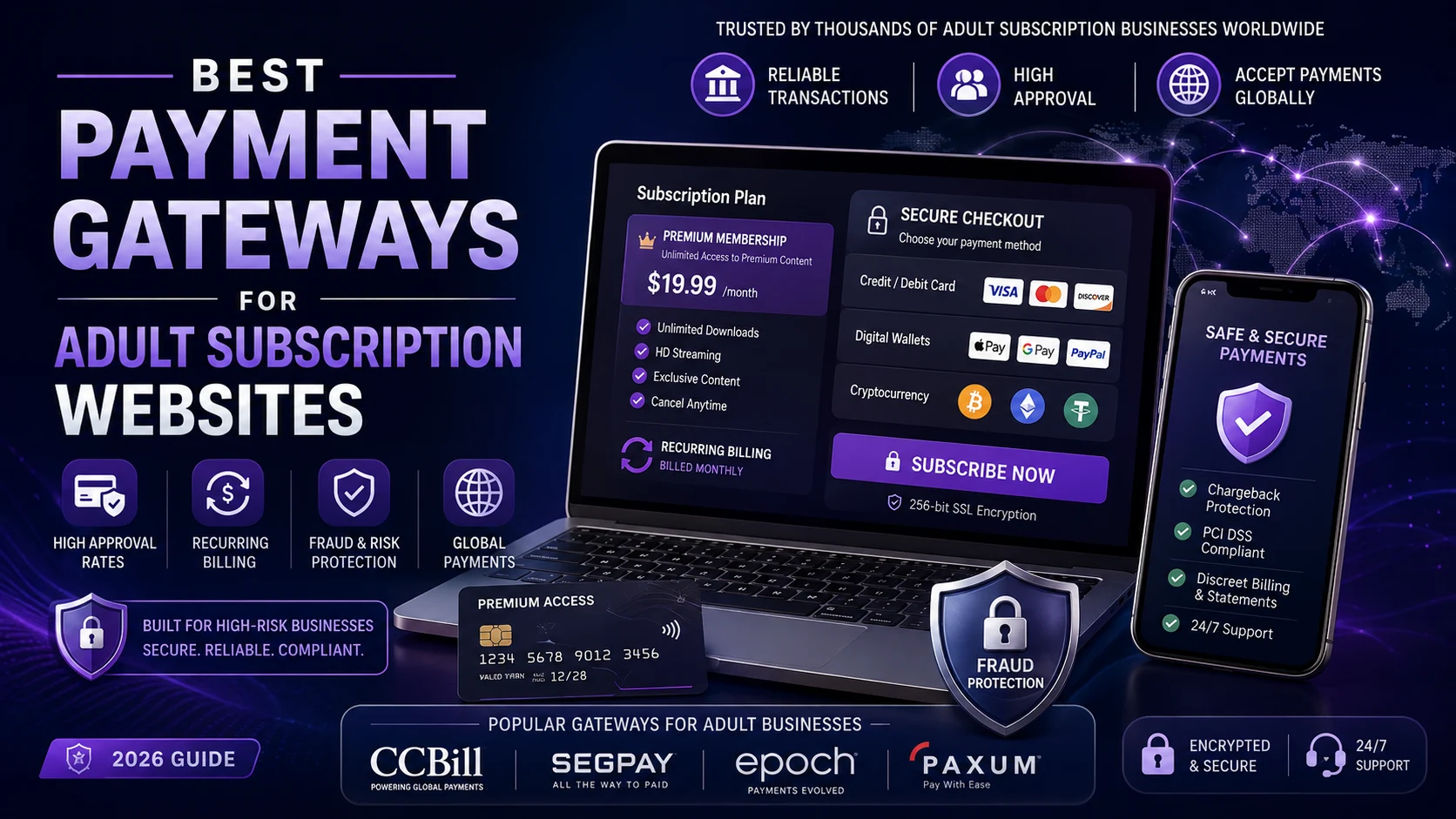
Recurring billing is where most adult payment gateway comparisons stop being generic and start actually mattering. A subscription site doesn’t just need a processor willing to accept adult content, it needs one built specifically around renewal logic, involuntary churn recovery, and the dunning and re-billing mechanics that determine whether a subscriber who fails a renewal charge comes back or is lost for good. This guide focuses specifically on that subscription-model lens, comparing the gateways genuinely built for recurring adult billing rather than one-off transactions.
CCBill and Epoch are the two most established options specifically for subscription and membership-model adult sites, each with genuine strengths in recurring billing infrastructure. SegPay fits well for lower-risk, faster-setup subscription models like dating platforms. Verotel is the strongest choice for subscription sites with significant international subscriber bases needing multi-currency support. Expect fee ranges of roughly 5-10% plus rolling reserves (0-20%, held 90-180 days) across this category, meaningfully higher than mainstream processing, reflecting the elevated dispute risk recurring adult billing carries. The subscription-specific features that actually matter, dunning management, involuntary churn recovery, and tokenized card-on-file billing, matter more to gateway selection here than headline rate alone.
Why Subscription Billing Needs a Different Evaluation Lens
A one-time-purchase adult site and a subscription/membership site face genuinely different payment infrastructure needs, even though both fall under the same “adult high-risk” umbrella:
- Involuntary churn: subscribers whose renewal charge fails due to an expired card, insufficient funds, or a declined transaction, is a distinct, recurring revenue problem one-time purchases don’t create, and gateways vary significantly in how well they handle recovery
- Renewal notification compliance: is a growing regulatory and card network expectation specifically for recurring billing models, distinct from one-time transaction disclosure requirements
- Chargeback patterns differ: Subscription billing sees a specific dispute pattern, “I forgot I was subscribed”, that one-time purchases don’t generate, requiring different prevention tooling than fraud-focused screening alone
- Card-on-file tokenization quality: directly affects renewal success rates, since expired or updated card details need to be handled gracefully to avoid unnecessary involuntary churn
This is why a subscription-focused adult site should evaluate gateways specifically on recurring billing infrastructure quality, not just general adult-industry acceptance.
The Gateways Built for Subscription and Membership Models
CCBill
CCBill is widely regarded as the adult industry’s most established subscription and membership billing provider, with extensive merchant and developer documentation covering payment forms, APIs, webhooks, reporting, testing environments, dynamic pricing, and third-party integrations. This depth of tooling specifically benefits subscription sites needing granular control over renewal logic, trial periods, and pricing tiers.
Best fit: High-volume subscription and membership sites wanting the most mature, deeply documented recurring billing infrastructure in the category, with the operational track record to match.
Epoch
Epoch positions itself around an all-inclusive integration model with international customization support, and is specifically noted for its facilitator model enabling fast launches, a genuine advantage for newer subscription and VOD platforms wanting to get a recurring billing model live quickly without extensive custom integration work.
Best fit: Subscription and VOD platforms prioritizing fast time-to-launch alongside genuine recurring billing capability, particularly niche or emerging content platforms.
SegPay
SegPay offers merchant services and payment processing with specific coverage for adult and dating verticals, generally recognized for faster setup relative to CCBill or Epoch, making it a common fit for lower-risk subscription models like dating platforms specifically.
Best fit: Dating and lower-risk subscription platforms prioritizing faster underwriting and setup over the deepest possible recurring billing feature set.
Verotel
Verotel specializes specifically in automatic recurring payment infrastructure, with particular strength in multi-currency support for subscription sites with a genuinely international subscriber base, a meaningful differentiator for platforms where subscription revenue comes from multiple regions rather than a single primary market.
Best fit: Subscription platforms with significant international subscriber volume needing native multi-currency recurring billing rather than single-currency processing with conversion applied after the fact.
NetBilling
NetBilling rounds out the group of long-established adult-industry processors, generally positioned alongside CCBill and Epoch as a trusted, integration-ready option for subscription and membership platforms.
Best fit: Subscription operators wanting an established alternative to the CCBill/Epoch pairing, worth evaluating directly against them for the specific fee structure and integration fit for a given platform.
Comparison at a Glance
| Provider | Subscription Strength | Setup Speed | Best For |
|---|---|---|---|
| CCBill | Deepest recurring billing tooling, mature API/webhook ecosystem | Moderate | High-volume membership/subscription sites |
| Epoch | Facilitator model, fast international launches | Fast | New subscription/VOD platforms prioritizing speed |
| SegPay | Solid recurring billing, adult/dating vertical focus | Fast | Dating and lower-risk subscription models |
| Verotel | Multi-currency native recurring billing | Moderate | Internationally distributed subscriber bases |
| NetBilling | Established, integration-ready | Moderate | Alternative to CCBill/Epoch worth direct comparison |
The Subscription-Specific Features That Actually Matter
Dunning Management and Involuntary Churn Recovery
When a renewal charge fails, what happens next determines whether that subscriber is recovered or lost. Strong dunning management includes automatic retry logic on a sensible schedule, card-updater services that automatically refresh expired card details without requiring the subscriber to re-enter information, and clear, non-alarming renewal-failure communication. Gateways vary meaningfully in how robust this tooling actually is, evaluating it directly, rather than assuming it’s uniform across providers, is one of the highest-leverage decisions a subscription operator makes.
Card-on-File Tokenization
Tokenized card storage, rather than raw card number retention, is both a PCI compliance requirement and a direct driver of renewal success, providers with mature tokenization infrastructure handle card updates (a bank reissuing a card, for instance) more gracefully, reducing unnecessary involuntary churn from what’s really just an administrative card-detail change rather than genuine non-payment.
Trial Period and Tiered Pricing Support
Subscription models frequently use free or discounted trial periods to drive conversion, and how a gateway handles the trial-to-paid transition, timing, notification, and billing logic, directly affects both conversion and dispute rates. A gateway with rigid, one-size-fits-all recurring billing logic constrains pricing strategy in ways operators sometimes only discover after launch.
Renewal Notification and Compliance
Growing regulatory and card network expectations around clear renewal notification, informing subscribers before a recurring charge, not just relying on original signup disclosure, are increasingly a compliance factor gateways need to support natively, not something operators should have to build entirely themselves on top of a generic billing system.
Fee Structures and Reserves: What Subscription Operators Should Expect
Adult subscription processing generally runs meaningfully higher than mainstream processing rates, reflecting the elevated dispute risk in the category:
- Processing rates commonly range from roughly 5% to 10%: varying by provider, business model, and processing history
- Rolling reserves are standard: typically ranging from 0% to 20% of volume, held for 90 to 180 days depending on the provider and the merchant’s track record
- Chargeback ratio targets are stricter than card network minimums suggest: While card networks trigger formal monitoring around 0.9-1%, subscription operators should aim meaningfully lower, under roughly 0.75%, given how directly chargeback performance affects reserve terms and account stability over time in this specific billing model
These figures should be treated as a starting baseline for negotiation and comparison, not a fixed universal rate, actual terms vary by provider, processing history, and risk profile.
Decision Framework: Choosing a Gateway for Your Subscription Model
If you’re a high-volume membership or content subscription site:
- CCBill’s depth of recurring billing tooling and mature integration ecosystem is generally the strongest starting point, particularly for platforms with complex tiered pricing or trial structures
If you’re launching a new subscription or VOD platform and want speed:
- Epoch’s facilitator model is worth prioritizing for faster time-to-launch, without sacrificing genuine recurring billing capability
If you’re running a dating or comparatively lower-risk subscription model:
- SegPay’s faster setup and adult/dating vertical focus make it a strong first evaluation, particularly if your dispute profile is genuinely lower-risk than typical adult content subscription billing
If your subscriber base is meaningfully international:
- Verotel’s native multi-currency recurring billing avoids the conversion friction and cost a single-currency gateway would introduce for non-domestic subscribers
Regardless of which provider you choose:
- Evaluate dunning management, card-on-file tokenization, and trial/tiered pricing support explicitly, not just headline processing rate, these subscription-specific features affect actual revenue retention more directly than a percentage-point difference in processing fees
- Build in a backup processor from the start rather than after an account disruption, the payment resilience approach covered in our companion guide on adult payment processing challenges applies with particular force to subscription businesses, where a processor disruption doesn’t just stop new sales, it interrupts active recurring revenue
Common Mistakes Subscription Operators Make Choosing a Gateway
- Evaluating gateways as if for a one-time-purchase business: Recurring billing infrastructure quality, dunning, tokenization, trial handling, matters more for subscription models than for simple transaction processing, and a generic adult-gateway comparison misses this distinction
- Focusing on headline rate over reserve terms and chargeback thresholds: A lower percentage rate paired with weak dunning management can cost more in lost involuntary-churn revenue than a slightly higher rate with strong recovery tooling
- Underestimating renewal notification compliance requirements: Treating this as a marketing/UX decision rather than a compliance one risks both regulatory exposure and elevated “I forgot I was subscribed” disputes
- Running a single processor for a subscription business specifically: Given how directly a processor disruption interrupts active recurring revenue (not just new sales), subscription operators have even more reason than one-time-purchase sites to build genuine processor redundancy from the start
Conclusion
For adult subscription and membership sites specifically, the right payment gateway isn’t just the one most willing to accept adult content, it’s the one with genuinely strong recurring billing infrastructure: robust dunning management, reliable card-on-file tokenization, and flexible trial and tiered-pricing support. CCBill and Epoch lead on subscription-specific depth and speed respectively, SegPay fits well for lower-risk dating and subscription models, and Verotel stands out for internationally distributed subscriber bases.
What matters most is evaluating providers on the mechanics that actually determine subscription revenue retention, not just adult-industry acceptance or headline processing rate, since involuntary churn recovery and renewal handling quality compound in ways that affect the business far more over time than a percentage-point fee difference.
Frequently Asked Questions
Q: What’s the difference between choosing a gateway for one-time adult purchases versus subscriptions?
A: Subscription models need strong recurring billing infrastructure specifically, dunning management for failed renewals, card-on-file tokenization, and trial/tiered-pricing support, that a one-time-purchase-focused evaluation wouldn’t prioritize the same way.
Q: What is involuntary churn, and why does it matter for gateway selection?
A: Involuntary churn is subscriber loss from failed renewal charges (expired cards, declines) rather than a deliberate cancellation. Gateways vary significantly in how well they recover this revenue through automatic retry logic and card-updater services, making this a genuine differentiator between providers.
Q: What chargeback ratio should adult subscription operators target?
A: While card networks trigger formal monitoring around 0.9-1%, subscription operators should aim meaningfully lower, under roughly 0.75%, since chargeback performance directly affects reserve terms and account stability in recurring billing models specifically.
Q: Is Verotel a better choice than CCBill for a subscription site?
A: It depends on your subscriber base. Verotel’s particular strength is native multi-currency recurring billing for internationally distributed subscribers, while CCBill offers the deepest overall recurring billing tooling and integration ecosystem, the right choice depends on whether international currency support or overall feature depth matters more for your specific platform.
Q: What reserve terms should adult subscription operators expect?
A: Typically 0-20% of processing volume held for 90–180 days, varying by provider and processing history, these terms should be confirmed explicitly in writing before signing, since they represent real tied-up working capital.
Q: Should a subscription-based adult site use a backup payment processor?
A: Yes, and arguably with more urgency than a one-time-purchase business, a processor disruption for a subscription site interrupts active recurring revenue, not just new sales, making processor redundancy a particularly high-value investment for this business model.
Comments
No comments yet. Be the first to share your thoughts.
Leave a comment