
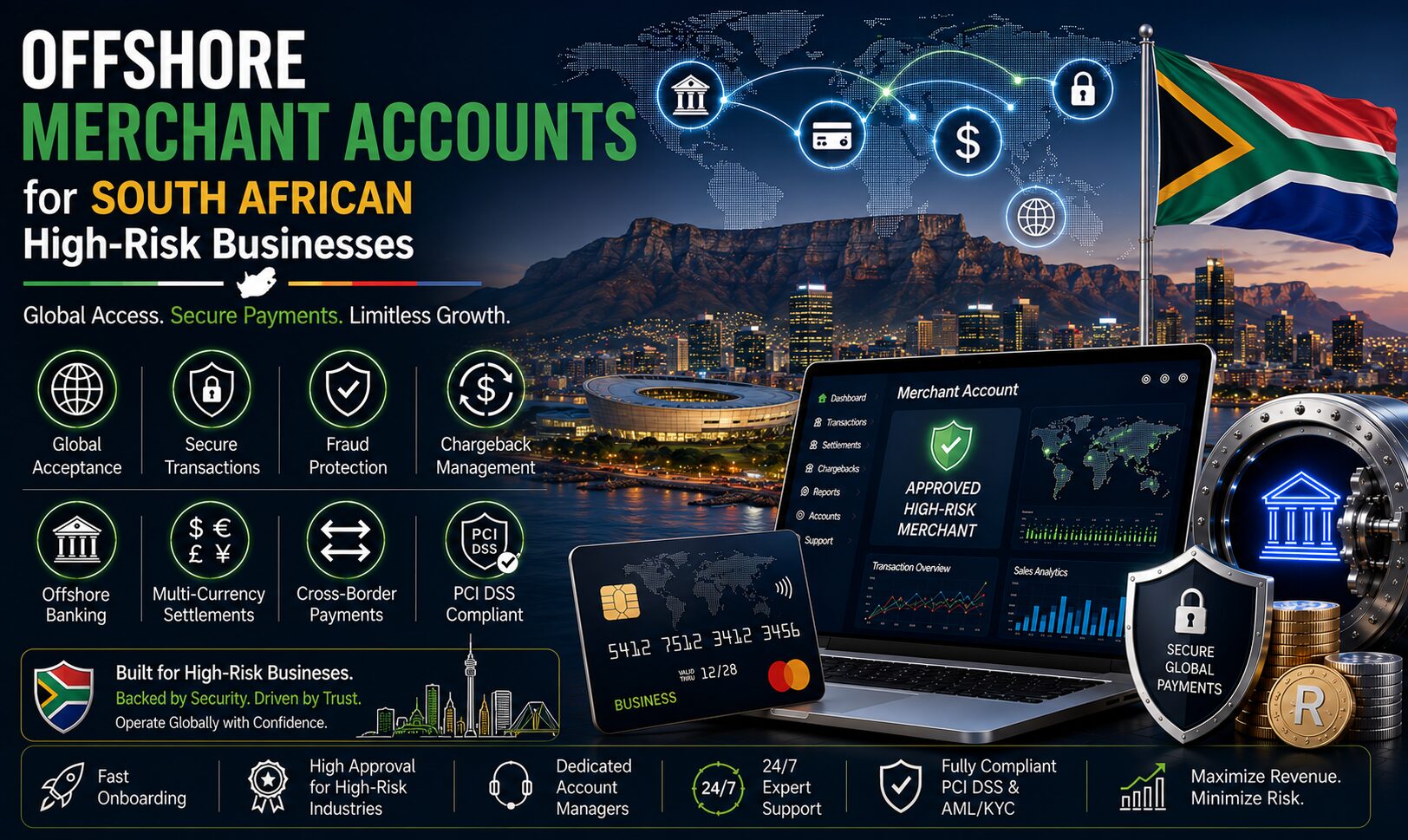
South Africa is in the middle of one of the most consequential regulatory pivots covered anywhere in this series, playing out in real time across 2026. Crypto assets have just been reclassified from outside South Africa’s exchange control framework to squarely inside it, following a high court ruling that reversed an earlier loophole within weeks. Meanwhile, the South African Reserve Bank has begun directly targeting the offshore payment facilitators and cross-border merchant structures that this entire guide series has been describing — and South Africa’s gambling market, despite processing an extraordinary R1.5 trillion in wagers annually, still has no legal category for online casino gaming at all. For high-risk merchants and payment providers, understanding where South Africa’s regulatory lines currently sit — and how fast they’re moving — matters enormously.
This guide covers South Africa’s rapidly evolving crypto and exchange control framework, the SARB’s new direct scrutiny of offshore payment facilitators, South Africa’s unusual provincial gambling licensing system, and what all of this means for payment processing strategy.
Crypto and Exchange Control: A Regulatory Position That Just Reversed Itself Twice
South Africa’s approach to crypto assets has moved through a genuinely dramatic sequence of legal reversals over the past year, and understanding the current position requires understanding how quickly it’s shifted.
A May 2025 court ruling briefly opened a loophole in South Africa’s exchange control regime. The Pretoria High Court ruled that cryptocurrencies do not constitute “capital” under South Africa’s Exchange Control Regulations, in a case involving a company that had shipped 4,405 Bitcoin — worth roughly R556 million — to a Seychelles-based exchange. This created a genuine, if temporary, gap: if crypto wasn’t “capital,” it fell outside the strict cross-border capital movement rules that have long defined South African financial regulation.
The South African Reserve Bank (SARB) appealed within two weeks, and the loophole closed almost as fast as it opened. The broader tension the ruling exposed — whether South Africa’s exchange control regime, built for a pre-crypto financial system, could meaningfully govern crypto asset movement at all — remained unresolved.
That tension was decisively answered on June 1, 2026. The Gauteng High Court, in Mangundhla and Another v South African Reserve Bank and Others, found that Bitcoin is both “money” and “capital” for purposes of South Africa’s exchange control framework — a direct reversal of the 2025 Pretoria ruling’s underlying logic, and a judgment that brings crypto squarely back within SARB’s traditional cross-border capital control authority.
Just days before that ruling, regulators had already moved to formally close the gap through direct policy action. On May 28, 2026, SARB, the Financial Sector Conduct Authority (FSCA), the Prudential Authority, and the Financial Intelligence Centre jointly issued Joint Communication 1 of 2026, clarifying that crypto assets used for domestic payment purposes — including stablecoins — are not currently considered “payments” under South Africa’s National Payment System Act, fall outside that Act’s current application, and are neither money nor legal tender under it. Critically, the Joint Communication noted that this treatment may change: proposed reforms to the NPS Act could give SARB a legislative basis for directly regulating crypto payment instruments going forward, meaning today’s “outside the NPSA” position is explicitly understood as provisional.
Draft Capital Flow Management Regulations, published April 17, 2026, extend this reclassification into formal capital control law. National Treasury’s draft regulations mark a significant tightening on the use and movement of crypto assets, imposing stringent restrictions on the purchase, sale, lending, declaration, and export of crypto — with sanctions including potential forfeiture to the state for non-compliance. Under the draft, licensed South African crypto exchanges (VALR, Luno, and other FSCA-authorized CASPs) become the mandatory channel for transactions above a specified threshold, and offshore exchanges facilitating South African-originated crypto movement into foreign wallets face real, if practically complex, enforcement exposure.
This directly targeted a specific arbitrage practice that had grown around South Africa’s exchange controls. South Africa’s R1 million annual Single Discretionary Allowance had enabled a legal-but-controversial strategy: buying stablecoins cheaply offshore, transferring them to a South African platform, and selling at the local premium. A platform called Kastelo built a structured, intermediated version of this arbitrage — and SARB issued a blocking order against it on November 24, 2025, citing exchange control contraventions tied to how the platform’s underlying loan structures facilitated the trades. Kastelo has disputed SARB’s characterization and sought judicial review; the matter is expected to be heard on the ordinary court roll later in 2026.
Industry reaction has been sharply critical of the direction regulators are taking. VALR — one of South Africa’s largest licensed exchanges — has publicly described the incoming capital flow provisions as “overly restrictive,” arguing they undermine the practical exercise of self-custody rights and rely on principles that don’t account for how decentralized crypto assets actually function. Regulators, for their part, point to the scale of the issue: an estimated 5.8 million South Africans engage in crypto-related activity both locally and offshore, and the government’s clear message is that this activity is now squarely within regulatory and enforcement view.
A functioning CASP licensing framework already exists alongside this exchange control tightening. South Africa operates a “Twin Peaks” regulatory model — the Prudential Authority handles institutional soundness, the FSCA handles market conduct, and SARB oversees the national payment system. Crypto-asset service providers have been licensed under the Financial Advisory and Intermediary Services (FAIS) Act since June 2023, with roughly 300 licenses approved out of 512 applications submitted (14 formally declined) — a genuinely functioning, actively used licensing pathway, distinct from the separate and evolving exchange control questions covered above.
Broader payment system modernization is underway in parallel. SARB’s Payments Ecosystem Modernisation programme is set to open the national payment system to licensed non-banks in the second half of 2026, moving away from the historical requirement that non-banks need a bank sponsor to clear and settle payments, with a draft activity-based authorization framework that was out for public comment until June 15, 2026. Separately, South Africa’s Cabinet approved the Conduct of Financial Institutions (COFI) Bill for parliamentary consideration in April 2026, a broader piece of financial sector legislation that will likely touch crypto and payment conduct standards further as it progresses.
SARB’s New Direct Scrutiny of Offshore Payment Facilitators
This is arguably the single most directly relevant 2026 development for this entire guide series, and it’s happening right now.
SARB is actively developing regulations specifically targeting offshore merchant payment structures, citing a documented increase in cross-border payment facilitator activity — arrangements where payment transactions are aggregated and acquired in South Africa on behalf of offshore merchants selling goods or services, including digital products. The core regulatory concern is that payments for goods and services actually provided or delivered within South Africa are being processed and classified as cross-border transactions specifically because the issuing or acquiring entities involved aren’t registered or incorporated in the country.
Payment facilitators occupy a specific regulatory gap SARB is now moving to close. These facilitators aren’t themselves acquirers — they operate under sponsorship arrangements with authorized domestic acquirers, but are not directly regulated in South Africa themselves. SARB has explicitly stated that such cross-border payment facilitators may be used to circumvent or weaken compliance with cross-border regulatory requirements, including customer due diligence, know-your-customer procedures, anti-money-laundering and counter-terrorist-financing obligations, and balance-of-payments reporting requirements.
Misclassification carries real, documented costs for South African consumers, not just a regulatory technicality. SARB’s draft directive specifically notes that misclassifying and processing what are functionally domestic payments as cross-border transactions restricts effective regulatory oversight of retail payments and imposes undue costs on customers, who end up paying international transaction fees for what are, in substance, domestic purchases of goods and services.
This is coordinated, multi-agency scrutiny, not a single regulator acting alone. South Africa’s 2026 Budget Review confirmed that SARB, the South African Revenue Service, and the Financial Intelligence Centre would jointly enhance supervisory oversight specifically to prevent anti-money-laundering, counter-terrorist-financing, and tax infringements from occurring through exactly this kind of cross-border payment facilitator structure.
What This Means for Payment Processing Strategy
The practical implication for any payment provider or merchant using South Africa as a base — or targeting South African consumers through an offshore-structured payment flow — is that 2026 marks a genuine inflection point. Structures that relied on payment facilitator arrangements to route what are functionally domestic South African transactions through offshore acquiring entities are now facing direct, coordinated regulatory attention specifically designed to identify and correct exactly this pattern. Any high-risk merchant genuinely serving South African customers should treat correct transaction classification — domestic versus cross-border — as a live compliance priority in 2026, not a settled administrative detail.
For crypto specifically, the practical takeaway is that South Africa’s regulatory position has moved decisively toward treating crypto as capital subject to exchange controls, following the June 2026 Mangundhla ruling and the parallel Capital Flow Management Regulations — meaning offshore crypto arbitrage and unlicensed cross-border crypto movement carry meaningfully higher legal risk than they did even twelve months ago.
Gambling in South Africa: One of the World’s Largest Markets With No Online Casino Category
South Africa’s gambling market is genuinely enormous — the NGB reported R1.5 trillion (roughly $89 billion) wagered during the 2024/2025 financial year, a 31.3% increase over the prior year — yet the country’s legal framework still has no formal category for online casino gaming at all.
South Africa operates a two-tier regulatory structure that’s easy to misunderstand. The National Gambling Board (NGB) sets national norms and standards under the National Gambling Act and monitors compliance across provinces, but it does not itself issue operator licenses. That authority sits entirely with nine Provincial Licensing Authorities (PLAs), each holding exclusive jurisdiction to investigate applications and issue licenses within its own province — meaning checking for a legitimate PLA license, not an NGB license, is the actual test of whether an operator is properly regulated.
There is no active “Online Casino” license category, so iGaming operators use a workaround. Provincial authorities recognize distinct license categories — bookmaker, totalisator, bingo, limited payout machine (LPM) operator, land-based casino, and key employee licenses — but iGaming operators wanting to offer online casino-style products must do so through the Bookmaker license route, since no dedicated online casino category currently exists. In practice, most “online casinos” operating in South Africa today are actually licensed sportsbooks using their provincial betting licenses to offer casino-style “contingency” games alongside sports wagering.
A single provincial license functions as a de facto national license. Despite the fragmented nine-province structure, a license from any one province — Western Cape is a commonly cited example — acts as a practical “national passport,” allowing the licensed operator to accept wagers from players across the entire country, without needing separate licensing in every province.
The legal status of online casino gaming specifically is currently being contested in court. Following an October 2025 Supreme Court of Appeal ruling and a subsequent Gauteng High Court decision reaffirming that online casinos remain illegal under current national law, there’s now a genuinely uncertain legal environment specifically around casino-style games offered through the Bookmaker workaround. Provincial boards may decline to adjudicate player disputes related to casino-style games specifically, if they determine the game type wasn’t strictly authorized under the operator’s underlying Bookmaker license — meaning the dispute-resolution protection that normally comes with proper licensing is itself in question for this specific game category.
A long-pending National Gambling Amendment Bill would formally resolve much of this, but implementation remains years away. Published for public comment in November 2024, the Bill would establish a nationally uniform licensing framework ending the current provincial fragmentation for online gambling specifically, formally legalize interactive gambling under a regulated national system, mandate deposit limits, session limits, and self-exclusion tools, and create three distinct license categories: remote gambling operator, manufacturer/supplier/maintenance provider, and employment licenses. As of April 2026, the Bill remains in Parliament, and industry observers place realistic implementation at 2027 to 2028 at the earliest, given the complexity of resolving concurrent national-provincial jurisdiction and the substantial commercial interests already established under the current fragmented system.
A 20% gross gaming revenue tax is under active consideration as part of the broader regulatory modernization discussion, alongside a newly launched online verification portal specifically designed to help players and payment providers alike confirm whether a given operator holds genuine provincial licensing.
Domestic vs. Offshore for South African Merchants: What Changes
| Factor | Domestic South African Setup | Offshore Processing |
| Provincially-licensed gambling (sports betting/bookmaker route) | Well-aligned with the PLA framework; single provincial license covers the whole country | Should complement, not replace, genuine provincial licensing |
| Online casino gaming specifically | Legally contested even under the Bookmaker workaround | Offshore licensing doesn’t resolve the underlying South African legal ambiguity |
| Crypto/CASP services | FSCA licensing under FAIS is functional and actively used (~300 approved) | Now subject to tightening exchange control treatment following the June 2026 ruling |
| Cross-border merchant payment flows | Increasingly scrutinized for domestic-vs-cross-border misclassification | SARB is actively developing regulation specifically targeting this structure |
| Best fit | PLA-licensed sportsbook/bookmaker operators, FSCA-licensed crypto exchanges | Non-gambling, non-crypto categories with genuine, correctly classified cross-border need |
Providers Worth Evaluating for the South African Market
- PayCly
PayCly positions itself as a leading payment service provider specifically for South African high-risk international merchants, offering multi-currency acceptance across ACH, bank transfers, cards, e-wallets, and cryptocurrency — relevant for South African businesses genuinely expanding internationally, provided transaction classification (domestic versus cross-border) is handled correctly given SARB’s tightening 2026 scrutiny in exactly this area.
- eMerchantBroker (EMB)
EMB’s experience across forex and adjacent high-risk categories extends usefully to South African merchants navigating a market where exchange control compliance now touches crypto-adjacent business models directly, following the reclassification of crypto as “capital” under the June 2026 Mangundhla ruling.
- WebPays
WebPays’ broad international high-risk experience is relevant for South African merchants in categories outside the gambling and crypto-specific complexities covered above, though any South Africa-facing merchant should confirm explicitly how a provider classifies transactions given SARB’s active 2026 crackdown on cross-border payment facilitator misclassification.
Industry-Specific Considerations for South African Merchants
Sports betting and bookmaker-licensed operations: A single Provincial Licensing Authority license functions as an effective national license, but operators offering casino-style “contingency” games alongside sports betting should treat the current legal contestation around online casino gaming as a genuine, unresolved risk factor rather than settled practice.
Crypto exchanges and CASPs: FSCA licensing under FAIS remains a functional, actively used pathway, but exchange control compliance has tightened meaningfully following the June 2026 court ruling and the parallel Capital Flow Management Regulations — cross-border crypto movement now carries real capital control exposure that didn’t exist in the same form even a year ago.
General high-risk e-commerce and cross-border merchants: SARB’s active development of regulation targeting offshore payment facilitators makes correct domestic-versus-cross-border transaction classification a genuine 2026 compliance priority, not a technical afterthought.
Documentation South African High-Risk Merchants Should Prepare
- Business registration and corporate structure documentation
- Provincial gambling license, where applicable, from at least one of South Africa’s nine Provincial Licensing Authorities, using the Bookmaker route for any iGaming/sports betting offering
- FSCA CASP license under FAIS, where applicable, for any crypto-asset business
- Clear transaction classification documentation distinguishing genuine cross-border transactions from South African-delivered goods and services, given SARB’s active 2026 scrutiny of this exact distinction
- 3–6 months of recent bank statements
- Processing history, including chargeback ratios, from any prior merchant accounts
- Exchange control compliance documentation, particularly relevant for any business handling crypto-related cross-border fund movement following the June 2026 regulatory tightening
Choosing the Right Setup: A Practical Framework
South African high-risk merchants are best served asking two genuinely current questions. First, for gambling: does the underlying license actually cover the specific product being offered, given that the Bookmaker route’s extension into casino-style games is under active legal contestation? Second, for anything crypto-adjacent or genuinely cross-border: is the transaction correctly classified as domestic or cross-border, given SARB’s newly active enforcement focus on exactly this distinction, and does the business’s crypto-handling comply with South Africa’s now-tightened exchange control treatment of crypto as capital?
Conclusion
South Africa’s 2026 high-risk payments landscape is defined by rapid, ongoing regulatory recalibration: a June 2026 court ruling that reclassified Bitcoin as both money and capital under exchange control law, a parallel Capital Flow Management Regulations process tightening crypto’s cross-border treatment, direct SARB scrutiny of offshore payment facilitator structures that this entire guide series has described, and a gambling market processing R1.5 trillion annually while still lacking any formal legal category for online casino gaming. For gambling operators, crypto exchanges, and cross-border merchants alike, providers like PayCly, eMerchantBroker, and WebPays offer relevant experience — but the defining 2026 task for any South Africa-facing high-risk business is staying current with a regulatory environment that has genuinely shifted multiple times within the same year.
Frequently Asked Questions (FAQs)
Q1: Is cryptocurrency treated as capital under South Africa’s exchange control regulations?
A: Yes, as of June 2026. The Gauteng High Court’s ruling in Mangundhla v South African Reserve Bank found that Bitcoin is both “money” and “capital” for exchange control purposes, reversing an earlier May 2025 ruling that had found the opposite.
Q2: Is online casino gambling legal in South Africa?
A: Its legal status is currently contested. Following an October 2025 Supreme Court of Appeal ruling and a subsequent Gauteng High Court decision, online casinos remain illegal under current national law, even though many sportsbooks offer casino-style “contingency” games under their Bookmaker licenses.
Q3: Is South Africa’s Reserve Bank cracking down on offshore payment processors?
A: Yes. SARB is actively developing regulations targeting cross-border payment facilitators that process what are functionally domestic South African transactions as cross-border payments, citing money-laundering risk and unfair international transaction fees charged to consumers.
Q4: Do South African crypto exchanges need a license?
A: Yes. Crypto-asset service providers have been licensed under the FAIS Act since June 2023, with roughly 300 licenses approved out of 512 applications as of mid-2026.
Q5: When might South Africa introduce a formal national online gambling license?
A: A National Gambling Amendment Bill addressing this remains in Parliament as of April 2026, with industry observers projecting realistic implementation no earlier than 2027-2028, given the complexity of resolving national-provincial jurisdictional overlap.
Comments
No comments yet. Be the first to share your thoughts.
Leave a comment