
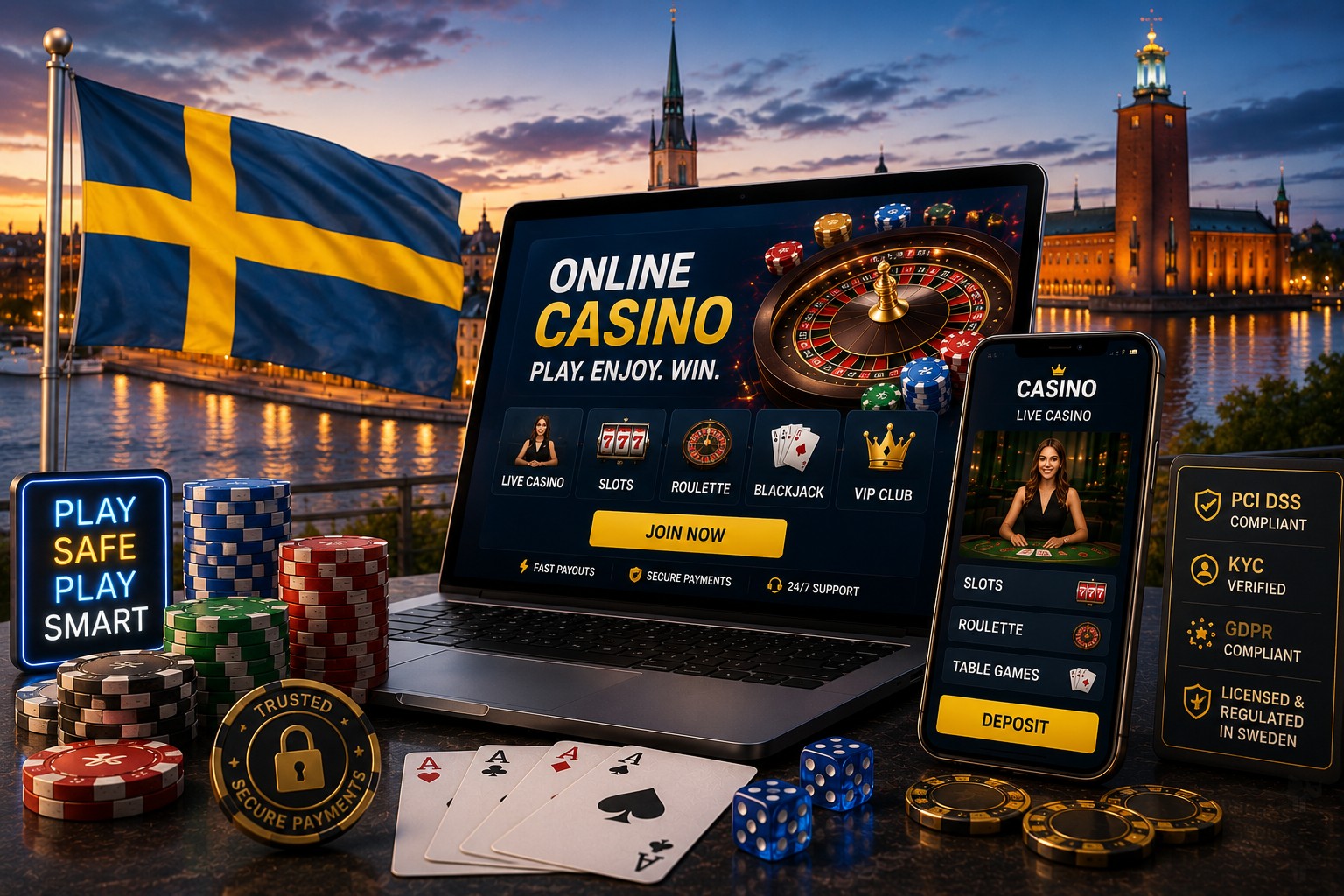
Sweden runs one of the most distinctive payment models in European gambling, and understanding it changes what “merchant account provider” even means in this market. Every Spelinspektionen-licensed casino is a BankID casino by definition — Swedish players authenticate with their national digital ID, and the deposit itself doubles as identity verification through what the industry calls “Pay N Play”: click deposit, authenticate with BankID, and a hidden, unique gaming account gets created automatically behind the scenes, all in under a minute. Trustly invented this model and has restricted it exclusively to Spelinspektionen-licensed operators since 2022, following a 130 million SEK fine from Sweden’s Financial Supervisory Authority and a subsequent AML policy tightening. This guide ranks the top 10 payment providers relevant to Swedish-licensed casino operators in 2026.
Why Swedish Casino Payment Processing Runs on a Different Model
BankID isn’t an optional convenience feature — it’s the regulatory backbone of the entire Swedish licensed market. Spelinspektionen requires BankID verification for all Swedish players at licensed operators, meaning any payment provider serving this market needs genuine, tested BankID integration, not a generic European identity-verification workaround.
Trustly restricted its Pay N Play product to licensed operators only, and there are no exceptions in 2026. Since 2022, Swedish Trustly is only available to operators holding an active Spelinspektionen license — the product connects directly to Swedish banks via BankID authentication, and Sweden’s major banks only let Trustly initiate payments against licensed counterparties. This is a hard technical and regulatory gate, not a business preference Trustly could reverse casually.
The Pay N Play model collapses registration and deposit into a single step, and this is what actually differentiates the Swedish market. When a player clicks deposit at a BankID casino, their verified identity data flows directly from their bank to the operator via encrypted API connections, creating a hidden gaming account tied to their personnummer under Spelinspektionen’s oversight — eliminating the need for separate username, password, or address entry entirely.
Speed and technical friction have become the primary competitive currency in this market, more than bonus offers. Swedish players consistently abandon platforms with unnecessary clicks, slow loading, or manual document handling — a top-ranked Swedish operator typically offers instant, automated payment rails for both Swish and Trustly, with withdrawals approved around the clock.
Operators, not players, absorb transaction costs for fast withdrawals. Trustly and Swish withdrawals are generally free for the player in the Swedish market — a deliberate operator cost decision made specifically to compete on speed and friction, meaning payment provider fee structure directly affects an operator’s ability to offer this table-stakes competitive feature.
Multiple casino brands frequently run under a single Spelinspektionen license, meaning a payment provider relationship often needs to scale cleanly across several branded properties simultaneously, not just one storefront.
The Top 10 Payment Providers for Swedish Casino Platforms
- Trustly
Trustly is the provider that defines this market — inventor of the Pay N Play model, restricted exclusively to Spelinspektionen-licensed operators since 2022, and holding the widest Nordic bank connectivity of any open banking payment provider in this space.
Strengths: Genuine market-originating infrastructure with the deepest BankID and Swedish bank integration of any provider; PSD-licensed payment institution status (registration number PSD, 2007/64/EC) offering real EU regulatory credibility; free instant withdrawals for players is a built-in competitive advantage operators can offer directly through this rail.
Weaknesses: Licensing gate is absolute — an operator without an active Spelinspektionen license cannot access Swedish Trustly under any circumstances; its international Trustly product (used by some MGA-licensed operators for broader EU players) is a genuinely separate offering from Swedish Trustly and shouldn’t be confused with it.
- Zimpler
Zimpler operates as a direct Pay N Play alternative to Trustly, offering the same bank-authentication deposit flow across the Swedish and broader Nordic market.
Strengths: Genuine Pay N Play infrastructure comparable to Trustly’s core model; strong presence across the broader Nordic region (Finland’s bank authentication network, Denmark’s MitID-equivalent flows), useful for operators targeting multiple Nordic markets under one payment relationship.
Weaknesses: Smaller documented market share than Trustly specifically within Sweden; confirm the specific bank connectivity breadth directly, since the “identical from the player’s chair” experience across Pay N Play providers masks real underlying differences in coverage.
- Brite
Brite is another genuine open banking payment provider using bank eID authentication, positioned as a direct alternative within the Pay N Play/Instant Banking category for Swedish-licensed operators.
Strengths: Genuine open banking infrastructure comparable to Trustly and Zimpler; part of the documented set of legitimate providers licensed operators can use to offer instant deposit-and-verify flows.
Weaknesses: Less market-defining presence than Trustly specifically; as with any Pay N Play alternative, confirm specific Swedish bank coverage depth directly rather than assuming full parity with Trustly’s connectivity.
- RoxPay
RoxPay’s genuine EU-licensed payment institution status (PCI DSS Level 1, ISO 27001 certified) is relevant for Swedish-licensed operators needing card processing and broader payment infrastructure alongside their core BankID/Pay N Play rails.
Strengths: Genuine EU regulatory credibility complementary to Spelinspektionen’s compliance-heavy environment; supports gambling processing broadly, useful as the card-and-international-payment layer alongside a Trustly/Zimpler/Brite BankID relationship.
Weaknesses: Not a BankID/Pay N Play specialist itself — best positioned as a complementary provider covering card acceptance and international players rather than a Swedish-native solution on its own.
- WebPays
WebPays offers dedicated gambling merchant account infrastructure relevant to Swedish operators needing card processing capability alongside their core Trustly/Swish rails, particularly for international or non-Swedish-bank-account players.
Strengths: Genuine gambling-vertical specialization; transparent published terms; useful complementary card-processing layer.
Weaknesses: Not BankID-native — pair explicitly with a genuine Pay N Play provider rather than relying on it alone for the core Swedish market.
- Inquid
Inquid’s named Casino & Betting specialization and MID cascading technology are relevant for the card-processing portion of a Swedish operator’s broader payment stack.
Strengths: Explicit betting-vertical specialization; MID cascading directly addresses elevated gambling-MCC decline rates for card transactions specifically.
Weaknesses: Confirm genuine Swedish BankID/Pay N Play integration explicitly — this is not a capability to assume from general European payment coverage.
- Amald
Amald’s dedicated MID structure offers account isolation value for Swedish operators running a multi-provider stack (Trustly/Zimpler for BankID deposits, plus a separate card processor for international coverage).
Strengths: Explicit dedicated MID offering; PCI-DSS compliant gateway infrastructure; useful as a complementary card layer.
Weaknesses: Not Sweden/BankID-specific — best used alongside a genuine Pay N Play provider.
- PayCly
PayCly’s multi-currency infrastructure is relevant for Swedish-licensed operators with international player exposure alongside their core SEK-denominated BankID business.
Strengths: Strong multi-currency settlement capability; streamlined onboarding.
Weaknesses: Confirm genuine BankID/Pay N Play support explicitly, or plan to pair it with a dedicated Swedish specialist.
- eLotPay
eLotPay’s hybrid card-and-crypto settlement model is relevant primarily for Swedish operators’ international player segments, since crypto sits outside the BankID-verified, Spelinspektionen-regulated Pay N Play ecosystem entirely.
Strengths: Genuine dual-rail flexibility for international, non-Swedish-bank-account players specifically.
Weaknesses: Not applicable to the core Swedish BankID market — evaluate purely as a supplementary option for international player segments.
- Fibonatix
Fibonatix offers standard-timeline European gambling merchant processing with multi-currency support, useful as a card-processing complement to a Swedish operator’s core Trustly/Swish infrastructure.
Strengths: Genuine European gambling-vertical positioning; documented KYC/compliance guidance.
Weaknesses: Not BankID-native — confirm this distinction clearly and pair with a genuine Pay N Play provider for the core Swedish market.
Comparison Table
| Rank | Provider | Standout Strength | BankID/Pay N Play Native? |
| 1 | Trustly | Market-originating Pay N Play infrastructure | Yes |
| 2 | Zimpler | Direct Pay N Play alternative | Yes |
| 3 | Brite | Open banking eID authentication | Yes |
| 4 | RoxPay | Genuine EU-licensed institution | No — complementary card layer |
| 5 | WebPays | Freeze-prevention focus | No — complementary layer |
| 6 | Inquid | MID cascading | No — confirm directly |
| 7 | Amald | Dedicated MID | No — complementary layer |
| 8 | PayCly | Multi-currency infrastructure | No — confirm directly |
| 9 | eLotPay | Crypto-hybrid for international players | No — outside core SE market |
| 10 | Fibonatix | European gambling positioning | No — complementary layer |
What to Genuinely Look For as a Swedish-Licensed Operator
Confirm your Spelinspektionen license is active and current before assuming any BankID-based provider will connect at all. Trustly, Zimpler, and Brite’s access to the Swedish BankID rail is licensing-gated with no exceptions — this isn’t negotiable at the provider level.
Build your payment stack around Pay N Play as the primary rail, with card processing as a genuine complement, not the other way around. Swedish player expectations are shaped entirely by the BankID-first experience, and a card-first checkout will underperform against that expectation.
Plan for operator-absorbed withdrawal fees on Trustly and Swish, since free instant withdrawals have become table-stakes competitive infrastructure in this specific market.
Don’t confuse Swedish Trustly with international Trustly — they’re genuinely separate products with different licensing requirements and player bases, despite sharing a brand name.
If targeting the broader Nordic region alongside Sweden, evaluate Zimpler and Brite’s specific coverage across Finland, Denmark, and Norway directly, since Pay N Play implementations vary by country’s underlying bank authentication system.
Frequently Asked Questions
Q1: What is Pay N Play and why does it matter for Swedish casino operators?
A: Pay N Play combines deposit and identity verification into a single step — a player authenticates with BankID, and a gaming account is created automatically behind the scenes. It’s the dominant payment experience Swedish players expect from licensed operators.
Q2: Can offshore or unlicensed casinos use Trustly for Swedish players?
A: No — Swedish Trustly has been restricted to Spelinspektionen-licensed operators exclusively since 2022, following a regulatory fine and AML policy change. Swedish banks only allow Trustly to initiate payments against licensed counterparties.
Q3: Is BankID mandatory for all Swedish-licensed online casinos?
A: Yes — every Spelinspektionen-licensed casino is a BankID casino by definition, since the regulator requires BankID verification for all Swedish players.
Q4: Who pays the transaction fees for Trustly and Swish withdrawals in Sweden?
A: Operators generally absorb these costs, offering free instant withdrawals to players as a competitive differentiator in a market where speed and friction drive player loyalty more than bonus offers.
Q5: Are Trustly and Zimpler interchangeable for Swedish operators?
A: They offer functionally similar Pay N Play experiences from the player’s perspective, but coverage depth, bank connectivity, and specific market presence differ — confirm each provider’s actual Swedish bank integration directly rather than assuming full parity.
Comments
No comments yet. Be the first to share your thoughts.
Leave a comment